
The broadest service list isn’t necessarily the right fit for your asbestos issue. Choosing asbestos consultancy services means matching the support to the decision you need to make: you may need a survey, advice on managing known asbestos-containing materials, or a separate service before refurbishment or demolition.
If records are incomplete or responsibilities are unclear, it can be difficult to know what to commission and whether the work will lead to practical action. For non-domestic premises, the Control of Asbestos Regulations 2012 set out the duty to manage asbestos, but appointing an adviser doesn’t transfer your responsibilities. Agree the scope and outputs from the outset so you know what the appointment covers and what action remains yours.
This guide explains what asbestos consultancy can cover and how to assess a provider’s competence, proposed scope and deliverables. It also outlines what to prepare before making an appointment, from existing survey reports to details of planned building work. With that information, you’ll be better placed to choose support that fits the issue and agree documented next steps for managing any identified risks.
Key Takeaways
- Distinguish advice from a management, refurbishment or demolition survey before deciding what to commission.
- Define the decision you need to make, then agree a written scope that matches the property information and intended use.
- Compare asbestos consultancy services by relevant experience, named personnel, clear outputs and follow-up, not broad assurances.
- Gather available survey reports, asbestos registers, management plans and previous-work records to help shape a useful brief.
- Confirm the adviser’s competence and the proposed next steps in writing, including any exclusions or separate services required.
Table of Contents
When do you need asbestos consultancy services?
Asbestos consultancy is professional advice that helps you interpret an asbestos-related issue, understand relevant responsibilities and identify suitable management actions. You may need asbestos consultancy services when existing information is unclear, controls are uncertain or a building decision depends on how asbestos should be managed.
Common reasons to seek advice include incomplete survey records, planned building work, materials that appear damaged, or uncertainty about whether known asbestos-containing materials are being monitored and managed appropriately. If you suspect a material has been damaged, avoid disturbing it and seek competent advice on what to do next. For background on what asbestos is and its associated health risks, consult a reliable overview, but use professional advice to make decisions about a specific property.
What can an asbestos consultant help you resolve?
An adviser can review available asbestos information, explain what it means for your circumstances and discuss suitable next steps. This can help when records conflict, the extent or condition of materials is uncertain, planned works raise questions, or you need to clarify how regulatory responsibilities apply. Under the Control of Asbestos Regulations 2012, duty-to-manage requirements apply to relevant non-domestic premises. The person with the duty remains responsible for managing asbestos; appointing a consultant doesn’t transfer that responsibility.
Be specific about the help you’re seeking. A consultancy appointment might involve advice on a management approach or clarification of responsibilities, but don’t assume it includes a site assessment, survey, project coordination or another task. Confirm the scope, exclusions and agreed outputs in writing before work begins.
Consultancy, asbestos surveys and removal: what is the difference?
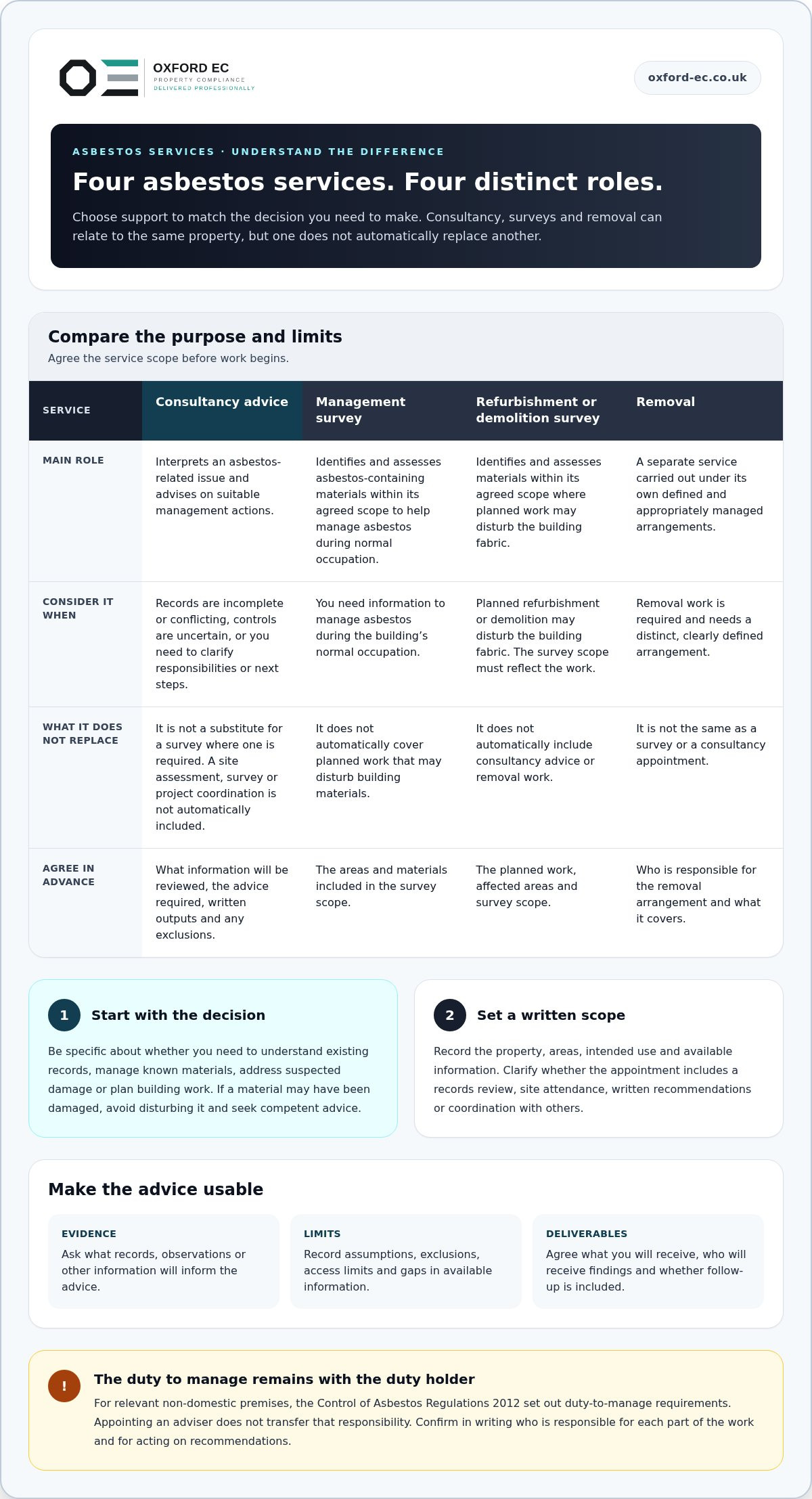
A survey identifies and assesses asbestos-containing materials within its agreed scope; consultancy advises on issues and management decisions; removal is separate work carried out under a defined arrangement. These services may relate to the same property, but one doesn’t automatically replace another.
A management survey is intended to help manage asbestos during normal occupation. A refurbishment or demolition survey is relevant where planned work may disturb the building fabric, and its scope must reflect the work. Consultancy may help you decide what information or service is needed, but it isn’t a substitute for a survey where one is required. Removal also needs its own clearly defined and appropriately managed arrangements. Confirm who is responsible for each part of the work.
Oxford Environmental Consultants provides asbestos advice alongside asbestos surveys and support to facilitate and manage safe removal. These are distinct services, so confirm what fits your situation and what the appointment includes. You can review its asbestos services when considering the next step.
What should asbestos consultancy services include?
A useful appointment starts with a defined decision, not a generic request for “asbestos advice”. The scope should reflect the issue you need to resolve, the property information available and what you need to decide afterwards. Depending on the agreed work, this may include reviewing existing records, advising on an asbestos management approach or clarifying responsibilities under the Control of Asbestos Regulations 2012.
Be clear about what the consultant will examine and what evidence they’ll rely on. Advice based on documents alone has different limits from a site visit or survey. Recommendations should explain their basis, note assumptions and identify gaps in the available information. They shouldn’t imply that uninspected areas or materials have been assessed.
Agree the brief, property scope and advice required
Give the adviser enough context to define a proportionate scope. Set out the building’s use, the areas involved, known or suspected asbestos information and why you’re seeking advice. Explain whether the concern relates to ongoing management, suspected damage, planned works or interpreting existing records. If work is planned, describe its location and extent so the adviser can consider whether further investigation may be needed.
Before the appointment, ask the consultant to record assumptions, exclusions and any limits on access or information. They should also clarify whether the agreed work includes a records review, site attendance, written recommendations or coordination with other parties. Don’t assume these tasks are included unless the scope says so.
Clarify outputs, recommendations and follow-up
Agree in advance what you’ll receive and how it will support your decision. Depending on the appointment, this could be written advice, a review of supplied records or recommendations for next actions. Ask how concerns identified during the work will be raised, who will receive the findings and whether follow-up is included or requires a separate appointment.
Agree the written scope and deliverables before work begins. A clear record helps both parties understand what was assessed, what remains uncertain and who is responsible for acting on recommendations. It also helps distinguish advice from further work, such as a management, refurbishment or demolition survey, removal, or another specialist appointment.
- Evidence: What records, observations or other information will inform the advice?
- Limits: Which areas, questions or tasks are excluded?
- Actions: What recommendations will be provided, and who must decide or arrange the next step?
This level of definition makes asbestos consultancy services easier to compare and reduces the risk of receiving advice that doesn’t address your decision. If the scope changes as new information emerges, ask for the revised work and outputs to be confirmed in writing before proceeding.
How to compare asbestos consultancy providers
Compare evidence and accountability, not polished claims or a headline price. Give each provider the same property details and decision to address, then assess what they propose, who will do the work and what you’ll receive. For survey-related work, the HSE's Asbestos: The survey guide provides guidance on survey standards and competence. It can help you frame questions, but it doesn’t replace checking a provider’s suitability for the specific appointment.
Check competence, qualifications and independence
Ask who will carry out and review the work, and what relevant asbestos experience and qualifications they hold. Request evidence for any claimed accreditation or professional status, then check that it is current and covers the service proposed. A credential alone doesn’t show that a particular appointment is suitable or guarantee compliance or safety.
Also ask whether the provider may recommend further work that it, or an associated contractor, could undertake. This doesn’t automatically make the advice unsuitable, but the relationship and responsibilities should be transparent. Clarify who makes recommendations, who approves additional work and how any separate appointment would be agreed.
Compare scope and evidence, not headline claims
Use the same brief for each provider and compare proposals against practical criteria. A clear written response should explain what is included, what is excluded and what happens after the advice or assessment.
| Check | Question to ask |
|---|---|
| Experience and personnel | Who will deliver and review the work, and what relevant experience do they have? |
| Written scope | Which property areas, records and questions are covered? What assumptions or exclusions apply? |
| Evidence and outputs | What written advice or records will be provided, and what evidence will support the recommendations? |
| Follow-up | How will urgent concerns be communicated, and are further actions or appointments included? |
Be wary of vague assurances such as “fully compliant” without an explanation of the work, evidence and limitations behind the claim. Recommendations should identify what is known, what remains uncertain and what action is proposed. Confirm whether that action is advice only or requires a separate survey, removal arrangement or specialist appointment.
A survey offer may be convenient, but it doesn’t prove that broader consultancy is unnecessary. A survey and consultancy answer different questions. Choose the service that matches your decision, and ask providers to explain the distinction in their proposals. A useful comparison starts with the same brief, a clear scope and documented next steps.
How to prepare for an asbestos consultancy appointment
A focused brief helps the adviser understand the property issue and provide relevant guidance. Before the appointment, organise the information you have, identify who can answer questions or authorise access, and agree what decision the advice needs to support. You don’t need to resolve every uncertainty in advance. Make the unknowns clear.
Gather records and define the decision needed
Start with the property’s available asbestos information. This may include survey reports, the asbestos register, management plans and records of previous remedial or removal work. Note when documents were produced and whether they cover the areas now in question. Records support an assessment, but they don’t replace a professional inspection where the agreed scope requires one.
Next, describe the issue in practical terms. Is the advice needed to support ongoing management, respond to suspected damage, plan building works or interpret information that appears incomplete? State the decision you need to make, such as whether further investigation is required before work can proceed. List unresolved questions instead of making assumptions about what the records prove.
- Property: Identify its use, relevant areas and any access restrictions.
- Work or concern: Describe planned works, known incidents, damage or changes to the building.
- People: Identify who controls the premises, holds the records, can arrange access and can authorise action.
Share details of affected rooms or building elements, the intended work and any known changes since the last survey. If access needs to be arranged, establish who will provide it and whether areas will be occupied during the appointment. These practical details help the adviser define what can be reviewed and whether the proposed scope is suitable.
Agree responsibilities and act on recommendations
Before the appointment, confirm who will receive the findings and who will review and implement any recommendations. This helps prevent advice sitting in an inbox without a clear owner. Afterward, record agreed actions, responsible people and review points in the property’s existing management arrangements, and update relevant asbestos information where required.
For related background on the purpose and context of a management survey, read this asbestos management survey guide. It can help frame questions, but the consultant’s agreed brief should still address your property and decision specifically. Good preparation gives asbestos consultancy services a defined starting point and makes it easier to track what happens next.
Choosing OEC for asbestos consultancy: define your next step
Oxford Environmental Consultants (OEC) provides asbestos consultancy to support clients with management strategies and regulatory requirements. It also offers asbestos management, refurbishment and demolition surveys, and facilitates and manages safe asbestos removal. These are related but distinct services, so the right starting point depends on the property issue and the decision you need to make.
Match the enquiry to the right asbestos support
Consider whether you need advice on managing known asbestos, a management survey for normal occupation, a refurbishment or demolition survey before planned works, or support to facilitate and manage removal. If you’re unsure, explain the circumstances and ask OEC to clarify the suitable scope. Before the appointment, confirm in writing what the work covers, what you’ll receive, any limitations and whether further services need a separate arrangement.
OEC’s asbestos services page outlines its related support. Reviewing it can help you frame an enquiry, but it shouldn’t replace confirming the details of your appointment. Ask about proposed deliverables and exclusions, and verify any qualifications or accreditations relevant to the work rather than relying on assumptions.
Prepare a clear enquiry for OEC
Give the adviser enough information to understand the issue before agreeing the brief. Include:
- Property type and the areas affected or requiring advice.
- Available survey reports, asbestos register, management plan and records of previous work.
- Any known damage, incidents or changes to the building.
- Planned works, including their location and intended extent.
- The key decision you need the advice to support, or the question that remains unresolved.
Sharing existing records helps establish what is known and where information may be missing. It also gives OEC context to discuss whether consultancy, a survey or a separate removal arrangement may be relevant. Don’t assume the records remove the need for further assessment; ask how the agreed scope will address any gaps.
A well-defined enquiry gives both parties a clear starting point: the property, the concern and the decision ahead. Before proceeding, make sure the proposed scope and outputs are documented so you know what is included and what remains your responsibility.
Set a clear course for asbestos management
The right asbestos consultancy services should address the issue you need to resolve, with a written scope, defined outputs and practical next steps. Before appointing an adviser, clarify whether you need professional advice, a survey for the property or planned works, or a separate removal arrangement. Check the provider’s relevant competence and make sure recommendations explain their evidence and limitations.
Oxford Environmental Consultants provides asbestos consultancy to support management strategies and regulatory requirements. OEC also offers asbestos surveys and facilitates and manages safe removal. Confirm the scope required for your property and what the proposed appointment includes before proceeding.
Prepare available survey reports, asbestos records and details of any planned work. A clear brief helps focus the discussion and establish what needs to happen next.
With the right information and responsibilities documented, you can move forward with a clearer, more manageable plan.
Frequently Asked Questions
What do asbestos consultancy services include?
Asbestos consultancy services provide advice to help clients understand asbestos information, responsibilities and suitable management actions. Depending on the agreed brief, this may include reviewing existing records, advising on management strategies or helping clarify regulatory requirements. The appointment should state what information will be assessed, what written advice or recommendations you’ll receive, and any limitations. Don’t assume a survey, site assessment or removal arrangement is included unless it is expressly in scope.
When should I appoint an asbestos consultant?
Appoint an asbestos consultant when you need informed advice to resolve an asbestos-related question or decide what action to take. Examples include incomplete or conflicting records, uncertainty about existing controls, planned works or concern about damaged material. If material may have been disturbed, avoid further disturbance and seek competent advice. Explain the issue and the decision you need to make so the adviser can confirm whether consultancy, a survey or another service is appropriate.
Is an asbestos survey the same as asbestos consultancy?
No. An asbestos survey identifies and assesses asbestos-containing materials within its agreed scope. Consultancy provides advice and support, such as interpreting records or considering management actions. Advice may help you determine whether a survey is needed, but it doesn’t replace one where the work requires it. A management survey and a refurbishment or demolition survey also have different purposes, so specify the building activity and areas involved when discussing the scope.
How do I check an asbestos consultant is competent?
Ask who will carry out and review the work, and request evidence of relevant experience, qualifications and any claimed accreditation or professional status. Check that the evidence is current and applies to the specific service proposed, rather than relying on a general assurance. Ask for a written scope, including methods, limitations, outputs and follow-up. If the provider may recommend further work it could undertake, clarify responsibilities and how that work would be agreed separately.
Can an asbestos consultant arrange asbestos removal?
Some providers can help coordinate removal, but consultancy advice and removal are distinct activities. Confirm who will arrange and manage the removal, who will carry it out, and what each appointment includes. Oxford Environmental Consultants states that it facilitates and manages safe asbestos removal; don’t assume this means the consultant personally undertakes the physical removal. Ask for the proposed responsibilities, scope and any separate arrangements to be documented before work proceeds.
Do I need asbestos consultancy before refurbishment work?
Not automatically. However, before refurbishment that could disturb asbestos-containing materials, establish whether suitable information is available and whether a refurbishment survey is needed for the planned work. Consultancy can help interpret existing records or clarify the next step, but it doesn’t replace a survey where one is required. Tell the adviser which areas will be affected and what work is planned, then confirm the scope of any survey or advice before work starts.
What information should I provide when requesting asbestos consultancy?
Provide the property type, the areas of concern, the reason for seeking advice and the decision you need to make. Share available survey reports, asbestos registers, management plans and records of previous remedial or removal work. Include details of planned building works, known damage or changes, access restrictions, and who manages the property records or can authorise access and action. Identify unresolved questions and ask the adviser to confirm the agreed scope and any documents required.