
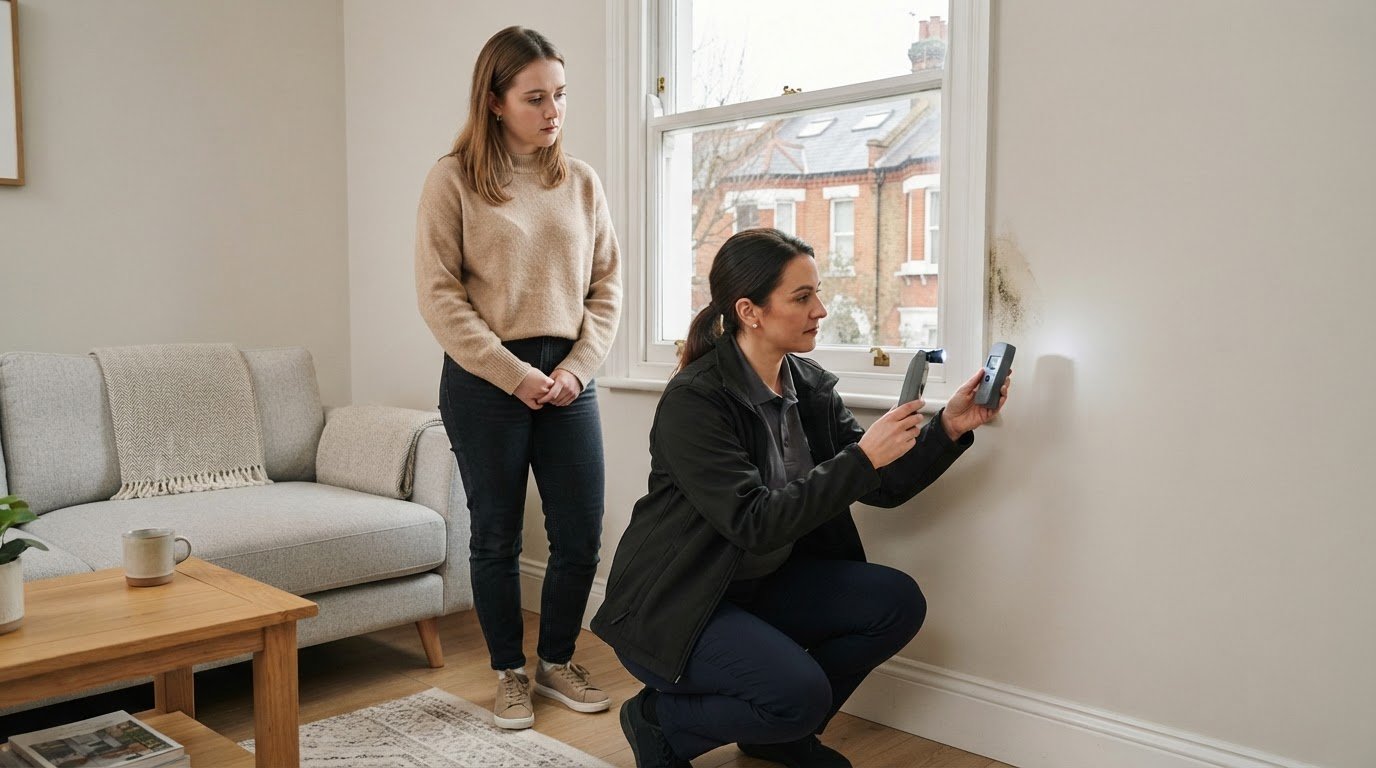
A patch of mould isn’t a diagnosis. Treating what’s visible without investigating the moisture source can leave the underlying problem unresolved and risks to tenants unaddressed. This guide explains landlord damp and mould responsibilities UK landlords need to manage, and why keeping a clear record of each step matters.
If you’re unsure whether the cause is a building defect, a leak or condensation, take the report seriously and investigate rather than assume the tenant is at fault. Assess the property, identify the likely cause and arrange appropriate action. The legal framework varies across England, Wales, Scotland and Northern Ireland, so duties and procedures should not be treated as identical across the UK.
In England, Awaab’s Law sets timeframes for social landlords responding to covered hazards. The Government is consulting on extending it to private rented homes, with the consultation due to close on 18 December 2026. This guide explains the key responsibilities and a practical process, from receiving a report through to remedy and review. It also covers when an independent damp and mould survey can help identify causes and inform prevention.
Key Takeaways
- See why duties depend on the property, tenancy and nation, and which legal frameworks may apply.
- Understand how landlord damp and mould responsibilities differ across England, Wales, Scotland and Northern Ireland.
- Learn what to record when a tenant reports damp or mould, and how to consider possible moisture sources without diagnosing remotely.
- Follow a structured response, from acknowledging the report and assessing risk to arranging remedial work and reviewing the outcome.
- Find out when a specialist damp and mould survey can help identify causes and inform proportionate remediation and prevention.
Table of Contents
- Landlord damp and mould responsibilities in the UK: what the rules cover
- The legal duties behind landlord damp and mould responsibilities
- How to assess damp, mould and the source of the problem
- A practical landlord response: from tenant report to verified remedial action
- How a professional damp and mould survey supports landlord decisions
Landlord damp and mould responsibilities in the UK: what the rules cover
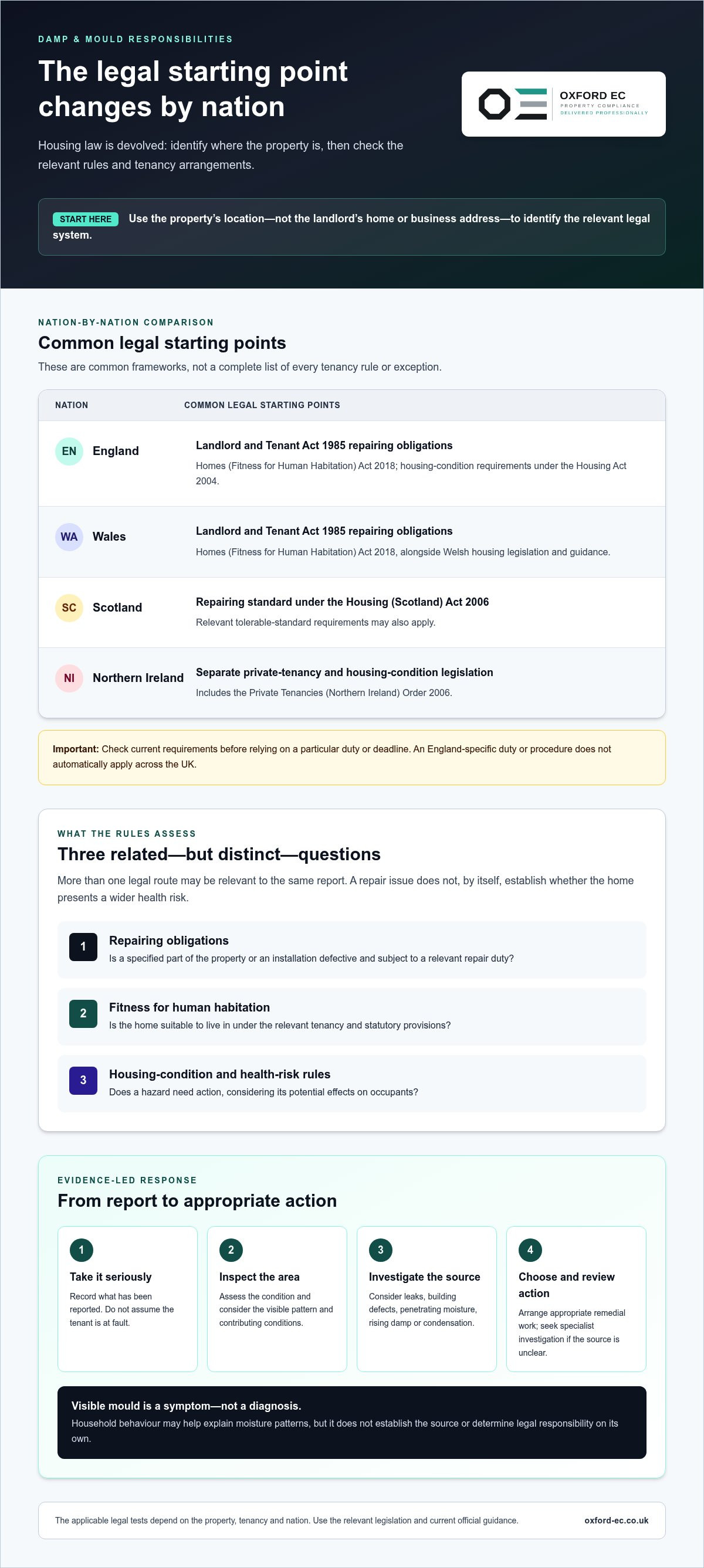
The rules depend on where the property is, the type and length of the tenancy, and whether it is privately or socially rented. Housing law is devolved, so an England-specific duty or procedure does not automatically apply across the UK. Start by identifying the property’s nation and tenancy arrangements, then check the legislation and current official guidance relevant to the case.
Which UK nation’s rules apply to a rented property?
Use the property’s location, not the landlord’s home or business address, to identify the relevant legal system. The table summarises common frameworks, but it does not cover every tenancy rule or exception. Check current requirements before relying on a particular duty or deadline.
| Nation | Common legal starting points |
|---|---|
| England | Landlord and Tenant Act 1985 repairing obligations; Homes (Fitness for Human Habitation) Act 2018; housing-condition requirements under the Housing Act 2004. |
| Wales | Landlord and Tenant Act 1985 repairing obligations and the Homes (Fitness for Human Habitation) Act 2018, alongside Welsh housing legislation and guidance. |
| Scotland | The repairing standard under the Housing (Scotland) Act 2006 and relevant tolerable-standard requirements. |
| Northern Ireland | Northern Ireland’s separate private-tenancy and housing-condition legislation, including the Private Tenancies (Northern Ireland) Order 2006. |
These frameworks address related but distinct issues. Repairing obligations generally concern the condition of specified parts of the property and installations. Fitness rules consider whether the home is suitable to live in, while housing-condition and health-risk regimes assess hazards and their potential effects on occupants. More than one legal route may be relevant. Identifying a repair duty does not, by itself, establish whether the home presents a wider health risk.
What is the landlord’s core responsibility when mould is reported?
Take the report seriously, assess the condition and investigate the likely source. Mould is a visible symptom, not a diagnosis. It may be associated with a leak, penetrating moisture, a building defect, rising damp or condensation, and several factors can contribute at once. A general overview of structural damp in buildings explains why identifying the moisture pathway matters, but it cannot determine the cause in a particular home.
Do not presume tenant fault based on the appearance of mould or how a room is used. Household behaviour may help explain moisture patterns, but it does not establish the source or determine legal responsibility on its own. Record what has been reported, inspect the affected area and decide whether further investigation is needed before choosing remedial work. Where the source is unclear, a specialist damp and mould survey can help identify causes and inform remediation and prevention.
The phrase landlord damp and mould responsibilities UK covers more than cleaning visible growth. The applicable legal tests differ, but a careful, evidence-led assessment helps distinguish repair issues from wider fitness or hazard concerns.
The legal duties behind landlord damp and mould responsibilities
Several legal tests may apply to the same report, but they ask different questions. Is something the landlord must repair defective? Is the home fit for human habitation under the tenancy? Does a hazard require action under housing-condition rules? The answer depends on the property, tenancy and nation. There is no single, uniform statutory test for landlord damp and mould responsibilities UK.
Repairing obligations and fitness for human habitation
In England and Wales, section 11 of the Landlord and Tenant Act 1985 implies repairing obligations into many residential tenancies, including duties concerning the structure and exterior and specified installations. Its application depends on the tenancy and statutory conditions. A defective roof, failed rainwater goods or leaking pipework may therefore raise a repair issue where the relevant obligation applies.
Repair is not the same as improvement. A duty to remedy disrepair does not automatically require a landlord to upgrade a property or install a particular ventilation system, although the facts and other legal duties may affect what action is needed. Condensation alone does not prove a breach either. Assess the evidence, including the pattern, contributing conditions, any defect and the relevant legal test.
The Homes (Fitness for Human Habitation) Act 2018 amended landlord-and-tenant legislation for qualifying tenancies in England and Wales. It enables a tenant to seek a remedy where the home is unfit, with the statutory assessment taking account of matters including damp and mould. It does not mean every instance of mould proves that a property is legally unfit. The circumstances, seriousness and relevant tenancy provisions matter. Scotland and Northern Ireland have separate housing legislation and standards.
Hazard assessment, enforcement and Awaab’s Law
In England, the Housing Health and Safety Rating System (HHSRS), under the Housing Act 2004, provides a framework for assessing housing hazards, including damp and mould. Updated guidance took effect on 23 June 2026. It streamlines the hazard categories from 29 to 21 and uses High, Medium and Low descriptions instead of the former A-to-J bands. Local authority assessment and enforcement are distinct from a tenant’s claim under fitness legislation.
Awaab’s Law applies to social landlords in England, not automatically to private landlords or homes in the other UK nations. Its first phase covers damp and mould hazards. Phase 2 is set to commence on 30 November 2026 and expands coverage to hazards including excess cold and heat, falls, structural collapse, fire, electrical hazards and domestic hygiene. The precise duties and response periods depend on the regulations and hazard involved. Check current primary guidance rather than assume one deadline applies to every report.
These regimes can overlap, but they are not interchangeable. Record which duty or hazard assessment informs each decision, and check current national rules before setting a timetable. Where the moisture source remains uncertain, a specialist damp and mould survey can help identify causes and inform remediation and prevention.
How to assess damp, mould and the source of the problem
Start with a reliable record, not a remote diagnosis. Log when the report was received, which rooms and surfaces are affected, how extensive the visible mould appears, whether it has returned after cleaning or previous work, and whether anyone has reported water ingress or a musty odour. Ask when the problem first appeared and whether it changes with weather, heating or room use. These details help direct an inspection and provide a baseline for reviewing the outcome.
At the property, record observations consistently. Note the affected wall or ceiling, its position in the room, nearby windows, plumbing, external walls and ventilation. Where appropriate, take dated photographs. Record visible conditions such as staining, peeling finishes, blocked vents, damaged seals or signs of a leak. Keep the tenant’s account distinct from what was directly observed. This makes the evidence clearer and avoids presenting an assumption as a finding.
- Leaks: Check for plumbing failures or water escaping from appliances, bathrooms or heating systems.
- Penetrating moisture: Consider water entering through a roof, wall, window or external defect, particularly if the affected area changes after rainfall.
- Possible rising damp: Moisture at the base of ground-floor masonry may warrant investigation, but appearance alone cannot confirm this mechanism.
- Condensation: Assess moisture generation alongside room temperature, heating patterns, insulation and ventilation. Check whether air can circulate around cold surfaces.
- Other building defects: Look for construction details or maintenance issues that could allow moisture to accumulate or prevent the building from drying.
What different damp patterns may indicate
Patterns can guide further checks, but they are clues, not conclusions. A low-level patch on ground-floor masonry may prompt investigation for rising damp. Localised wetting below a roof junction may suggest water ingress. Mould on a cold external wall or around a window may be consistent with condensation. Test each possibility against the property’s condition and history. Mould colour, shape or location alone cannot reliably identify its cause or assign responsibility.
When a specialist damp and mould inspection is useful
Arrange a specialist inspection when the source remains uncertain, the problem recurs after remedial work or several factors may be interacting. A survey can document visible conditions, assess likely moisture sources and provide advice on remediation and prevention. Oxford Environmental Consultants’ damp and mould surveys support this evidence-gathering process. Findings should explain what was observed, what remains uncertain and what further steps may be appropriate.
Keep technical findings separate from legal conclusions. A survey can inform decisions about repairs or further investigation, but it does not determine liability or replace the applicable legal test. Managing landlord damp and mould responsibilities UK landlords face means establishing the evidence, addressing the identified cause and keeping a clear record of the reasoning.
A practical landlord response: from tenant report to verified remedial action
A consistent response turns a tenant’s report into an evidence trail: acknowledge, assess, inspect, diagnose, act and review. Keep the record in one case file so decisions, instructions and outcomes can be followed later. Make the response proportionate to the reported condition, the occupants’ circumstances and the legal duties that apply to the property.
How should landlords prioritise a report?
Record the affected location, extent, duration and any recurrence, alongside reported health concerns and relevant household circumstances. Consider the severity and whether anyone may be particularly vulnerable when deciding how promptly to inspect and what interim steps may be appropriate. Don’t rely on a generic target. Check current statutory requirements for the nation, tenancy and hazard involved, including any applicable Awaab’s Law deadlines.
- Acknowledge the report. Confirm receipt, note the date and gather enough detail to understand the affected rooms, visible conditions, recurrence and reported impact. Tell the tenant what happens next and keep a copy of the communication.
- Assess immediate risk. Consider the extent and location of mould, any active leak or worsening damage, occupants’ health concerns and potential vulnerability. If the report indicates an urgent risk, prioritise appropriate assessment and interim risk management rather than waiting for a routine visit.
- Inspect the property. Arrange access and examine the reported areas and relevant surrounding features. Record dated observations and photographs where appropriate. If access cannot be arranged, document attempts and agree another opportunity. Do not treat lack of access as evidence that the reported condition is absent.
- Establish the likely cause. Use the inspection evidence to assess whether a defect, water ingress, condensation or interacting factors may be involved. If the source remains unclear, the problem recurs or technical assessment is needed, arrange further investigation before settling on a remedy.
- Act on the findings. Set out the work required, who will arrange it and the intended timescale. Address the identified moisture source as well as visible mould. Cleaning or repainting alone may not resolve an underlying leak or building defect.
- Review and record the outcome. Retain work instructions, completion evidence and communications. Arrange a proportionate follow-up to check the affected area and identify any remaining actions.
What should happen after repairs or remediation?
Completion is not the same as verification. Record which work addressed the suspected source and whether affected materials need further assessment or time to dry. At follow-up, note any visible recurrence, moisture conditions or outstanding defects, and assign each remaining action to a named person with a date. Share relevant updates with the tenant and keep their response with the case record.
A clear chronology supports consistent decisions and helps explain why a particular course of action was chosen. For landlord damp and mould responsibilities UK landlords must manage, keep evidence at every stage: the report, assessment, work and review.
How a professional damp and mould survey supports landlord decisions
A specialist survey can help when an initial inspection has not established why damp or mould is present, or when the problem returns after work. It adds a structured technical assessment to the evidence already gathered, helping distinguish between possible moisture sources and decide what further investigation or remediation may be proportionate.
What a damp and mould survey can establish
An inspection considers visible conditions alongside potential contributing factors in the building. Depending on access and the evidence available, this may include the location and extent of affected areas, nearby building elements, signs of water ingress and conditions that could contribute to condensation. The aim is to assess likely causes, not infer them from mould’s appearance alone.
Findings should make clear what was observed, which causes are suspected and where uncertainty remains. Hidden defects, restricted access or conditions that change over time may limit what can be established during a visit. A careful report separates observations from interpretation and identifies areas needing further attention, rather than presenting an unsupported diagnosis as fact.
Turning survey findings into a documented action plan
Oxford Environmental Consultants provides UK-wide damp and mould surveys to identify causes and advise on remediation and prevention. Recommendations can help landlords connect technical findings to practical next steps, such as investigating a suspected building defect, addressing a moisture source or reviewing conditions that may contribute to recurrence. The damp and mould survey service supports this evidence-led decision process.
To make findings useful in practice, link each recommended action to the relevant observation, the person responsible for arranging it and the record that will show it is complete. Note any follow-up checks, such as reviewing the affected area after remedial work or investigating a remaining source of moisture. This connects the survey to the property’s repair and maintenance history instead of leaving it as a standalone document.
A survey informs a landlord’s decisions. It does not replace legal duties, determine liability or constitute legal advice. The applicable obligations and response deadlines still depend on the property, tenancy and jurisdiction. For landlords managing landlord damp and mould responsibilities UK, technical evidence can clarify the condition and help guide action, while the landlord remains responsible for deciding and documenting the steps taken.
Oxford Environmental Consultants combines specialist damp and mould expertise with UK-wide property compliance experience. When the source remains unclear, a focused inspection can help establish what the evidence indicates and what may need attention next.
Make the next step evidence-led
Uncertainty about the source of damp can delay sound decisions. A clear assessment gives you a firmer basis for deciding what needs attention, recording why action was chosen and planning how to review the outcome. That discipline supports the practical side of landlord damp and mould responsibilities UK landlords must manage, without treating a technical report as a substitute for their own legal obligations.
Oxford Environmental Consultants’ damp and mould surveys help identify likely causes and inform remediation and prevention as part of its UK-wide property compliance work. If the evidence gathered so far has not resolved the cause, a specialist inspection can help clarify what the property needs next.
Take the next step with a clear record, a proportionate plan and confidence in the decisions ahead.
Frequently Asked Questions
Can a landlord blame a tenant for condensation and mould?
No. Mould alone does not prove that tenant behaviour caused the problem. Condensation may involve moisture levels, ventilation, heating, insulation or building conditions, sometimes in combination. For example, mould around a window does not establish whether the main issue is cold surfaces, restricted airflow or another defect. Investigate the circumstances, record what supports each finding and assess responsibility against the evidence and applicable duties. Avoid charges or repair decisions based on assumptions.
Is a tenant legally required to let the landlord inspect damp and mould?
Access depends on the tenancy terms and the law applying to the property. Landlords should follow relevant notice and access requirements, agree a suitable appointment where possible and explain what the inspection will involve. Do not enter without the required agreement or authority. If access is refused, keep a dated record of proposed appointments and replies, then seek jurisdiction-specific legal advice before deciding how to proceed.
What happens if a landlord does not address damp and mould after being notified?
Possible routes depend on the nation, tenancy and circumstances. A tenant may raise the issue with the relevant local housing authority or use a landlord or housing-provider complaints process. The appropriate route differs across the UK. For landlords, a clear response record can help demonstrate what was considered and done. Do not assume one UK-wide process or remedy applies. Check current guidance from the relevant authority for the property’s location.
Does Awaab’s Law apply to private landlords across the UK?
No. Awaab’s Law applies to social landlords in England under phased statutory provisions. It does not automatically cover private landlords or all four UK nations. As at 2026, Phase 2 is set to begin on 30 November and extend coverage to additional hazards. The Government is consulting on extension to the private rented sector, with implementation anticipated from 2028. Check current legislation and commencement provisions, and continue meeting other applicable duties.
Does a landlord have to move a tenant out during damp or mould repairs?
There is no single answer for every property. Whether continued occupation is appropriate depends on the conditions, work required, occupants’ circumstances, tenancy and applicable duties. A contained repair may allow occupation, while extensive works or a serious hazard may require a different plan. Assess the specific risks, explain proposed arrangements to the tenant and document the reasons. Seek suitable housing or legal advice if safety during the work is uncertain.
Can a landlord charge a tenant for mould damage?
Not solely because mould is present. Before seeking payment or making a deposit deduction, establish the likely cause and consider whether disrepair or other property conditions contributed. For example, evidence of a leak or defective external fabric may affect how responsibility is assessed. Review the tenancy terms and applicable law, preserve inspection records and communications, and obtain legal advice if liability remains disputed. A charge should rest on evidence, not an assumption about household behaviour.
How can a landlord prove that damp and mould have been dealt with?
Build a dated file connecting the original complaint to the outcome. Include the inspection record, repair instructions, invoices or completion notes, photographs and relevant tenant communications. For example, record what was done to address a leak as well as any treatment of the affected surface. Arrange a follow-up where appropriate and note whether the condition has recurred. If the cause remains unclear, a specialist assessment can add technical evidence to the file.