Could a water system pass a Legionella test and still have underlying risks? Yes. A sample is a snapshot, while stagnation, poor temperature control, scale or biofilm may continue to create favourable conditions for bacterial growth. Preventing legionella growth in water systems means managing those conditions, not relying on test results alone.
If you’re responsible for a building, clear, repeatable checks are more useful than general advice. Legionella can grow in water between 20°C and 45°C. Temperature control aims to keep hot water hot and cold water below 20°C. The right measures depend on the system and the risks identified.
This guide explains which conditions can increase risk and how to build practical controls and monitoring into routine water-system management. It also explains when a competent Legionella risk assessment can identify system-specific measures, and how water sampling can help verify controls as part of a wider strategy. Oxford Environmental Consultants provides Legionella risk assessments and water sampling to support that process.
Key Takeaways
- Learn how exposure routes, system design and building users shape Legionella risk.
- Match prevention measures to the system, from planned flushing at little-used outlets to controls designed for cooling towers.
- Make prevention repeatable by assigning responsibility for checks, corrective action, records and review.
- Use a competent risk assessment to identify hazards and select proportionate controls for your water system.
- Understand why preventing legionella growth in water systems relies on ongoing management, with sampling used to gather evidence where appropriate.
Table of Contents
- What conditions allow Legionella to grow in water systems?
- How do temperature, water movement and cleanliness limit Legionella growth?
- Which Legionella prevention controls work best for different water systems?
- How can you put Legionella prevention into a practical routine?
- How can a Legionella risk assessment and sampling support prevention?
What conditions allow Legionella to grow in water systems?
Legionella are bacteria that can multiply in water and cause illness when contaminated water droplets are inhaled. Showers, spray-producing taps and cooling towers can create aerosols that people may breathe in. Legionnaires’ disease is a serious form of infection. For background on the bacteria and associated illnesses, see What is Legionella?
Prevention controls manage the conditions that allow Legionella to grow and spread; testing checks for evidence of bacteria in a sample. A sample represents one place and time, so it cannot replace management of the whole system. Risk depends on the system’s design and use, the potential for exposure, and whether people who may be exposed could be more vulnerable to illness.
Which water-system conditions increase Legionella risk?
Temperature is a key control. HSE guidance identifies 20°C to 45°C as the range in which Legionella can grow. For hot and cold water systems, the guidance recommends storing hot water at 60°C or above and ensuring it reaches 50°C at outlets within one minute, or 55°C in healthcare premises. Cold water should be stored and distributed below 20°C. These targets need to be considered across the system, rather than inferred from a reading at one outlet.
Stagnation can occur at infrequently used outlets or in dead legs, sections of pipework that hold water but are no longer in regular use. When water remains still, temperature control can be lost and risk may increase. Scale, sediment and biofilm can also create conditions in which bacteria persist and are harder to control. Biofilm is a layer of microorganisms attached to a surface. Deposits in tanks, pipes or fittings can shelter bacteria from effective controls.
Which buildings and system components need attention?
Hot and cold water systems, showers and cooling towers all need consideration, but they don’t present identical risks. A shower may generate droplets close to the user, while a cooling tower can disperse aerosols outdoors. Pipework layout, water temperatures, frequency of use, maintenance, and the condition of storage and distribution components all affect the risk profile.
Occupants matter, too. The potential consequences of exposure can vary according to who uses or is near the system, including people who may be more susceptible to infection. A little-used outlet may need different controls from frequently used showers or a cooling tower. Water hygiene services, including a system-specific Legionella risk assessment, can help identify relevant hazards and inform proportionate controls. Effective prevention starts with understanding the actual system, not applying the same checklist to every building.
How do temperature, water movement and cleanliness limit Legionella growth?
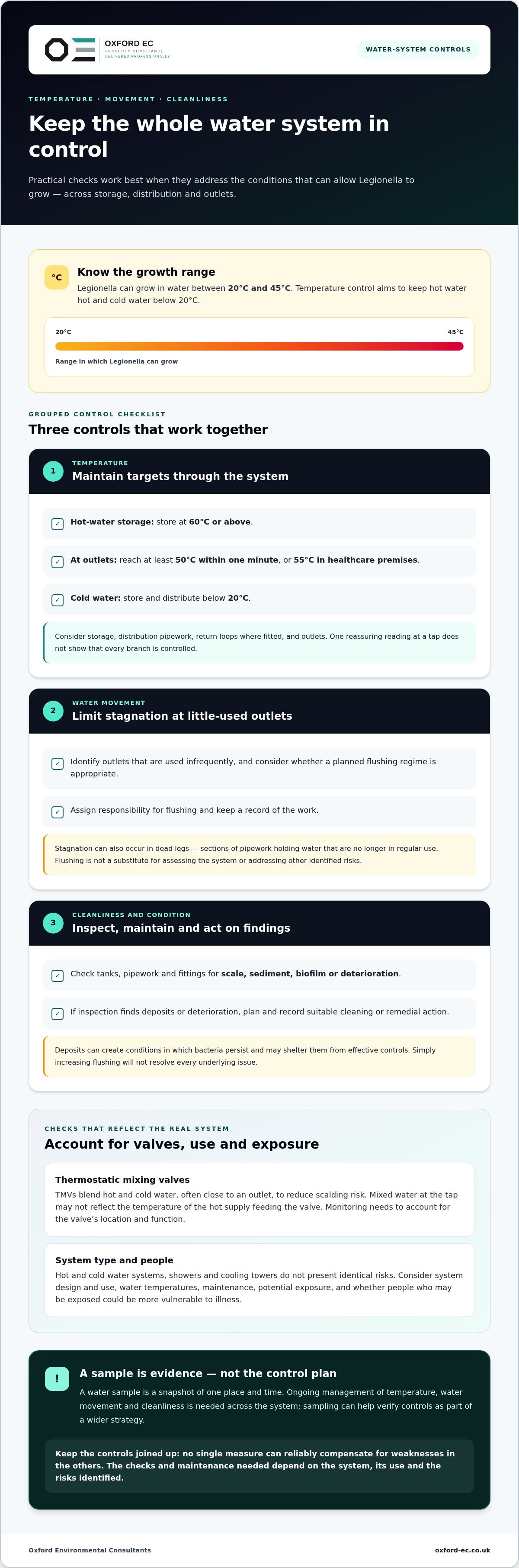
Effective control depends on how the whole system performs, not on a reassuring reading at one tap. Hot and cold water need to stay within the relevant temperature control limits as they are stored, circulated and delivered. HSE guidance recommends storing hot water at 60°C or above and reaching at least 50°C at outlets within one minute, or 55°C in healthcare premises. Cold water should be stored and distributed below 20°C. These are system management targets, not a reason to rely on a single spot check.
How should temperature control be approached?
Consider the route water takes through the system: storage, distribution pipework, return loops where fitted, and outlets. Checks at suitable points can show whether water is being maintained at the intended temperatures throughout the system. A tap reaching the target does not, by itself, show that every branch is controlled.
Thermostatic mixing valves (TMVs) reduce scalding risk by blending hot and cold water, often close to an outlet. Mixed water at the tap may therefore not reflect the temperature of the hot supply feeding the valve. Temperature monitoring needs to account for the valve’s location and function, while safe operation and Legionella controls are managed together. The GOV.UK guidance on Legionnaires’ disease provides official UK information relevant to understanding these controls.
Why do flushing, cleaning and maintenance matter?
Water left unused in pipework or an outlet can lose temperature control and become stagnant. Regular use helps keep water moving. Where outlets are used infrequently, a planned flushing regime may be appropriate. Identify the outlets that need attention, assign responsibility for flushing and keep a record. Flushing is not a substitute for assessing the system or addressing other identified risks.
Inspection and maintenance should also address physical conditions that can undermine control. Scale and sediment may build up in tanks, pipework or fittings, while biofilm can develop on wetted surfaces. If inspection finds deposits or deterioration, plan and record suitable cleaning or remedial action. Simply increasing flushing won’t resolve every underlying issue.
Temperature control, water movement and cleanliness work best together. No single measure can reliably compensate for weaknesses in the others. This is the practical basis of preventing legionella growth in water systems. The right checks and maintenance depend on the system, its use and the risks identified. A water hygiene risk assessment can help define suitable controls. For support with water hygiene requirements, discuss your requirements.
Which Legionella prevention controls work best for different water systems?
No single measure suits every system. Temperature management, flushing, cleaning, monitoring and sampling each address a different part of the risk. The right combination depends on system design, how it is used and the risk assessment findings.
| Measure | Purpose and suitable context | Limitation |
|---|---|---|
| Temperature management | Controls water temperatures across hot and cold water systems, including storage and distribution. | A reading at one outlet cannot confirm that the whole system is controlled. TMVs also affect the temperature measured at the outlet. |
| Routine use or flushing | Helps manage stagnation at low-use outlets and sections of pipework. | Doesn’t correct unsuitable temperatures, remove all deposits or replace other controls. |
| Cleaning and maintenance | Addresses scale, sediment, biofilm or deterioration identified during inspection. | Must target the condition and system component involved. It isn’t a substitute for ongoing management. |
| Monitoring | Checks whether defined controls, such as temperature management, are being maintained. | Records show performance at the points and times checked, not necessarily throughout the system. |
| Water sampling | Provides evidence about bacteria in a sample taken from a selected location. | Represents that sample at that time; it cannot guarantee the rest of the system is free from risk. |
When are routine controls more useful than one-off testing?
Routine controls act between sampling events. A temperature check may flag a control problem, flushing may help address stagnation at an identified low-use outlet, and maintenance can respond to deposits found during inspection. Sampling can add useful evidence when the risk assessment indicates it, but the method, locations and frequency should reflect the system and its circumstances. There is no universal sampling schedule for every building.
A negative result does not show that Legionella cannot grow elsewhere or at another time. Conditions can change, and a sample covers only the place and time it represents. Maintain the controls and monitoring identified as appropriate by the assessment, regardless of an individual result.
How do controls differ between system types?
For hot and cold water systems, controls commonly focus on temperature, circulation, low-use outlets, and the condition of storage and pipework. Showers need particular attention to outlet use and maintenance because they can generate inhalable droplets. Cooling towers also disperse aerosols, so their controls need to reflect their design, operation and water-management requirements. Applying a hot-water checklist to a cooling tower, or the reverse, can miss important system-specific risks.
Preventing legionella growth in water systems means selecting measures that address identified conditions, then checking they remain effective. Sampling supports that process, but does not replace it. Oxford Environmental Consultants’ water hygiene services include Legionella risk assessments and water sampling to help assess risks and gather evidence about controls.
How can you put Legionella prevention into a practical routine?
A reliable routine turns the risk assessment into clear tasks, assigned responsibilities and useful records. To prevent legionella growth in water systems, organise the work into steps that staff can follow and review when circumstances change.
- Understand the system. Keep an up-to-date record of its storage, pipework, outlets and key components. Note areas that are infrequently used and any parts of the system that may be difficult to access or maintain.
- Identify the risks. Use a competent Legionella risk assessment to consider how the system is used, where water may stagnate, how temperatures are controlled and who could be exposed. Use the findings to set proportionate controls instead of relying on a generic checklist.
- Set controls and responsibilities. Document the required checks and maintenance, who completes them, how often they take place and who receives concerns. Make sure staff know how to report missed checks or readings outside the site’s control limits.
- Monitor, record and act. Record results and findings using a consistent site process. Assign responsibility for corrective action, specify how completion is confirmed and escalate unresolved issues to a competent person.
- Review the arrangements. Check that controls remain suitable and effective. Reassess when system use, building occupancy or configuration changes, or when monitoring shows persistent problems.
What should a routine prevention plan record?
Records should make the control scheme traceable. Include the system areas covered, required controls and checks, findings, corrective actions, and the name of the person who completed each check and when. Make entries legible and specific: “checked” is less useful than a recorded result that identifies the relevant location. Clear records help those responsible see whether checks are being completed and whether issues remain unresolved.
When should controls be reviewed or escalated?
Changes to equipment, building use, occupancy or water-system configuration can alter exposure or create new areas of stagnation. Review the assessment and controls when these changes occur, and when checks identify repeated temperature deviations, poor water movement, deposits or ineffective measures. Don’t let a recurring issue become a routine exception. Refer unresolved concerns for competent review and document the decision and follow-up.
For more detail on the assessment process and its role in compliance, read the Legionella risk assessment guide.
How can a Legionella risk assessment and sampling support prevention?
Prevention needs more than a list of routine checks. A competent Legionella risk assessment examines how the water system is designed and used, identifies potential hazards and exposure routes, considers who may be at risk, and recommends controls proportionate to the findings. This helps duty-holders understand why particular measures are needed and where to focus attention.
What can a professional assessment add?
Some risks aren’t apparent from routine temperature readings alone. A system review can identify infrequently used outlets, sections of pipework where water may stagnate, and features that complicate monitoring or maintenance. The findings can then be translated into a documented control scheme, with responsibilities for checks, corrective action and review clearly assigned. For further detail on the assessment process, see the Legionella risk assessment guide.
The assessment should remain relevant as the building changes. Altered occupancy, water-system modifications or changes in how outlets are used may affect the risk profile and make a review necessary. A written assessment is a foundation for control, not a substitute for putting its recommendations into practice.
When can water sampling help verify controls?
Sampling can provide evidence about Legionella or other bacteria in water collected from selected locations. A competent person should determine whether sampling is appropriate and, if so, where and how to take samples, based on the system, assessment findings and reason for testing. Results apply to the samples collected at that time. They cannot show that every part of a system is free from risk or predict future conditions.
That’s why a negative result doesn’t remove the need to maintain suitable controls. Temperature management, planned flushing, monitoring and maintenance continue to address system conditions between sampling events. If a sample indicates a concern, consider the result alongside system information and control records to determine appropriate action.
Oxford Environmental Consultants provides Legionella risk assessments and water sampling and analysis as part of a broader water hygiene management approach. Explore water hygiene services and Legionella sampling for information about assessment and sampling support. Used appropriately, both can help duty-holders make informed decisions about preventing legionella growth in water systems, without treating a test result as a guarantee.
Make Legionella prevention part of routine water management
Effective prevention is ongoing, not a one-off test. Control the conditions that support bacterial growth, tailor measures to the system, and keep checks, responsibilities and records clear. A competent risk assessment helps identify system-specific hazards and proportionate controls, while water sampling can provide evidence where appropriate.
That’s the practical basis of preventing legionella growth in water systems: understand the risks, maintain controls and review them when circumstances change. Oxford Environmental Consultants provides Legionella risk assessments, water sampling and analysis, and water hygiene services across the United Kingdom to support duty-holders in managing these risks.
With a clear, risk-based plan, you can make prevention a consistent part of managing your building’s water system.
Frequently Asked Questions
What temperature prevents Legionella growth in water systems?
Temperature control aims to keep water outside the range where Legionella can grow, rather than relying on one reading. HSE guidance identifies 20°C to 45°C as the growth range. It recommends storing hot water at 60°C or above and reaching at least 50°C at outlets within one minute, or 55°C in healthcare premises. Controls need to be considered across the system.
Can Legionella grow in cold water systems?
Yes. Legionella can grow if parts of a cold water system warm into the 20°C to 45°C range and other conditions support growth. For example, poorly positioned or insulated pipework may be affected by nearby heat sources, while infrequently used branches can stagnate. Cold water should be stored and distributed below 20°C, with checks and corrective action guided by the system-specific risk assessment.
Does flushing taps prevent Legionella?
Flushing can help manage stagnation at infrequently used outlets, but it isn’t a complete prevention measure. A risk-based flushing plan should identify which outlets need attention, how the task is carried out and how it’s recorded. Flushing won’t correct unsuitable system temperatures or remove scale and biofilm. If an outlet is rarely used, review whether it should remain in service or whether the pipework can be altered.
Does water testing prove a system is free from Legionella?
No. A water sample provides evidence about water collected from a specific location at a particular time. It can’t establish that every part of the system is free from Legionella or predict future conditions. Interpret results alongside temperature records, maintenance findings and the risk assessment. Sampling can support a control strategy where appropriate, but it doesn’t replace ongoing system management.
How often should a water system be checked for Legionella?
There’s no single checking schedule that suits every system. The risk assessment and written control scheme should define the checks, locations and frequency needed for the building and its water system. Record results and act on concerns rather than treating checks as a paperwork exercise. Review the risk assessment at least every two years, and sooner if the system changes or controls appear ineffective.
What should I do if a water outlet is rarely used?
Identify the outlet in the site’s water management arrangements and determine whether it needs planned flushing or another control. Record who is responsible and when the task is completed. Consider why the outlet is unused: if it’s no longer needed, removing redundant pipework may reduce stagnant sections, subject to suitable assessment and work planning. Don’t assume occasional flushing alone addresses every risk associated with the outlet.
When should I arrange a Legionella risk assessment?
Arrange a competent assessment when you’re responsible for a building’s water system and need to understand whether it could create a foreseeable Legionella exposure risk. It’s especially relevant if the system, building use or occupancy changes, or if routine checks identify persistent problems. The assessment should identify hazards, people potentially exposed and proportionate controls. It provides a practical foundation for preventing legionella growth in water systems.