

Could your current safety protocols withstand the scrutiny of a £900,000 non-compliance fine? Many duty-holders operate under the dangerous assumption that a basic temperature check suffices for legal protection, yet the reality of UK property management in 2026 demands a far more rigorous water hygiene risk assessment. Rigorous scrutiny. Statutory alignment. Absolute compliance. Failing to distinguish between isolated testing and a holistic management strategy leaves your organisation vulnerable to severe legal repercussions and the physical risks associated with poorly managed water systems.
You likely recognise that maintaining statutory compliance is an exhausting, multi-faceted obligation that often feels fragmented across various providers and contradictory reports. This definitive guide provides a professional overview of current statutory requirements, including the Health and Safety at Work etc. Act 1974 and the Renters' Rights Act 2026, whilst detailing the technical risk factors and rigorous assessment processes required for total regulatory alignment. We will examine the specific pillars of HSE ACoP L8 and HSG274 to provide you with a clear, actionable roadmap for remedial works and the peace of mind that only professional certification can deliver.
Key Takeaways
- Statutory Clarity. Rigorous Scrutiny. Absolute Compliance. Understand that a professional water hygiene risk assessment is a comprehensive evaluation of building systems that identifies micro-biological hazards far beyond basic Legionella testing.
- Identify the technical risks posed by biofilm and colonising bacteria within water storage assets, ensuring your maintenance programme addresses the specific vulnerabilities of calorifiers, cooling towers, and distribution pipework.
- Meticulous Audit. Technical Precision. Total Transparency. Learn how a structured process, combining desktop history reviews with exhaustive on-site inspections, provides the evidence-based results required for an audit-ready portfolio.
- Navigate the complexities of HSE ACoP L8 and HSG274 to determine exactly when statutory triggers or significant building changes necessitate an immediate review of your water safety scheme.
- Safe hands. Expert delivery. Streamlined solutions. Discover the operational benefits of integrating water hygiene management with asbestos and fire safety surveys for a unified and robust property compliance strategy.
Table of Contents
- Understanding Water Hygiene Risk Assessments: Beyond Legionella
- Technical Components: Identifying Micro-biological and Physical Hazards
- The Assessment Process: Rigorous Scrutiny. Absolute Precision.
- Legal Obligations and Review Frequencies: Maintaining Statutory Alignment
- Professional Water Hygiene Management: The Oxford Environmental Approach
Understanding Water Hygiene Risk Assessments: Beyond Legionella
A professional water hygiene risk assessment is defined as a systematic, evidence-based evaluation of a building’s entire water infrastructure to identify potential points of failure and biological proliferation. Whilst many providers offer basic temperature monitoring, a true assessment scrutinises the holistic integrity of the system to ensure it remains fit for purpose. Rigorous inspection. Statutory compliance. Asset protection. These are the three pillars of a professional survey designed to shield your organisation from the physical and legal risks associated with water contamination.
The intersection of the Health and Safety at Work etc. Act 1974 and modern water safety is clear: duty-holders have an uncompromising legal obligation to manage risks to health. Relying on a standard Legionella-only assessment often leaves significant gaps in a property's safety profile. A comprehensive assessment evaluates the entire Water Safety Plan, considering how water is stored, distributed, and used across the site. It doesn't just look at the presence of bacteria; it examines the environmental conditions that allow such hazards to thrive.
The Legal Framework: HSE ACoP L8 and HSG274
Statutory alignment begins with the Approved Code of Practice (ACoP) L8. This document carries a unique legal status; failing to follow its guidance is often cited as evidence of a breach of health and safety law. Supporting this is HSG274, which provides the technical specifications for managing cooling towers, hot and cold water systems, and other risk-prone assets. Within this framework, the 'Duty Holder', typically an employer or building owner, retains ultimate legal accountability, whilst the 'Responsible Person' manages the day-to-day technical delivery of the written scheme of control.
Microbial, Physical, and Chemical Hazards
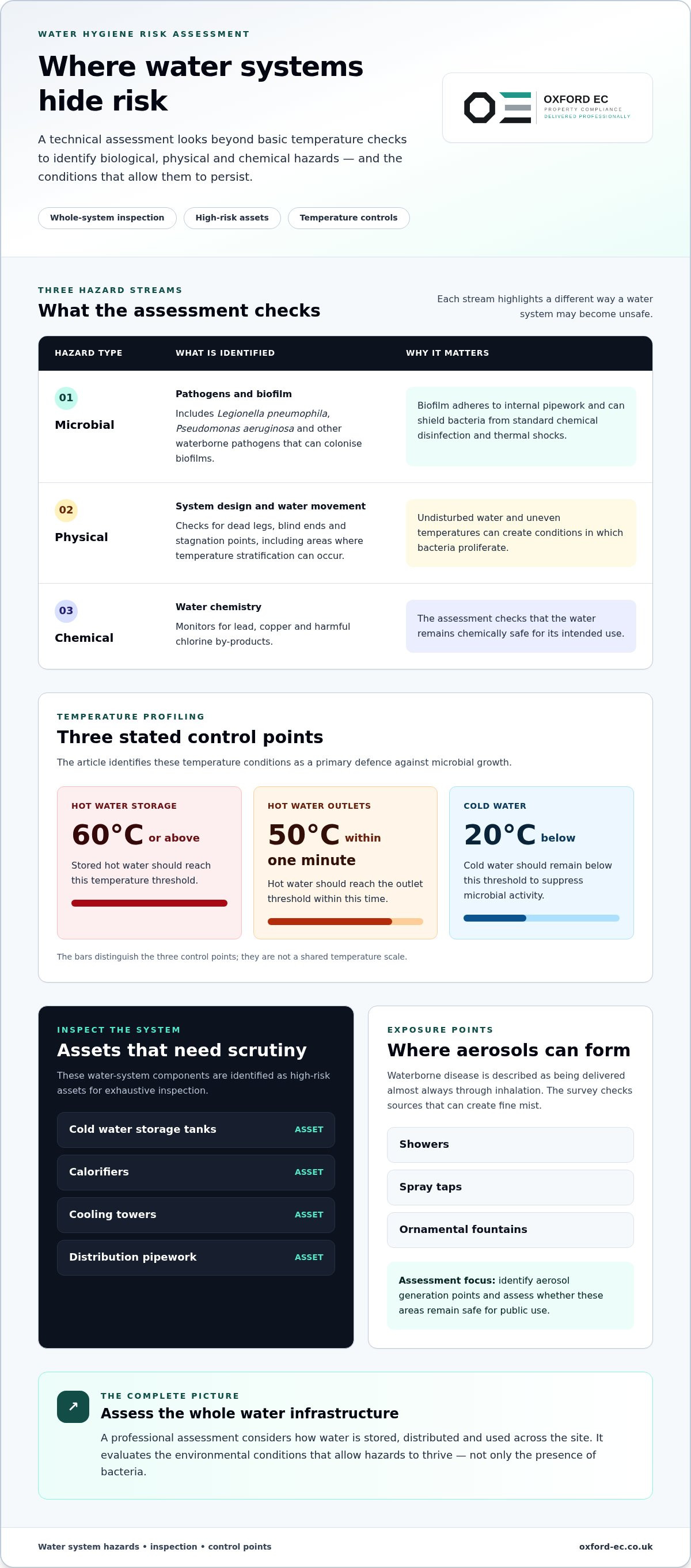
A meticulous water hygiene risk assessment categorises hazards into three distinct technical streams to ensure no vulnerability is overlooked:
- Microbial: Beyond Legionella Pneumophila, we scrutinise systems for Pseudomonas Aeruginosa and other waterborne pathogens that colonise biofilms.
- Physical: We identify structural failings such as dead legs, blind ends, and stagnation points where water temperature stratification allows bacteria to proliferate undisturbed.
- Chemical: The survey monitors for lead, copper, and harmful chlorine by-products to ensure the water remains chemically safe for its intended use.
By addressing these hazards simultaneously, the assessment provides a robust protective shield for both the building's occupants and the duty-holder's legal standing.
Technical Components: Identifying Micro-biological and Physical Hazards
A professional water hygiene risk assessment must penetrate beneath the surface of visible infrastructure to evaluate the microscopic and mechanical threats within. Meticulous inspection. Technical rigour. Absolute transparency. We conduct exhaustive scrutiny of high-risk assets, including cold water storage tanks, calorifiers, and cooling towers, to ensure every potential point of failure is documented and mitigated. These components are the engines of a water system; if they're poorly maintained, they become the primary source of contamination for the entire building.
Understanding the science of biofilm is fundamental to modern water management. These complex microbial communities adhere to internal pipework surfaces, creating a robust, protective matrix that shields bacteria from standard chemical disinfection and thermal shocks. Once established, biofilm allows pathogens to colonise the system and resist routine cleaning efforts. Temperature profiling remains the primary defence against this growth. We verify that hot water is stored at 60°C or above and reaches outlets at 50°C within one minute, whilst cold water must remain below 20°C to suppress microbial activity. This rigorous approach to control measures is a cornerstone of any effective CDC guide to water management programs, ensuring that environmental conditions don't favour bacterial proliferation.
The delivery mechanism for waterborne disease is almost always through inhalation. Identifying aerosol generation points is a critical phase of the survey. We assess showers, spray taps, and ornamental fountains, as these assets create the fine mist required for bacteria to enter the human respiratory system. For duty-holders, securing professional Water Sampling and technical analysis is the only way to confirm that these high-risk areas remain safe for public use.
The Criticality of Schematic Diagrams
An accurate, up-to-date schematic diagram is not merely a visual aid; it's a mandatory component of a legally valid water hygiene risk assessment. Our surveyors trace the water journey from the point of entry to the furthest outlet, identifying 'dead legs' and 'blind ends' that harbour stagnant water. These stagnant pockets provide the optimal breeding ground for pathogens, making their identification and eventual removal a priority for maintaining statutory compliance.
Water Sampling and Laboratory Analysis
Visual inspections are essential, but water sampling provides the empirical data required for a complete risk profile. We conduct professional sampling for Legionella and Total Viable Counts (TVC) using UKAS-accredited laboratories. Interpreting these results requires a high level of expertise in understanding CFU/litre (Colony Forming Units) measurements. Any deviation from the expected range triggers an immediate review of the written scheme of control to ensure the building remains a safe environment for all occupants.
The Assessment Process: Rigorous Scrutiny. Absolute Precision.
A professional water hygiene risk assessment is not a cursory walk-through; it is an exhaustive audit of both physical infrastructure and administrative controls. The process begins with a meticulous desktop audit. We review existing logbooks, previous assessment history, and the current written scheme of control to identify gaps in the historical record. If the paper trail is fragmented, the legal defence of the duty-holder is compromised. Our experts scrutinise these records to ensure they align with the requirements of HSG274 and ACoP L8.
Rigorous on-site inspection follows the initial audit. Every asset is inspected, photographed, and documented to create an evidence-based report. We evaluate the structural integrity of tanks, the condition of insulation, and the security of lids to prevent external contamination. In high-risk environments, this process aligns with the principles of a Water Infection Control Risk Assessment (WICRA), ensuring that the environment is managed to prevent the transmission of waterborne pathogens. This level of detail provides a robust protective shield for the organisation.
Step 1: System Identification and Mapping
Locating every water storage and distribution asset across a complex property is a technical challenge that requires discipline. We verify the accuracy of existing schematics and identify any undocumented modifications to the system. A system map is the foundational prerequisite for risk identification, providing a comprehensive visual record of the entire water journey from entry to outlet. Without this clarity, 'hidden' risks like dead legs remain unmanaged.
Step 2: Temperature Profiling and Flow Testing
Testing sentinel outlets is critical to ensure temperatures remain outside the 20°C to 45°C danger zone where bacteria thrive. We assess flow rates at various points to identify areas of low usage or stagnation that could lead to microbial proliferation. Our surveyors also evaluate the performance of Thermostatic Mixing Valves (TMVs); these are essential for safety but can become significant risk points if they aren't maintained according to a strict programme.
Step 3: Risk Categorisation and Remedial Actions
Utilising a defined score matrix allows us to prioritise identified risks based on their severity and the vulnerability of the occupants. We provide a clear, time-bound action plan for remedial works that is easy for facilities managers to execute. This plan differentiates between 'Immediate Action' requirements, which present an acute risk, and 'Long-term Management' recommendations that ensure continued statutory alignment. The result is a streamlined, logical solution to what is often a fragmented and complex problem.
Legal Obligations and Review Frequencies: Maintaining Statutory Alignment
Legal accountability in property compliance is absolute. A common misconception amongst duty-holders is that the HSE mandates a fixed biennial review for all systems. Whilst the explicit "two-year rule" was removed to encourage a risk-based approach, the requirement for a water hygiene risk assessment to remain a "living document" is more stringent than ever. Complacency is a significant legal liability. You must ensure your assessment reflects the current state of the building, its occupants, and its usage patterns to remain audit-ready for HSE or local authority scrutiny.
The financial and reputational consequences of failure are severe. In October 2024, Sanctuary Housing was fined £900,000 for failures in managing Legionella, following a similar £600,000 fine issued to Amey Community Limited. These cases demonstrate that courts now impose unlimited fines for breaches of health and safety law. With the Renters' Rights Act 2026 now in effect, the legal responsibilities of landlords have intensified, making a robust management programme a prerequisite for continued operation. Protecting your assets and your reputation requires more than a tick-box exercise; it requires technical mastery and meticulous record-keeping.
When to Review Your Risk Assessment
Static reports offer no protection against evolving risks. You must commission an immediate reassessment if any of the following trigger events occur:
- Significant changes to the water system, such as building refurbishments or the installation of new plant equipment.
- Changes to the building's occupancy or an increase in the vulnerability of its users, particularly in healthcare or residential settings.
- Monitoring results, such as failed temperature checks or positive laboratory samples, indicating that current control measures are no longer effective.
- A change in the building's use that leads to altered water demand or increased stagnation.
The Role of the Responsible Person
Statutory alignment depends on the appointment of a "competent person" with the necessary skills, knowledge, and experience to oversee the water management programme. This individual is tasked with turning the water hygiene risk assessment into a functional Written Scheme of Control. They must maintain a contemporaneous logbook of all monitoring and maintenance activities, as this document serves as the primary evidence of compliance during an audit. Without a trained Responsible Person, even the most detailed risk assessment remains a dormant and ineffective document. If you require assistance in establishing these protocols, our experts provide comprehensive Legionella Risk Assessments to secure your portfolio.
Professional Water Hygiene Management: The Oxford Environmental Approach
Oxford Environmental Consultants (OEC) operates as the definitive guardian for complex property portfolios. National reach. Technical mastery. Absolute accountability. We provide a water hygiene risk assessment service that transcends simple inspection, delivering a robust protective shield for duty-holders managing multi-site UK estates. By centralising your compliance requirements with a single, high-level consultancy, you eliminate the dangerous fragmentation that often leads to regulatory failure and excessive administrative burden. Our approach is built upon the promise of absolute precision and legal robustness, ensuring your organisation remains protected against the high stakes of non-compliance.
Managing property safety requires a unified strategy rather than a collection of isolated reports from disparate providers. Our integrated compliance model allows you to align your water hygiene strategy with parallel requirements for Asbestos Management Surveys and Fire Risk Assessments. This streamlined methodology ensures that every technical hazard is identified, categorised, and managed under a single, cohesive framework. We deliver technically dense reporting that provides absolute clarity amongst the complexities of HSE ACoP L8 and HSG274, transforming raw data into an actionable Written Scheme of Control. This methodical rhythm creates a sense of momentum and reliability, leading you through a process that is controlled, mapped out, and thoroughly documented.
Why Choose Oxford Environmental Consultants?
Rigorous scrutiny. Evidence-based results. Professional delivery. Our commitment to regulatory mastery ensures that your organisation remains fully compliant with the latest UK legislation, including the Renters' Rights Act 2026. We provide expert Water Sampling and accredited laboratory analysis to verify the efficacy of your control schemes. By choosing a single consultant for your multi-disciplinary requirements, you secure a "safe pair of hands" capable of navigating the most intricate technical challenges across your entire national portfolio. Our surveyors are positioned across the UK to provide local expertise backed by uncompromising national standards of excellence.
Next Steps: Secure Your Compliance
Securing your property assets begins with a comprehensive compliance audit to identify immediate vulnerabilities and establish a baseline for safety. OEC develops a bespoke management strategy tailored to the specific operational needs of your buildings, ensuring that every asset is accounted for within a statutory framework that is ready for any external audit. To protect your occupants and shield your organisation from the severe financial and legal risks of failure, Contact Oxford Environmental Consultants for a Water Hygiene Risk Assessment to initiate your professional audit process.
Securing Statutory Alignment for 2026 and Beyond
Compliance is an active commitment. It's not a static document. Technical mastery. Regulatory precision. Absolute accountability. A robust water hygiene risk assessment serves as the foundational pillar for your written scheme of control, protecting your building from microbial hazards and your organisation from unlimited legal fines. By meticulously scrutinising every asset from the point of entry to the furthest outlet, you ensure that your property remains a safe environment for all occupants whilst maintaining total alignment with current UK legislation.
Oxford Environmental Consultants provides the technical expertise and national reach required to manage complex multi-site portfolios. Our specialists maintain deep mastery of HSE ACoP L8 and HSG274 standards, delivering an integrated safety solution that spans water, fire, and asbestos. This multi-disciplinary approach eliminates fragmented reporting and provides the audit-ready transparency your duty-holders require. Secure your property's compliance with a professional Water Hygiene Risk Assessment from OEC and gain the peace of mind that comes from absolute regulatory precision. Maintaining safety is a complex challenge, but with the right partner, it becomes a streamlined and manageable process.
Frequently Asked Questions
What is a water hygiene risk assessment?
A water hygiene risk assessment is a technical, systematic evaluation of a building's water systems designed to identify potential hazards and points of failure. It scrutinises physical assets such as cold water storage tanks and calorifiers alongside administrative controls to ensure the environment doesn't favour the proliferation of waterborne pathogens. This process provides a robust protective shield for duty-holders by establishing a clear, evidence-based management strategy.
Is a Legionella risk assessment a legal requirement for landlords?
Yes; landlords have an uncompromising legal obligation to ensure their properties are safe from waterborne hazards. Under the Health and Safety at Work etc. Act 1974 and the Control of Substances Hazardous to Health (COSHH) Regulations, landlords must identify and assess the risk of exposure to Legionella. Failure to maintain these standards can lead to severe legal repercussions, including unlimited fines and criminal prosecution.
How often should a water hygiene risk assessment be carried out?
There's no longer a mandated biennial expiry date; however, the assessment must remain a "living document" that is reviewed whenever significant changes occur. Industry best practice suggests a review at least every two years or immediately following system modifications, changes in building use, or failed monitoring results. Maintaining statutory alignment requires a proactive approach rather than waiting for a fixed calendar date.
Who is responsible for water hygiene in a commercial building?
The ultimate legal accountability rests with the "Duty Holder", typically the employer or building owner. They must appoint a "Responsible Person" with the necessary skills, knowledge, and technical competence to manage the water safety programme effectively. This individual ensures that the written scheme of control is executed and that all monitoring activities are documented as a contemporaneous record of compliance.
What happens during a water hygiene site survey?
A surveyor conducts a meticulous inspection of every water storage and distribution asset across the property. This includes temperature profiling of sentinel outlets, flow testing, and verifying the accuracy of existing schematic diagrams to identify 'dead legs' or stagnation points. Every asset is photographed and documented to create a comprehensive, audit-ready report that prioritises remedial works based on a defined risk matrix.
Can I carry out my own water hygiene risk assessment?
You may only carry out the assessment if you possess the technical competence and knowledge required to identify and evaluate the specific risks associated with your water system. Whilst simple domestic-style systems might be manageable by a trained landlord, complex commercial infrastructures demand professional scrutiny. Most duty-holders appoint external specialists to ensure absolute precision and to mitigate the risk of legal non-compliance.
What should be included in a water hygiene logbook?
A compliant logbook must contain a contemporaneous record of all monitoring, inspection, and maintenance activities. This includes monthly temperature checks, quarterly showerhead descaling, and annual tank inspections, alongside laboratory results from any water hygiene risk assessment or sampling activities. It serves as your primary evidence of compliance during an HSE audit, demonstrating that your written scheme of control is being actively managed.
What is the difference between a water hygiene risk assessment and a water safety plan?
The risk assessment is the technical identification of hazards, whilst the water safety plan (WSP) is the broader management framework that outlines how those risks are controlled. A professional water hygiene risk assessment provides the empirical data and remedial actions that inform the development of the WSP. Together, they form a comprehensive defensive strategy that ensures long-term statutory alignment and occupant protection.