

Is your current asbestos management plan a legal shield or a ticking time bomb for your site? Precision. Protection. Compliance. For any developer or contractor, the discovery of hidden fibres during structural teardowns is more than a setback; it's a critical failure in risk management that invites immediate HSE scrutiny. An asbestos demolition survey is not merely a box-ticking exercise but a forensic, fully intrusive audit required by law before any pre-2000 structure is dismantled. With approximately 5,000 asbestos-related deaths still recorded annually in Great Britain as of 2026, the regulatory landscape has never been more demanding or less forgiving of oversight.
We understand that the fear of unforeseen project delays and the technical complexities of HSG264 compliance can be overwhelming. This definitive guide promises to help you master the legal requirements and intricate nuances of pre-demolition inspections to ensure total site safety and regulatory alignment. We'll navigate the latest 2026 regulatory updates, clarify the necessity of rigorous surveying standards, and provide a clear roadmap for a safe site handover. By the end of this article, you'll possess the expertise to transform a high-risk liability into a meticulously controlled, compliant demolition programme.
Key Takeaways
- Define the Duty Holder's legal mandate under CAR 2012 and HSG264 to ensure absolute regulatory alignment and avoid costly HSE intervention.
- Master the methodology of a fully intrusive asbestos demolition survey to locate every hidden asbestos-containing material within the building fabric.
- Distinguish between refurbishment and demolition scopes to eliminate the risk of "scope creep" and unforeseen structural hazards during site works.
- Streamline your demolition programme by integrating detailed survey reports into the tender process for a safe and efficient contractor handover.
- Leverage a multi-disciplinary approach to manage asbestos, fire safety, and water hygiene as a unified, risk-protected compliance strategy.
Table of Contents
- Understanding the Legal Mandate for Asbestos Demolition Surveys
- The Methodology of a Fully Intrusive Pre-Demolition Inspection
- Asbestos Refurbishment vs Demolition Surveys: Critical Distinctions
- Managing the Demolition Programme: From Survey to Site Clearance
- Navigating Property Compliance with Oxford Environmental Consultants
Understanding the Legal Mandate for Asbestos Demolition Surveys
The legal architecture surrounding building demolition is uncompromising. Under the Control of Asbestos Regulations 2012 (CAR 2012), an asbestos demolition survey is a mandatory prerequisite for any structure built or refurbished before the year 2000. It is not a suggestion. It is a statutory requirement. It is a forensic audit. Whilst a standard management survey identifies materials for daily occupancy, it fails to penetrate the structural fabric where the highest risks reside. To understand the gravity of these risks, one must first consider the foundational question: What is Asbestos? This hazardous mineral, once prized for its insulation properties, now represents a significant criminal and civil liability for those who fail to manage its presence with absolute precision.
The consequences of non-compliance are severe. The Health and Safety Executive (HSE) maintains a zero-tolerance stance toward the accidental disturbance of asbestos-containing materials (ACMs). Fines for regulatory breaches can reach hundreds of thousands of pounds, and in cases of gross negligence, individual directors may face criminal liability and custodial sentences. Relying on an outdated management survey for a full demolition project is legally insufficient and dangerously negligent. A management survey is designed for "normal" occupation; it doesn't account for the aggressive, destructive nature of demolition works which inevitably uncover hidden fibres within wall cavities, floor voids, and structural supports.
The Role of HSG264 in Site Safety
HSG264 serves as the technical cornerstone for all asbestos inspections in the UK, establishing a rigorous framework that surveyors must follow to ensure every fibre is accounted for. This guidance mandates that an asbestos demolition survey be "fully intrusive," requiring the surveyor to use aggressive, destructive techniques to access every concealed area within a building's footprint. HSG264 is the definitive, gold-standard technical guide for conducting asbestos inspections and surveys within the United Kingdom. It dictates that surveyor competence is not optional; it is a fundamental pillar of site safety that protects the estimated 1.3 million tradespeople in the UK currently at risk of exposure.
Duty Holder Responsibilities and Liability
Accountability. Precision. Compliance. Under the Construction (Design and Management) Regulations 2015, the legal "Duty Holder"—often the client or building owner—bears the ultimate responsibility for commissioning the correct survey type. Failure to do so doesn't just lead to project delays; it leads to HSE intervention and immediate site closure. Maintaining an accurate asbestos register is a live, ongoing obligation that must reflect the forensic findings of the pre-demolition audit. Oxford Environmental Consultants (OEC) acts as a meticulous partner, providing the asbestos consultancy services required to align your project with these stringent legislative standards. We provide the "safe pair of hands" needed to navigate these complex requirements, ensuring your site handover is legally robust and physically safe.
The Methodology of a Fully Intrusive Pre-Demolition Inspection
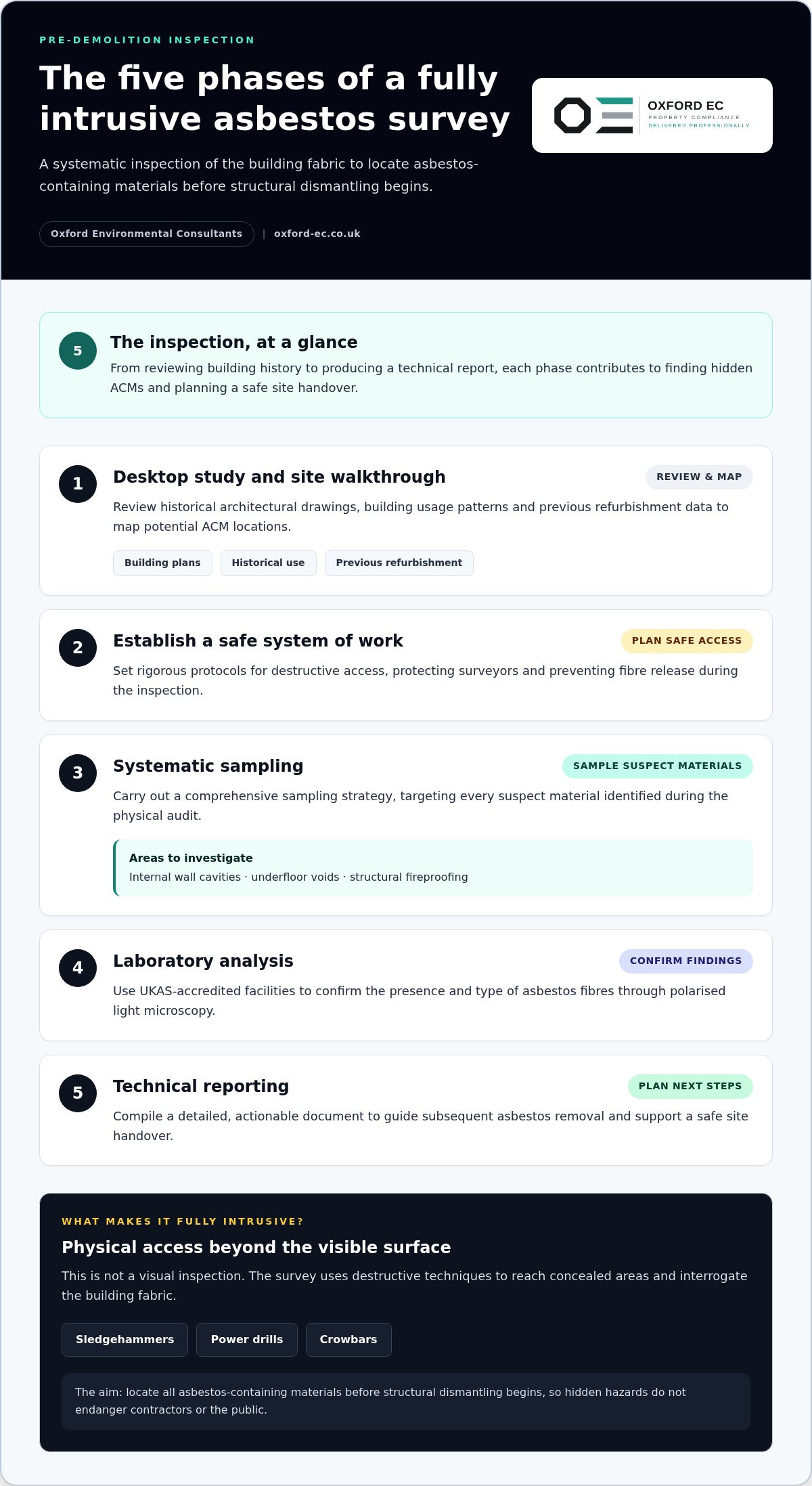
Systematic. Rigorous. Total. A pre-demolition survey is not a visual inspection; it is a physical interrogation of the building fabric. The core philosophy of an asbestos demolition survey is the exhaustive location of all asbestos-containing materials (ACMs) before structural dismantling begins, ensuring that no hidden hazards remain to endanger contractors or the public. This process requires a meticulous desktop study of building plans, historical usage records, and previous refurbishment data to identify high-risk areas such as internal wall cavities, underfloor voids, and structural fireproofing. Every inaccessible nook must be reached, as the legal mandate for these surveys demands a level of scrutiny that standard management inspections simply cannot provide.
The Five Phases of a Demolition Survey
- Phase 1: Desktop Study and Site Walkthrough – Reviewing historical architectural drawings and usage patterns to map potential ACM locations.
- Phase 2: Establishing a Safe System of Work – Developing rigorous protocols for destructive access to ensure surveyor safety and prevent fibre release.
- Phase 3: Systematic Sampling – Executing a comprehensive sampling strategy that targets every suspect material identified during the physical audit.
- Phase 4: Laboratory Analysis – Utilising UKAS-accredited facilities to confirm the presence and type of asbestos fibres through polarised light microscopy.
- Phase 5: Technical Reporting – Compiling a detailed, actionable document that serves as the blueprint for subsequent asbestos removal and safe site handover.
Destructive Access and Site Integrity
Penetrate. Dismantle. Verify. Unlike other survey types, the methodology here is intentionally destructive, employing tools such as sledgehammers, power drills, and crowbars to bypass structural barriers that might conceal legacy asbestos. Because this process involves intentionally breaking into building elements, the premises must be entirely unoccupied to eliminate any risk of accidental exposure to third parties. These aggressive techniques are governed by the professional standards upheld by bodies such as the Asbestos Testing and Consultancy Association (ATaC), ensuring that even in unstable or complex structures, the survey remains controlled and technically sound. Managing these risks requires a sophisticated understanding of structural integrity, particularly when sampling within load-bearing elements or dilapidated environments where the danger of collapse is as prevalent as the mineral itself.
The transition from a raw building to a safe demolition site hinges entirely on the precision of this forensic audit. If you are overseeing a complex teardown and require a meticulous assessment to protect your project timeline, our team offers the technical expertise needed to secure your site compliance with absolute confidence.
Asbestos Refurbishment vs Demolition Surveys: Critical Distinctions
Distinction. Clarity. Commercial viability. Choosing between a refurbishment and a demolition survey is not a matter of preference but a question of project scope and statutory obligation. Whilst both fall under the broad "Refurbishment and Demolition" (R&D) category defined in HSG264, their application determines the legal safety of your site. A refurbishment survey is a surgical strike; an asbestos demolition survey is a total audit. Misjudging this distinction leads to "scope creep," where a project intended for minor upgrades evolves into structural work that exceeds the survey's original remit, leaving the duty holder exposed to legal and physical risk.
When to Choose a Refurbishment Survey
Targeted. Specific. Efficient. A refurbishment survey is appropriate when the planned works are confined to specific areas or systems within a building. It's the ideal choice for utility upgrades, window replacements, or partial floor renovations where the structural integrity of the building remains largely intact. For a deeper analysis of how these inspections fit into your broader safety strategy, consult our guide on Asbestos Refurbishment vs Demolition Surveys. This targeted approach ensures compliance without unnecessary structural damage to areas that will remain in use, providing a cost-effective solution for maintenance and modernisation programmes.
The "Fully Destructive" Nature of Demolition Surveys
Absolute. Final. Uncompromising. An asbestos demolition survey is the only legally robust solution when a building is slated for total removal. It is the final barrier between a standing structure and a safe site clearance. Unlike refurbishment-level inspections, this survey requires the dismantling of every wall, the lifting of every floorboard, and the penetration of every structural void. Using a refurbishment survey for a full demolition project is a catastrophic error. It leaves uninspected asbestos-containing materials (ACMs) in place, which are then disturbed during mechanical teardowns, leading to immediate HSE intervention and significant health risks for the site workforce.
Precision pays dividends. The cost of a comprehensive survey is a fraction of the expense incurred by unforeseen project delays. When hidden asbestos is discovered mid-demolition, the site stops. Contractors are demobilised. Emergency removal teams are brought in at premium rates. By commissioning a rigorous asbestos demolition survey from the outset, developers eliminate these variables and ensure a predictable, compliant path to site handover. We provide the meticulous oversight required to identify these risks before they become liabilities, acting as the "safe pair of hands" for complex UK-wide demolition projects.
Managing the Demolition Programme: From Survey to Site Clearance
Integration. Precision. Accountability. The asbestos demolition survey report serves as the technical foundation for the entire project lifecycle, transitioning from a diagnostic audit to a core component of the demolition tender. It's imperative that this document is fully integrated into the contractor's Method Statement and Risk Assessment (RAMS) to ensure that every identified hazard is managed with absolute control. A failure to translate forensic survey findings into actionable site instructions is a primary cause of accidental exposure and immediate HSE intervention. By providing a clear, evidence-based report, duty holders can ensure that all bidding contractors are quoting against a transparent and accurate scope of work, eliminating the risk of unforeseen financial variations.
Interpreting the Asbestos Survey Report
Analysis. Priority. Action. Every technical report produced following an asbestos demolition survey includes granular risk assessments and priority scoring based on the specific material type, its condition, and the extent of the ACMs present. These scores aren't mere suggestions; they dictate the urgency and methodology of the required remediation within the context of the Control of Asbestos Regulations 2012. Oxford Environmental Consultants (OEC) provides the expert asbestos consultancy required to interpret these findings, ensuring that the resulting demolition method statement is both safe and legally robust. We bridge the gap between raw technical data and site-level execution, providing the "safe pair of hands" needed to navigate complex property requirements and ensure total regulatory alignment.
Facilitating Safe Asbestos Removal
Identification. Classification. Remediation. The transition from survey to removal requires a clear understanding of the regulatory distinction between licensed, notifiable non-licensed (NNLW), and non-licensed asbestos work. High-risk materials, such as asbestos insulation or loose fill, require a mandatory 14-day advance notice to the HSE using an ASB5 notification form before work can commence. For lower-risk materials, the standards of professional competence remain equally high to prevent the 0.1 fibres per cubic centimetre control limit from being exceeded. Our Asbestos Removal Services facilitate this critical phase, ensuring all contractors are fully compliant and that all hazardous waste is disposed of at authorised facilities with a complete audit trail.
The final phase of the programme is the four-stage clearance process, a rigorous inspection protocol required for licensed removal projects to verify that an area is safe for mechanical demolition. This involves a thorough visual inspection, air monitoring, and a final assessment by an independent analyst. Even with a meticulous survey, "hidden" asbestos can occasionally be discovered within structural cores or deep foundations during active site works. In these instances, the demolition must cease immediately until a further assessment is conducted. This structured approach ensures that the final site handover isn't just a formality but a verified state of absolute safety.
Navigating Property Compliance with Oxford Environmental Consultants
Precision. Protection. Peace of mind. Executing an asbestos demolition survey provides the diagnostic clarity required for structural works, yet it exists within a broader ecosystem of property compliance. Oxford Environmental Consultants (OEC) operates as a multi-disciplinary guardian, ensuring that the high-stakes transition from an occupied building to a cleared site is managed with absolute technical mastery. We don't just identify fibres; we provide a streamlined, one-stop logical solution to fragmented safety problems across the United Kingdom. This integrated approach allows developers and duty holders to move forward with projects that are not only physically safe but also legally robust and audit-ready.
A Holistic Approach to Building Safety
Demolition is a dynamic process that fundamentally alters a building's safety profile. As walls are removed and voids are opened, established fire compartmentation is often compromised, necessitating a renewed focus on life safety systems. Integrating rigorous Fire Risk Assessments during these property transitions ensures that fire escape routes and protective barriers remain functional throughout the project lifecycle. Redundant water systems also pose a risk; stagnant pipework in partially demolished structures can become breeding grounds for Legionella. OEC's ability to manage asbestos, fire safety, and water hygiene concurrently provides a protective shield against multi-faceted risks, ensuring total compliance across all property safety pillars.
Why OEC is the Safe Pair of Hands for Your Project
Rigour. Accountability. Expertise. Our commitment to regulatory alignment is uncompromising, positioning OEC as the premier partner for complex, multi-site demolition programmes. We protect duty holders from the severe risks of HSE intervention and litigation by delivering evidence-based results that withstand the highest levels of scrutiny. Whether you are managing a single commercial asset or a national portfolio, our team provides the national reach and meticulous detail required for an asbestos demolition survey that ensures a safe site handover. We act as your accountable partner, managing the entire compliance lifecycle from the initial survey to the facilitation of safe removal. By choosing a partner that thrives on detail and order, you secure the future of your development with a disciplined consultancy that values transparency above all else.
Enquire about our Asbestos Demolition Surveys
Securing Your Site’s Compliance Future
Navigating the complexities of structural teardowns requires more than just caution; it demands a forensic commitment to regulatory precision. We have established that a mandatory asbestos demolition survey acts as the definitive legal shield against HSE intervention and unforeseen site hazards. By distinguishing between targeted refurbishment and total structural audits, duty holders can eliminate the risks of scope creep and project stagnation. Integrating these findings into a broader safety framework ensures that fire compartmentation and water hygiene remain uncompromised during property transitions.
Since 2018, Oxford Environmental Consultants has provided the meticulous technical expertise and national coverage required to manage high-stakes safety requirements across the UK. Our multi-disciplinary auditing approach delivers the absolute precision needed for a safe, compliant site handover. We remain your accountable partner in property safety, transforming fragmented compliance issues into a singular, robust solution that protects both your project timeline and your legal standing.
We look forward to protecting your next project with the rigour and mastery your site deserves.
Frequently Asked Questions
Is an asbestos demolition survey a legal requirement for all buildings?
An asbestos demolition survey is a statutory requirement for all UK buildings constructed or refurbished before the year 2000. Under the Control of Asbestos Regulations 2012, duty holders must ensure that a fully intrusive inspection is conducted before any structural dismantling or teardown begins. This legal mandate ensures that all asbestos-containing materials are identified and safely removed, protecting contractors and the public from accidental fibre release during the demolition process.
Can a building be occupied during a demolition asbestos survey?
No, a building must be entirely unoccupied during this type of inspection. Because the methodology involves aggressive, destructive access to penetrate wall cavities, floor voids, and structural cores, there is a heightened risk of temporary fibre release. To maintain absolute safety and comply with HSG264 standards, the premises must be vacated. This allows surveyors to use heavy tools and equipment to conduct a forensic audit without endangering occupants or third parties.
How long does an asbestos demolition survey take to complete?
The duration of the site work depends on the scale, complexity, and structural age of the property. A small residential unit might be completed within a single day, whilst large industrial complexes or multi-storey commercial assets can require several weeks of intensive field work. Following the physical inspection, UKAS-accredited laboratory analysis of samples typically takes an additional three to five working days before a final, actionable report is issued to the duty holder.
What is the difference between a management survey and a demolition survey?
A management survey is a standard inspection designed to locate asbestos disturbed during normal occupancy and routine maintenance. In contrast, an asbestos demolition survey is a fully intrusive, destructive audit required before structural teardowns. It bypasses surface finishes to inspect the building fabric itself. Relying on a management survey for demolition is legally insufficient and leaves hidden materials undetected within the structural core. This distinction is vital for total site safety and compliance.
What happens if asbestos is found during the demolition survey?
If asbestos-containing materials are identified, they must be safely managed or removed before demolition can proceed. The survey report categorises the materials and provides a risk assessment to guide remediation. High-risk materials often require removal by licensed contractors and a 14-day notification to the HSE. Our team facilitates this transition, ensuring all removal work is conducted legally and that the site is cleared and verified safe for mechanical demolition.
How much does an asbestos demolition survey cost in the UK?
Costs are determined by the size of the building, the complexity of its construction, and the number of samples required for laboratory analysis. Each project is unique, and factors such as safe access requirements or the presence of hazardous environments can influence the final fee. We recommend requesting a bespoke quote that accounts for your specific project scope to ensure your compliance budget is both accurate and professionally managed.
How long is an asbestos demolition survey report valid for?
The report remains valid as long as the building's structural condition and the scope of the planned demolition work do not change. However, if structural alterations occur or if the demolition programme is significantly delayed, a re-inspection may be necessary to ensure the data remains accurate. It's best practice to conduct the survey as close to the commencement of works as possible to ensure the findings reflect the current state of the premises.
Do I need a survey if I am only demolishing a small part of a building?
Yes, a survey is required for any portion of a pre-2000 building that is subject to demolition or major refurbishment. The inspection must be fully intrusive within the specific footprint of the planned works. Even localised demolition, such as removing an internal wall or a structural extension, can uncover legacy asbestos hidden within the fabric. Failing to survey these targeted areas is a breach of the Control of Asbestos Regulations 2012.