
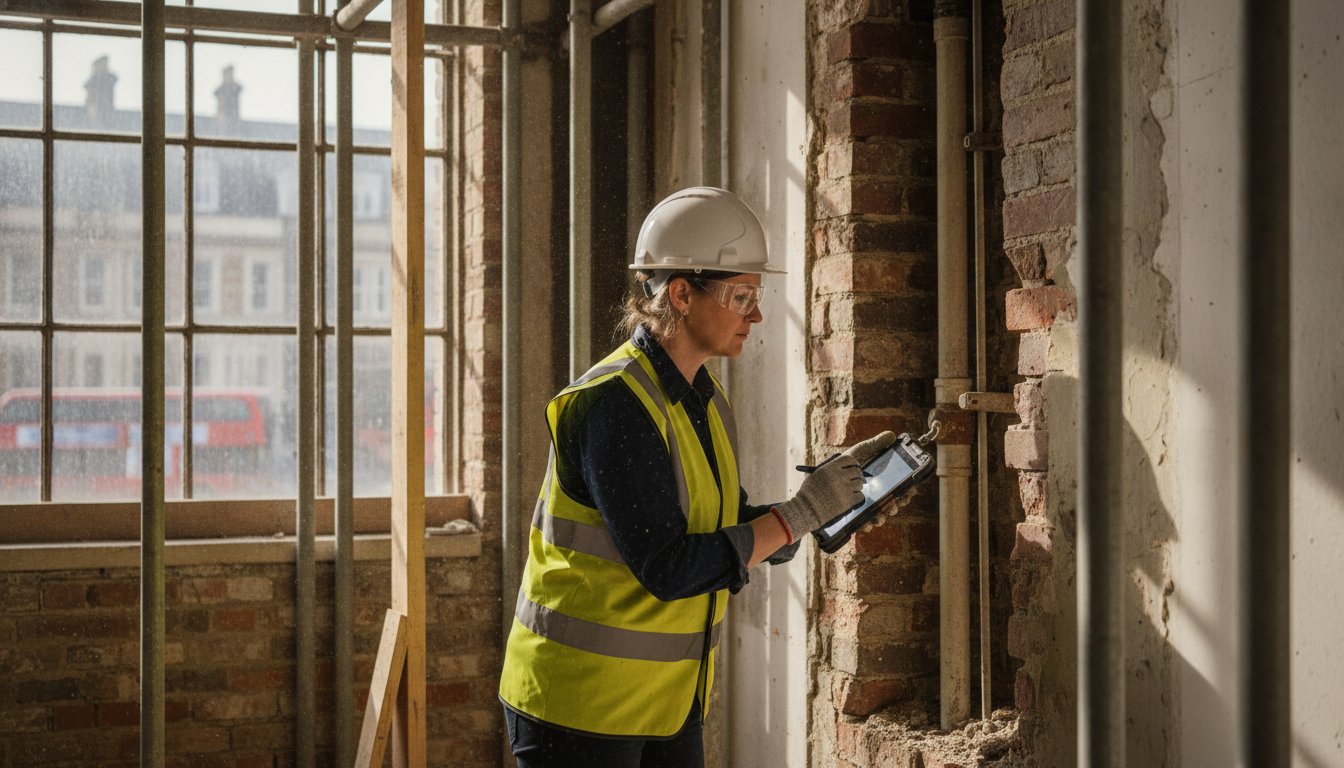
What if the viability of your redevelopment hinges on what your current asbestos register cannot see? Project delays. Legal exposure. Unforeseen costs. Many duty-holders mistakenly rely on management-level data, only to face immediate site closures when a contractor disturbs a hidden asbestos insulating board during a required asbestos refurbishment survey. You likely recognise that the Control of Asbestos Regulations 2012 (CAR 2012) demands absolute compliance, yet the prospect of an intrusive, destructive survey often feels like an invitation for property damage. It’s a valid concern. The anxiety of hitting a regulatory standstill can make the pre-construction phase feel like a minefield.
This guide ensures you navigate these complexities with total precision. You’ll gain a clear understanding of the survey scope, learn to identify competent consultants, and secure a project-ready register. We examine the 2026 HSE enforcement priorities, intrusive methodologies, and the specific duties you must discharge to remain audit-ready and protected.
Key Takeaways
- Grasp the mandatory legal requirements under Regulation 4 of CAR 2012 to ensure your renovation project remains fully compliant with UK health and safety legislation.
- Discover how an intrusive asbestos refurbishment survey identifies concealed hazards within the building fabric to eliminate the risk of unforeseen project delays.
- Distinguish between management and refurbishment scopes to ensure your asbestos register provides the necessary depth for structural modernisation works.
- Master the criteria for evaluating surveyor competence and the critical importance of Professional Indemnity insurance for high-stakes property assets.
- Align your project with a multi-disciplinary consultancy to provide a rigorous, audit-ready framework that protects both personnel and legal liability.
Table of Contents
The Legal Mandate for an Asbestos Refurbishment Survey
An asbestos refurbishment survey is a mandatory, fully intrusive inspection required by law before any renovation, structural alteration, or modernisation works commence. Unlike standard management assessments, this specific survey type penetrates the building fabric to locate materials that remain hidden during daily occupancy. It's an essential safeguard. A legal necessity. A project foundation. For a comprehensive overview of asbestos and its historical application in UK construction, understanding its prevalence in structural elements like partition voids and floor screeds is vital for any duty holder.
Under the Control of Asbestos Regulations 2012 (CAR 2012), specifically Regulation 4, the "duty to manage" extends to ensuring that no person is exposed to fibres during works. The Building Safety Act 2022 further reinforces this by demanding a "Golden Thread" of digital information, where accurate asbestos data must be maintained throughout a building’s lifecycle to ensure long-term safety. Failing to commission a survey leads to severe repercussions. Legal prosecution. Unlimited fines. Immediate site closures. These aren't hypothetical risks but active enforcement realities that can cripple a redevelopment programme.
CAR 2012 and the Duty Holder's Responsibilities
The "Duty Holder" is typically the building owner, the facilities manager, or any person who has, by virtue of a contract or tenancy, an obligation to maintain or repair non-domestic premises. In a commercial refurbishment context, this individual carries the legal weight of ensuring site safety. You must provide detailed asbestos information to all contractors and designers before they begin work to prevent accidental disturbance. The Duty Holder’s primary obligation is to ensure that a suitable and sufficient refurbishment survey is completed to identify all asbestos-containing materials within the specific scope of the planned works.
Refurbishment Surveys and Project Liability
Executing an asbestos refurbishment survey early in the planning phase serves as a pre-emptive strike against project failure. It prevents the dreaded "stop-work" orders that occur when contractors unexpectedly encounter suspect materials mid-renovation. This alignment is critical for fulfilling your duties under the Construction (Design and Management) Regulations 2015 (CDM), which mandate that clients provide essential pre-construction information. By identifying risks early, you protect your budget from the astronomical costs of emergency decontamination and retrospective remedial works. Learn more about our comprehensive asbestos consultancy services to see how we assist in managing these high-stakes liabilities through rigorous, audit-ready reporting.
Methodology: The Anatomy of a Destructive Inspection
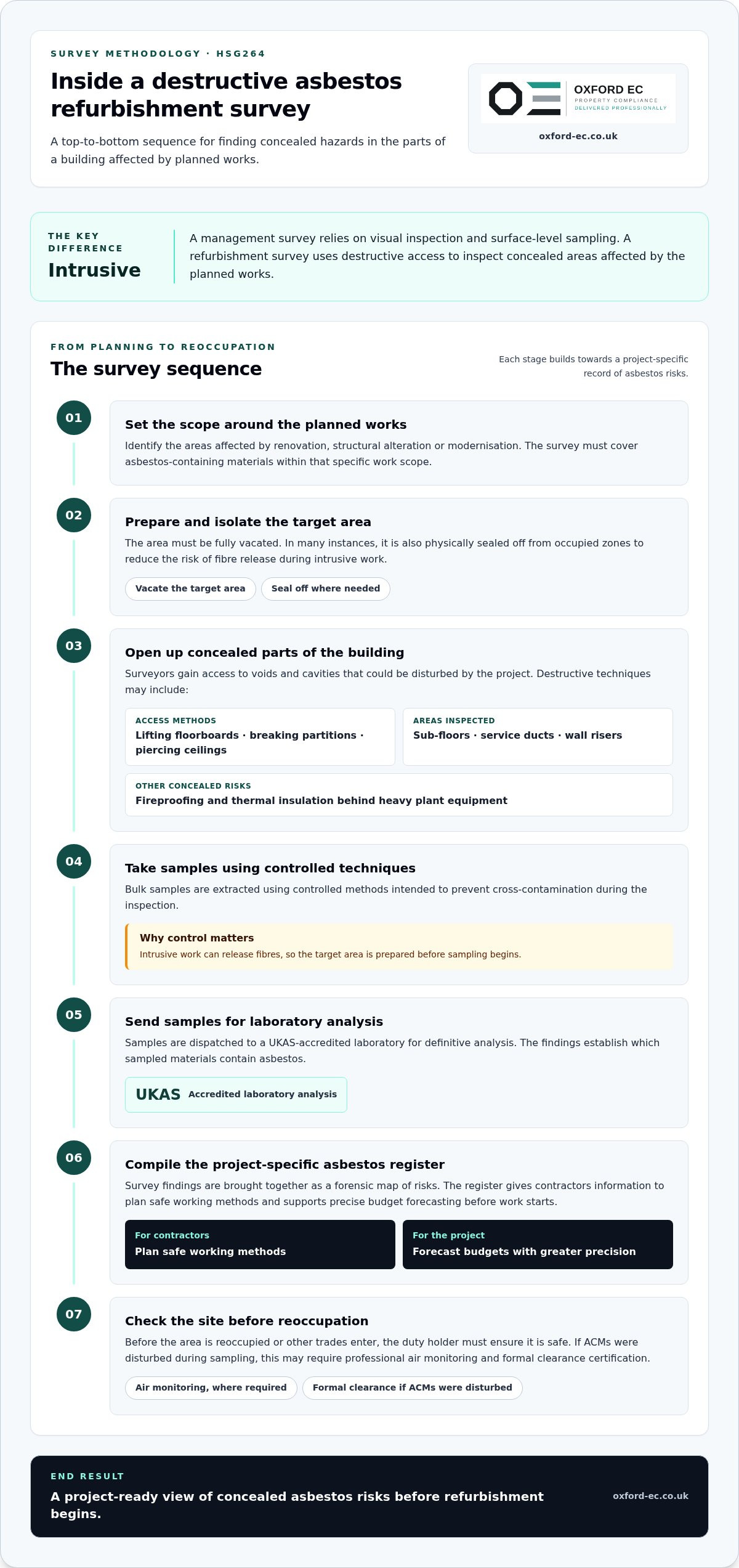
The fundamental distinction between a standard assessment and an asbestos refurbishment survey lies in the level of penetrative scrutiny applied to the building fabric. Whilst management surveys rely on visual inspection and surface-level sampling, a refurbishment-grade inspection requires aggressive, destructive access to all areas affected by the proposed works. This methodology is governed by The Legal Mandate for an Asbestos Refurbishment Survey as defined in the HSG264 guidance, which provides the technical framework for identifying Asbestos-Containing Materials (ACMs) that remain concealed behind structural barriers.
Safety protocols dictate that the target area must be fully vacated and, in many instances, physically sealed from occupied zones to mitigate the risk of fibre release during intrusive works. Cross-contamination is a significant liability. To prevent this, surveyors employ controlled techniques to extract bulk samples of materials, which are then dispatched to a UKAS-accredited laboratory for definitive analysis. The resulting data is then synthesised into a project-specific asbestos register, providing a forensic map of risks. This document serves as a critical pre-construction tool, allowing for precise budgetary forecasting and the development of safe working methods for your contractors. It eliminates the guesswork that often leads to mid-project stoppages.
Common Destructive Techniques Employed
Surveyors must gain access to every concealed void and cavity that might be disturbed during renovation. Lifting floorboards. Breaking partitions. Piercing ceilings. These actions are necessary to inspect sub-floors, service ducts, and wall risers where legacy asbestos insulating board (AIB) or pipe lagging often resides. We also conduct rigorous, intrusive inspections of structural fireproofing and thermal insulation situated behind heavy plant equipment. This level of detail ensures that no hidden hazard remains to jeopardise your contractors once the main project commences, providing the absolute precision required for high-stakes redevelopment. It's the only way to guarantee a truly project-ready register.
Managing Site Reoccupation Post-Survey
Following the completion of an intrusive asbestos refurbishment survey, the duty holder must ensure the environment is safe for reoccupation or for other trades to enter. This often necessitates professional air monitoring and a formal 'clearance' certification if ACMs were disturbed during the sampling process. Ensuring the site is safe. Validating air quality. Providing peace of mind. If you require assistance in navigating these post-survey requirements, you may Explore our remedial services for post-survey management to ensure your site remains fully compliant. For a tailored project consultation, speak with our technical team today.
Management vs Refurbishment Surveys: Strategic Differences
The distinction between management and refurbishment-grade inspections is an essential pillar of property compliance. Surface-level data. Ongoing monitoring. Daily safety. Whilst management surveys identify materials that might be disturbed during normal occupancy, the asbestos refurbishment survey is a forensic, project-specific tool designed to penetrate the building fabric and expose hidden risks before any structural changes occur. See our guide on asbestos management surveys for daily compliance to understand how these baseline assessments form the foundation of your building’s safety file.
Strategy dictates that management surveys remain ongoing, requiring periodic reinspection to verify material condition. In contrast, a refurbishment survey is a one-off, intensive exercise tailored strictly to the scope of planned works. Adhering to high asbestos consultancy standards ensures that this transition from daily management to construction-ready data is handled with technical precision, protecting both the workforce and the duty holder's legal standing.
When a Management Survey is Insufficient
Relying on a management register for construction planning is a high-stakes error that often leads to regulatory intervention. These surface-level reports frequently list hidden cavities as "presumed absent" or "inaccessible," creating a false sense of security for contractors. A minor office refit in 2025 illustrates this risk perfectly. Whilst the existing register showed no hazards, a required asbestos refurbishment survey conducted ahead of radiator upgrades revealed legacy asbestos insulating board (AIB) concealed within the wall cavity. This discovery prevented accidental disturbance, yet it highlights how easily "hidden" asbestos can derail a project that lacks intrusive data. Without that forensic scrutiny, the risk of fibre release during demolition is absolute.
Phased Refurbishment and Survey Planning
Large-scale redevelopments delivered in stages require a sophisticated, tiered approach to survey planning. You must balance the need for intrusive, destructive data with the operational requirement to keep certain building wings functional. This often involves conducting surveys in phases, ensuring that specific zones are cleared and sealed for inspection whilst others remain occupied. It’s a delicate coordination of safety and productivity. Meticulous planning. Zonal isolation. Strategic delivery. Once the refurbishment is complete, your focus must shift back to the "duty to manage" for the remaining lifecycle of the asset. Understand your ongoing duties with our asbestos reinspection checklist to ensure your long-term compliance remains robust after the contractors have left the site.
Evaluating Asbestos Consultancy Services for Your Project
Technical mastery. Regulatory alignment. Absolute accountability. Selecting a consultant to conduct an asbestos refurbishment survey requires a level of scrutiny that goes beyond verifying a basic accreditation certificate. The Health and Safety Executive (HSE) defines competence through a combination of rigorous training, demonstrable experience, and a proven track record in identifying complex Asbestos-Containing Materials (ACMs) in high-stakes environments. You must ensure your chosen professional carries specialised Professional Indemnity (PI) insurance that specifically includes asbestos consultancy, as standard policies often exclude this high-risk category. This protection is vital. It safeguards your organisation against the legal and financial fallout of a missed identification or an inadequate risk assessment.
The value of a consultant also lies in their ability to view asbestos through the lens of broader property compliance. A meticulous expert doesn't just list hazards; they provide a "safe pair of hands" for the entire pre-construction phase, ensuring that the asbestos data integrates seamlessly with fire safety and structural requirements. Request a professional property compliance audit to ensure your asset management strategy is robust, integrated, and fully aligned with current UK legislation.
Technical Expertise and Audit-Ready Reporting
Clear data. Actionable insights. Seamless delivery. Your survey report must be more than a static document; it should function as a prioritised action plan for your demolition or refurbishment contractors. High-resolution photography and detailed, CAD-ready floor plans are essential for pinpointing the exact location and extent of ACMs within the building fabric. We ensure our findings are delivered via a digital, searchable database, allowing project managers to instantly access critical safety information. This transparency prevents the misinterpretation of data that often leads to accidental disturbance on-site.
Independence and Integrity in Consultancy
Unbiased oversight. Transparent procurement. Risk mitigation. Utilising an independent consultant to manage the removal tender process prevents the inherent conflicts of interest that arise when a surveyor is linked to a removal contractor. This separation ensures that the scope of removal is neither inflated nor understated, protecting your budget whilst maintaining uncompromising safety standards. By acting as your accountable partner, an independent consultant provides the scrutiny required to verify that all remedial works are completed to the highest standard before the main project begins.
Oxford Environmental Consultants: National Excellence in Compliance
Precision. Mastery. Protection. Oxford Environmental Consultants (OEC) operates as a disciplined, high-level consultancy dedicated to the rigorous management of property risks across the UK. Our execution of the asbestos refurbishment survey is defined by an uncompromising commitment to technical precision, ensuring that duty-holders meet the stringent requirements of CAR 2012 with total confidence. We don't merely provide data; we deliver a legally robust framework that shields your organisation from the inherent risks and liabilities of structural modernisation. By positioning ourselves as the "safe pair of hands" for complex, multi-faceted requirements, we manage the technical meat of the subject with a level of scrutiny that standard service providers often fail to achieve.
A Multi-Disciplinary Safety Shield
Efficiency in compliance is achieved through the strategic integration of fragmented safety requirements. Managing asbestos risks in isolation often leads to overlooked overlaps in building safety, particularly concerning the interaction between insulation materials and fire compartmentation. By aligning your asbestos strategy with other critical compliance pillars, you ensure a streamlined, one-stop solution to complex regulatory demands that is both cost-effective and legally sound. Discover our fire safety and compartmentation services to see how we protect the structural life-safety of your property through meticulous inspection. Simultaneously, our technical team provides comprehensive oversight for water-based risks, ensuring your asset is safe from every environmental angle whilst maintaining full regulatory alignment. Explore our water hygiene and Legionella risk assessments for a holistic approach to property health and safety management.
Secure Your Compliance for 2026
The future of UK safety standards demands more than just a historical register; it requires meticulous, digital, and audit-ready reporting. OEC’s national reach allows us to support duty-holders with multi-site portfolios, providing a consistent standard of excellence across the United Kingdom. We prepare your building for the heightened enforcement trends of 2026 by delivering an asbestos refurbishment survey that is transparent, evidence-based, and fully actionable for any project team. Our reports don't just sit on a shelf; they actively manage your liability and provide a clear roadmap for safe structural change. Secure your property compliance by contacting OEC today to ensure your next refurbishment project is founded on technical mastery and legal certainty.
Securing Your Redevelopment Programme for 2026 and Beyond
Executing a successful property modernisation requires a commitment to absolute precision. You now understand that a management register is insufficient for structural change. A rigorous asbestos refurbishment survey is the only method to guarantee contractor safety and legal robustness. By identifying hidden hazards before the first hammer falls, you eliminate the risk of site closures and unlimited fines under CAR 2012. Technical mastery. Regulatory alignment. Peace of mind. This proactive approach ensures your project remains viable and your personnel remain protected.
Oxford Environmental Consultants provides the expert multi-disciplinary property compliance needed to manage high-stakes assets across the country. Our national UK coverage and authoritative, audit-ready reporting ensure your project remains on track and fully aligned with the evolving "Golden Thread" of safety data. We act as the safe pair of hands for your most complex requirements, integrating asbestos findings with fire and water safety strategies to provide a streamlined, one-stop solution.
We look forward to acting as your accountable partner in delivering a safe, compliant, and successful renovation. Don't leave your project’s legal standing to chance.
Frequently Asked Questions
Is an asbestos refurbishment survey a legal requirement for domestic properties?
Legal obligations apply when any construction or renovation work is commissioned. Whilst the "duty to manage" under CAR 2012 primarily targets non-domestic premises, the Construction (Design and Management) Regulations 2015 (CDM) require that homeowners or their contractors identify hazards before work begins. For common areas in blocks of flats, a survey is a strict legal mandate. Ensuring safety. Protecting residents. Discharging duty. You must provide this data to contractors to prevent accidental exposure.
How long does an asbestos refurbishment survey take to complete?
Project duration depends entirely on the building’s scale and structural complexity. A standard retail unit might require a single day on-site, whereas a multi-storey commercial complex could necessitate several days or weeks of intrusive inspection. Laboratory analysis of bulk samples typically requires an additional 24 to 48 hours for definitive results. Precise scheduling. Rigorous sampling. Timely reporting. We provide a specific timeline following an initial review of your project’s scope and floor plans.
Can I carry out refurbishment work if I already have a management survey?
No, a management survey is insufficient for structural alterations. Management-level data only covers surface-level materials and those easily accessible during daily occupancy. It doesn't penetrate the building fabric where legacy insulation or board often resides. You must commission a dedicated asbestos refurbishment survey to identify hidden hazards before any demolition or modernisation starts. Relying on management data risks site-wide contamination and immediate legal prosecution. Forensic scrutiny is a non-negotiable project requirement.
Does the building have to be empty during a refurbishment survey?
Yes, the specific survey zones must be vacated to ensure personnel safety. Because the methodology involves destructive techniques that can release fibres, we require the area to be cleared and often physically sealed. This prevents cross-contamination and allows our surveyors to work with the necessary intensity. Controlled access. Zonal isolation. Validated safety. Once the survey is complete and air clearance is confirmed, the area can be safely reoccupied by other trades.
What happens if asbestos is found during the refurbishment survey?
Any identified Asbestos-Containing Materials (ACMs) must be risk-assessed for removal or encapsulation. The findings are immediately integrated into your asbestos register, which then informs the safe system of work for your contractors. If the material is high-risk, such as pipe lagging or insulating board, a licensed contractor must be appointed for its safe removal. Precise identification. Risk mitigation. Legal alignment. This process ensures that hazards are managed before they can derail your project’s timeline.
How much does a professional asbestos refurbishment survey cost in the UK?
Costs are determined by the property’s size, age, and the number of bulk samples required for laboratory analysis. Residential refurbishment surveys typically start from £300 to £500 plus, while commercial assets are quoted based on the specific technical scope and complexity of the building fabric. We provide bespoke, fixed-fee quotations that reflect the depth of inspection required to ensure your project remains fully compliant. Professional indemnity. Technical expertise. Audit-ready results.
What is the difference between a refurbishment survey and a demolition survey?
The primary difference lies in the geographical scope and the level of destruction. A refurbishment survey is targeted specifically at the areas being renovated, preserving the rest of the structure. In contrast, a demolition survey is a comprehensive, fully intrusive inspection of the entire building before total removal. Both are destructive. Both are intrusive. Both require vacant possession. The choice depends entirely on whether the building is being modernised or completely razed.
How often should an asbestos refurbishment survey be updated?
These surveys are project-specific and do not require periodic updates like management-level assessments. Once the survey is completed for a specific renovation scope, it remains valid for that work. However, if your project expands to include areas not previously inspected, you must commission an additional survey to cover the new zones. New scope. New inspection. Total protection. This ensures that no hidden materials are disturbed as the redevelopment programme evolves over time.