
Fifty-eight per cent. That is the proportion of fire safety audits deemed satisfactory in the latest enforcement cycle, leaving thousands of UK businesses exposed to unlimited fines and criminal liability. Compliance is not a suggestion. It is a mandate. It is a shield. For property managers, commissioning a commercial fire risk assessment often feels like a descent into regulatory complexity, especially whilst grappling with the competent person definition and the shifting requirements of the Building Safety Act 2026.
Managing multiple compliance streams requires a level of technical scrutiny that few internal teams can maintain without professional support. This guide delivers the absolute legal certainty required to protect your occupants and assets through a rigorous breakdown of the Fire Safety Order and associated professional standards. We shall examine the specific technical requirements for fire door inspections, the necessity of compartmentation surveys, and the practical steps required to build a robust remediation plan that ensures your property remains audit-ready and fully protected.
Key Takeaways
- Identify the non-delegable legal duties of the "Responsible Person" under the Regulatory Reform (Fire Safety) Order 2005 to avoid personal liability and heavy fines.
- Execute a robust commercial fire risk assessment by systematically identifying ignition sources, fuel loads, and the specific safety requirements of vulnerable occupants.
- Clarify the "competent person" definition to determine when your facility requires professional technical scrutiny rather than a standard internal review.
- Understand the vital role of compartmentation and mandatory fire door inspections in maintaining passive fire protection and ensuring legal compliance.
- Optimise property management by integrating fire safety with asbestos and water hygiene audits for a more efficient, multi-disciplinary approach to total compliance.
Table of Contents
- The Legal Framework: Navigating the Fire Safety Order and the Responsible Person
- The Five Essential Steps of a Commercial Fire Risk Assessment
- DIY vs Professional Assessment: Defining the Competent Person
- Passive Fire Protection: The Critical Focus on Compartmentation and Doors
- The Multi-Disciplinary Advantage: Integrating Fire, Asbestos, and Water Safety
The Legal Framework: Navigating the Fire Safety Order and the Responsible Person
The Regulatory Reform (Fire Safety) Order 2005 serves as the primary statutory instrument for fire safety across England and Wales. It demands absolute compliance. It mandates precision. It enforces accountability. This legislation dictates that every non-domestic premises must undergo a regular commercial fire risk assessment to identify potential hazards and safeguard occupants. These Fire safety principles are no longer static; they have been significantly bolstered by the Fire Safety Act 2021 and the Building Safety Act 2022. Specifically, Section 156 of the Building Safety Act, which commenced on 1 October 2023, now requires all fire risk assessments to be recorded in full, regardless of the size of the organisation or the number of employees.
Failure to align with these standards carries severe penalties. Enforcement is rising. Prosecutions increased by 79% in the 2023/24 period according to recent enforcement data. Courts now frequently impose unlimited fines for systemic failures, whilst individual "Accountable Persons" face up to two years' imprisonment for serious breaches. Beyond criminal liability, non-compliance typically voids commercial insurance policies, leaving businesses financially exposed following an incident.
Who is the Responsible Person in a Commercial Setting?
The "Responsible Person" (RP) is typically the employer, the building owner, or any individual exercising control over the premises. This duty is non-delegable. You can outsource the technical execution of a commercial fire risk assessment, but the legal liability remains yours. In multi-occupied buildings, multiple RPs must co-operate and co-ordinate their safety measures to ensure a seamless protective envelope. If your organisation employs five or more people, or is subject to specific licensing, every finding must be documented and made available for inspection by the Fire and Rescue Service.
Mandatory Review Triggers for Your Assessment
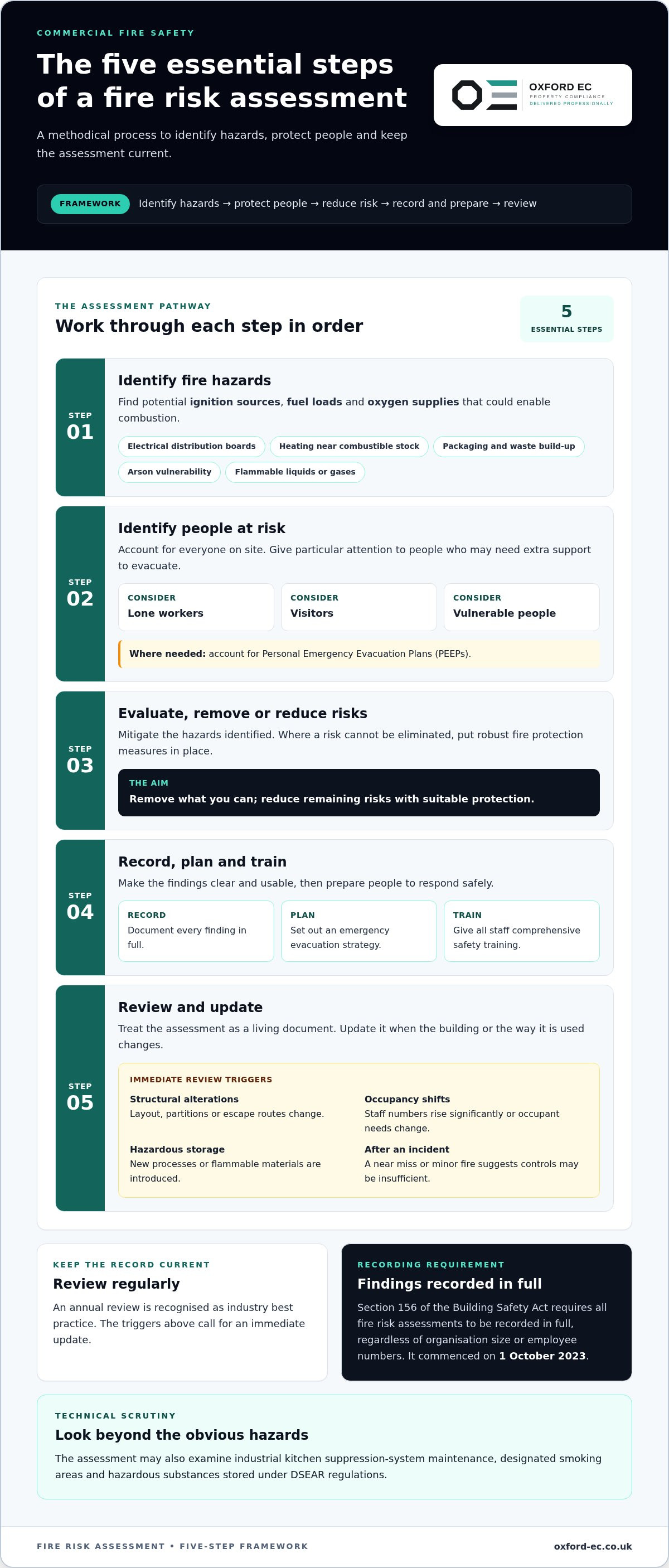
A fire risk assessment is a living document. It requires constant scrutiny. Whilst an annual review is the recognised industry best-practice standard, certain events necessitate an immediate update. These triggers include:
- Structural Alterations: Changes to building layout, partitions, or escape routes.
- Occupancy Shifts: Significant increases in staff numbers or changes to the "type" of occupant, such as vulnerable persons.
- Hazardous Storage: New processes or the introduction of flammable and hazardous material storage.
- Post-Incident Analysis: Any "near miss" or minor fire incident that suggests existing controls are insufficient.
Regular reviews ensure that your safety strategy evolves alongside your business operations, maintaining a "safe pair of hands" approach to property management and legal robustness.
The Five Essential Steps of a Commercial Fire Risk Assessment
Execute. Document. Protect. A commercial fire risk assessment is not a cursory walkthrough; it is a methodical technical audit. This process requires a disciplined adherence to a five-step framework designed to eliminate ambiguity and maximise occupant safety. Whilst the UK Government fire risk assessment guidance provides a baseline for these duties, complex commercial environments demand a higher register of scrutiny to account for intricate building layouts and industrial processes.
- Step 1: Identify Fire Hazards. Locate potential ignition sources, fuel loads, and oxygen supplies that could facilitate combustion.
- Step 2: Identify People at Risk. Account for everyone on-site, with specific focus on lone workers, visitors, and vulnerable individuals who may require Personal Emergency Evacuation Plans (PEEPs).
- Step 3: Evaluate, Remove, or Reduce Risks. Actively mitigate identified hazards and implement robust fire protection measures where risks cannot be entirely eliminated.
- Step 4: Record, Plan, and Train. Document every finding in full, establish a clear emergency evacuation strategy, and ensure all staff receive comprehensive safety training.
- Step 5: Review and Update. Maintain the assessment as a living document, updating it to reflect any physical or operational changes within the premises.
Hazard Identification: Beyond the Obvious
Technical precision is paramount during hazard identification. Beyond visible ignition sources, an effective audit scrutinises the integrity of electrical distribution boards, the maintenance logs of industrial kitchen suppression systems, and the proximity of heating elements to combustible stock. Waste management protocols must be analysed to prevent the accumulation of packaging materials, whilst external areas require assessment for arson vulnerability and the safe positioning of designated smoking zones. Dangerous substances, including flammable liquids or gases, must be stored in accordance with DSEAR regulations to prevent catastrophic incidents. If your facility houses complex machinery or hazardous materials, you may need to consult with a specialist to ensure full regulatory alignment.
Evaluating the Adequacy of Existing Precautions
The third step involves a rigorous evaluation of your current protective envelope. This includes testing the decibel levels of fire alarms to ensure they are audible in all plant rooms and checking that emergency lighting provides sufficient illumination along every escape route. Firefighting equipment, such as extinguishers and hose reels, must be correctly specified for the local risk and maintained under a strict service contract. To satisfy insurance underwriters and legal auditors, you must maintain a comprehensive, time-stamped record of all identified risks and the specific remedial actions taken to mitigate them. This documentation serves as your primary evidence of due diligence during a Fire and Rescue Service inspection.
DIY vs Professional Assessment: Defining the Competent Person
Competence is the cornerstone of fire safety legislation. Under the Regulatory Reform (Fire Safety) Order 2005, a "competent person" must possess sufficient training, experience, and knowledge to carry out the task correctly. This is not a subjective self-assessment. It is a legal threshold. Whilst small, low-risk premises, such as a single-storey retail unit with straightforward escape routes, may find a DIY approach sufficient, complex commercial environments demand a higher register of technical expertise. Relying on a generic template for a multi-storey office or a manufacturing facility is a high-stakes gamble. It ignores the unique structural vulnerabilities of the site.
Professional assessors provide what is often termed a "linguistic handshake" with enforcement officers. When the London Fire Brigade or local fire authority conducts an audit, a professionally produced commercial fire risk assessment demonstrates an immediate commitment to rigorous standards. It uses the correct regulatory terminology. It references specific British Standards. It shows that the "Responsible Person" has sought expert counsel to protect their assets and occupants.
The Limitations of Internal Staff Assessments
Internal staff often fall victim to "familiarity bias." They walk past a wedged-open fire door or a blocked escape route so frequently that these hazards become invisible. Additionally, most internal employees lack the technical depth to evaluate compartmentation or the integrity of fire-stopping in hidden ceiling voids. The legal stakes are now higher than ever. Under the Building Safety Act 2022, an individual conducting a commercial fire risk assessment can face personal criminal liability if their work is deemed insufficient following a fire. This risk often outweighs any perceived cost saving of an in-house review.
Benefits of an External Professional Audit
An external audit delivers impartial, uncompromising scrutiny. It removes the internal politics of compliance and provides a clear, evidence-based remediation plan. This plan does not just list faults; it prioritises spend based on life safety and legal urgency. By engaging a specialist partner, you ensure your building is aligned with the latest fire safety developments and technical benchmarks. Learn more about our fire safety services to discover how a professional audit provides the absolute legal certainty your organisation requires. It is the only way to move from a "tick-box" exercise to a robust shield of protection.
Passive Fire Protection: The Critical Focus on Compartmentation and Doors
Passive fire protection represents the building's internal resilience. It is the silent, structural barrier that contains combustion at its source. Whilst active systems like alarms and sprinklers provide warning and initial suppression, passive measures ensure the building fabric remains a protective envelope. A comprehensive commercial fire risk assessment must scrutinise these elements to prevent the rapid, uncontrolled spread of smoke and flame through structural voids. This is not a surface-level check; it is a forensic analysis of the building's ability to resist thermal transfer.
Compartmentation Surveys: Protecting the Building Fabric
Compartmentation is the practice of dividing a building into "cells" using fire-rated walls and floors. It is frequently compromised. Modern utility installations often result in unsealed penetrations where cables, pipes, and ductwork breach fire-resistant barriers. These apertures allow toxic smoke to bypass escape routes in seconds. Specialist compartmentation survey services are required to identify these hidden risks within service risers and ceiling voids where standard visual inspections fail. Identifying these breaches is the only way to ensure the "golden thread" of safety remains unbroken throughout the property's lifecycle.
Fire Door Integrity: The First Line of Defence
Fire doors are critical life-safety components. They are not merely furniture. Under the Fire Safety (England) Regulations 2022, fire door inspections have become a standalone legal requirement for multi-occupied buildings. Technical scrutiny must extend to the integrity of intumescent seals, the exactness of door-to-frame gaps, and the operational reliability of self-closing mechanisms. For residential-commercial hybrids, regulations now mandate quarterly checks of doors in communal areas and annual checks of flat entrance doors. For a deeper technical breakdown of these requirements, consult our guide on Fire Door Inspection Regulations UK: The Definitive Compliance Guide for 2026.
Holistic fire safety also demands the rigorous testing of auxiliary systems. This includes the structural inspection of fire escape staircases to ensure they remain free from corrosion and obstruction; it also encompasses the strict maintenance of emergency lighting and alarm systems. Emergency lighting must undergo annual discharge tests to comply with BS 5266, whilst fire alarms require bi-annual servicing under BS 5839 standards. These active and passive streams must be managed simultaneously to maintain total property compliance and ensure safe passage during an evacuation.
The Multi-Disciplinary Advantage: Integrating Fire, Asbestos, and Water Safety
Compliance is fragmented. Risks are interconnected. Strategy must be unified. For large commercial portfolios, managing safety in silos is a logistical vulnerability that often leads to statutory oversight or physical danger. A commercial fire risk assessment provides the foundation for life safety, but its effectiveness is amplified when it's integrated into a broader multi-disciplinary framework. By aligning fire safety with asbestos management and water hygiene, property managers eliminate the friction of multiple contractors and ensure a cohesive protective shield across the building fabric.
Fire Safety and Asbestos: A Dangerous Intersection
The remediation of fire safety defects frequently requires invasive work that can inadvertently disturb the building's structural integrity. Installing new fire alarm systems or emergency lighting often involves drilling into ceiling voids and walls where asbestos-containing materials (ACMs) may reside. If a fire risk assessment is not cross-referenced with a current asbestos management plan, a simple safety upgrade can trigger a significant environmental incident. It's vital to consult A Complete Guide to Asbestos Management Surveys to ensure all passive fire protection works are executed without compromising air quality or legal standing. This integrated approach prevents project delays and protects both contractors and occupants from hazardous exposure.
Streamlining Your Compliance Strategy
The "Total Compliance" model represents the pinnacle of professional property management. Rather than scheduling disparate audits, a streamlined strategy allows for the simultaneous execution of fire, Legionella, and damp and mould inspections. This methodology provides a single point of accountability. It reduces administrative burden. It delivers cost efficiency. Aligning these streams ensures that every risk, from water-borne pathogens to smoke-spread vulnerabilities, is documented within a unified remediation schedule. This level of oversight is particularly critical for high-rise residential-commercial hybrids where the Building Safety Act demands a "golden thread" of information. It's the only way to transform your risk profile from a fragmented liability into a robustly managed asset.
View our full range of compliance services to understand how a consolidated audit can protect your portfolio. Choosing a single, meticulous partner like Oxford Environmental Consultants ensures that your safety obligations are met with technical precision and regulatory mastery. We act as the guardian of your property's compliance, providing the safe pair of hands necessary to navigate the complex requirements of 2026 and beyond.
Achieving Total Property Compliance Through Technical Scrutiny
The 2026 regulatory landscape demands absolute precision. It requires evidence. It necessitates accountability. It demands results. Navigating the complexities of the Fire Safety Order and the Building Safety Act is no longer a task for the generalist; it requires a meticulous partner capable of identifying subtle structural vulnerabilities whilst maintaining a "golden thread" of digital documentation. By integrating your commercial fire risk assessment with broader asbestos and water hygiene audits, you eliminate fragmented risks and secure a robust shield against both physical hazards and legal liability.
Oxford Environmental Consultants act as your safe pair of hands, providing professional fire safety and compartmentation experts who deliver comprehensive multi-disciplinary compliance reporting. Our team offers expert guidance on Fire Safety Order and Building Safety Act alignment to ensure your portfolio remains audit-ready and fully protected against the rising tide of enforcement activity.
Request a Professional Commercial Fire Risk Assessment from Oxford Environmental Consultants
Securing your premises is a strategic investment in longevity and safety. We look forward to helping you master your legal obligations with absolute certainty.
Frequently Asked Questions
Is a commercial fire risk assessment a legal requirement for my business?
Yes, a commercial fire risk assessment is a mandatory legal requirement for virtually all non-domestic premises under the Regulatory Reform (Fire Safety) Order 2005. This includes shops, offices, factories, and the common parts of multi-occupied residential buildings. The legislation places the burden of proof on the "Responsible Person" to ensure that fire hazards are identified and mitigated. Failure to maintain a valid assessment leaves the business open to prosecution by the Fire and Rescue Service.
How often should a commercial fire risk assessment be carried out?
You must review your commercial fire risk assessment regularly to ensure it remains "suitable and sufficient" for the premises. Whilst the law doesn't specify a fixed timeframe, the industry standard for best practice is an annual review. Immediate updates are required if you change the building's layout, increase occupancy levels, or store new hazardous materials. Keeping the document current ensures that your safety strategy evolves alongside your operational requirements.
Who is legally allowed to carry out a fire risk assessment in the UK?
The law states that a "competent person" must carry out the assessment. This is defined as someone with enough training, experience, and knowledge to identify fire risks and recommend appropriate remedial actions. For simple premises, a business owner might feel capable, but complex or high-risk buildings require professional technical scrutiny. Engaging an external expert ensures that your assessment meets the rigorous standards expected by enforcement officers and insurance underwriters.
What happens if I do not have a valid fire risk assessment for my premises?
Operating without a valid assessment exposes you to severe legal and financial consequences. Local authorities can issue formal enforcement notices, and serious breaches often lead to unlimited fines or prison sentences of up to two years. Additionally, most commercial insurance providers will refuse to pay out following a fire if you cannot prove that a compliant assessment was in place. It effectively removes your legal and financial safety net.
Does my fire risk assessment need to be a written document?
Yes, all fire risk assessments must now be recorded as a written document. Following the commencement of Section 156 of the Building Safety Act in October 2023, the previous exemption for businesses with fewer than five employees was removed. Every employer and building owner must now maintain a full, written record of their fire safety findings and the measures taken to protect the premises. This ensures a transparent audit trail for inspectors.
How much does a professional commercial fire risk assessment cost?
The cost of a professional assessment varies based on the specific complexity and scale of your property. Factors such as building size, the nature of your business activities, and the level of risk involved all influence the technical time required for a thorough audit. Rather than focusing on the initial outlay, you should consider the value of legal certainty and the protection of your assets. A professional review provides a definitive remediation plan.
What is the difference between a fire risk assessment and a fire safety audit?
A fire risk assessment is a proactive document produced by the building's Responsible Person to identify and manage hazards. In contrast, a fire safety audit is an inspection carried out by the local Fire and Rescue Service to check your compliance with the law. The audit will scrutinise your existing risk assessment, maintenance logs, and physical safety measures. If the audit finds your assessment is inadequate, you may face formal enforcement action.
Can my local fire and rescue service carry out my risk assessment for me?
No, your local fire and rescue service cannot carry out your risk assessment. Their role is strictly limited to enforcement and auditing to ensure businesses are following the law. Because they are the body that would prosecute you for non-compliance, they cannot provide the assessment themselves as it would create a conflict of interest. It is your responsibility to appoint a competent person or an external specialist to complete this technical work.