
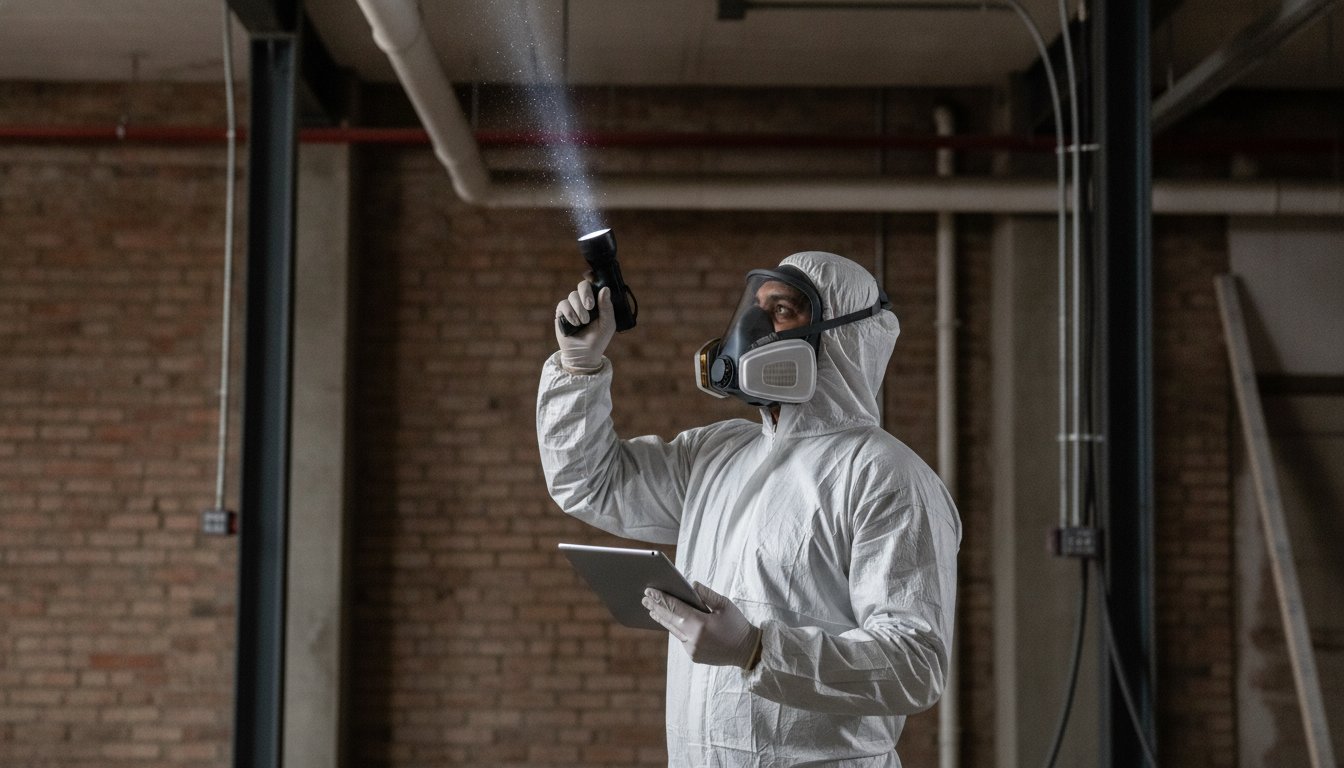
Precision. Protection. Accountability. With over 5,000 asbestos-related deaths recorded annually in Great Britain, the margin for error in property management has never been slimmer. You understand that the weight of the Control of Asbestos Regulations 2012 (CAR 2012) isn't just a matter of paperwork; it's a critical shield for your occupants and your corporate reputation. Identifying dependable asbestos removal services uk often feels like a daunting task amidst shifting Health and Safety Executive (HSE) guidance and the ever-present threat of heavy fines for non-compliance.
This definitive guide provides a robust framework for addressing the 2026 compliance environment, ensuring you meet the latest standards for independent air clearance and surveyor competency. We'll examine the technical distinctions between management and refurbishment surveys, outline your legal duties as a property owner, and demonstrate how a meticulous, multi-disciplinary approach streamlines the management of complex safety risks across your entire portfolio. By the end of this guide, you'll have a clear, audit-ready roadmap to secure your property assets and ensure the absolute safety of every individual on-site. Audit-ready. Rigorous. Safe.
Key Takeaways
- Legal Mastery. Ensure full alignment with the Control of Asbestos Regulations 2012 to shield your organisation from the risk of severe prosecution and fines.
- Precise Identification. Learn how to deploy the correct survey type, whether Management or Refurbishment, to secure a definitive record of all asbestos-containing materials.
- Regulatory Alignment. Navigate the selection of asbestos removal services uk by understanding the mandatory requirements for licensed, non-licensed, and notifiable works.
- Rigorous Safety. Adopt professional abatement standards, including H-Class vacuum filtration and independent air clearance, to ensure a sterile post-removal environment.
- Integrated Compliance. Streamline fragmented safety requirements through a multi-disciplinary consultancy model that addresses asbestos, fire, and water risks concurrently.
Table of Contents
- Understanding Asbestos Risks and Legal Duty to Manage in the UK
- The Critical Role of Asbestos Surveys Before Removal Works
- Licensed vs Non-Licensed Asbestos Removal: Navigating Requirements
- Executing Safe Asbestos Abatement: The Removal and Disposal Process
- Strategic Asbestos Consultancy: Why a Multi-Disciplinary Approach Wins
Understanding Asbestos Risks and Legal Duty to Manage in the UK
Fatalities. Liability. Scrutiny. Asbestos remains the single largest cause of occupational death in the UK, claiming over 5,000 lives annually through historical exposure amongst tradespeople. Whilst many associate these risks with heavy industry, the modern reality involves the silent degradation of materials within commercial and public estates. Under the Control of Asbestos Regulations 2012 (CAR 2012), property owners cannot claim ignorance; the law demands active, documented management. Failure to discharge these duties can lead to unlimited fines and custodial sentences, reflecting the gravity with which the Health and Safety Executive (HSE) views regulatory negligence.
The Health Implications of Asbestos Exposure
Mesothelioma and asbestosis represent the most severe outcomes of fibre inhalation, where microscopic particles bypass the body's natural defences to cause irreversible scarring of the lung tissue or malignant tumours in the lining of the chest cavity, often remaining dormant for 20 to 60 years before symptoms manifest. This latency period creates a significant long-term liability for landlords, as secondary exposure from damaged materials can affect office workers or retail staff decades after a failure in management. Understanding the fundamental asbestos risks and properties is essential for anyone responsible for building safety, as even minor disturbances can release thousands of respirable fibres into the atmosphere.
Who is the Duty Holder under CAR 2012?
Identify. Assess. Control. The duty holder is typically the person or organisation with clear responsibility for the maintenance or repair of non-domestic premises, ranging from freeholders and managing agents to employers. Legal obligations under Regulation 4 of CAR 2012 mandate that these individuals must locate asbestos, assess its condition, and maintain a written management plan that is accessible to any person likely to disturb the fabric of the building. Selecting expert asbestos removal services uk is a critical component of corporate risk mitigation, as professional intervention ensures that hazardous materials are handled without endangering occupants. Oxford Environmental Consultants (OEC) acts as a guardian of compliance, providing the meticulous auditing required to ensure your records are audit-ready and legally robust.
Simply identifying the material is insufficient. A common misconception suggests that leaving asbestos in situ removes the need for action; however, this strategy requires a rigorous compliance framework including annual reinspections and updated risk assessments to prevent accidental fibre release. When degradation occurs, engaging professional asbestos removal services uk becomes an immediate legal necessity to restore safety and maintain the integrity of your property portfolio.
The Critical Role of Asbestos Surveys Before Removal Works
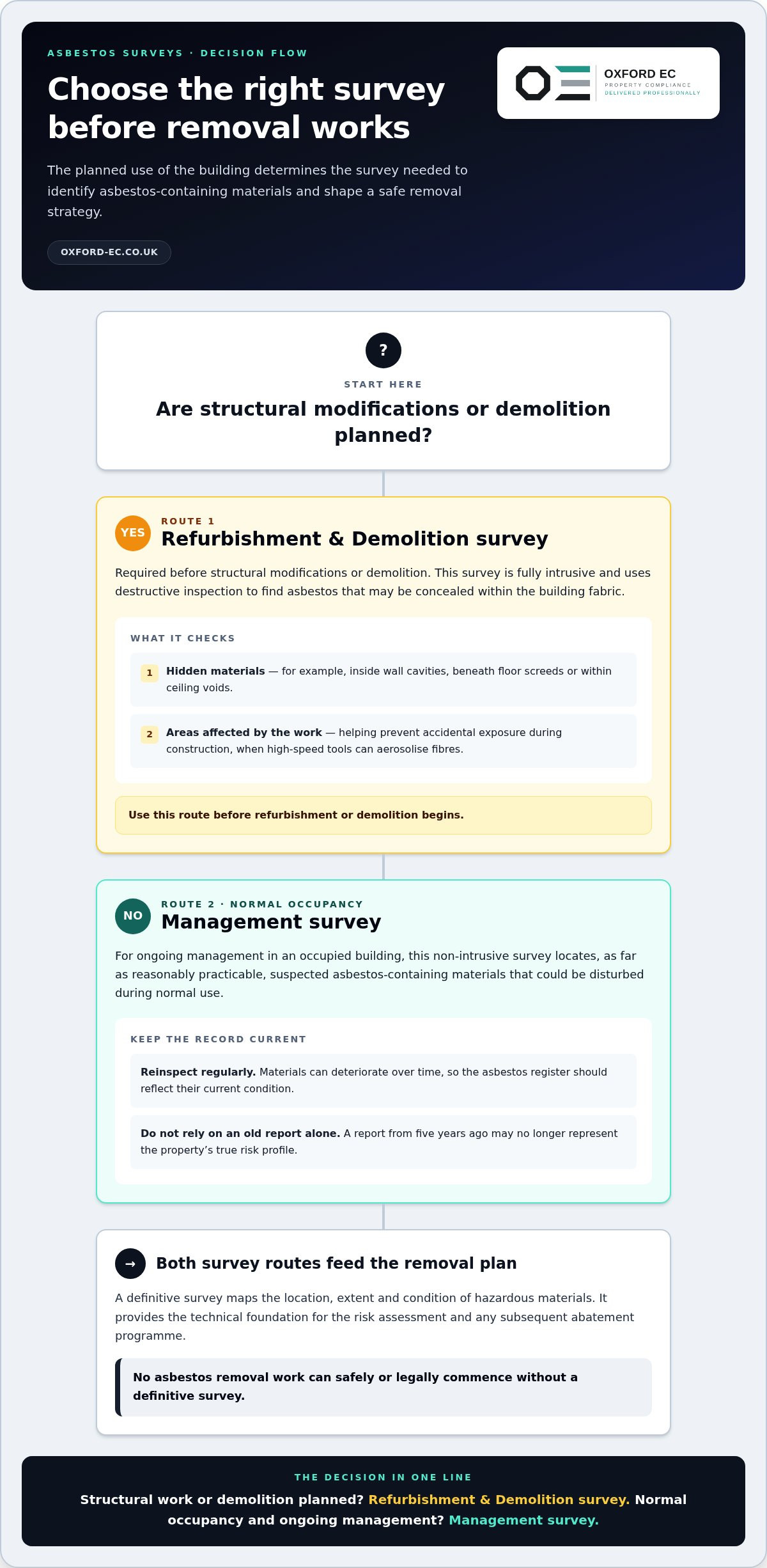
Identification. Blueprint. Safety. No asbestos removal services uk can safely or legally commence without a definitive survey to map the location, extent, and condition of hazardous materials. Under the Control of Asbestos Regulations 2012, the duty to manage starts with a thorough risk assessment, which serves as the technical foundation for any subsequent abatement programme. At Oxford Environmental Consultants (OEC), we treat the survey not as a static document, but as a dynamic risk management tool that bridges the gap between identifying a hazard and executing a safe removal strategy. This precision prevents the "surprises" that often lead to project stagnation or accidental exposure.
Asbestos Management Surveys for Ongoing Compliance
The primary objective of a management survey is to locate, as far as reasonably practicable, the presence and condition of any suspected asbestos-containing materials (ACMs) that could be disturbed during normal occupancy. This is a non-intrusive process, designed to maintain a safe building environment without disrupting daily operations. However, the integrity of your asbestos register relies on regular reinspection; materials degrade over time, and a report from five years ago may no longer reflect the true risk profile of the property. Maintaining accurate Asbestos Management Surveys ensures that your compliance remains robust and your occupants protected through every year of the building's lifecycle.
Refurbishment and Demolition (R&D) Surveys
Before any structural modifications or demolition activities begin, the law mandates a more aggressive approach to identification. Refurbishment and demolition surveys are fully intrusive and involve destructive inspection techniques to access ACMs hidden within the building fabric, such as within wall cavities, under floor screeds, or inside ceiling voids. This level of scrutiny is essential to prevent accidental exposure during construction works, where high-speed tools can instantly aerosolise fibres. For a deeper analysis of these specific requirements, you may review our guide on Asbestos Refurbishment vs Demolition Surveys.
OEC's meticulous surveying process ensures that every project phase is mapped with absolute precision, protecting both the health of your contractors and the legal standing of your organisation. If you are planning structural works and require a definitive assessment of your property's safety, you can speak with our technical consultancy team to arrange a site-specific inspection. Precision in the survey phase is the only way to guarantee safety in the removal phase.
Licensed vs Non-Licensed Asbestos Removal: Navigating Requirements
Categorisation. Compliance. Risk mitigation. Determining the legal framework for hazardous material disposal is a critical phase that dictates the technical requirements, notification periods, and personnel qualifications necessary for a project. Whilst the Control of Asbestos Regulations 2012 (CAR 2012) mandates that all asbestos-containing materials (ACMs) require expert handling, the legislation divides work into three distinct categories: licensed, non-licensed, and notifiable non-licensed work (NNLW). Selecting the appropriate asbestos removal services uk requires a technical understanding of these tiers to ensure your organisation avoids the severe legal repercussions of misclassification.
Criteria for Licensed Asbestos Abatement
Licensable work is defined by the high risk of fibre release and the friability of the material being disturbed. This category typically encompasses high-risk ACMs such as sprayed coatings, asbestos insulation, and asbestos insulating board (AIB) where the exposure is likely to exceed the statutory control limit of 0.1 fibres per cubic centimetre. For these projects, the contractor must hold a specific license from the Health and Safety Executive (HSE), and a mandatory 14-day notification period must be observed before any work commences on-site. Professional asbestos consultancy services are vital at this stage to provide the scrutiny required to validate these high-stakes classifications and manage the complex logistics of a licensed site.
Managing Non-Licensed Removal Safely
Non-licensed work generally involves lower-risk materials where the fibres are tightly bound within a matrix, such as vinyl floor tiles, textured coatings, or asbestos cement roofing sheets. Despite the lower risk profile, these tasks still require a task-specific risk assessment and a rigorous method statement to prevent accidental damage. A critical area of focus in 2026 is the accurate identification of Notifiable Non-Licensed Work (NNLW), which applies when the work is non-licensed but the material is degraded or the task is large-scale; this requires a notification to the HSE, although the 14-day waiting period does not apply.
OEC provides a "safe pair of hands" by delivering a streamlined solution for both licensed and non-licensed requirements, ensuring that every project, regardless of its legal tier, is executed with absolute precision. We maintain an uncompromising stance on safety, utilising detailed auditing to ensure that even standard asbestos removal services uk meet the highest professional safety standards. By integrating these removal needs into a broader compliance framework, we ensure your property remains safe, documented, and fully aligned with current regulatory expectations.
Executing Safe Asbestos Abatement: The Removal and Disposal Process
Containment. Decontamination. Disposal. The physical execution of asbestos abatement is a high-precision operation that requires the total isolation of the hazard zone to prevent environmental cross-contamination. Professional asbestos removal services uk must adhere to a rigid technical protocol that begins long before the first material is disturbed. This process relies on specialised equipment, including H-Class vacuums equipped with High-Efficiency Particulate Air (HEPA) filtration and high-specification Respiratory Protective Equipment (RPE), to ensure that both the operatives and the surrounding building remain sterile throughout the duration of the works.
Site Containment and Negative Pressure Units
Site setup is the most critical phase of the abatement lifecycle. Operatives construct airtight enclosures using heavy-duty polythene, which are then placed under negative pressure using Negative Pressure Units (NPUs). These units serve a dual purpose; they continuously filter the air within the enclosure and ensure that any air leakage flows inward, effectively preventing fibre migration to adjacent clean areas. Access is strictly controlled through three-stage Decontamination Units (DCUs), where personnel follow a mandatory showering and cleaning sequence to ensure no microscopic fibres are transported outside the work zone. This meticulous approach is what differentiates a high-level asbestos removal management programme from a standard construction project.
Air Quality Monitoring and Clearance Certification
Verification is the final pillar of safety. In alignment with the 2026 regulatory focus on stricter accountability, the appointment of an independent air clearance analyst by the client is now a standard requirement to avoid any conflict of interest with the removal contractor. The four-stage clearance process is an exhaustive auditing procedure that includes a preliminary site check, a thorough visual inspection of the work area, air volume sampling to ensure fibre levels are below the statutory threshold, and a final post-enclosure assessment. Only upon the successful completion of these stages is a "Certificate of Reoccupation" issued, providing the property owner with documented peace of mind that the area is safe for normal use.
Waste management remains equally rigorous. All asbestos-containing materials must be double-bagged in UN-approved, labelled containers and stored in locked, sealed skips before being transported to a licensed hazardous waste facility. OEC provides a "safe pair of hands" for these complex remedial works, ensuring that every gram of hazardous waste is tracked and documented through a robust chain of custody. We provide the technical oversight necessary to ensure your asbestos removal services uk are delivered with absolute precision and legal robustness.
Strategic Asbestos Consultancy: Why a Multi-Disciplinary Approach Wins
Integrated. Efficient. Robust. Asbestos management shouldn't exist in a professional vacuum; it's a fundamental pillar of the building's structural and life-safety ecosystem. Fragmented safety management often creates critical blind spots where one discipline's remedial work inadvertently compromises another's compliance status. By centralising your asbestos removal services uk through a strategic consultancy, property owners eliminate the administrative friction and safety risks associated with managing multiple, disconnected contractors. This holistic approach ensures that no safety gaps exist within your property portfolio, providing a protective shield against corporate risk.
The Intersection of Asbestos and Fire Safety
Compartmentation surveys and fire door inspections frequently reveal legacy asbestos materials hidden within wall cavities or door cores that were previously undocumented. If a fire safety contractor disturbs these materials without prior knowledge, the resulting fibre release can lead to immediate site contamination and severe legal liability. OEC manages this overlap by synchronising Fire Safety Services with asbestos management protocols. This ensures that every passive fire protection intervention is cross-referenced against the asbestos register, protecting both the operatives and the long-term safety of the building occupants. We provide the technical oversight necessary to ensure that fire safety improvements don't come at the cost of environmental safety.
The Value of a Multi-Disciplinary Compliance Audit
Managing a diverse property portfolio requires a constant cycle of auditing, yet commissioning separate damp, mould, and water hygiene surveys is logistically complex and financially inefficient. A multi-disciplinary audit provides a streamlined solution where a single, meticulous partner manages the entire risk landscape. This strategy ensures that Damp & Mould Surveys are conducted with a full understanding of the underlying building fabric, preventing the accidental disturbance of ACMs during moisture remediation.
OEC acts as the guardian of your estate, delivering the rigorous, audit-ready documentation required to withstand the highest levels of regulatory scrutiny. By choosing a unified provider for your asbestos removal services uk and wider safety needs, you secure total peace of mind through documented compliance and evidence-based results. Our "one-stop" logical solution addresses fragmented problems with absolute precision. Contact Oxford Environmental Consultants for a comprehensive compliance audit.
Securing Your Property Assets through Technical Excellence
Compliance is not a static achievement but a continuous commitment to safety and precision. Managing the complexities of asbestos removal services uk requires more than just reactive abatement; it demands a proactive strategy rooted in meticulous auditing and technical mastery. By aligning your property management with the latest HSE guidance and ensuring every survey is tailored to the specific structural requirements of your building, you mitigate the risk of severe legal penalties and safeguard the health of every occupant. Precision. Protection. Accountability.
OEC provides the comprehensive multi-disciplinary safety expertise and national UK service delivery needed to manage these high-stakes requirements. Our commitment to rigorous audit-ready reporting ensures that your compliance documentation is always precise and legally robust. We act as your safe pair of hands, ensuring that asbestos, fire, and water risks are managed through a single, streamlined solution.
You don't have to manage these fragmented safety risks alone. With a disciplined partner by your side, you can achieve total peace of mind and focus on the growth and safety of your property portfolio.
Frequently Asked Questions
Is asbestos removal always necessary if it is found in my building?
Removal isn't mandatory if the material is in sound condition and situated where it won't be disturbed. Under the Control of Asbestos Regulations 2012, you may choose to encapsulate and manage the risk through a documented management plan. This requires annual reinspections to verify the material's integrity. However, if the material is degraded or located in a high-traffic area where damage is likely, professional removal becomes the only viable path to long-term compliance and safety.
How long does a typical commercial asbestos removal project take?
Project timelines vary significantly based on the material's risk category and the project's scale. Licensed removals require a mandatory 14-day notification period to the HSE before site works begin. A small-scale office abatement might be completed in two to three days, whereas large industrial decommissioning can span several weeks. Factors such as site access, the complexity of the containment enclosure, and the time required for independent four-stage air clearance all influence the final delivery schedule.
What is the difference between a management survey and a refurbishment survey?
A management survey is designed for normal building occupation to identify ACMs that could be disturbed during daily activities. It is largely non-intrusive. Conversely, a refurbishment survey is a destructive, fully intrusive inspection required before any structural works. It locates hidden asbestos within the building fabric that a standard survey would miss. Selecting the correct survey type is the first step in commissioning safe asbestos removal services uk for your property portfolio.
Can I stay in the building whilst asbestos removal is being carried out?
Occupants can often remain in the building, provided the work area is totally isolated. Professional contractors use airtight polythene enclosures and negative pressure units to ensure no fibres escape the hazard zone. However, the specific room or floor undergoing abatement must be vacated entirely until a Certificate of Reoccupation is issued. For high-risk licensed projects in sensitive environments like schools or hospitals, out-of-hours delivery is frequently recommended to provide absolute peace of mind.
How is asbestos waste disposed of legally in the UK?
Legal disposal requires a strict chain of custody and UN-approved packaging. All hazardous waste must be double-bagged, clearly labelled, and transported in sealed, locked containers by a registered waste carrier. You must receive a Hazardous Waste Consignment Note for every load removed from your site. This document serves as your legal proof that the material was deposited at a licensed landfill facility, ensuring your organisation remains fully compliant with UK environmental protection laws.
What happens if I accidentally disturb asbestos during a renovation?
Stop work immediately, evacuate the area, and seal all entrances to prevent fibre migration. You must not attempt to clean the area with standard equipment, as this will aerosolise the fibres. Contact a technical consultant to arrange emergency air monitoring and site decontamination. Identifying the extent of the spread through professional asbestos removal services uk is critical to restoring a safe environment and fulfilling your legal reporting obligations under the RIDDOR framework if necessary.
How often should my asbestos management plan be reviewed?
Your asbestos management plan must be reviewed at least every 12 months to ensure it remains accurate. Legislation dictates that the plan should also be updated whenever there is a change in the building's use, structural modifications are made, or the condition of known ACMs is found to have degraded. Regular reviews prevent the data from becoming obsolete, ensuring that any contractors attending the site are provided with a precise and current risk profile.
What documentation should I receive after asbestos removal is complete?
Upon completion, you must receive a comprehensive handover pack for your records. This includes the four-stage air clearance certificate (Certificate of Reoccupation), waste consignment notes, and an updated asbestos register reflecting the removal. These documents are essential for your health and safety file and are required during building surveys, property sales, or HSE audits. Maintaining these records in a digital, audit-ready format ensures you can demonstrate total legal compliance at any time.