

Precision. Accountability. Absolute compliance. In 2026, the margin for regulatory error has vanished. Is your current approach to commercial fire safety testing a robust shield or a legal liability waiting to be exposed?
We understand that the overlapping demands of the Regulatory Reform (Fire Safety) Order and the Building Safety Act create significant administrative friction. You're likely concerned about maintaining the 'Golden Thread' of information whilst managing multiple contractors for fragmented safety disciplines. This comprehensive guide enables you to master the technical requirements and legal obligations of commercial fire safety testing to protect your assets and ensure absolute regulatory alignment. We provide a clear roadmap for both active and passive safety systems, detailing the rigorous auditing processes required to meet the latest UK standards. By examining everything from compartmentation surveys to fire alarm maintenance, we illustrate how professional consultancy provides the streamlined, evidence-based results necessary for total peace of mind.
Key Takeaways
- Master the dual requirements of the Regulatory Reform (Fire Safety) Order 2005 and the Building Safety Act 2022 to maintain the critical 'Golden Thread' of safety information.
- Implement a rigorous regime for commercial fire safety testing to ensure absolute reliability for active systems, specifically BS 5839 alarms and BS 5266 emergency lighting.
- Recognise the role of passive fire protection by conducting professional fire door inspections and compartmentation surveys to prevent the internal spread of smoke and flame.
- Define the 'competent person' requirement to ensure all safety audits are conducted by disciplined experts with the necessary technical and regulatory mastery.
- Optimise property management through multi-disciplinary surveys that align fire safety, asbestos management, and water hygiene into a single, streamlined compliance roadmap.
Table of Contents
- Understanding Commercial Fire Safety Testing: Legal Obligations in 2026
- Active Fire Protection: Rigorous Testing for Alarms and Emergency Lighting
- Passive Fire Protection Scrutiny: Fire Doors and Compartmentation Surveys
- Determining Testing Frequency and The 'Competent Person' Requirement
- Navigating Compliance: The Value of Multi-Disciplinary Safety Audits
Understanding Commercial Fire Safety Testing: Legal Obligations in 2026
Systematic verification. Technical precision. Absolute compliance. Commercial fire safety testing is the rigorous process of validating that both active and passive fire protection systems perform exactly as intended under emergency conditions. In 2026, this discipline is defined by the intersection of the Regulatory Reform (Fire Safety) Order 2005 and the Building Safety Act 2022. These frameworks have shifted the burden of proof onto the 'Accountable Person', requiring a level of scrutiny that goes far beyond basic visual checks. Precision in commercial fire safety testing is the only viable method to mitigate the escalating legal and financial risks associated with modern property management. Beyond the immediate threat to life, a failure in these systems can lead to total asset loss and the permanent revocation of building insurance.
The Regulatory Landscape: RRO vs. The Building Safety Act
Digital records. Accountable persons. Regulatory alignment. The Building Safety Act 2022 has redefined the landscape for higher-risk buildings, introducing a more stringent regime that demands a 'Golden Thread' of digital information. A critical component of this is Regulation 38, which mandates the handover of fire safety information to the responsible person to ensure the building's fire safety principles are maintainable throughout its lifecycle. This legislation works alongside the Fire Safety Order to ensure that every safety measure, from alarm sensors to structural barriers, is subject to continuous, recorded scrutiny. Failure to demonstrate a robust audit trail for commercial fire safety testing carries severe penalties. Non-compliance doesn't just result in enforcement notices; it can lead to unlimited fines and custodial sentences for those found negligent in their duties.
Defining the Scope of Professional Testing
Physical verification. Technical mastery. Evidence-based results. It's vital to distinguish between a Fire Risk Assessment (FRA) and physical asset testing. Whilst an FRA identifies potential hazards and management failures, physical testing verifies the mechanical and structural integrity of safety systems under load. This work must be conducted by a 'competent person' who possesses the technical mastery to interpret complex British Standards and legislative nuances. Professional testing involves the physical activation of alarms, the measurement of emergency lighting lux levels, and the intrusive inspection of fire-stopping seals. At OEC, we act as a meticulous guardian of your property compliance, providing the disciplined oversight needed to manage multi-faceted safety requirements across your entire portfolio. Our approach ensures that your assets aren't just compliant on paper but are demonstrably safe in practice.
Active Fire Protection: Rigorous Testing for Alarms and Emergency Lighting
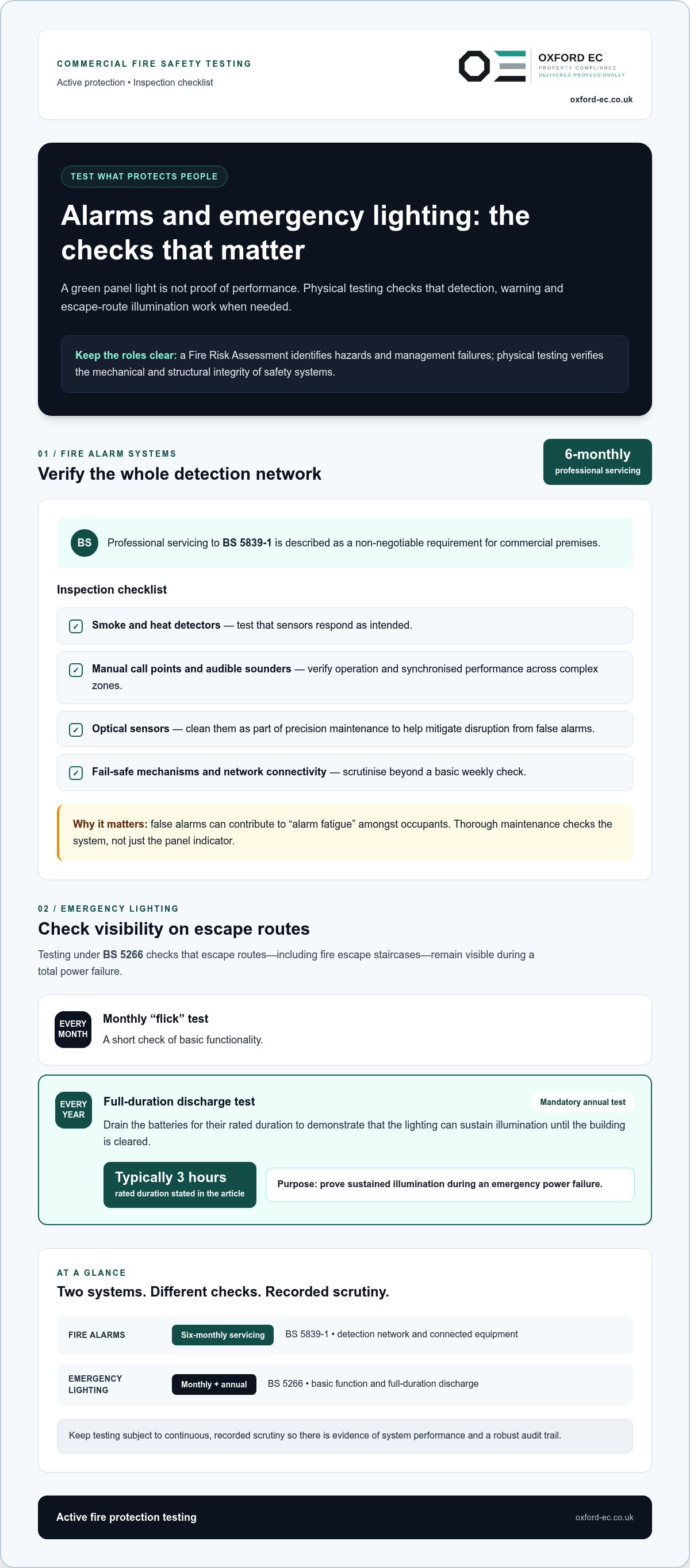
Reliability. Detection. Response. Active fire protection systems represent the mechanical heartbeat of building safety. Whilst a Fire Risk Assessment identifies the need for these systems, commercial fire safety testing provides the empirical proof that they'll function during a crisis. It's not enough for a panel to show a green light. Every sensor, sounder, and battery must be scrutinised to ensure absolute signal integrity. This rigorous approach to commercial fire safety testing moves beyond the superficial 'weekly beep', to conduct a deep-dive audit of the system’s fail-safe mechanisms and network connectivity.
Fire Alarm Inspection, Maintenance, and Servicing
Absolute detection reliability. Professional six-monthly servicing to BS 5839-1 standards is a non-negotiable requirement for commercial premises. This isn't merely a compliance exercise; it's a technical verification of the entire detection network. We test smoke and heat detectors, manual call points, and audible sounders to ensure synchronised performance across complex zones. Precision maintenance, including the cleaning of optical sensors, is essential to mitigate the disruption caused by false alarms, which can lead to 'alarm fatigue' amongst occupants. Following a government fire safety checklist provides a baseline, but professional maintenance ensures technical mastery and legal robustness.
Emergency Light Inspection and Testing Protocols
Illumination. Evacuation. Safety. Emergency lighting testing under BS 5266 ensures that escape routes, including fire escape staircases, remain visible during a total power failure. Whilst monthly 'flick' tests verify basic functionality, the mandatory annual full-duration discharge test is critical. This procedure drains the batteries for their rated duration, typically three hours, to prove they can sustain illumination until the building is cleared. Learn more about our emergency lighting services to understand how we map these requirements to your specific layout. If your current records lack this level of detail, it may be time to speak with a compliance specialist regarding your active system strategy.
Passive Fire Protection Scrutiny: Fire Doors and Compartmentation Surveys
Structural integrity. Fire containment. Lifesaving barriers. Whilst active systems provide the warning, passive fire protection acts as the silent guardian of building safety by providing the physical resistance needed to delay the spread of fire. It's the infrastructure designed to compartmentalise a fire, limiting its growth and protecting escape routes for occupants. Within the scope of commercial fire safety testing, passive measures require high-level scrutiny to ensure they haven't been compromised by historical building works, general wear, or substandard installation. Hidden defects within ceiling voids, service risers, or floor cavities often go unnoticed during standard risk assessments, making intrusive professional surveys a critical component of any robust safety strategy. At OEC, we act as an accountable partner, identifying these vulnerabilities before they compromise your asset's resilience.
Professional Fire Door Inspections
Legal accountability. Precision auditing. Technical verification. The Fire Safety (England) Regulations 2022 have formalised the requirement for regular, recorded checks on fire doors in multi-occupied buildings to ensure they remain fit for purpose. A professional inspection goes beyond checking if a door is propped open; it involves a meticulous assessment of the entire assembly, including intumescent seals, smoke brushes, hinges, and self-closing devices. We verify the 'fit and finish' to ensure the door achieves its rated fire resistance, typically 30 or 60 minutes, to maintain effective smoke and flame containment. For a deeper dive into these standards, consult our Fire Door Inspection Regulations UK: The Definitive Compliance Guide for 2026.
Compartmentation and Passive Protection Surveys
Horizontal containment. Vertical separation. Structural resilience. Compartmentation is the practice of dividing a building into 'fire cells' using fire-resistant walls and floors to prevent the rapid spread of heat and toxic gases between zones. This is particularly vital for buildings utilising 'stay put' or phased evacuation strategies, where the safety of occupants depends entirely on the building's structural integrity. Our compartmentation surveys involve a disciplined examination of every breach, from pipe penetrations to ventilation ducting, ensuring that fire-stopping materials are correctly applied and aligned with original design specifications. Integrating this level of detail into your commercial fire safety testing programme provides the evidence-based assurance that your property remains a safe environment for all stakeholders, whilst protecting the building's core structural elements from catastrophic failure.
Determining Testing Frequency and The 'Competent Person' Requirement
Rigorous scheduling. Uncompromising standards. Legal accountability. Managing a complex property portfolio requires a master schedule that leaves no margin for administrative ambiguity or technical oversight. In 2026, the definition of a 'competent person' has been sharpened by the Building Safety Regulator to ensure that those responsible for commercial fire safety testing possess the specific training, experience, and formal qualifications necessary to interpret complex British Standards. True competence involves more than a basic understanding of equipment; it requires the ability to provide evidence-based results that can withstand the most intense regulatory scrutiny. Third-party certification remains the gold standard for accountability, acting as a technical handshake that confirms your safety systems have been audited by a disciplined, high-level consultancy.
Mandatory Testing Frequencies at a Glance
Precision timing. Regulatory alignment. Risk mitigation. To maintain absolute compliance and ensure building insurance remains valid, duty-holders must adhere to specific technical cycles that vary based on the asset's use and height. For fire alarm systems, BS 5839-1 mandates weekly functional tests by a designated user alongside comprehensive six-monthly inspections by a specialist technician. Emergency lighting requires monthly functional 'flick' tests to verify battery health, complemented by a mandatory annual full-duration discharge test to BS 5266. Fire door inspections have also seen increased scrutiny; buildings over 11 metres now require six-monthly checks under the Fire Safety (England) Regulations 2022, whilst other commercial assets should be audited at least annually to verify the integrity of seals and closers. Adhering to these cycles ensures that commercial fire safety testing isn't a sporadic event but a continuous process of protection.
The Golden Thread of Information
Digital integrity. Immutable records. Operational transparency. The Building Safety Act 2022 mandates the 'Golden Thread' of information, which is a live, digital trail documenting a building's safety case from its design through its entire operational life. Transitioning from fragmented paper logs to a robust digital asset management system is no longer optional for those seeking to remain audit-ready. This system must organise testing data into a centralised, accessible format that records the exact date of every audit, the specific credentials of the technician, and the precise outcome of each test. Crucially, any identified defects must be tracked within this digital environment from the moment of identification through to the verified completion of remedial works. This level of meticulous documentation provides the 'safe pair of hands' assurance required by the modern regulatory landscape, ensuring that your compliance status is always transparent and defensible.
Navigating Compliance: The Value of Multi-Disciplinary Safety Audits
Coordinated delivery. Operational efficiency. Risk consolidation. In the complex environment of modern property management, treating safety disciplines as isolated silos is an inefficient and potentially hazardous strategy. Commercial fire safety testing often necessitates intrusive access into the building fabric, particularly during compartmentation surveys or the installation of new detection hardware. By integrating these requirements into a multi-disciplinary safety audit, duty-holders can significantly reduce site disruption and ensure that all regulatory obligations, from fire safety to water hygiene, are met with consistent technical precision. This holistic approach provides a streamlined roadmap for compliance, allowing for a single point of accountability across a national portfolio.
The Synergy of Asbestos and Fire Safety
Hazard identification. Contractor protection. Regulatory alignment. Fire compartmentation surveys frequently involve the inspection of ceiling voids and service risers where asbestos-containing materials (ACMs) may be present. Without a prior asbestos management survey, fire safety contractors risk accidental exposure during intrusive commercial fire safety testing, leading to immediate site closures and legal repercussions under the Control of Asbestos Regulations 2012. Identifying hazardous materials before commencing safety upgrades avoids costly project delays and ensures that fire-stopping works are conducted within a safe, controlled environment. For a detailed understanding of these requirements, consult A Complete Guide to Asbestos Management Surveys: Compliance and Safety.
Securing Peace of Mind with Oxford Environmental Consultants
Technical mastery. National delivery. Accountable partnership. At Oxford Environmental Consultants, we project the persona of a meticulous expert, providing the disciplined oversight needed to manage multifaceted property requirements. Our national coverage ensures that whether you require fire alarm maintenance, emergency lighting testing, or professional fire door inspections, the standard of delivery remains uncompromisingly high across every asset in your United Kingdom portfolio. We don't just act as a service provider; we serve as a guardian of your compliance status, offering evidence-based results that provide absolute peace of mind. By choosing a partner with expertise in fire, asbestos, and water hygiene, you secure a 'safe pair of hands' capable of navigating the most complex regulatory landscapes with precision and order.
Securing Your Assets: The Path to Absolute Compliance in 2026
Technical precision is no longer optional. Maintaining the 'Golden Thread' of information requires a disciplined approach to both active detection and passive containment. By aligning your property with BS 5839 and BS 5266 standards, you ensure that every alarm, emergency light, and fire door acts as a verified shield against risk. This rigorous oversight is the only way to mitigate the legal and financial liabilities inherent in modern property management.
Our national UK coverage and multi-disciplinary expertise in fire, asbestos, and water hygiene provide the streamlined solution needed for complex property portfolios. Entrusting your commercial fire safety testing to a meticulous consultancy ensures that your legal obligations are met with absolute precision and legal robustness. We act as your accountable partner, providing the evidence-based results necessary for total peace of mind.
Take the proactive step today to ensure your building remains a safe, compliant, and resilient environment for the future.
Frequently Asked Questions
How often should commercial fire alarms be tested by a professional?
Professional fire alarm testing must occur at least every six months to comply with BS 5839-1 standards. This technical audit complements your weekly user checks by verifying the integrity of the entire detection network. A competent technician will inspect batteries, sounders, and signal paths to ensure absolute reliability. Failing to adhere to this schedule can invalidate building insurance and leave the 'Accountable Person' liable for regulatory breaches.
Is it a legal requirement to have a written fire safety testing log?
Maintaining a written or digital fire safety log is a strict legal requirement under the Regulatory Reform (Fire Safety) Order 2005. This record provides the evidence-based proof of your commercial fire safety testing regime. It must document every test, inspection, and remedial action taken across the premises. In the event of an audit by the Fire and Rescue Service, a missing or incomplete logbook serves as primary evidence of management negligence.
What is the difference between a fire risk assessment and fire safety testing?
A Fire Risk Assessment is a systematic evaluation of hazards and management procedures, whereas fire safety testing is the physical verification of asset performance. The assessment identifies what systems are required; the testing proves they actually work. For example, an assessment might note the presence of fire doors, but a physical inspection validates the integrity of their seals and hinges. Both are essential for a robust safety strategy.
Can I carry out emergency light testing myself or do I need a company?
Designated staff can conduct monthly functional 'flick' tests, but a competent professional must perform the mandatory annual full-duration discharge test. This annual audit requires the system to be drained for its rated duration, typically three hours, to verify battery stamina under BS 5266 standards. Professional testing ensures that technical nuances, such as lux levels and charging rates, are precisely measured and recorded for legal compliance.
What happens if my building fails a fire door inspection?
If a building fails a fire door inspection, the 'Responsible Person' must initiate immediate remedial works to restore the assembly's integrity. Defects like excessive gaps, damaged intumescent seals, or faulty closers compromise the building's compartmentation and life-safety infrastructure. All repairs must be documented within your safety records to maintain the 'Golden Thread' of information. Continued use of non-compliant doors places occupants at risk and exposes the business to enforcement notices.
Who is the 'Responsible Person' for fire safety in a shared commercial building?
In shared commercial buildings, the 'Responsible Person' is typically the employer for their specific demised area and the landlord or managing agent for common parts. These parties have a legal duty to cooperate and coordinate their safety measures. This ensures that commercial fire safety testing covers the entire building fabric seamlessly. Clear communication is vital to ensure that shared systems, such as the central fire alarm, are maintained to a uniform standard.
How does the Building Safety Act 2022 change fire testing for high-rise buildings?
The Building Safety Act 2022 introduces the role of the 'Accountable Person' and mandates the 'Golden Thread' of digital information for high-rise residential buildings. This requires a more rigorous approach to documenting the lifecycle and maintenance of safety assets. Testing frequencies for components like fire doors have been formalised to ensure structural resilience. These changes aim to provide absolute transparency and accountability throughout the building's operational life, moving away from fragmented paper records.
Do I need a compartmentation survey if I already have a fire risk assessment?
Yes, a compartmentation survey is often necessary because a standard Fire Risk Assessment is generally non-intrusive and cannot identify hidden breaches. Compartmentation audits involve a disciplined examination of ceiling voids, service risers, and floor cavities to ensure fire-stopping materials are correctly applied. This identifies 'hidden' defects that would otherwise compromise your building's ability to contain smoke and flame. It provides the technical depth that a visual assessment simply cannot offer.