

Could a single undetected breach in a hidden service riser be the difference between a contained incident and a £450,000 non-compliance fine? Precision. Accountability. Protection. You likely recognise that the legislative landscape has shifted irreversibly since the introduction of the Building Safety Act 2022, placing an unprecedented burden of proof on the Responsible Person. Identifying hidden structural fire risks whilst managing fragmented safety data is a significant challenge for any modern duty-holder, yet professional compartmentation survey services have become the essential mechanism for ensuring your property meets the rigorous standards required in 2026.
We understand that you require a "safe pair of hands" to manage these technical complexities and secure your property assets against regulatory scrutiny. This definitive guide delivers a comprehensive roadmap for achieving full legal compliance through meticulous structural auditing and the establishment of a robust Golden Thread of safety information. We'll examine the transition to BS EN 13501-1:2018 standards, the critical importance of intrusive inspections for fire stopping, and how to transform fragmented data into a clear remedial strategy that satisfies the Building Safety Regulator.
Key Takeaways
- Understand why standard Fire Risk Assessments often fail to meet 2026 statutory requirements and why intrusive inspections are now essential for structural fire safety.
- Discover how specialist compartmentation survey services provide a rigorous audit of service penetrations and fire-resisting subdivisions to protect life and property.
- Learn to navigate the Building Safety Act 2022 by establishing a digital 'Golden Thread' of information that stands up to regulatory scrutiny.
- Identify the technical differences between British and European fire classification standards to ensure your passive fire protection remains fully compliant.
- Gain a clear remedial roadmap for fire stopping and see how integrating multi-disciplinary audits can streamline your portfolio's safety management.
Table of Contents
- Understanding Compartmentation Survey Services and Legislative Mandates
- Technical Scope: What a Professional Survey Investigates
- Compartmentation Surveys vs Standard Fire Risk Assessments
- Methodology: From Intrusive Inspection to the Golden Thread
- Securing Compliance with OEC’s Expert Survey Services
Understanding Compartmentation Survey Services and Legislative Mandates
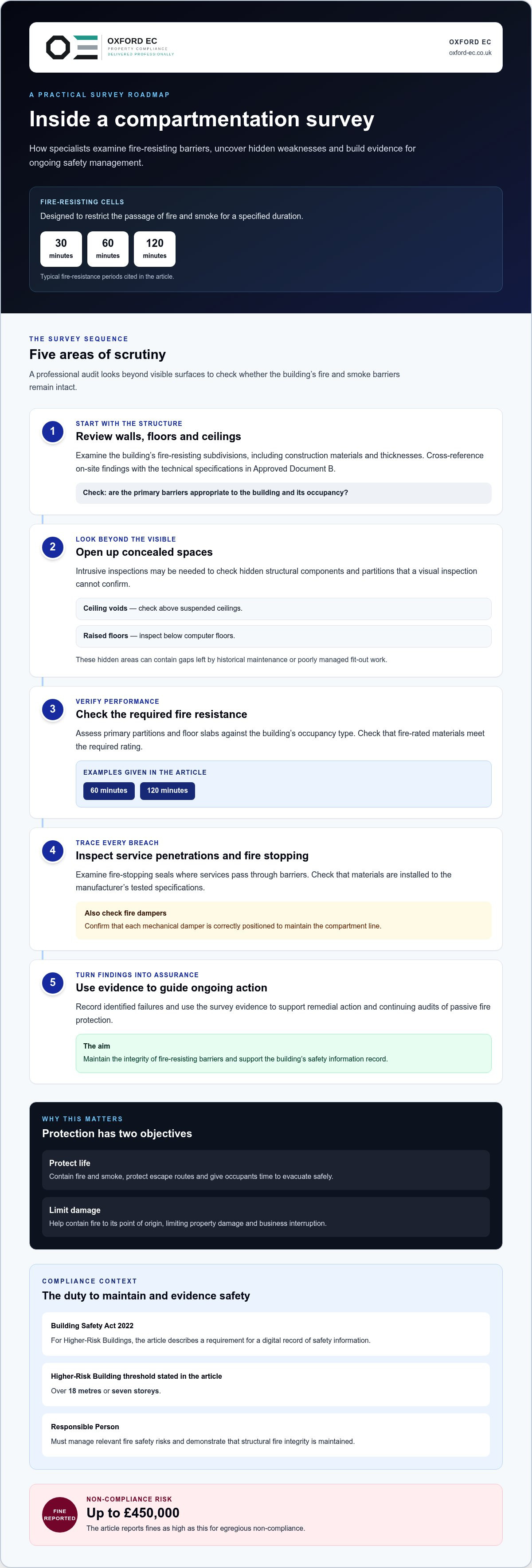
Compartmentation is the strategic subdivision of a building into fire-resisting cells. These cells are engineered to restrict the passage of fire and smoke for a specified duration, typically 30, 60, or 120 minutes. Structural integrity. Smoke containment. Life preservation. By 2026, the reliance on professional compartmentation survey services has transitioned from a best-practice recommendation to a non-negotiable statutory mandate for multi-occupancy and high-rise assets. This rigorous auditing process ensures that every fire-resistant barrier, including floors, walls, and service penetrations, remains capable of performing its critical function under the duress of a thermal event.
The 2026 landscape places a heavy burden of proof on the "Duty Holder" and the "Accountable Person" to demonstrate that structural fire integrity is maintained throughout the building's lifecycle. Under the Regulatory Reform (Fire Safety) Order 2005 and the Fire Safety Act 2021, the Responsible Person must manage risks associated with the external walls and the internal structure. Failure to verify these barriers through regular, intrusive scrutiny can lead to catastrophic safety failures and severe legal consequences, including fines that have reached as high as £450,000 for egregious non-compliance. Professional compartmentation survey services provide the necessary evidence-based assurance that these legal obligations are being met with absolute precision.
The Legal Framework: Approved Document B and the Building Safety Act
Approved Document B dictates the minimum periods of fire resistance required for various building types, yet its guidance is only effective if the physical structure remains uncompromised. The Building Safety Act 2022 has intensified this requirement for Higher-Risk Buildings (HRBs), which include those over 18 metres or seven storeys, by mandating a digital record of safety information. This legislation requires the Accountable Person to proactively identify and mitigate structural risks. Maintaining the integrity of Passive fire protection is no longer a "set and forget" task; it requires a continuous cycle of auditing and remedial action to satisfy the Building Safety Regulator.
Life Safety vs Property Protection: The Dual Objective
The primary role of compartmentation is the protection of life by securing escape routes and providing occupants with the essential time required for safe evacuation. Beyond life safety, these enclosures serve a vital role in limiting property damage and business interruption by containing fire to its point of origin. In 2026, insurance providers increasingly demand independent compartmentation surveys as a condition of coverage for commercial assets. This shift reflects a growing recognition that structural containment is the most effective method for protecting high-value equipment and ensuring the long-term resilience of property portfolios.
Technical Scope: What a Professional Survey Investigates
Scrutiny. Rigour. Technical mastery. A professional audit of your property’s fire-resisting subdivisions requires an exhaustive examination of every structural barrier to ensure the absolute containment of fire and smoke. Unlike a standard risk assessment, compartmentation survey services delve into the hidden fabric of the building to verify that walls, floors, and ceilings maintain their intended fire-resistance integrity. This involves a meticulous review of construction materials and thicknesses, cross-referencing on-site findings with the technical specifications outlined in Approved Document B to ensure full statutory alignment.
The investigation extends beyond the primary structure to include a high-level scrutiny of fire-stopping materials and fire dampers. Surveyors must confirm that every mechanical damper is correctly positioned to maintain the compartment line and that all fire-stopping seals are installed according to the manufacturer's tested specifications. This level of detail ensures that your passive fire protection strategy is not merely a theoretical plan but a robust, physical reality capable of withstanding a thermal event.
Assessing Structural Barriers and Fire-Resisting Elements
Verification. Precision. Evidence. Surveyors must often supplement visual inspections with intrusive "opening up" works to inspect the fire rating of hidden structural components within ceiling voids and raised floors. These hidden spaces often conceal compromised fire-rated partitions where historical maintenance or poorly managed fit-out projects have left significant gaps in the building’s defence. A professional survey identifies these failures by:
- Evaluating the fire-resistance period of primary partitions and floor slabs against the building's specific occupancy type.
- Inspecting the continuity of fire-rated barriers in hidden voids, including those above suspended ceilings and below computer floors.
- Checking the installation quality and specification of fire-rated materials to ensure they match the required fire-resistance rating (e.g., 60 or 120 minutes).
Identifying Vulnerabilities in Service Penetrations and Voids
Breaches. Risks. Categorisation. Service penetrations for pipes, cables, and ductwork represent the most frequent point of failure in modern commercial and residential buildings. Professional surveyors provide a detailed analysis of these breaches, paying specific attention to mixed-service penetrations where sensitive data cables may be routed alongside high-temperature heating pipes. Inadequately sealed breaches allow for the rapid transfer of toxic smoke and heat between compartments, often bypassing even the most advanced active fire detection systems.
Each identified vulnerability is categorised by its potential impact on life safety and property protection, allowing duty-holders to prioritise their remedial roadmap effectively. This exhaustive level of auditing is a core component of professional compartmentation survey services, providing the Accountable Person with the precise data needed to maintain the Golden Thread of information. By identifying common failures in service voids, surveyors ensure that every fire-stopping seal is not only present but correctly specified and installed according to rigorous British and European testing data.
Compartmentation Surveys vs Standard Fire Risk Assessments
Distinction. Clarity. Accountability. Whilst a standard Fire Risk Assessment (FRA) is a mandatory requirement for all non-domestic premises, it is primarily a management-level overview that evaluates fire safety protocols, signage, and obvious hazards. A typical 'Type 1' FRA is non-intrusive and surface-level; it relies on visual inspections of accessible areas and assumes that the underlying structure matches the original design intent. In contrast, compartmentation survey services provide a forensic, structural audit that looks specifically at the physical barriers designed to contain fire and smoke. A 'satisfactory' FRA result provides no guarantee that the building's fire-resisting subdivisions remain intact, especially in assets that have undergone historical maintenance or service upgrades.
The necessity for a dedicated survey is often triggered by specific milestones in a building's lifecycle. Post-construction audits, major refurbishment works, or the transition of a property into the Higher-Risk Building (HRB) category all demand a level of scrutiny that a standard FRA cannot provide. Duty-holders must recognise that relying on a surface-level assessment for structural assurance is a significant risk. Professional compartmentation survey services bridge this gap by verifying the physical reality of the building fabric against the theoretical safety strategy.
Why an FRA May Not Be Sufficient for High-Risk Assets
Scrutiny. Complexity. Liability. For complex structures such as hospitals, care homes, and high-rise residential blocks, the limitations of a standard FRA represent a critical vulnerability. These buildings often feature extensive service networks and complex ceiling voids where hidden structural defects can remain undetected for years. Relying solely on a non-intrusive assessment for fire integrity assurance exposes the Accountable Person to substantial professional liability risks. If a fire spreads beyond its compartment of origin due to an unrecorded breach, the 'satisfactory' status of a previous FRA will offer little protection against regulatory enforcement or legal action.
Intrusive Inspection: Looking Beyond the Surface
Verification. Precision. Rigour. The 'intrusive' nature of a compartmentation survey is what distinguishes it as a high-level compliance tool. This process involves 'opening up' the building fabric to inspect inaccessible voids, service shafts, and the junctions between walls and floor slabs. Surveyors utilise specialised techniques to scrutinise the areas that active fire systems cannot reach. At OEC, we employ a methodical approach that minimises operational disruption whilst ensuring a comprehensive, audit-ready inspection. By physically verifying the presence and specification of fire-stopping materials within hidden voids, we provide property managers with the empirical evidence required to maintain a robust Golden Thread of safety information.
Methodology: From Intrusive Inspection to the Golden Thread
Strategy. Execution. Documentation. The delivery of professional compartmentation survey services follows a methodical sequence designed to eliminate ambiguity and provide a definitive record of structural integrity. This process commences with a comprehensive desk study, where our surveyors scrutinise existing architectural drawings and historical fire safety records to identify the theoretical compartment lines of the asset. Once the baseline is established, we transition to the physical on-site inspection, utilising intrusive techniques to verify the performance of every fire-resisting subdivision. Every identified breach is documented with clear, high-resolution photographic evidence, ensuring that the final report is not merely a summary of findings but a forensic audit of the building fabric.
In 2026, the digitisation of safety data is the core requirement for duty-holders managing high-rise and complex assets. To support the "Golden Thread" of information, we utilise a rigorous "Red-Amber-Green" (RAG) system to categorise findings based on their severity and impact on life safety. This risk-based prioritisation allows property managers to allocate resources effectively, addressing critical failures immediately whilst scheduling lower-risk maintenance as part of a long-term remedial roadmap. To secure your property’s compliance and establish this essential digital record, you can request a comprehensive compartmentation survey from our technical team.
Developing a Robust Audit Trail for Building Safety
Accuracy. Transparency. Evidence. Compartmentation data serves as a critical component of the Safety Case Report required under the Building Safety Act 2022. Regulators and emergency services now demand accessible, up-to-date digital records that prove the building’s passive fire protection is functioning as designed. OEC ensures that every identified breach is mapped to a specific location on the building’s floor plans and accompanied by a detailed remedial specification. This level of precision eliminates the guesswork for contractors and provides an indisputable audit trail for statutory bodies.
Prioritising Remedial Actions and Fire Stopping Strategies
Specification. Accreditation. Integrity. Selecting the correct fire-stopping products for specific structural breaches requires technical mastery of material performance and compatibility. Our methodology ensures that every remedial recommendation is aligned with third-party accredited testing data, specifically the BS EN 13501-1:2018 classification system. It’s essential that both the surveyor and the remedial contractor hold recognised third-party accreditations to maintain the integrity of the safety strategy. Furthermore, we establish a formal "re-inspection" cycle, ensuring that compartmentation integrity is verified after any building modifications or service upgrades to prevent the introduction of new vulnerabilities.
Securing Compliance with OEC’s Expert Survey Services
Oxford Environmental Consultants (OEC) stands as a national multi-disciplinary partner for duty-holders managing high-value or complex property portfolios. Precision. Rigour. Accountability. Our compartmentation survey services are engineered to provide the ultimate level of structural assurance, acting as a protective shield against both physical fire risk and legal liability. By positioning OEC as your "safe pair of hands," you ensure that your property’s passive fire protection strategy is managed with the technical mastery required to satisfy the Building Safety Regulator. We offer a streamlined, logical solution to fragmented safety problems, ensuring that every structural barrier is verified with absolute precision.
Our national coverage allows us to support multi-site portfolios with a consistent, high-level reporting standard that stands up to the most intense regulatory scrutiny. We recognise that the stakes of fire safety compliance are high, which is why our approach is fundamentally uncompromising. OEC doesn't merely act as a service provider; we serve as a guardian of your compliance, delivering evidence-based results that provide peace of mind to Accountable Persons and building owners alike. This commitment to technical excellence ensures that your assets remain safe, compliant, and fully aligned with the statutory mandates of 2026.
Multi-Disciplinary Expertise: Fire Safety Meets Structural Integrity
Holistic safety management requires a deep understanding of how various building systems interact. OEC’s extensive background in Asbestos Management Surveys and Legionella Risk Assessments informs a more comprehensive approach to structural fire safety. This multi-disciplinary insight is particularly vital during intrusive works, where our knowledge of hazardous materials ensures that fire-stopping investigations don't inadvertently compromise asbestos-containing materials. Commissioning multi-disciplinary surveys through a single professional partner delivers significant efficiency gains, reducing operational downtime and providing a unified data set that simplifies the management of the Golden Thread. We provide clear, actionable advice that moves beyond simple data collection to offer a genuine remedial roadmap.
Professional Accountability and Rigorous Reporting Standards
Every OEC compartmentation report undergoes a rigorous internal quality assurance process to ensure it meets the highest standards of technical accuracy and regulatory alignment. We deliver audit-ready documentation that provides the Accountable Person with the transparency needed to prove compliance under the Building Safety Act 2022. Our experts assist clients in navigating complex interactions with the Building Safety Regulator, ensuring that every safety case is supported by robust, photographic evidence. This disciplined approach to reporting ensures that you're always prepared for an inspection or audit. Contact Oxford Environmental Consultants to organise your compartmentation survey today.
Future-Proofing Your Property Compliance Strategy
Precision. Accountability. Resilience. The 2026 regulatory landscape leaves no room for ambiguity regarding structural fire integrity. You've seen that relying on surface-level assessments is a significant risk whilst professional compartmentation survey services provide the intrusive scrutiny required to satisfy the Building Safety Regulator and protect your occupants. Establishing a digital Golden Thread is no longer a choice but a statutory mandate for those managing complex or high-rise assets. This forensic approach ensures that every fire-resisting subdivision is physically verified and documented to the highest technical standards.
As expert multi-disciplinary safety consultants, OEC provides the technical mastery and national UK coverage needed to manage large property portfolios with absolute confidence. Our rigorous, audit-ready compliance reporting ensures that every structural barrier is verified and every remedial action is prioritised according to tested standards. It's time to transition from fragmented data to a unified, evidence-based safety case. Secure your building's compliance with an OEC compartmentation survey today. We're ready to act as your safe pair of hands in an increasingly scrutinised environment.
Frequently Asked Questions
Is a fire compartmentation survey a legal requirement for UK businesses?
Yes, maintaining structural fire integrity is a statutory obligation under the Regulatory Reform (Fire Safety) Order 2005 and the Fire Safety Act 2021. Whilst the legislation doesn't use the specific phrase "compartmentation survey," it mandates that the Responsible Person must manage risks associated with the building's structure and internal partitions. For higher-risk buildings, the Building Safety Act 2022 requires documented evidence of structural containment to satisfy the Building Safety Regulator and maintain the Golden Thread of information.
How often should a compartmentation survey be carried out on a commercial property?
The frequency of a survey is determined by the building's risk profile, though a standard recommendation is every three to five years. However, any significant building refurbishment, change in occupancy, or major service installation should trigger an immediate re-inspection. For complex assets like hospitals or high-rise residential blocks, more frequent auditing is often necessary to ensure that historical maintenance hasn't compromised the building's fire-resisting subdivisions.
What is the difference between fire stopping and fire compartmentation?
Compartmentation is the strategic division of a building into fire-resisting cells, whereas fire stopping refers to the specific materials and seals used to close breaches within those divisions. Think of compartmentation as the architectural strategy and fire stopping as the technical execution. Professional compartmentation survey services evaluate both the presence of these divisions and the integrity of the fire-stopping materials used to maintain the compartment line.
Can minor building works or IT installations compromise existing compartmentation?
Yes, minor building works and IT installations are the leading causes of compromised fire compartments in modern commercial properties. Data cable runs, HVAC upgrades, and plumbing repairs often involve drilling through fire-rated partitions without subsequent, compliant fire stopping. Even a single unsealed breach for a fibre-optic cable can allow toxic smoke to bypass structural defences, rendering the entire compartment ineffective during a thermal event and exposing duty-holders to legal liability.
Who is qualified to perform a compartmentation survey under the Building Safety Act?
A compartmentation survey must be conducted by a "competent person" with demonstrable technical expertise and relevant professional accreditations. In the 2026 landscape, the Building Safety Regulator expects surveyors to hold recognised certifications from bodies such as the Institution of Fire Engineers (IFE) or the Royal Institution of Chartered Surveyors (RICS). OEC utilises expert multi-disciplinary safety consultants to ensure every audit meets these rigorous standards and provides a "safe pair of hands" for complex portfolios.
What should I expect to see in a professional compartmentation survey report?
A professional report should include a detailed schedule of findings mapped to your building’s floor plans and supported by high-resolution photographic evidence of every breach. You should expect a risk-based prioritisation system, such as a Red-Amber-Green (RAG) rating, which clearly identifies critical failures requiring immediate attention. The document must provide specific remedial recommendations that align with BS EN 13501-1:2018 to ensure all future fire-stopping works are fully compliant.
What happens if my building fails to meet compartmentation standards during a survey?
If your building fails to meet standards, the survey report will serve as your remedial roadmap for corrective action and financial planning. The Responsible Person must address critical breaches immediately to mitigate life safety risks and avoid potential enforcement action or fines, which can reach £450,000 for severe non-compliance. Compartmentation survey services from OEC provide the technical specifications required to ensure that all subsequent fire-stopping works are audit-ready and legally robust.