
A single failed battery in a dark stairwell isn't just a maintenance oversight; it's a criminal liability that could invalidate your entire insurance policy. Under the Regulatory Reform (Fire Safety) Order 2005, the burden of proof rests entirely on the Responsible Person to demonstrate that life-safety systems are fully operational and aligned with the latest legislative frameworks. Interpreting the complex emergency lighting testing requirements uk often feels like a moving target, particularly with the transition to the BS 5266-1:2025 code of practice. Total precision. Absolute accountability. Legal protection.
You likely recognise that maintaining these systems is non-negotiable, yet the logistical strain of managing monthly functional checks alongside full-duration annual discharge tests can quickly become overwhelming. We've designed this guide to provide total legal peace of mind by distilling the latest British Standards into an actionable 2026 compliance framework. You'll master the mandatory testing frequencies, understand the new requirements for five-yearly photometric verification, and learn how to maintain an audit-ready logbook that satisfies the most rigorous fire service inspections.
Key Takeaways
- Establish a robust legal foundation by aligning your site with the Regulatory Reform (Fire Safety) Order 2005 and the recently updated BS 5266-1:2025 code of practice.
- Implement a meticulous inspection schedule. Daily visual checks, monthly functional tests, and annual full-duration discharge cycles are essential for operational continuity.
- Navigate the specific emergency lighting testing requirements uk to mitigate the risk of criminal prosecution and ensure your insurance remains valid during a power outage.
- Document every intervention within a formal Fire Safety Logbook. This record serves as your primary evidence of due diligence during mandatory fire service audits.
- Deploy expert inspection protocols to verify lux levels and battery performance. Professional oversight provides the technical certainty required for complex, multi-site portfolios.
Table of Contents
Understanding the Legal Framework: BS 5266-1 and Your Duties
Statutory law. Technical rigour. Absolute compliance. These three pillars form the bedrock of fire safety management within the United Kingdom. The primary legislation governing these life-safety systems is the Regulatory Reform (Fire Safety) Order 2005, which mandates that all non-domestic premises provide adequate illumination to ensure the safety of occupants during a power failure or fire emergency. While the Order sets the legal mandate, the technical methodology for achieving this is codified in British Standards. As of late 2025, BS 5266-1:2025 has become the primary code of practice, succeeding the 2016 version and expanding the scope to include specific categories such as Emergency Escape Lighting and Standby Lighting. Mastery of emergency lighting testing requirements uk is not merely a matter of best practice; it's a statutory necessity for every business owner.
Who is Responsible for Emergency Lighting?
The law identifies a "Responsible Person" or "Duty Holder" who carries the full weight of legal accountability for property safety. In commercial environments, this is typically the employer or building manager, whilst in residential blocks, the responsibility falls to the landlord or managing agent. This individual must ensure that an Emergency light system is not only installed but maintained with surgical precision. A Fire Risk Assessment (FRA) serves as the roadmap for this process, identifying specific locations where illumination is required. It's important to understand that "adequate illumination" is not a subjective term; it requires professional validation through precise lux level measurements to ensure escape routes remain visible during a total power loss.
The Consequences of Safety Negligence
Uncompromising standards. Documented evidence. Legal protection. Failure to maintain a compliant testing regime invites severe scrutiny from the Fire and Rescue Service during routine inspections. Inspectors will demand to see a comprehensive Fire Safety Logbook documenting every monthly flick test and annual discharge cycle. Negligence in this area leads to more than just financial penalties; it can result in the total invalidation of your building insurance and, in the event of a fatality, potential prosecution under corporate manslaughter legislation. Implementing professional property compliance audits acts as a protective shield, ensuring that technical failures are identified and rectified long before they become legal liabilities. Adhering to emergency lighting testing requirements uk ensures that your organisation remains audit-ready and legally robust at all times.
The Emergency Lighting Testing Schedule: When to Inspect
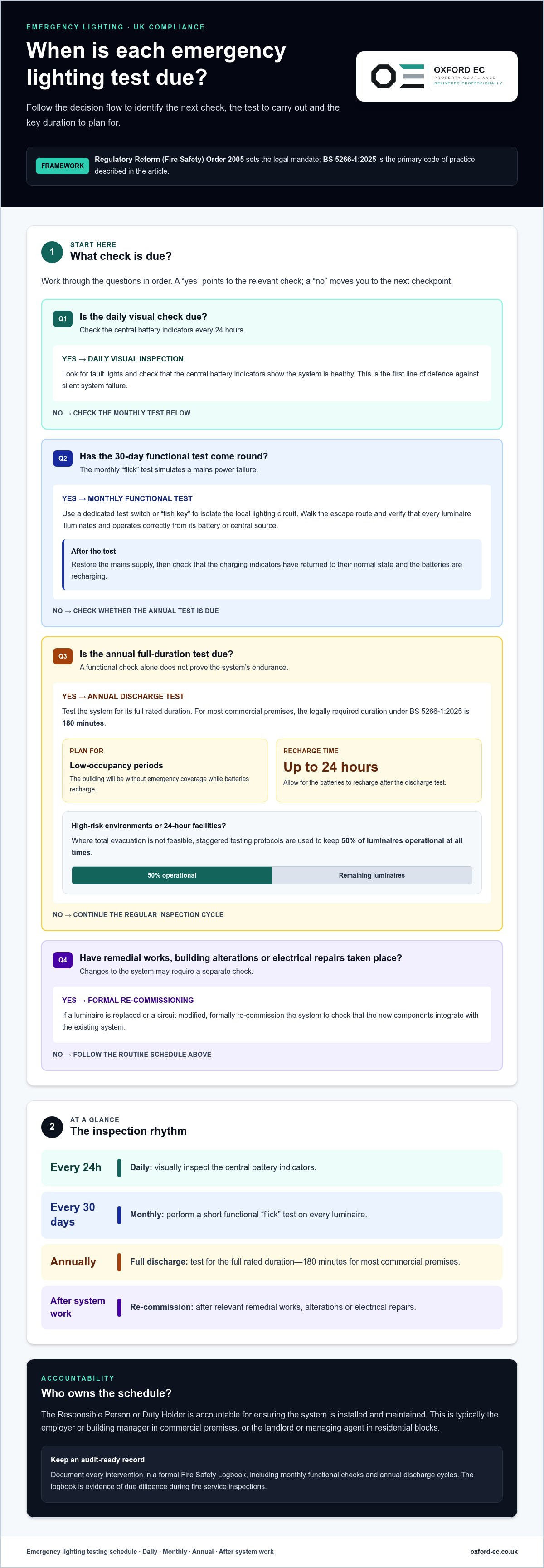
Precision in timing. Methodical execution. Rigorous oversight. Adhering to the emergency lighting testing requirements uk necessitates a multi-tiered approach to system verification that spans the entire operational year. Compliance isn't a static achievement but a continuous cycle of vigilance that begins with daily observations. The Responsible Person must conduct a visual inspection of the central battery indicators every 24 hours to ensure the system is healthy and no fault lights are present. This simple check provides the first line of defence against silent system failure, ensuring that the control equipment remains in a state of readiness without requiring a full power isolation.
The Monthly Functional "Flick" Test
Every 30 days, a short functional test must be performed to simulate a mains power failure. Using a dedicated test switch or a "fish key" to isolate the local lighting circuit, the operator must verify that every individual luminaire illuminates instantly and operates correctly from its internal battery or central source. This "flick test" is designed to be brief, typically lasting only long enough to walk the escape route and visually confirm that all lamps are functional. Once the mains supply is restored, you must scrutinise the charging indicators, usually green or red LEDs, to confirm they have returned to their normal state and the batteries are actively recharging.
The Annual Three-Hour Discharge Test
Whilst monthly checks confirm operation, they do not prove endurance. The annual discharge test subjects the system to its full rated duration, which is legally required to be 180 minutes for most commercial premises under BS 5266-1:2025. This test must be meticulously planned for low-occupancy periods because the building will be left without emergency coverage whilst the batteries recharge, a process that can take up to 24 hours. In high-risk environments or 24-hour facilities where total evacuation isn't feasible, staggered testing protocols are used to ensure that 50% of the luminaires remain operational at all times. This prevents the facility from being left in total darkness should a genuine power failure occur immediately after the test.
System integrity must also be validated following any remedial works, building alterations, or repairs to the electrical infrastructure. If a luminaire is replaced or a circuit modified, the system requires formal re-commissioning to ensure the new components integrate seamlessly with the existing safety net. If the logistical burden of managing these complex schedules is straining your internal resources, you may wish to speak with our technical team to discuss a managed testing programme that guarantees total compliance with emergency lighting testing requirements uk.
The Inspection Checklist: What a Professional Test Includes
Meticulous scrutiny. Technical exactness. Operational integrity. Whilst the testing schedule defines the frequency of intervention, the checklist defines the quality of the inspection itself. A professional assessment of emergency lighting testing requirements uk extends far beyond a binary pass or fail result. It requires a forensic examination of every component to identify latent defects that could compromise the system during a prolonged power outage or fire event. High-level compliance demands that every fitting is not just functional, but optimised for its specific environment and purpose. This level of detail is what separates a cursory check from a rigorous safety audit.
Luminaire and Signage Integrity
Physical degradation often precedes electrical failure. Inspectors must examine casings for discolouration or heat damage, as these symptoms frequently indicate failing ballasts or stressed internal circuitry that could lead to an independent fire risk. Diffusers must be cleaned meticulously to remove accumulated dust and grime, ensuring that the lumen output remains sufficient to meet the strict light levels defined in BS 5266-1. The directional orientation of "Running Man" signage must also be verified against current escape route plans to ensure occupants are led towards safety rather than into hazardous dead-ends. Integrating these checks into broader fire safety services ensures that your physical environment remains a safe conduit for evacuation at all times.
Technical Circuitry and Battery Performance
The heart of the system is the changeover mechanism. This critical component must be tested to ensure it triggers the automatic transition from mains power to battery supply within seconds of a failure. During the annual discharge cycle, technicians look for "dimming" bulbs which often signal that individual battery cells are reaching their end-of-life and can no longer hold a stable voltage. For buildings utilising central battery systems, the inspection includes a detailed audit of the inverter performance and the integrity of the distribution cabling. Adhering to these emergency lighting testing requirements uk provides the evidence-based results needed to satisfy fire authorities and property insurers alike. By identifying these technical failures early, you prevent the catastrophic failure of the safety net when it's most needed.
Documentation and Logbooks: The Proof of Compliance
Evidence. Accountability. Legal robustness. In the eyes of a fire safety inspector, a test that isn't documented is a test that never occurred. Whilst the physical activation of luminaires ensures operational readiness, the Fire Safety Logbook provides the statutory burden of proof required to satisfy the Regulatory Reform (Fire Safety) Order 2005. Maintaining a meticulous record is a core component of emergency lighting testing requirements uk, serving as a forensic trail of due diligence that protects the Responsible Person from claims of negligence. Whether you manage a single site or a national portfolio, your documentation must be clear, contemporaneous, and readily accessible for scrutiny during an unannounced audit.
Essential Logbook Data Points
Precision. Detail. Verification. A compliant logbook entry must transcend simple "pass" or "fail" notations by providing a granular view of the system's status. Every individual luminaire must be assigned a unique identification number that corresponds to a site zone plan, allowing for the immediate location of specific units during remedial works. For every inspection, the record must capture the exact date and time of the test, the specific nature of any faults identified, such as battery depletion or lamp failure, and the printed name and credentials of the competent person conducting the scrutiny. While traditional physical logbooks remain a staple for on-site accessibility, digital compliance platforms are increasingly utilised by multi-site managers to provide real-time oversight and automated alerts for missed testing windows.
Managing Remedial Actions
The "Fail-Fix-File" workflow is the industry standard for managing system deficiencies. When a unit fails to meet the emergency lighting testing requirements uk, the law mandates that repairs are initiated without delay to restore the building's safety envelope. Documentation does not end at the point of failure; you must record the specific remedial actions taken, including the date of component replacement and the results of the subsequent re-test. Keeping copies of manufacturer certificates for new battery packs or LED luminaires within your logbook provides an additional layer of technical evidence. For organisations facing complex system failures, utilising professional remedial services ensures that faults are rectified by qualified technicians and documented to an audit-ready standard, effectively closing the compliance loop.
Why Appoint a Professional Emergency Light Testing Company?
Strategic oversight. Technical mastery. Unbiased verification. Delegating the management of emergency lighting testing requirements uk to a specialised consultancy ensures that your compliance status is validated by an objective third party. Whilst internal facilities teams may possess generalist knowledge, they often lack the calibrated lux level meters and sophisticated battery discharge monitoring equipment required to prove system performance to British Standards. A professional partner provides more than just a signature in a logbook; they provide a defensive shield of technical evidence that withstands the most forensic fire service audit or insurance investigation.
The administrative burden of tracking multiple compliance schedules often leads to critical gaps in site safety. By appointing an expert provider, you consolidate fragmented tasks into a structured, managed programme. This integration ensures that emergency lighting inspections are synchronised with fire alarm maintenance and fire door assessments, creating a unified fire safety strategy. This holistic approach eliminates the risk of missed deadlines and ensures that every life-safety component is scrutinised with the same level of professional rigour, protecting both the occupants and the Duty Holder.
To further streamline your operational oversight through integrated facilities management, learn more about The CFS Group and their bespoke service offerings.
The Benefit of Multi-Disciplinary Safety Surveys
Efficiency. Synergy. Consolidation. One of the primary advantages of partnering with Oxford Environmental Consultants is our ability to deliver multi-disciplinary compliance audits in a single site visit. Our technicians are trained to execute emergency light testing alongside asbestos management surveys or legionella risk assessments, significantly reducing site disruption and travel costs. This methodology provides you with a comprehensive "compliance dashboard" for your entire property portfolio, allowing for the strategic management of risks across diverse technical divisions through a single, accountable point of contact. By minimising the number of independent contractors on site, you streamline your operations whilst maintaining absolute regulatory alignment.
Selecting a Competent Provider
Technical reporting standards. Professional indemnity. Proven expertise. When selecting a provider to manage your emergency lighting testing requirements uk, you must look beyond the initial cost. "Cheap" testing often results in superficial inspections that fail to identify latent battery defects or incorrect signage orientation, leading to expensive remedial work or legal penalties later. A competent provider delivers detailed technical reports, maintains robust insurance coverage, and demonstrates a deep alignment with BS 5266-1:2025. This commitment to precision ensures your organisation remains legally robust and operationally safe, providing the "safe pair of hands" required for complex property requirements.
Achieving Absolute Precision in Statutory Fire Safety
Rigorous standards. Uncompromising detail. Total accountability. Navigating the emergency lighting testing requirements uk demands a disciplined approach to property management that prioritises occupant safety over administrative convenience. By aligning your maintenance cycles with the BS 5266-1:2025 code of practice and maintaining a forensic logbook of every intervention, you effectively insulate your organisation from the severe legal and financial repercussions of non-compliance. This methodical commitment to safety ensures that your escape routes remain illuminated during critical failures, providing the legal robustness required to satisfy both fire authorities and insurers.
Oxford Environmental Consultants acts as your safe pair of hands by delivering a streamlined, one-stop solution to complex regulatory burdens across your entire property portfolio. Our national coverage and multi-disciplinary expertise allow us to provide audit-ready reporting that satisfies the most stringent fire service inspections whilst simultaneously addressing other critical compliance areas such as asbestos or water hygiene through a single point of contact.
Achieving absolute precision in fire safety doesn't have to be an overwhelming challenge when you have a dedicated partner to manage the technical scrutiny for you.
Frequently Asked Questions
Is emergency lighting testing a legal requirement in the UK?
Statutory mandate. Criminal liability. Absolute obligation. Yes, testing is a legal requirement under the Regulatory Reform (Fire Safety) Order 2005. The legislation dictates that the Responsible Person must maintain all fire safety systems in an efficient state and in good repair. Failure to adhere to emergency lighting testing requirements uk can lead to unlimited fines, the invalidation of insurance policies, or potential imprisonment in cases of severe negligence.
How often should emergency lighting be tested by law?
Daily. Monthly. Annually. The BS 5266-1:2025 standard mandates a three-tier frequency for system verification. You must conduct daily visual checks of central battery indicators, monthly functional "flick" tests to ensure lamp activation, and an annual full-duration discharge test. This annual test ensures the batteries can sustain illumination for the full three-hour legal minimum required for most commercial premises.
Can I carry out the monthly emergency light tests myself?
Technical competence. Procedural accuracy. Documented evidence. Yes, a designated on-site staff member can perform monthly functional checks provided they are deemed a "competent person." This individual must understand how to operate the test switch or fish key safely and be capable of accurately recording the results in the Fire Safety Logbook. However, the more complex annual discharge tests often require professional equipment to verify battery health and lux levels.
What happens if an emergency light fails its three-hour discharge test?
Immediate remediation. Risk mitigation. Documented resolution. If a luminaire fails to remain illuminated for the full 180-minute duration, it must be repaired or replaced without delay. You must record the failure in your logbook and file the subsequent commissioning certificate once the unit is restored to full functionality. A system with depleted battery cells leaves your building legally non-compliant and poses a direct risk to life safety during a power failure.
Do I need a logbook for emergency lighting testing?
Mandatory record. Forensic proof. Audit readiness. Yes, maintaining a dedicated Fire Safety Logbook is a statutory requirement for demonstrating due diligence to the authorities. This document must contain the unique identification number of every luminaire and a chronological record of all tests, faults, and remedial actions. Fire and Rescue Service inspectors will request this logbook as their primary evidence of your alignment with emergency lighting testing requirements uk.
How long should emergency lights stay on for during a power cut?
Rated duration. Battery stamina. Legal minimum. Most commercial and multi-occupancy residential buildings require a minimum duration of three hours (180 minutes). This period is designed to allow for a safe evacuation, the arrival of emergency services, and the potential re-entry of occupants once the building is secured. While some specific low-risk environments previously allowed for shorter durations, modern British Standards now mandate the three-hour threshold for almost all non-domestic settings.
What is the difference between maintained and non-maintained emergency lighting?
Constant illumination. Reactive activation. Operational distinction. Maintained luminaires function like standard lights but remain lit via battery supply during a power failure, whereas non-maintained units only activate when the mains supply is interrupted. Maintained systems are typically required in public assembly buildings, such as cinemas or theatres, where occupants may be unfamiliar with the layout and total darkness must be prevented at all times.
Does my small business really need an emergency lighting system?
Risk assessment. Statutory duty. Life safety. Almost certainly. If your premises are used during hours of darkness or contain areas that lack sufficient natural light to illuminate escape routes, a system is mandatory. Your Fire Risk Assessment (FRA) will formally define the specific requirements for your building based on its size, complexity, and occupancy levels, ensuring that you meet the necessary legal threshold for life safety.