

In the current regulatory climate, a missing signature is no longer just an administrative oversight. It's a liability. It's a risk. It's a potential breach of the Building Safety Act that carries personal accountability for those in charge. You likely feel the weight of fragmented records across multiple sites whilst struggling to maintain a comprehensive facilities manager compliance checklist that accounts for evolving standards like Awaab’s Law. Managing these complexities shouldn't feel like a gamble with your professional reputation.
This guide delivers a rigorous, audit-ready framework designed to consolidate your statutory obligations into a single, defensible roadmap for 2026. By adopting a methodical approach to multi-disciplinary safety surveys, you can secure the peace of mind that comes from absolute technical precision and legal robustness. We will dissect the essential pillars of property safety, including comprehensive fire risk assessments, asbestos management protocols, and the stringent requirements for water hygiene and damp mitigation. This guide ensures your estates remain compliant, protected, and prepared for the highest levels of regulatory scrutiny.
Key Takeaways
- Identify the critical regulatory shifts under the Building Safety Act 2022 and Fire Safety Act 2021 to ensure your property remains legally defensible and compliant.
- Differentiate between Type 1 and Type 4 fire risk assessments to provide the appropriate level of technical scrutiny for complex or high-risk building structures.
- Secure your estates against invisible hazards by implementing laboratory-standard water sampling and asbestos management surveys that exceed basic visual inspections.
- Develop a rigorous facilities manager compliance checklist that categorises obligations by statutory priority and maintains a time-stamped, audit-ready evidence trail.
- Integrate professional damp and mould surveys into your maintenance programme to meet the stringent requirements of Awaab’s Law and protect indoor air quality.
Table of Contents
- The Shifting Landscape of UK Facilities Management Compliance
- Fire Safety and Passive Protection: Beyond the Basic Risk Assessment
- Water Hygiene and Hazardous Materials: Managing Invisible Risks
- Damp, Mould, and Indoor Air Quality: New Statutory Standards
- Implementing Your Compliance Checklist: From Static to Dynamic
The Shifting Landscape of UK Facilities Management Compliance
Within the rigorous context of modern facilities management, compliance is the continuous process of aligning physical assets with statutory safety and environmental legislation. It is no longer a peripheral task. It's a core discipline. It's a legal mandate. True compliance requires the meticulous synchronisation of building systems with evolving UK standards to ensure every asset remains safe, efficient, and legally defensible. By 2026, the primary drivers of this landscape are the Building Safety Act 2022 and the Fire Safety Act 2021, both of which have fundamentally redefined the responsibilities of those managing the built environment.
A professional facilities manager compliance checklist must clearly distinguish between mandatory requirements and advisory recommendations. In a regulatory audit, the word "shall" indicates a non-negotiable statutory obligation, whilst "should" denotes industry best practice that, if ignored, requires a robust technical justification. Central to this is the "Golden Thread" of information. Documentation is now as critical as the physical inspection. If an inspection isn't recorded with time-stamped evidence and precise technical data, the law treats it as if it never occurred. Data integrity is the new baseline for safety.
Legislative Drivers: The Building Safety Act 2022 and Beyond
The Building Safety Act has introduced the roles of the Accountable Person and the Principal Accountable Person, placing direct legal responsibility on individuals to manage fire and structural risks. High-rise residential buildings (HRBs) now require a comprehensive safety case report that proves risks are being actively identified and mitigated. Scrutiny on building height and occupancy risk factors has intensified. Every decision must be backed by empirical evidence to satisfy the Building Safety Regulator's stringent standards.
The Cost of Non-Compliance: Legal and Reputational Scrutiny
Failure is expensive. Negligence in meeting statutory duties can lead to unlimited fines and, in cases of severe breach, custodial sentences for duty-holders. Beyond the legal system, compliance failures trigger sharp increases in insurance premiums and significantly devalue property assets. Proactive engagement with professional property compliance audits is the most effective method to identify hidden vulnerabilities before they escalate into litigation. Maintaining a dynamic facilities manager compliance checklist isn't just about safety; it's about protecting the organisation's financial and reputational viability.
Fire Safety and Passive Protection: Beyond the Basic Risk Assessment
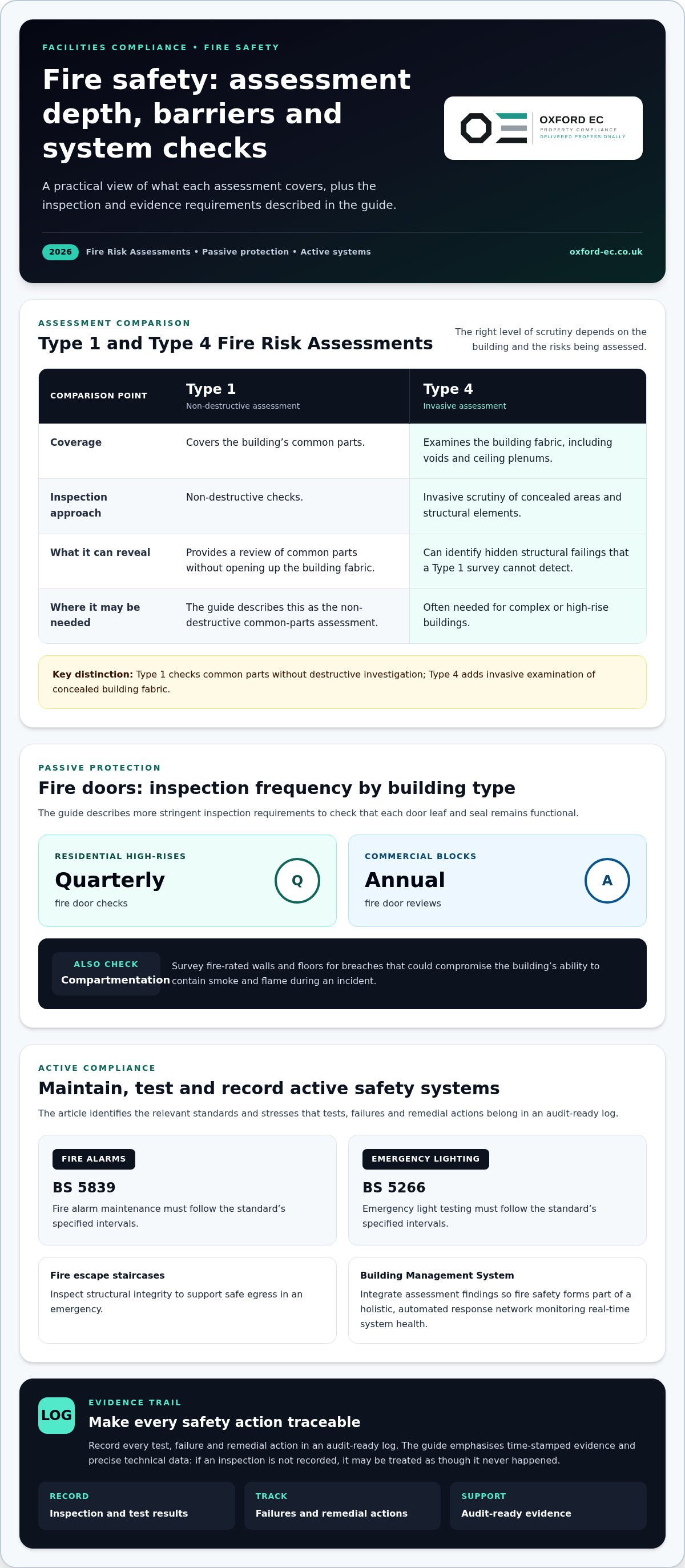
A robust Fire Risk Assessment (FRA) serves as the technical foundation of any property safety programme. It isn't a static document. It's a living protocol. For the modern professional, a comprehensive facilities manager compliance checklist must move beyond superficial visual checks to address the structural realities of the building. Whilst a Type 1 FRA covers non-destructive common parts, complex or high-rise buildings often necessitate a Type 4 assessment. This invasive level of scrutiny examines the building's fabric, including voids and ceiling plenums, to identify hidden structural failings that Type 1 surveys simply cannot detect. Integrating these findings into your Building Management System (BMS) ensures that fire safety isn't managed in isolation but as part of a holistic, automated response network that monitors real-time system health.
Fire Doors and Compartmentation: The Passive Defence
Passive fire protection is your silent guardian. In 2026, the requirements for fire door inspections have become significantly more stringent, demanding quarterly checks in residential high-rises and annual reviews for commercial blocks to ensure every leaf and seal remains functional. A compartmentation survey is equally vital; it identifies breaches in fire-rated walls and floors that compromise the building's ability to contain smoke and flame during a live incident. You can access specialised support through Oxford Environmental Consultants (OEC) fire safety services to ensure these surveys are conducted to an audit-ready standard. For a deeper dive into these evolving regulations, consult our Fire Risk Assessments: A Comprehensive Guide to UK Compliance in 2026.
Alarm Systems and Emergency Lighting: Active Compliance
Active systems require relentless maintenance and meticulous record-keeping. Fire alarm maintenance and emergency light testing must adhere to strict BS 5839 and BS 5266 intervals respectively to guarantee fail-safe operation. Beyond the electronics, the structural integrity of fire escape staircases must be inspected to ensure safe egress during an emergency scenario. Every test, every failure, and every remedial action must be recorded in an audit-ready log that stands up to regulatory scrutiny. This level of detail mirrors the rigour required for other statutory duties, such as those found in the HSE Legionella guidance. If your current facilities manager compliance checklist lacks this multi-disciplinary depth, it may be time to request a professional compliance review to bridge the gap between basic safety and absolute legal robustness.
Water Hygiene and Hazardous Materials: Managing Invisible Risks
Invisible risks demand visible evidence. It's a technical mandate. It's a safety imperative. Managing hazardous substances under COSHH and the Control of Asbestos Regulations (CAR) 2012 is a non-negotiable statutory duty for any duty-holder. For a comprehensive facilities manager compliance checklist, visual inspections are fundamentally insufficient; water and air hygiene require specialist laboratory analysis to confirm the absolute absence of pathogens or hazardous fibres. This technical rigour also intersects with operational efficiency, as poorly managed HVAC and water systems often suffer from scale and bio-fouling, which significantly increases energy consumption and operational costs. A cradle-to-grave approach to hazardous materials ensures every phase, from initial identification to eventual removal, is documented, controlled, and legally sound.
Legionella Control: Water Sampling and Risk Management
Legionella management is a high-stakes responsibility. It requires a structured programme of temperature monitoring and water sampling to prevent the proliferation of Legionella bacteria within complex plumbing systems. Every site must undergo commercial legionella risk assessments to identify potential dead-legs, aerosol-generating outlets, and temperature fluctuations that could foster bacterial growth. Sampling frequencies vary based on system complexity and risk level, but the requirement for a defensible evidence trail remains constant. For a deeper understanding of these technical obligations, refer to our guide on Legionella Risk Assessment: The Essential Guide to UK Compliance 2026. Precise data is your only protection against the severe legal consequences of an outbreak.
Asbestos Management: Identification, Surveys, and Consultancy
Asbestos remains the single greatest cause of work-related deaths in the UK. Any building constructed or refurbished before 2000 must maintain a live, up-to-date Asbestos Register to protect occupants and contractors alike. It's essential to differentiate between standard Management Surveys, designed for day-to-day occupancy, and Refurbishment or Demolition (R&D) Surveys, which are intrusive and mandatory before any structural works begin. Engaging expert asbestos consultancy allows for the precise planning of remediation or removal, ensuring that your facilities manager compliance checklist meets the highest safety standards. Detailed protocols for these surveys can be found in A Complete Guide to Asbestos Management Surveys: Compliance and Safety. Transparency in these records is the only shield against the legal liabilities discussed in previous sections.
Damp, Mould, and Indoor Air Quality: New Statutory Standards
Damp and mould management has transitioned from a maintenance inconvenience to a critical statutory obligation. It's a health priority. It's a legal necessity. The implementation of Awaab’s Law has fundamentally altered the risk profile for duty-holders across both social and private sectors, ending the era of treating moisture issues as mere surface defects. Any robust facilities manager compliance checklist must now prioritise the identification of root causes, such as thermal bridging, interstitial condensation, or ventilation failure. This shift requires a move away from visual guesswork toward evidence-based diagnostics. Utilising technical tools like thermal imaging and moisture metering is essential to provide a defensible survey that correlates building fabric performance with occupant health and indoor air quality.
Awaab’s Law and the Duty to Inspect
The legislation imposes rigorous, non-negotiable timelines for duty-holders to investigate and remediate reported hazards. Professional damp and mould inspections are the only reliable method to generate the technical evidence required to prove compliance during a regulatory audit. These surveys provide a clear, time-stamped record of the building's condition and the effectiveness of any remedial actions taken. For a comprehensive overview of these evolving safety standards, consult our guide on Professional Damp and Mould Inspection: A Guide to Building Safety and Compliance in 2026. Inaction is no longer a viable management strategy.
Structural Integrity: Fire Escapes and Building Fabric
Compliance extends beyond the internal environment to the structural components that facilitate safe egress. Regular fire escape staircase inspections are a statutory requirement to ensure that external escape routes remain structurally sound and free from significant corrosion or obstruction. This physical integrity is a vital component of the broader safety programme, working in tandem with the compartmentation surveys mentioned in previous sections to maintain the building's defensive layers. When defects are identified, prompt engagement with remedial services is essential to restore the property to a compliant state. A comprehensive facilities manager compliance checklist must integrate these structural assessments to ensure that the building fabric supports both occupant health and emergency safety.
Implementing Your Compliance Checklist: From Static to Dynamic
A static document is a liability. It's a snapshot. It's outdated the moment it's printed. Transitioning to a dynamic facilities manager compliance checklist requires a fundamental shift in operational philosophy. You must categorise your obligations into three distinct pillars: Statutory, Mandatory, and Advisory. Statutory duties are those legally required by UK law, such as the Building Safety Act; Mandatory duties relate to internal organisational requirements or insurance contracts; Advisory duties represent industry best practice. By structuring your framework this way, you prioritise high-stakes legal duties whilst maintaining a clear path toward operational excellence. The 2026 standard for compliance is "Audit-Ready," which demands that every check produces a time-stamped evidence trail. This irrefutable record of completion is the only defence against regulatory scrutiny. Moving away from annual "deep dives" toward continuous monitoring reduces the compliance burden on your team by identifying and resolving vulnerabilities in real-time through a streamlined, multi-disciplinary approach.
Organising by Frequency: Daily, Monthly, and Annual Audits
Maintaining control over a complex estate requires a methodical rhythm of inspection. A structured facilities manager compliance checklist should be broken down into specific intervals to ensure no statutory duty is overlooked:
- Daily and Weekly: Conduct fire alarm testing, water flushing of infrequently used outlets, and general visual safety checks of escape routes.
- Monthly and Quarterly: Execute emergency light flicker tests, formal fire door inspections, and water temperature monitoring to manage Legionella risks.
- Annual: Schedule comprehensive Fire Risk Assessments (FRA), asbestos re-inspections for pre-2000 buildings, and annual Legionella risk reviews.
Professional Scrutiny: Why External Audits are Essential
Internal teams often suffer from familiarity bias. They see what they expect to see. Professional scrutiny from an external consultant provides the necessary objectivity to identify compliance blind spots that internal audits might miss. Reports generated by Oxford Environmental Consultants are designed to be technically rigorous and legally robust, providing duty-holders with a definitive defence in the event of a Health and Safety Executive (HSE) or local authority investigation. These documents don't just list failures; they provide a structured, evidence-led pathway to remediation. This level of precision ensures your estate remains a "safe pair of hands" for all stakeholders and occupants.
Securing Your Estate Against Future Regulatory Scrutiny
The landscape of property management has shifted toward a model of continuous, evidence-based accountability. It's a technical mandate. It's a legal necessity. Maintaining a rigorous facilities manager compliance checklist is no longer just about operational efficiency; it's about establishing a robust legal defence through absolute precision. By integrating fire risk assessments, asbestos management, and water hygiene protocols into a single, unified framework, you eliminate the fragmentation that leads to compliance blind spots. This multi-disciplinary approach ensures that every survey and remediation action is documented to the exact standards required by 2026 legislation.
Oxford Environmental Consultants provides the multi-disciplinary expertise necessary to manage these complex requirements across national portfolios. Our reports are specifically engineered to withstand the highest levels of regulatory scrutiny, offering you the peace of mind that comes from a safe pair of hands.
Achieving absolute compliance is a disciplined process, but with the right technical partner, it becomes a streamlined and manageable reality.
Frequently Asked Questions
What is the most critical item on a facilities manager compliance checklist?
The most critical items on a facilities manager compliance checklist are statutory life safety obligations, specifically fire risk assessments, asbestos management, and water hygiene. These duties carry the highest legal risk and personal liability for duty-holders. Neglecting these areas creates immediate danger for occupants and leaves the organisation vulnerable to unlimited fines. Every checklist must prioritise these three pillars to ensure the building remains legally defensible and operationally safe.
How often should a commercial Fire Risk Assessment be updated?
A commercial Fire Risk Assessment should be reviewed regularly to ensure it remains valid, typically on an annual basis or whenever significant changes occur. These changes include structural alterations, a change in the building's use, or a substantial increase in the number of occupants. Under the Fire Safety Act 2021, the emphasis is on continuous validity. If the assessment no longer reflects the building's current risk profile, it's legally obsolete.
Is a Legionella risk assessment a legal requirement for all UK businesses?
Yes, a Legionella risk assessment is a legal requirement for all UK businesses and landlords who manage premises with water systems. Under the Health and Safety at Work Act 1974 and the Management of Health and Safety at Work Regulations, duty-holders must identify and assess the risk of exposure. This applies regardless of the size of the building or the complexity of the plumbing, ensuring that all water systems are safe for use.
What are the penalties for failing to maintain an Asbestos Register?
Failing to maintain a precise Asbestos Register can result in unlimited fines and custodial sentences of up to two years for those in charge. The Health and Safety Executive (HSE) enforces these penalties strictly under the Control of Asbestos Regulations 2012. Beyond criminal prosecution, duty-holders face significant civil litigation risks and the potential for their insurance policies to be voided, creating a catastrophic financial and reputational liability for the organisation.
How does the Building Safety Act 2022 change FM compliance duties?
The Building Safety Act 2022 introduces the role of the Accountable Person and mandates the "Golden Thread" of digital information for high-rise residential buildings. This legislation shifts the facilities manager compliance checklist from a periodic review to a continuous monitoring process. Duty-holders must now produce a safety case report that proves risks are being actively managed, ensuring that building safety information is accurate, accessible, and up to date at all times.
Can I perform my own damp and mould inspections under Awaab’s Law?
Whilst visual checks are common, a defensible damp and mould inspection under Awaab’s Law requires professional technical scrutiny. Inspections must identify the root cause of moisture, such as interstitial condensation or structural failings, rather than just treating the surface symptoms. Using a professional consultant ensures that the evidence gathered is technically rigorous and stands up to the strict remediation timelines now mandated by UK social housing standards and private rental regulations.
What is the difference between a fire door inspection and a fire risk assessment?
A Fire Risk Assessment is a broad evaluation of a building’s overall fire safety strategy, whilst a fire door inspection is a specific, technical audit of passive protection components. The FRA identifies the need for fire doors, but the inspection ensures each door’s integrity, including gaps, seals, and self-closing mechanisms. Both are essential. The FRA sets the strategy, whereas the door inspection provides the technical proof that the strategy is physically functioning correctly.
Why should I use a multi-disciplinary consultancy for building compliance?
Using a multi-disciplinary consultancy like Oxford Environmental Consultants (OEC) reduces the administrative burden and ensures consistency across all safety reports. Managing fire, asbestos, and water hygiene through a single partner eliminates the risk of "compliance blind spots" that occur when different contractors operate in isolation. This integrated approach provides a streamlined, audit-ready evidence trail that is more efficient to manage and significantly more robust during a regulatory inspection.