

Did you know that approximately 75% of fire doors in existing UK stock currently fail basic compliance checks? This failure rate places lives at risk. It exposes directors to litigation. It compromises building insurance. You recognise that professional fire door integrity testing is a non-negotiable pillar of property management, yet the complexities of the Fire Safety (England) Regulations 2022 and evolving British Standards can make it difficult to maintain a robust, audit-ready safety record.
This guide provides you with the technical clarity and legal confidence needed to manage your commercial or residential portfolio effectively. We will detail the specific requirements for quarterly communal checks and annual flat entrance inspections, whilst outlining how professional scrutiny of hardware, seals, and frames ensures your assets remain fully compliant with BS 8214 and BS 9999. By the end of this article, you'll have a practical framework for national compliance, positioning your safety strategy as a dependable shield against risk and a "safe pair of hands" for your property assets.
Key Takeaways
- Understand the technical parameters of fire door integrity testing and how it differs from standard inspections to guarantee FD30 or FD60 performance.
- Recognise the primary mechanics of failure, including the degradation of intumescent seals and improper gap tolerances that compromise passive fire protection.
- Evaluate the critical relationship between fire door performance and building compartmentation to ensure a unified and robust safety strategy.
- Implement a professional protocol for precise gap measurement and hardware inspection to maintain alignment with current British Standards.
- Discover how a multi-disciplinary approach to compliance surveys can streamline asset management whilst providing a "safe pair of hands" for legal accountability.
Table of Contents
What is Fire Door Integrity Testing?
Scrutinise. Verify. Protect. Fire door integrity testing is the technical validation of an assembly's performance under extreme thermal stress. It's a precision-led process. Whilst a standard visual inspection identifies surface-level defects, a comprehensive integrity test evaluates the door's functional capacity to act as a passive fire protection system by scrutinising technical tolerances against the original manufacturer's test evidence. Relying on visual checks alone is a high-risk strategy. A 2026 report on social housing in England revealed that 65% of fire doors failed to meet the FD30 legal minimum standard, highlighting the inadequacy of surface-level assessments. Within the "Golden Thread" of building safety information, fire door integrity testing provides the verifiable, evidence-based data required to prove that each aperture remains a robust barrier to fire spread.
The Legal Framework: Regulatory Reform (Fire Safety) Order 2005
Under the Regulatory Reform (Fire Safety) Order 2005, the designated Responsible Person holds a non-delegable duty to ensure all fire safety equipment is maintained in efficient working order and a state of good repair. The Fire Safety Act 2021 has explicitly clarified that for multi-occupied residential buildings, the structure, external walls, and all flat entrance doors leading to common parts fall under the remit of the Fire Safety Order. For high-rise assets, the Building Safety Act 2022 mandates even stricter levels of accountability. It requires a comprehensive digital record that tracks the lifecycle of safety components, ensuring that every fire door is part of a transparent, audit-ready compliance programme.
FD30 vs FD60: Integrity Ratings Explained
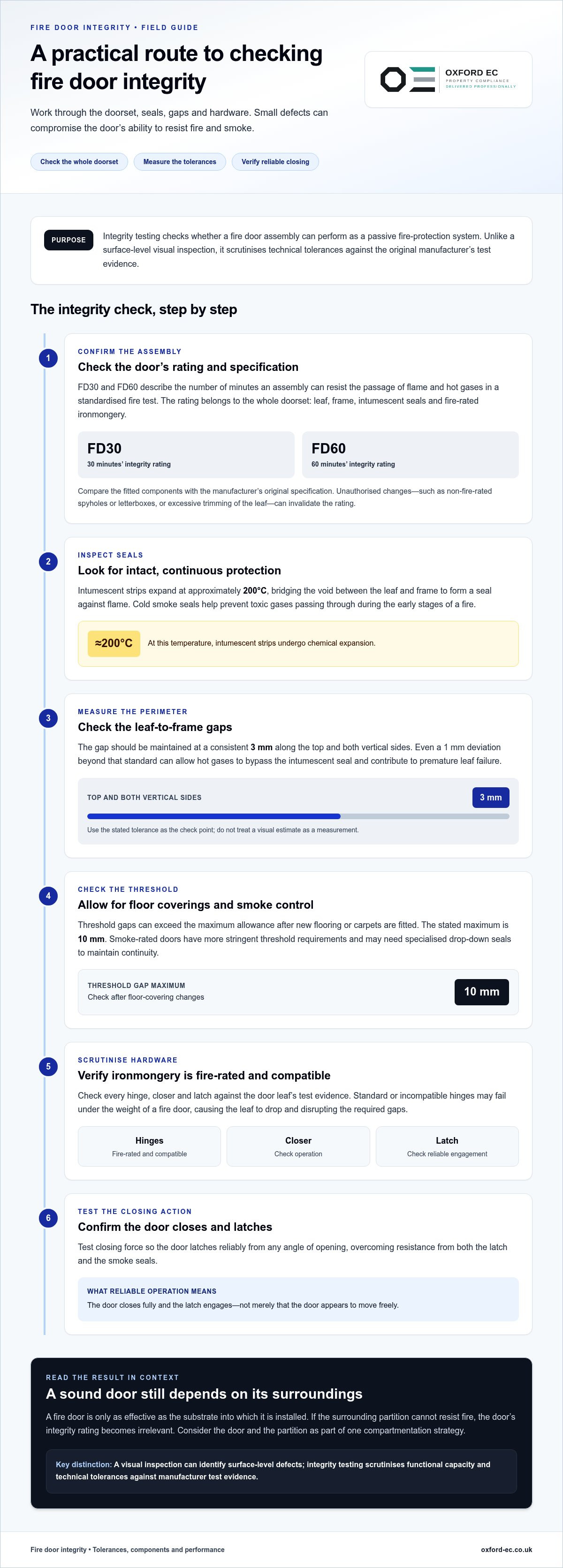
Integrity ratings, such as FD30 or FD60, define the specific number of minutes an assembly can resist the passage of flame and hot gases during a standardised fire test. This rating is a product of the entire doorset, encompassing the leaf, frame, intumescent seals, and fire-rated ironmongery. It's vital to maintain the manufacturer’s original specification throughout the door's service life. Even minor, unauthorised modifications, such as the installation of non-fire-rated spyholes, uncertified letterboxes, or the excessive trimming of a door leaf, can completely invalidate the integrity rating. Our specialised fire safety protocols ensure that every component is audited for alignment with BS 8214 to prevent such critical failures.
The Mechanics of Failure: Why Integrity Testing is Critical
Precision is the difference between a life-saving barrier and a decorative liability. Fire doors don't typically fail due to a single catastrophic event; they fail through gradual mechanical degradation, improper maintenance, or uncertified modifications. Fire door integrity testing provides the technical scrutiny required to identify these invisible risks. Whilst a door may appear functional, the science of its performance relies on the reactive synergy of its components. Intumescent strips serve as the reactive core. When temperatures reach approximately 200°C, these strips undergo a chemical expansion to bridge the void between the leaf and the frame, creating a robust seal against flame. Cold smoke seals are equally vital. They prevent the passage of toxic gases during the early stages of a fire, providing occupants with the clear visibility needed for evacuation before the heat triggers the intumescent reaction.
To ensure the intumescent expansion effectively seals the aperture, the gap between the door leaf and the frame must be maintained at a consistent 3mm tolerance along the top and both vertical sides. Deviations from this measurement are the most common cause of failure in existing UK building stock.
Leaf Gaps and Threshold Tolerances
Meticulous measurement is non-negotiable. Even a 1mm deviation beyond the 3mm standard can allow hot gases to bypass the intumescent seal, leading to premature leaf failure. We frequently observe threshold gaps that exceed the maximum 10mm allowance after the installation of new floor coverings or carpets. If a door is smoke-rated, the threshold requirements are even more stringent, often requiring specialised drop-down seals to maintain the seal's continuity. Room integrity testing principles demonstrate that even minor air leakage paths can undermine fire suppression efforts, a technical reality that applies directly to fire door tolerances.
Ironmongery and Hardware Scrutiny
Every hinge, closer, and latch must be fire-rated and compatible with the specific door leaf's test evidence. Non-compatible ironmongery is a critical failure point. Standard hinges may fail under the weight of a fire door, causing the leaf to drop and ruining the required gap tolerances. We rigorously test the closing force of every assembly to ensure the door latches reliably from any angle of opening, overcoming the resistance of both the latch and the smoke seals. If you are concerned about the compatibility of your existing hardware, you can request a technical hardware audit to ensure your estate meets the necessary safety standards.
Integrity Testing and Building Compartmentation
A fire door is only as effective as the substrate into which it is installed. If the surrounding partition fails to resist the passage of fire, the door's integrity rating becomes irrelevant. This technical reality necessitates a holistic approach to building safety. Our fire door integrity testing protocols extend beyond the leaf and frame to scrutinise the door-to-wall interface. We identify systemic failures that standard visual checks often overlook. This scrutiny is particularly critical in high-rise residential buildings where the "Golden Thread" of information requires verifiable evidence of fire-stopping efficacy at every junction. By integrating compartmentation survey services into your safety regime, you ensure that every fire-rated aperture is part of a continuous, unbroken barrier. OEC’s multi-disciplinary approach identifies these vulnerabilities by examining the building as a single, unified safety system rather than a collection of fragmented parts.
Passive Fire Protection Surveys
The interface between a fire door frame and the wall is a common site for "hidden" breaches that allow fire and smoke to bypass the doorset entirely. During our surveys, we frequently discover that contractors have used non-fire-rated expanding foam or have failed to apply intumescent mastic to the required depth. We evaluate the specific fire-stopping materials used, ensuring that fire-rated batts and high-performance sealants are correctly installed to maintain the assembly's integrity. For a comprehensive technical analysis of these requirements, consult our Passive Fire Protection Survey guide. This level of technical scrutiny is essential for accurate Fire Door Inspections that reflect real-world performance under fire conditions.
The Impact of Structural Movement
Buildings are dynamic. They settle. They shift. This movement can warp frames and alter the critical 3mm gap tolerances discussed in previous sections. Regular re-testing is mandatory to account for these environmental changes over time. A door that passed inspection two years ago may now be non-compliant due to structural subsidence, thermal expansion, or heavy usage patterns. Integrating fire door integrity testing into a broader property compliance audit provides a streamlined, logical solution for complex estates. OEC acts as your "guardian" of compliance, providing the meticulous oversight needed to manage multiple safety requirements through a single, accountable partner. This ensures your assets remain a "safe pair of hands" for occupants and stakeholders alike.
The Professional Testing Protocol: Steps to Compliance
Audit. Measure. Certify. A professional testing regime must be repeatable, evidence-based, and technically exhaustive. Whilst many providers offer simple visual checks, fire door integrity testing requires a structured five-step protocol to ensure every component functions as a unified safety barrier. Our methodology moves logically from surface-level inspection to mechanical validation. We don't just look; we scrutinise. Each assessment follows a disciplined sequence to provide the precision required for legal robustness.
- Step 1: Visual Assessment. We examine the door leaf, frame, and glazing for signs of warping, delamination, or uncertified modifications that compromise the assembly's original test evidence.
- Step 2: Precision Measurement. Using calibrated gauges, we verify that gap tolerances at the head and stiles remain within the 3mm standard, whilst ensuring threshold gaps do not exceed 10mm for non-smoke-rated doors.
- Step 3: Seal Scrutiny. We audit the condition and continuity of intumescent and cold smoke seals, identifying any missing sections or paint contamination that would prevent effective expansion during a thermal event.
- Step 4: Functional Validation. Every self-closing device is tested to confirm the door latches reliably from any angle of opening, overcoming the resistance of seals and latch bolts without manual intervention.
- Step 5: Reporting. All findings are collated into a comprehensive, audit-ready document that provides a transparent record of compliance for every asset within the estate.
Documenting the Golden Thread
Detailed photographic evidence serves as the foundation of the modern safety record. We provide high-resolution imagery of every identified failure point to ensure duty-holders have an indisputable evidence base for remedial prioritisation. Every door is assigned a unique asset tag, often via durable QR codes, to facilitate a digital lifecycle history that aligns with the Building Safety Act 2022 requirements. This granular level of reporting is vital during fire service inspections, as it demonstrates a proactive and meticulous approach to property management that prioritises occupant safety.
Frequency of Testing: When to Organise a Survey
Legislative requirements vary by building height and usage profile. For multi-occupied residential buildings over 11 metres, the Fire Safety (England) Regulations 2022 mandate quarterly checks of communal fire doors and annual inspections of flat entrance doors. High-usage environments, such as healthcare facilities or educational estates, often require 6-month cycles due to the accelerated wear on hinges and closing mechanisms. We recommend coordinating these fire door integrity testing cycles with your wider fire risk assessments to maintain a streamlined compliance schedule that leaves no room for error.
Choosing a Specialist for Fire Door Integrity
Expertise. Independence. Accountability. Selecting a partner for fire door integrity testing requires more than a cursory check of credentials; it demands a firm that operates as an uncompromising guardian of your legal obligations. Whilst some providers focus solely on the supply of hardware, a specialist consultancy provides the independent scrutiny necessary to validate the performance of existing assets without the conflict of interest inherent in manufacturing-led models. This "Safe Pair of Hands" approach ensures that every audit is conducted with absolute precision and technical rigour. At OEC, we manage the entire compliance lifecycle, providing a seamless transition from initial inspection to detailed remedial advice that prioritises life safety and regulatory alignment.
The Multi-Disciplinary Advantage
Efficiency. Precision. Streamlined delivery. For managers of complex, national estates, the administrative burden of coordinating multiple safety contractors is a significant risk factor. We mitigate this by offering a multi-disciplinary solution that integrates fire door checks with asbestos management surveys and water hygiene audits. This unified strategy allows for a single site visit to address multiple regulatory requirements, reducing operational downtime and providing a holistic view of building fabric safety. By consolidating your compliance needs, you achieve a level of oversight that fragmented service delivery cannot match, ensuring that fire, water, and asbestos risks are managed through a single, accountable framework.
Accountability and Peace of Mind
Competence. Transparency. Rigorous standards. Every surveyor within our team is suitably trained and demonstrates the technical mastery required to navigate the complexities of the Building Safety Act 2022. We provide peace of mind through robust professional indemnity insurance and a commitment to evidence-based results that stand up to the most intense regulatory scrutiny. Our reports are not just documents; they are audit-ready shields that protect your organisation from liability whilst safeguarding the people within your buildings. We invite you to enquire about our fire door integrity testing services today to secure your property assets.
Securing Your Estate through Technical Scrutiny
Maintaining property compliance is an uncompromising discipline. It requires a move away from superficial inspections towards a regime of fire door integrity testing that scrutinises every technical tolerance. You've seen that a fire door's performance depends on its reactive synergy with intumescent seals, precise gap measurements, and the surrounding building compartmentation. Failing to manage these variables creates a significant breach in your passive fire protection strategy. Oxford Environmental Consultants provides the authoritative guidance you need to navigate the Fire Safety Act 2021 with confidence. Our multi-disciplinary approach streamlines your asset management by combining fire safety, asbestos, and water hygiene into a single, rigorous framework. We deliver the audit-ready reporting duty-holders require to prove compliance and protect occupants. By positioning your estate as a "safe pair of hands," you ensure long-term safety and legal robustness for every commercial and residential asset.
Take the necessary steps today to fortify your property compliance and achieve absolute peace of mind.
Frequently Asked Questions
How often is fire door integrity testing legally required in the UK?
Under the Fire Safety (England) Regulations 2022, responsible persons for multi-occupied residential buildings over 11 metres must conduct quarterly checks of communal fire doors. Flat entrance doors require annual inspections. For commercial premises, the Regulatory Reform (Fire Safety) Order 2005 mandates regular maintenance, which is typically interpreted as six-monthly for high-usage areas. Compliance requires a proactive schedule to ensure every assembly remains fit for purpose throughout its lifecycle.
What is the maximum allowable gap between a fire door and its frame?
The standard technical requirement for the gap between the door leaf and the frame is 3mm along the top and both vertical sides. Threshold gaps should generally not exceed 10mm for fire-rated doors, though this reduces to 3mm if smoke protection is required. Precise measurement with calibrated gauges is essential during fire door integrity testing. Deviations beyond these tolerances allow hot gases to bypass intumescent seals, leading to assembly failure.
Can I perform my own fire door integrity tests?
Whilst the law allows a "competent person" to conduct checks, professional fire door integrity testing requires technical expertise and calibrated equipment that most building managers lack. Competence is defined by having sufficient training, experience, and knowledge. Given that approximately 75% of existing UK fire doors fail basic compliance, relying on internal visual checks often misses critical mechanical failures. Independent third-party scrutiny provides the legal robustness needed to protect duty-holders from litigation.
Do flat entrance doors require integrity testing under the Fire Safety Act 2021?
Yes. The Fire Safety Act 2021 clarified that flat entrance doors in multi-occupied residential buildings fall under the Regulatory Reform (Fire Safety) Order 2005. This means they must be included in the building’s fire risk assessment and maintenance regime. For buildings over 11 metres, the 2022 Regulations mandate annual inspections of these doors. This ensures the integrity of the compartmentation between individual dwellings and communal escape routes is maintained at all times.
What happens if a fire door fails an integrity test?
If a door fails, the duty-holder must implement remedial actions immediately to restore its protective capacity. Common failures include excessive gaps, damaged seals, or non-fire-rated ironmongery. OEC provides detailed reports that categorise failures by risk level, allowing for prioritised repairs. In some cases, minor adjustments to hinges or seal replacement can restore compliance. However, significant structural warping or uncertified modifications often require a full doorset replacement to guarantee safety and legal alignment.
Is there a difference between a fire door inspection and a compartmentation survey?
Yes. A fire door inspection focuses exclusively on the door assembly, including the leaf, frame, hardware, and seals. A compartmentation survey is a broader assessment of the building's ability to contain fire within specific zones. It examines walls, floors, and ceilings for breaches, such as unsealed service penetrations. Combining these services ensures that the fire door is not only compliant but also effectively integrated into a robust, continuous fire-resistant barrier across the estate.
What are the penalties for non-compliant fire doors in commercial premises?
Non-compliance with the Regulatory Reform (Fire Safety) Order 2005 can lead to severe legal consequences. Fire services have the power to issue enforcement notices, which can escalate to unlimited fines or custodial sentences for responsible persons in cases of extreme negligence. Beyond legal penalties, a failure in fire door integrity can invalidate building insurance and lead to catastrophic reputational damage. Professional testing acts as a protective shield against these significant financial and legal risks.
How long does a professional fire door integrity test take per door?
A thorough integrity test typically takes between 15 and 30 minutes per doorset, depending on the complexity of the assembly and the condition of the hardware. This duration allows for a meticulous 13-point check, including precise gap measurements and functional testing of self-closing devices. Our surveyors work methodically to ensure minimal disruption whilst maintaining the high level of technical scrutiny required for an audit-ready compliance report that satisfies fire service inspectors.