

The average financial penalty for fire safety non-compliance now stands at £27,519, a figure that highlights the high stakes of inadequate property oversight. Rigorous auditing. Legal robustness. Absolute precision. Most responsible persons recognise that compliance is non-negotiable, yet they're often confronted by opaque consultancy fees whilst calculating their fire compartmentation survey cost. It's difficult to reconcile the need for safety with a lack of clarity regarding which tier of assessment a specific building requires under current UK legislation.
This guide serves as a strategic roadmap to help you understand the critical factors influencing your fire safety investment and broader risk assessment strategy. We'll outline how to distinguish between varying service levels to ensure your documentation satisfies both the Fire Service and your insurers. By the end of this article, you'll possess a structured framework for evaluating professional competence, allowing you to move beyond price-driven decisions toward a model of total regulatory assurance.
Key Takeaways
- Identify how your statutory obligations under the Regulatory Reform (Fire Safety) Order 2005 form the non-negotiable foundation of your compliance budget.
- Understand the primary variables, such as building scale and occupancy profiles, that dictate the technical scrutiny and duration of a professional site assessment.
- Learn how your fire compartmentation survey cost is influenced by building height and the requirement for invasive Type 4 testing versus standard non-destructive methods.
- Discover why prioritising third-party accreditation over the lowest initial fee is essential for maintaining insurance validity and ensuring legal robustness.
- Explore the strategic advantages of multi-disciplinary surveys, such as pairing fire risk assessments with asbestos management, to reduce site disruption and total expenditure.
Table of Contents
- Understanding Fire Risk Assessment Costs and Legal Mandates
- Variable Factors: What Determines Your Compliance Quotation?
- Technical Depth: Fire Compartmentation Survey Cost and High-Rise Assets
- Evaluating Professional Competence vs Initial Fee
- Strategic Compliance: Integrating Fire Safety with Property Management
Understanding Fire Risk Assessment Costs and Legal Mandates
The Fire Risk Assessment (FRA) is not a discretionary administrative exercise. It's a fundamental statutory requirement. Statutory obligation. Professional accountability. Risk mitigation. Under the Regulatory Reform (Fire Safety) Order 2005, every non-domestic premises in the UK must undergo a systematic evaluation of fire hazards and the safety of occupants. The cost of this assessment is inextricably linked to the technical depth required to satisfy the Responsible Person’s legal duty. This role carries significant weight; the individual or entity appointed is personally liable for ensuring that fire safety measures are adequate to protect life and property. Any investment in professional auditing is, therefore, an investment in the legal security of the duty holder.
The Regulatory Reform (Fire Safety) Order 2005 and its Impact
Compliance is a mandatory prerequisite for any commercial operation. The 2005 Order applies to all non-domestic premises, including the common parts of multi-occupied residential buildings. The legislation demands that an assessment be "suitable and sufficient," a phrase that dictates the level of expertise required during the site survey. A superficial "tick-box" exercise fails this legal benchmark. When considering your fire compartmentation survey cost, it's vital to recognise that the complexity of the building’s layout and its fire-stopping integrity directly influences the scope of the work. Technical mastery is required to identify latent defects in structural fire protection that an untrained eye would miss, ensuring the assessment remains legally valid under scrutiny from the Fire and Rescue Service.
The Financial Risk of Non-Compliance
The true cost of fire safety is best measured against the price of failure. Catastrophic liability. Unlimited fines. Custodial sentences. The Fire Safety Act 2021 significantly expanded the scope of assessments, specifically including the structure, external walls, and individual flat entrance doors for multi-occupied residential buildings. Failure to account for these elements can lead to unlimited financial penalties or imprisonment for the Responsible Person. Beyond legal sanctions, an inadequate assessment often leads to the invalidation of insurance policies following a fire event, leaving the asset owner to bear the total cost of remediation and third-party claims. A professional assessment from a specialist provider like Oxford Environmental Consultants serves as a protective shield. It preserves the commercial value of the asset and ensures that the fire compartmentation survey cost is viewed as a strategic investment in legal immunity rather than a mere overhead. Precision in auditing ensures that the property remains compliant and, crucially, safe for all inhabitants.
Variable Factors: What Determines Your Compliance Quotation?
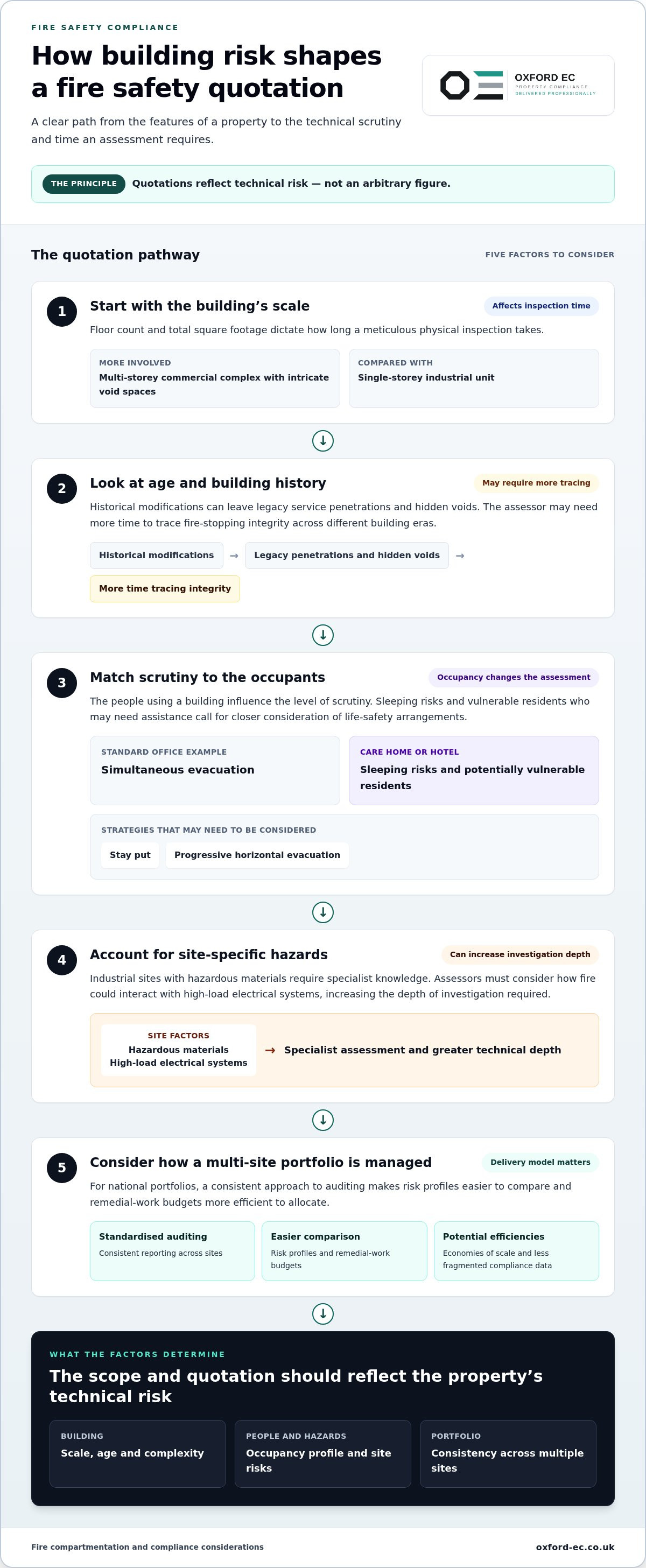
Quotations for fire safety auditing are never arbitrary. They're calculated reflections of technical risk. Scale. Scrutiny. Specificity. The primary driver of any fire compartmentation survey cost is building scale, as floor count and total square footage dictate the time required for a meticulous physical inspection. A multi-storey commercial complex with intricate void spaces requires significantly more resource than a single-storey industrial unit. Technical precision. Asset protection. Legal assurance. Beyond size, the age of the structure plays a critical role. Historical modifications often feature legacy service penetrations or hidden voids that complicate the audit process, requiring an assessor to spend more time tracing the integrity of fire-stopping measures across various building eras.
Building Complexity and Occupancy Profiles
The nature of the occupants fundamentally shifts the level of scrutiny required. Whilst a standard office might follow a "simultaneous evacuation" strategy, a residential care home or hotel involves "sleeping risks" and potentially vulnerable residents who require assistance. These environments demand a higher degree of technical mastery to ensure that life safety systems support "stay put" or "progressive horizontal evacuation" protocols. Following official government guidance ensures that these specific risks are catalogued with absolute precision. Similarly, industrial sites involving hazardous materials necessitate specialist knowledge to evaluate how fire might interact with high-load electrical systems, which directly influences the fire compartmentation survey cost by increasing the depth of the investigation required.
Multi-Site Requirements and National Portfolios
For national property managers, managing a diverse portfolio requires a disciplined and consistent approach to reporting. Standardised auditing across multiple sites allows for easier comparison of risk profiles and more efficient budget allocation for remedial works. Choosing a consultancy with national delivery capabilities ensures that the same rigorous standards are applied to every asset, regardless of location. This structured methodology often unlocks economies of scale, reducing the administrative burden of managing fragmented compliance data across separate providers. A single, accountable partner can provide a streamlined solution that protects both the inhabitants and the legal standing of the organisation. If you're managing a complex asset or a nationwide portfolio, speak with our technical consultants to discuss a structured compliance programme.
Technical Depth: Fire Compartmentation Survey Cost and High-Rise Assets
Technical precision. Structural integrity. Regulatory alignment. Property managers must distinguish between assessment methodologies to ensure their compliance strategy is both legally robust and financially efficient. For multi-occupancy residential buildings, the choice between a Type 1 and Type 4 assessment is the primary determinant of the fire compartmentation survey cost. A Type 1 survey is a non-destructive audit of common parts only, whereas a Type 4 assessment is the most comprehensive tier, involving destructive sampling within both common areas and individual dwellings. This invasive approach is often required when there is reason to suspect serious structural defects or where previous works have compromised the building’s original fire-stopping design.
The Role of Compartmentation in Fire Safety Investment
Effective fire stopping is the silent guardian of life safety. Compartmentation surveys serve to identify breaches in fire-resisting walls and floors, such as unsealed cable penetrations or compromised riser shafts. Whilst non-destructive inspections provide a high-level overview, destructive testing involves opening up voids to verify that internal fire barriers are correctly installed. These surveys provide a level of detail that a standard Fire Risk Assessment cannot reach, acting as a technical deep-dive that informs long-term remedial budgets. The total fire compartmentation survey cost fluctuates based on the volume of service penetrations and the complexity of the building’s hidden voids, as each point of potential failure requires individual scrutiny and documentation.
High-Rise Assets and the Golden Thread of Information
Buildings exceeding 18 metres or seven storeys are now categorised as higher-risk buildings under the Building Safety Act 2022. This legislation mandates the maintenance of a "Golden Thread" of information, which is a digital record of a building’s safety systems and structural integrity. For these assets, the depth of assessment is significantly increased to satisfy the Building Safety Regulator. The initial investment in a high-quality audit is higher due to the rigorous evidence-gathering required to support the Safety Case Report. Oxford Environmental Consultants fire safety services are designed to meet these exact standards, providing the technical evidence needed to demonstrate that risks are being managed effectively throughout the building’s lifecycle. Choosing a meticulous partner ensures that this digital record is accurate, accountable, and audit-ready at all times.
Evaluating Professional Competence vs Initial Fee
Price is a poor proxy for value in life safety. Low-cost providers often deliver "tick-box" documents that fail to identify latent structural defects. This is a false economy. An inadequate assessment doesn't just leave occupants at risk; it exposes the Responsible Person to significant legal action. If the Fire and Rescue Service deems an assessment insufficient, they may issue a Prohibition Notice, effectively closing the building until compliance is proven. Rigorous auditing. Technical mastery. Legal robustness. A professional survey must be suitable and sufficient to withstand the scrutiny of both regulators and insurers.
The Risk of Inadequate Fire Risk Assessments
A professional assessor must demonstrate a synthesis of formal qualifications and extensive field experience. Cheap surveys often overlook critical defects in fire doors or structural barriers, leading to catastrophic failure during a fire incident. When evaluating your fire compartmentation survey cost, consider the liability of an overlooked breach in a riser shaft or a compromised floor slab. A comprehensive report must provide clear action plans, prioritised risk ratings, and granular photographic evidence to justify every technical recommendation. Without this level of detail, the document is merely a list of observations rather than a strategic compliance tool.
Accreditation and Technical Scrutiny
Competence in the fire safety sector is defined by rigorous third-party accreditation. Standards such as BAFE SP205 represent a hallmark of expertise, ensuring the consultancy operates under a robust internal quality assurance process. This oversight ensures that every audit is peer-reviewed and remains aligned with current legislative frameworks. Property managers should scrutinise the provider's internal auditing protocols rather than just the bottom line. Adopting a standard-led approach through OEC compliance services guarantees that your documentation remains audit-ready and legally robust under the most demanding scrutiny.
The cheapest quote almost always excludes the technical support required after the report is delivered. Remedial advice. Legislative interpretation. Ongoing consultancy. Without these elements, the property manager is left with a list of problems but no clear path to resolution. Investing in competence ensures the survey serves as a protective shield for your asset. True value lies in the precision of the data and the assurance that your property is managed by a safe pair of hands that understands the high-stakes nature of modern fire safety compliance.
Strategic Compliance: Integrating Fire Safety with Property Management
Fire safety compliance shouldn't exist in a vacuum. Technical synergy. Operational efficiency. Strategic oversight. Many property managers treat individual compliance requirements as isolated tasks, which leads to fragmented data and inflated logistical overheads. By adopting a multi-disciplinary approach, you can significantly optimise your fire compartmentation survey cost whilst ensuring a higher standard of building safety. Integrating these services allows for a unified view of asset health, transforming compliance from a reactive "to-do" list into a proactive safety strategy. Oxford Environmental Consultants (OEC) specialises in this streamlined delivery, organising complex technical data into a cohesive, audit-ready framework that satisfies both regulators and insurers.
The Multidisciplinary Advantage
The logistical cost of managing separate contractors for fire, water, and asbestos is substantial. Site disruption. Administrative friction. Redundant travel fees. Combining a fire risk assessment with an asbestos management survey is a logical step for older properties where structural fire-stopping often involves legacy materials. Similarly, Legionella risk assessments can be conducted concurrently with fire safety audits, reducing the number of site visits and providing a comprehensive overview of environmental risks. OEC’s expertise extends to damp and mould inspections, ensuring that building health is monitored with the same technical rigour as fire protection, providing duty-holders with a single, accountable partner for all statutory requirements.
Securing Your Professional Quotation
To provide an accurate, fixed-fee quotation for a national portfolio, consultants require granular building data. Floor plans. Asset lists. Historical compliance records. Providing this information upfront allows for a more precise calculation of the fire compartmentation survey cost, ensuring there are no hidden fees during the survey process. Whilst short-term savings are attractive, duty-holders must prioritise long-term legal robustness and the technical precision of their documentation. A high-quality audit is a protective shield against future liability. It ensures that your property remains compliant, your occupants remain safe, and your legal standing remains unassailable.
Securing Your Asset Through Technical Excellence
Technical mastery. Legal robustness. Absolute precision. Precision in compliance is the only shield against the escalating legal and financial risks of the modern regulatory landscape. By prioritising technical mastery and rigorous auditing, property managers ensure their portfolios remain resilient under the strictest scrutiny from the Fire and Rescue Service. Optimising your fire compartmentation survey cost requires a fundamental shift; safety must be viewed as a core pillar of asset management rather than a discretionary overhead.
Oxford Environmental Consultants provides the multi-disciplinary expertise required to navigate these complexities, from adhering to the Building Safety Act 2022 to delivering audit-ready reporting for national UK portfolios. Our integrated approach to fire, asbestos, and water hygiene ensures that your compliance strategy is both efficient and legally robust. You're not just buying a report; you're securing a safe pair of hands for your most complex property requirements.
Take the next step toward total regulatory assurance and protect your inhabitants with evidence-based safety results today.
Frequently Asked Questions
Is a fire risk assessment a legal requirement for all UK businesses?
Yes, a fire risk assessment is a mandatory legal requirement for almost all non-domestic premises under the Regulatory Reform (Fire Safety) Order 2005. This includes commercial buildings, charities, and the common parts of multi-occupied residential blocks. The Responsible Person must ensure a suitable assessment is conducted to identify hazards and protect occupants. Failure to maintain a valid assessment can result in unlimited fines or criminal prosecution, as it forms the basis of legal compliance.
How often should a fire risk assessment be reviewed and what does that cost?
Legislation dictates that assessments must be reviewed regularly to remain valid, which industry best practice defines as an annual occurrence. You must also conduct a review if the building's purpose changes, structural alterations occur, or after a fire incident. The cost for these reviews depends on building complexity and whether a completely new assessment is required. Maintaining a consistent review cycle ensures that your fire safety documentation remains audit-ready and provides a robust legal defence.
What factors most significantly increase the cost of a fire risk assessment?
Building scale and the complexity of the internal layout are the primary drivers of cost. Multi-storey structures with intricate void spaces require more time for meticulous physical inspection. Additionally, high-risk occupancy profiles, such as care homes or hotels with sleeping risks, demand higher levels of technical scrutiny. The requirement for a specific fire compartmentation survey cost also increases when invasive testing is necessary to verify structural integrity in older or heavily modified commercial assets.
Can I carry out my own fire risk assessment to save money?
You may only conduct your own assessment if you are deemed a "competent person" with the necessary training and experience. For small, low-risk premises, a simple self-assessment might suffice. However, for complex commercial buildings or residential blocks, the Fire and Rescue Service expects a high degree of technical mastery. Appointing a professional consultant provides the legal assurance that the assessment is suitable and sufficient to withstand regulatory auditing and protect the Responsible Person from liability.
Does the cost of a fire risk assessment include fire door inspections?
A standard fire risk assessment provides a high-level visual audit of fire doors, but it does not typically include the granular, individual door inspections required for full compliance. Professional fire door inspections are often commissioned as a separate, more detailed service to ensure every door's hardware and seals function correctly. Integrating these inspections with your broader safety strategy can improve operational efficiency and provide a more comprehensive overview of your property's total passive fire protection.
How do I know if the quote I have received for an FRA is reasonable?
A reasonable quote reflects the technical depth and time required for a rigorous site survey. You should evaluate the proposal based on the assessor's professional qualifications and the comprehensiveness of the final report. If a quote is significantly lower than market averages, it may indicate a superficial tick-box exercise that lacks the detail to satisfy insurers. Ensure the fee covers clear action plans, prioritised risk ratings, and evidence-based results that offer genuine legal protection.
What is the difference between a Type 1 and a Type 4 fire risk assessment?
A Type 1 assessment is a non-destructive survey of the common parts of a building and is the standard requirement for purpose-built flats. In contrast, a Type 4 assessment is the most comprehensive and invasive tier, involving destructive sampling in both common areas and individual dwellings. The fire compartmentation survey cost for a Type 4 audit is higher due to the requirement for opening up voids to inspect hidden structural fire-stopping and compartmentation integrity.
Will a fire risk assessment cost more for a high-rise residential building?
Yes, high-rise buildings exceeding 18 metres fall under the strictest scrutiny tiers of the Building Safety Act 2022. These assets require an intensive audit process to support the Golden Thread of digital information and the building’s Safety Case Report. The increased technical depth, coupled with the complexity of life safety systems in taller structures, necessitates a higher level of professional resource to ensure the building remains fully compliant and safe for all inhabitants and residents.