
A single oversight in water hygiene can lead to a £20,000 fine under the Renters' Rights Act 2026 or, in the most severe cases of negligence, a multi-million pound prosecution. The stakes are absolute. Safety is paramount. Compliance is non-negotiable. For property owners and duty-holders, the complexity of aligning with ACOP L8 and HSG274 technical guidance often creates a landscape of uncertainty and risk. You understand that maintaining a legionella management plan is a statutory requirement, yet the technical nuances of complex plumbing systems and the rigorous frequency of monitoring can feel overwhelming.
We recognise that the burden of documentation and the fear of regulatory scrutiny weigh heavily on your daily operations. This guide provides the technical clarity you require to master your legal obligations and identify critical water system vulnerabilities before they escalate into health hazards. We'll preview the essential components of an audit-ready written scheme, the specific monitoring intervals required for 2026, and the precise steps to ensure your property remains a safe, legally fortified environment.
Key Takeaways
- Legal. Robust. Compliant. Understand the statutory mandates of the Health and Safety at Work Act 1974 and COSHH to ensure absolute regulatory alignment and protect your professional standing.
- Identify. Monitor. Protect. Discern the technical vulnerabilities within water systems, such as stagnation and the 20°C to 45°C thermal danger zone, where Legionella bacteria proliferate.
- Rigorous. Methodical. Exact. Implement a comprehensive legionella management plan that incorporates a methodical written scheme of control, including monthly sentinel monitoring and weekly flushing regimes.
- Expertise. Scrutiny. Accountability. Recognise why expert risk assessments are indispensable for identifying the hidden system risks that standard internal inspections frequently overlook in complex property portfolios.
- Integrated. Streamlined. Efficient. Consolidate your compliance obligations by combining water hygiene with fire and asbestos management to create a single, cohesive, and audit-ready property safety strategy.
Table of Contents
The Legal Mandate: Legionella Compliance in 2026
Legal. Rigid. Uncompromising. The Health and Safety at Work etc. Act 1974 establishes the foundational duty for all UK employers to ensure the safety of their premises, including the management of biological risks. Under the Control of Substances Hazardous to Health (COSHH) Regulations 2002, Legionella is classified as a hazardous biological agent that requires strict scrutiny and technical control. To understand the underlying science, one might ask What is Legionella?; it is a bacterium that thrives in man-made water systems, necessitating a robust legionella management plan to mitigate the risk of Legionnaires' disease. This plan isn't merely a suggestion but a statutory requirement for any individual or organisation in control of a premises where water is stored or used.
The 2026 regulatory environment has shifted toward transparency and precision. The Renters' Rights Act 2026, which came into force on 1 May 2026, has intensified the focus on property standards, with non-compliance now carrying fines of up to £20,000. Digital audit trails and real-time temperature monitoring are no longer optional luxuries but are the expected standard for demonstrating alignment with ACOP L8 and HSG274. The Health and Safety Executive's Approved Code of Practice (ACOP L8) and its supporting technical guidance, HSG274, remain the definitive frameworks for modern water hygiene management. These documents provide the rigorous standards required to ensure every water system is maintained in a state of absolute safety.
Defining the Duty-Holder’s Liabilities
Accountability. Ownership. Responsibility. The duty-holder is the individual or organisation in control of the premises, often the employer or landlord, who bears the primary legal liability for occupant health and safety. Failure to appoint a "Competent Person" to oversee water hygiene management is a critical breach that leaves the organisation legally exposed. In 2026, claiming ignorance regarding system modifications or neglected pipework is an invalid defence during a Health and Safety Executive (HSE) audit. The duty-holder must ensure that the risk assessment is reviewed whenever there is reason to suspect it is no longer valid, such as changes to the water system or its use, to maintain a continuous shield of protection.
Regulatory Scrutiny and Written Schemes
Audit-ready. Precise. Evidentiary. For organisations with five or more employees, a written scheme of control is a mandatory requirement that must detail the specific measures taken to manage risks and ensure safety. A professional assessment serves as a protective shield, preventing HSE intervention and significantly reducing the risk of corporate manslaughter charges following an outbreak. You must ensure your water hygiene regime is as rigorous as your fire risk assessments to maintain a unified front of property safety. This methodical approach ensures that every valve, tank, and outlet is accounted for within a legally robust framework, providing peace of mind through documented precision and evidence-based results.
Identifying System Vulnerabilities: Where Bacteria Thrive
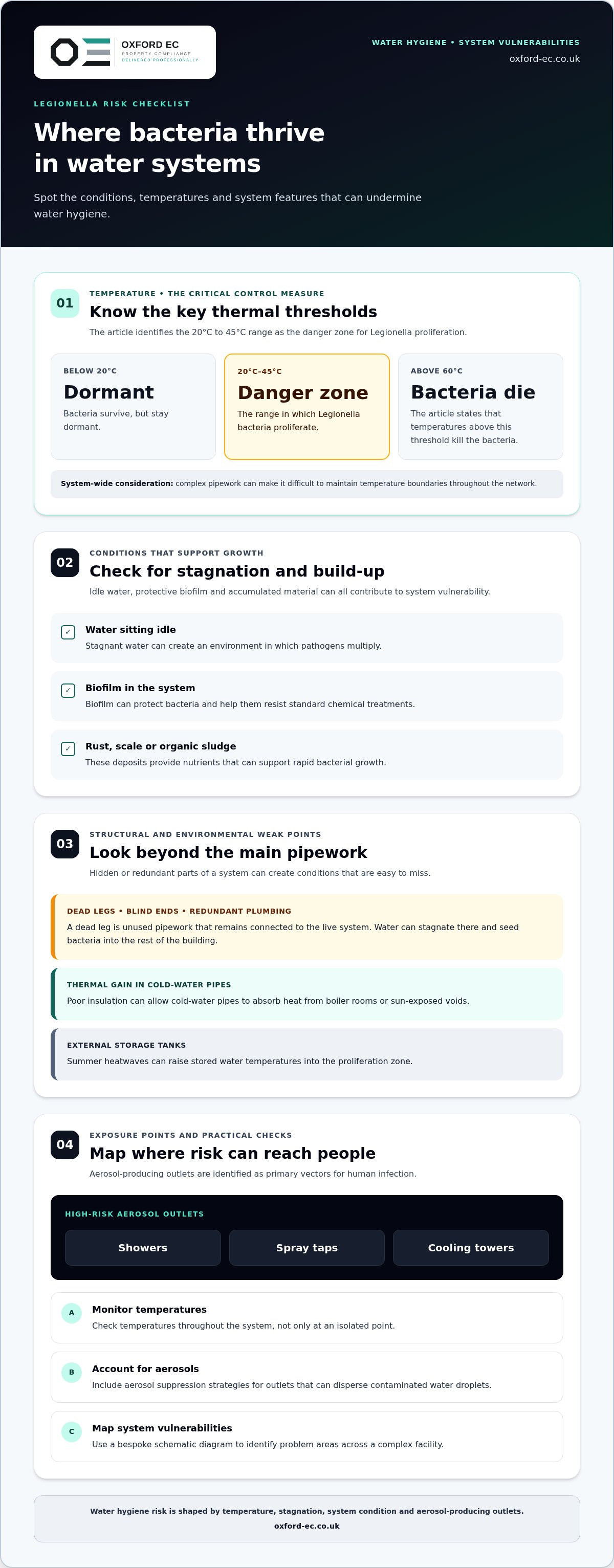
Legionella colonisation is a mechanical failure. Stagnation. Nutrients. Proliferation. When water sits idle, it creates an incubator for pathogens. Biofilm acts as a protective shield, allowing bacteria to resist standard chemical treatments. Rust, scale, and organic sludge provide the necessary nutrients for rapid growth. This biological process is the primary reason why a legionella management plan must account for every cubic centimetre of a system to ensure total occupant safety.
Temperature remains the most critical control measure. The thermal range between 20°C and 45°C is the danger zone. Below 20°C, the bacteria survive but stay dormant; above 60°C, they die. However, many complex systems struggle to maintain these boundaries throughout the entire pipework network. High-risk outlets that produce aerosols, such as showers, spray taps, and cooling towers, are the primary vectors for human infection. You must ensure your UK legal requirements for Legionella control are met through rigorous temperature monitoring and aerosol suppression strategies.
Commercial and Industrial Risk Factors
Dead legs. Blind ends. Redundant plumbing. These are the structural flaws that undermine safety. A dead leg is a section of pipework that is no longer in use but remains connected to the live system, allowing water to stagnate and seed the rest of the building with bacteria. In large industrial assets, thermal gain is a persistent threat; poor insulation allows cold water pipes to absorb ambient heat from boiler rooms or sun-exposed voids. Every complex facility requires a bespoke schematic diagram to map these vulnerabilities, ensuring that no part of the infrastructure is left to chance. If you are unsure of your current system's integrity, you can speak with our technical team for a professional review.
Environmental Health Integration
Seasonal shifts. Material degradation. Property health. External storage tanks are particularly susceptible to summer heatwaves, which can push water temperatures into the proliferation zone. The materials used in construction also play a role; certain rubbers and sealants act as food sources for bacteria and should be replaced with approved alternatives. We often find that water hygiene issues are symptomatic of broader building failures. Linking your water safety strategy to a professional damp and mould inspection ensures a comprehensive approach to environmental health. This holistic view prevents isolated fixes and creates a resilient, audit-ready property portfolio.
The Professional Scrutiny: Assessment vs DIY
Expertise. Scrutiny. Certainty. Relying on a generic checklist for a complex commercial water system isn't just risky; it's a fundamental failure of duty. Whilst basic domestic assessments might seem straightforward, the health risks of Legionella are too severe to leave to chance in high-occupancy environments. A professional legionella management plan requires a level of technical competence that internal staff rarely possess. A meticulous site survey involves a methodical physical inspection of every water outlet, plant room, and storage vessel to ensure no vulnerability remains hidden from the duty-holder.
Definitive bacterial detection is achieved through strategic water sampling and analysis conducted in UKAS-accredited laboratories. This process moves beyond visual guesswork to provide empirical evidence of water safety. The resulting audit-ready reporting translates raw technical data into a prioritised remedial action plan, allowing the duty-holder to address high-risk areas with surgical precision. This methodical approach ensures that every valve and tank is accounted for in a legally robust framework that stands up to the most rigorous external audit.
What a Professional Assessment Delivers
A professional survey provides a comprehensive asset register, cataloguing every tank, calorifier, and thermostatic mixing valve (TMV) within the infrastructure. We establish a baseline for hot and cold water performance at sentinel outlets through rigorous temperature profiling, ensuring the "hot hot, cold cold" rule is consistently met. Photographic evidence is used to document system defects and non-compliance, ensuring that every report is transparent, evidence-based, and ready for regulatory scrutiny. This level of detail provides a "safe pair of hands" for national property portfolios where fragmented data can lead to catastrophic oversights.
The Limitations of Tick-Box Templates
Generic templates often fail to satisfy HSE inspectors in commercial or high-risk settings because they lack site-specific context and technical depth. Hidden dead legs in refurbished or repurposed properties are frequently overlooked by untrained eyes, creating pockets of stagnant water that bypass standard checks and seed the wider system with pathogens. It's also vital to ensure water hygiene alignment with asbestos management surveys during building works. Disturbing old pipework or insulation can trigger multi-disciplinary safety risks, requiring a coordinated consultancy approach that integrates water safety with fire and asbestos compliance.
Implementing an Effective Written Scheme of Control
Precision. Discipline. Continuity. A legionella management plan is only as effective as the written scheme of control that dictates its daily execution. This document serves as the operational manual for water safety, outlining the specific monitoring and maintenance tasks required to maintain a bacteriologically safe environment. The monthly discipline of temperature monitoring at sentinel outlets ensures the "hot hot, cold cold" rule is strictly observed; hot water must reach 50°C (or 55°C in healthcare settings) within one minute, whilst cold water must remain below 20°C after two minutes of flow.
Stagnation is a catalyst for bacterial growth. Weekly flushing regimes for infrequently used water points, such as guest rooms or redundant staff toilets, are essential for maintaining water movement and preventing nutrient build-up. A regular programme for descaling and disinfecting showerheads and hoses every quarter removes the scale and organic matter that protect pathogens from thermal or chemical control. Your risk assessment must be a living document; it requires a formal review at least every 24 months, or immediately following significant system alterations or changes in building use.
Roles and Responsibilities
Structure and accountability are paramount. The duty-holder must assign an Appointed Person and a Deputy to oversee the scheme, often supported by a specialist contractor for technical monitoring tasks. Logbook management is the evidentiary backbone of compliance; every check must be signed, dated, and stored securely to provide a robust audit trail for HSE inspectors. In the event of a positive Legionella sample, a pre-defined emergency procedure must be triggered, involving immediate isolation of the outlet and a technical investigation into the source of the contamination.
Remedial Actions and Upgrades
Identify. Rectify. Secure. When a risk assessment highlights structural plumbing failures, prompt intervention is required to maintain legal alignment. Removing dead legs is a permanent solution to eliminate stagnant water traps that cannot be managed through flushing alone. In cases of severe contamination or sediment build-up, tank cleaning and chlorination become technically necessary to restore system integrity. By utilising professional remedial services, you ensure that physical defects are corrected by experts who understand the intersection of plumbing and hygiene.
Integrated Compliance: The Oxford Environmental Advantage
Integrated. Cohesive. Robust. Water hygiene isn't an isolated discipline; it's a critical pillar within a broader framework of property safety that requires technical synchronicity. Managing a legionella management plan in a vacuum, detached from fire safety and asbestos risks, often leads to fragmented data and significant administrative friction for the duty-holder. Our multi-disciplinary expertise allows us to streamline property audits by combining Legionella, Asbestos, and Fire safety into a single, cohesive compliance strategy that ensures absolute precision across your entire estate. This unified approach eliminates the gaps that often appear when using multiple, disconnected service providers.
We provide national delivery with consistent standards, ensuring that whether you manage a single commercial asset or a vast UK property portfolio, your reporting remains rigorous and audit-ready. This commitment to technical mastery ensures that every document we produce withstands the highest levels of regulatory scrutiny from the Health and Safety Executive. By aligning your water hygiene strategy with other statutory requirements, you create a resilient safety shield that protects both occupant health and your legal standing. Our role as an accountable partner is to provide the technical evidence required to demonstrate absolute regulatory alignment at every level of your organisation.
The Meticulous Expert Approach
Precision. Order. Efficiency. Our meticulously organised surveys are designed to reduce the administrative burden on the duty-holder by consolidating fragmented requirements into a streamlined workflow. By providing a single point of contact for all property compliance and water hygiene requirements, we eliminate the need to coordinate multiple vendors with conflicting schedules and reporting formats. This "safe pair of hands" approach protects your reputation and your physical assets through expert environmental consultancy that prioritises evidence-based results. We thrive on the details that others overlook, ensuring your documentation is always ready for a professional audit.
Securing Your Property Compliance
Booking your initial risk assessment is the first step towards total legal immunity and occupant safety in an increasingly regulated market. For complex refurbishment and demolition projects, we provide specialist consultancy to ensure that water systems are safely decommissioned or modified without compromising the wider building's integrity. Contacting Oxford Environmental Consultants for a comprehensive review of your property compliance ensures that your legionella management plan is integrated into a future-proof safety shield. This methodical transition from assessment to implementation provides the peace of mind that comes from knowing every risk has been scrutinised and mitigated by experts.
Securing Your Regulatory Future in 2026
Compliance. Safety. Immunity. These aren't just goals; they're the mandatory benchmarks for every property duty-holder in 2026. You've recognised that a robust written scheme of control, underpinned by the "hot hot, cold cold" rule, is the only way to ensure absolute property safety and legal alignment. By identifying technical vulnerabilities like dead legs and biofilm, you move from reactive maintenance to proactive risk management that protects both your occupants and your professional reputation.
Implementing a rigorous legionella management plan requires more than just a template; it demands the meticulous eye of an expert partner. Oxford Environmental Consultants provides the rigorous technical expertise and regulatory mastery needed to navigate the complex mandates of ACOP L8 and HSG274. Our comprehensive multi-disciplinary compliance reporting integrates water hygiene with fire and asbestos safety, offering a single, audit-ready solution with national UK coverage for large property portfolios. We're ready to act as your guardian of compliance.
Take the definitive step towards technical precision and total property safety today. We look forward to securing your assets.
Frequently Asked Questions
Is a Legionella risk assessment a legal requirement for all UK businesses?
Conducting a Legionella risk assessment is a mandatory legal requirement for all UK employers and property duty-holders. This obligation stems from the Health and Safety at Work etc. Act 1974 and the COSHH Regulations 2002. These laws require you to identify and assess risks from biological agents. Failure to comply can result in severe penalties, including fines up to £20,000 under the Renters' Rights Act 2026 or unlimited fines for corporate negligence.
How often should a Legionella management plan be reviewed?
Your legionella management plan should be reviewed at least every 24 months to ensure it remains valid and effective. However, immediate reviews are necessary if there are significant changes to the water system, building use, or if a positive sample is detected. Regular reviews demonstrate proactive compliance to the Health and Safety Executive (HSE). For higher-risk environments, such as care homes or hospitals, more frequent annual reviews are often considered best practice under BS 8580-1:2019.
Can a landlord carry out a Legionella risk assessment themselves?
UK law allows landlords to conduct their own assessments if they are competent to do so, but they remain legally liable for any oversights. Whilst simple domestic properties with combi boilers present lower risks, complex commercial assets require technical mastery of pipework and plant systems. Most duty-holders lack the specialist equipment and regulatory knowledge to identify hidden dead legs or biofilm. Appointing a professional ensures the assessment is audit-ready and provides a robust legal shield.
What are the common symptoms of Legionnaires’ disease?
Legionnaires' disease typically presents as a severe form of pneumonia with symptoms including high fever, a persistent cough, muscle pain, and headaches. Some patients also experience chest pains or shortness of breath as the infection progresses. It's vital to recognise these signs early, as the disease has a fatality rate of approximately 30% in untreated or vulnerable cases. Because the symptoms mirror other respiratory infections, clinical diagnosis through specialist testing is essential for effective medical treatment.
What immediate actions should be taken if Legionella bacteria are detected?
If Legionella bacteria are detected, you must immediately isolate the affected outlets and prevent access to avoid aerosol exposure. The next steps involve a technical investigation to identify the source of contamination, followed by remedial actions such as thermal disinfection or chlorination. You must record these events in your logbook and conduct follow-up water sampling to confirm the system is safe. Following a clear emergency protocol within your legionella management plan is critical for regulatory alignment.
Do I need a management plan if my property is currently vacant?
Yes, vacant properties require a management plan because stagnation is a primary catalyst for bacterial proliferation. When water sits idle in pipework for extended periods, biofilm develops and provides a breeding ground for pathogens. Duty-holders should implement a regular flushing regime to maintain water movement and prevent nutrient build-up during void periods. Before re-occupancy, a thorough review of the risk assessment and potential disinfection may be necessary to ensure the water system is safe for use.
How long does a professional Legionella risk assessment typically take?
The duration of a professional assessment depends entirely on the scale and complexity of the property. A standard domestic or small office inspection typically takes between one and two hours to complete. However, large industrial facilities or multi-storey commercial buildings with cooling towers and complex plant rooms may require several days of methodical scrutiny. A professional surveyor must inspect every outlet and storage vessel to ensure the resulting report is comprehensive and audit-ready for scrutiny.
What is the difference between a risk assessment and water sampling?
A risk assessment is a physical survey of the water system's design and management to identify potential hazards and vulnerabilities. In contrast, water sampling is the process of collecting physical samples for laboratory analysis to detect the presence of specific bacteria. Whilst the risk assessment provides the framework for control, sampling provides empirical evidence of the system's current condition. Both are essential components of a rigorous hygiene regime, but sampling does not replace the legal requirement for a written scheme.