Between 2005 and 2024, UK courts handed down £8.6 million in fines across 28 Legionella prosecutions, with half of those enforcement cases involving a fatality. Compliance is critical. Scrutiny is unyielding. For commercial duty holders, understanding the exact legal requirements for legionella testing in business premises is not merely an administrative exercise; it is an essential safeguard against severe HSE penalties and corporate liability.
Many responsible persons recognise that a Legionella risk assessment is legally mandated under the Health and Safety at Work etc. Act 1974 and COSHH, yet widespread confusion persists over when routine temperature checks must escalate to accredited laboratory analysis. This guide clarifies the specific operational triggers that necessitate microbiological sampling under HSE ACoP L8 and HSG274, enabling you to establish an audit-ready water hygiene scheme that protects building occupants without disrupting day-to-day operations. Ahead, we detail mandatory sampling frequencies, British Standards, and the documentation required to demonstrate due diligence to regulatory inspectors.
Key Takeaways
- Distinguish between mandatory Legionella risk assessments and condition-specific laboratory sampling under the Health and Safety at Work etc. Act 1974.
- Identify the operational triggers and legal requirements for legionella testing in business premises, including temperature breaches, stagnant distribution lines, and evaporative cooling assets.
- Ensure sampling integrity by aligning your testing regimes with BS 7592 methodology and independent UKAS-accredited laboratory analysis.
- Establish compliant five-year record-keeping protocols to ensure logbooks, maintenance records, and inspection certificates remain audit-ready for HSE inspectors.
- Construct a proportionate, site-specific written scheme of control that safeguards commercial water systems without impeding day-to-day business productivity.
Table of Contents
- The Legal Framework Governing Legionella Testing in UK Business Premises
- Mandatory Assessment vs Water Testing: Understanding Your Exact Legal Obligations
- Statutory Standards for Water Sampling and UKAS Laboratory Analysis
- Legal Record-Keeping, Logbooks, and Statutory HSE Audit Readiness
- Developing an Audit-Proof Legionella Control Scheme for Your Business
The Legal Framework Governing Legionella Testing in UK Business Premises
UK health and safety law treats water hygiene with uncompromising gravity. Commercial operators cannot afford ambiguity regarding statutory obligations. The legal requirements for legionella testing in business premises stem from a layered hierarchy of criminal statutes, statutory instruments, and formal codes of practice designed to prevent the proliferation of pathogenic bacteria.
Statutory Legislation: HASAWA 1974, MHSWR 1999, and COSHH 2002
Primary liability rests upon the Health and Safety at Work etc. Act 1974. Under Section 2, employers must ensure the health and safety of their workforce; Section 3 extends this duty to protect non-employees, such as visitors or contractors; Section 4 places liability on anyone controlling commercial premises. Regulation 3 of the Management of Health and Safety at Work Regulations 1999 (MHSWR) mandates proactive risk assessments to identify workplace hazards systematically. Under the Control of Substances Hazardous to Health Regulations 2002 (COSHH), the waterborne Legionella bacterium is formally classified as a biological agent, requiring business operators to prevent exposure or implement rigorous control schemes where prevention isn't reasonably practicable.
The Legal Significance of HSE ACoP L8 and Technical Guidance HSG274
Statutory weight. Legal presumption. Actionable proof.
The HSE Approved Code of Practice L8 (fourth edition, 2013) holds special legal standing under Section 17 of HASAWA. While not a standalone statute, failure to observe ACoP L8 creates an automatic presumption of guilt in health and safety prosecutions unless duty holders prove compliance via equally effective methods. HSG274 operationalises this framework across three distinct scopes: Part 1 governs evaporative cooling systems (revised in 2024), Part 2 addresses hot and cold water installations, and Part 3 dictates controls for specialised risk systems. Adhering to these standards forms the baseline defence against regulatory enforcement.
Duty Holders, Responsible Persons, and Appointed Competence
Clear accountability prevents statutory breaches. In commercial leases, confusion often arises over where responsibility falls between landlords and tenants. Legally, the duty holder is whoever retains operational control over the water system. Fully repairing leases typically transfer this burden directly to commercial tenants, whereas common-parts management remains strictly with the landlord or managing agent.
The duty holder must formally appoint a competent person with sufficient training, technical expertise, and operational authority to implement controls. Understanding the strict legal requirements for legionella testing in business premises means knowing when in-house resources suffice and when third-party verification is non-negotiable. For many duty holders, retaining specialist oversight via OEC compliance services bridges internal capability gaps, establishing an unbroken audit trail of statutory governance.
Mandatory Assessment vs Water Testing: Understanding Your Exact Legal Obligations
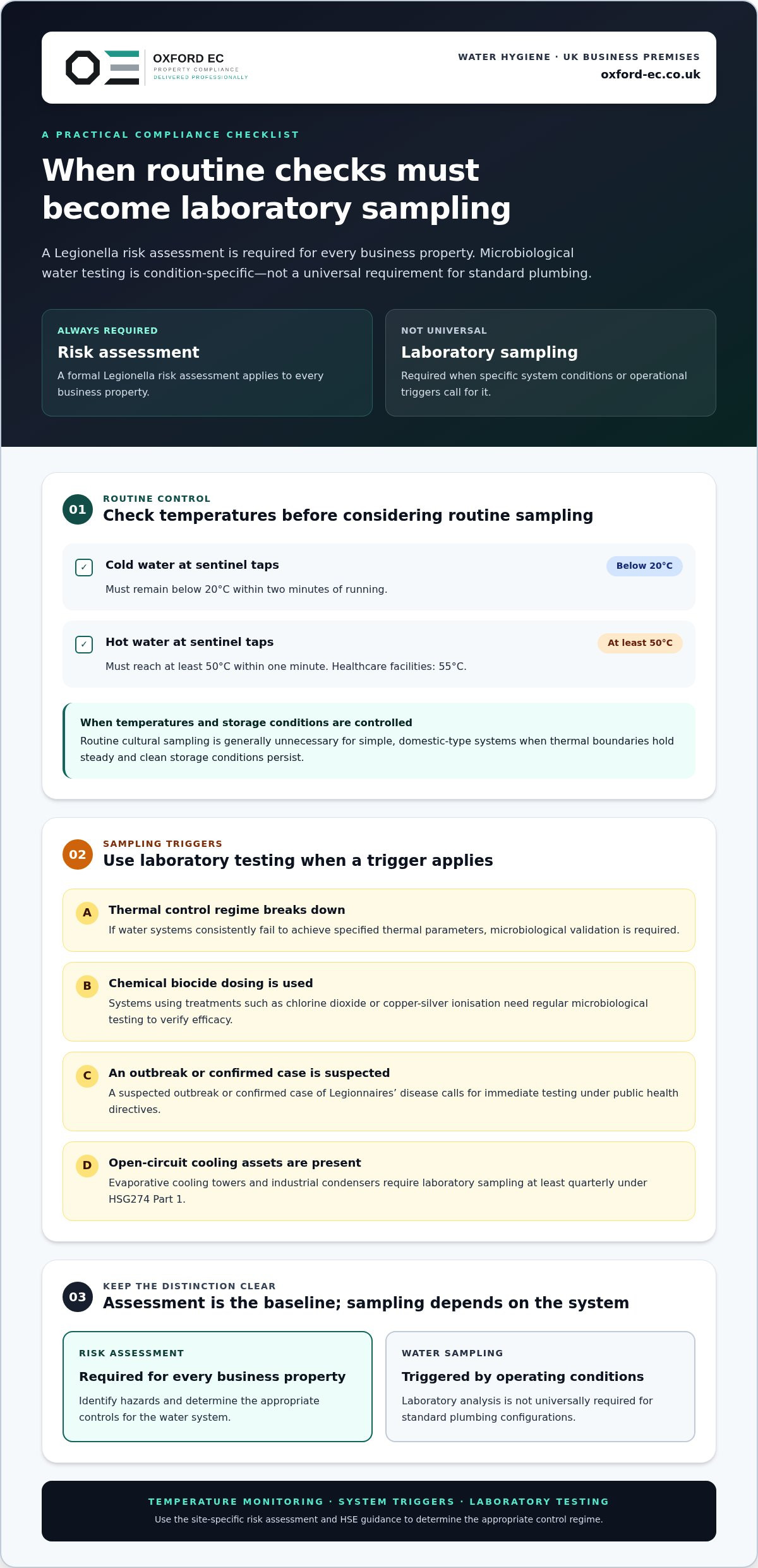
Duty holders frequently conflate a physical risk assessment with microbiological water testing. They aren't identical obligations. While carrying out a formal Legionella risk assessment is a blanket statutory requirement under HASAWA 1974 for every business property, laboratory water sampling is not universally mandated for standard plumbing configurations. Discerning this boundary prevents unnecessary expenditure whilst guaranteeing strict regulatory compliance.
When Is Laboratory Water Testing Legally Mandated by HSE?
Specific operational criteria convert discretionary sampling into an enforceable duty. The statutory guidance outlined in HSG274 Part 2 specifies that businesses must initiate laboratory sampling under defined operational triggers:
- Open-circuit cooling assets: Evaporative cooling towers and industrial condensers demand quarterly laboratory sampling at minimum under HSG274 Part 1.
- Control regime breakdown: Water systems failing to achieve specified thermal parameters consistently require microbiological validation.
- Biocide treatment regimens: Systems relying on chemical dosing, such as chlorine dioxide or copper-silver ionisation, require regular microbiological testing to verify efficacy.
- Post-incident investigations: Any suspected outbreak or confirmed case of Legionnaires' disease mandates immediate testing under public health directives.
Duty holders must consult the authoritative legal requirements for legionella testing to ensure their operational verification meets HSE expectations.
Routine Temperature Monitoring vs Microbiological Water Sampling
Thermal control remains the primary defence in typical commercial buildings. Routine monitoring centres on monthly temperature audits at sentinel taps: cold water must remain below 20°C within two minutes of running, whilst hot water must reach at least 50°C within one minute (55°C in healthcare facilities). If these thermal boundaries hold steady and clean storage conditions persist, routine cultural sampling is generally unnecessary for simple, domestic-type systems.
Understanding these thresholds forms the core of an audit-ready water hygiene programme. For organisations seeking an integrated compliance roadmap, consulting our dedicated water hygiene services provides complete technical clarity on physical inspections versus sampling routines.
Assessing Water System Complexity and Susceptible Occupant Profiles
Assess the system. Quantify the aerosol. Protect the vulnerable.
The regulatory necessity for testing escalates alongside mechanical complexity and occupant vulnerability. Commercial facilities operating spa pools, hydrotherapy tanks, industrial humidifiers, or expansive, dead-leg-prone distribution networks generate aerosolised droplets, substantially heightening transmission risks. In healthcare settings, residential care homes, and high-density commercial hospitality, duty holders face stringent statutory expectations. In these high-dependency environments, the legal requirements for legionella testing in business premises dictate rigorous, scheduled sampling programmes regardless of temperature stability. If your site features complex assets or serves vulnerable populations, duty holders can contact our specialist technical consultants to evaluate whether mandatory sampling applies to your systems.
Statutory Standards for Water Sampling and UKAS Laboratory Analysis
Rigorous collection. Controlled transit. Accredited analysis.
Executing microbiological water sampling is an exact science governed by strict technical parameters. Adhering to the legal requirements for legionella testing in business premises requires uncompromising alignment with established British Standards and accredited laboratory procedures. Collecting a sample incorrectly or allowing temperature deviations during transit invalidates analytical findings, rendering the exercise legally indefensible during an audit.
Compliance with BS 7592: Sampling Protocols and Chain of Custody
Field methodology dictates evidentiary value. Sampling must strictly follow BS 7592:2022, which governs sampling for Legionella bacteria in water systems across commercial premises. Technicians must collect both pre-flush samples to assess local outlet colonisation and post-flush samples to evaluate systemic water quality. Sample containers must contain sodium thiosulphate to neutralise oxidising biocides immediately upon collection. Furthermore, samples must reach the testing facility within 24 hours under temperature-controlled conditions (shielded from light and maintained between 6°C and 20°C). Procuring specialist sampling through OEC water hygiene services guarantees complete chain of custody from extraction to final certificate.
Understanding Action Thresholds: Interpreting Laboratory CFU/L Results
UKAS-accredited microbiological laboratories quantify Legionella using colony-forming units per litre (CFU/L) through ISO 11731 culture methods. HSG274 establishes distinct statutory response tiers based on these microbiological counts:
- Under 100 CFU/L: Denotes acceptable operational control. Routine monitoring schedules and existing temperature controls continue unchanged.
- 100 to 1,000 CFU/L: Indicates localized or emergent systemic colonisation. Duty holders must review control measures, check temperature profiles, inspect physical assets for stagnation, and resample to establish trends.
- Exceeding 1,000 CFU/L: Signals severe systemic contamination. Duty holders must immediately review risk assessments, initiate remedial disinfection or thermal pasteurisation, and resample until microbiological control is re-established.
Limitations of Dip Slides and Rapid Testing in Commercial Audits
Convenience cannot replace compliance. Some duty holders deploy generic dip slides or rapid lateral flow testing kits, assuming they fulfill the legal requirements for legionella testing in business premises. Dip slides merely detect non-specific total viable counts (TVC) of general aerobic bacteria; they don't identify pathogenic Legionella pneumophila strains. Rapid test kits frequently register dead cells or lack sensitivity at lower thresholds, leading HSE inspectors to reject them as defensible proof of control. When statutory assurance is required, duty holders should schedule formal sampling directly through the OEC contact page.
Legal Record-Keeping, Logbooks, and Statutory HSE Audit Readiness
Documented evidence. Traceable accountability. Uncompromising transparency.
In regulatory law, an undocumented check is an unperformed check. HSE inspectors and Environmental Health Officers (EHOs) scrutinise paperwork first; an incomplete logbook serves as primary evidence of systemic management failure. Satisfying the legal requirements for legionella testing in business premises mandates maintaining an active, verifiable audit trail demonstrating continuous oversight.
Mandatory Contents of an Audit-Ready Water Hygiene Logbook
Under MHSWR 1999 and ACoP L8, businesses employing five or more people must record the significant findings of their risk assessment in writing. An audit-ready logbook, whether maintained digitally or within a physical binder on site, must contain:
- System schematic diagrams: Up-to-date layout drawings identifying dead legs, storage vessels, sentinel outlets, and isolation valves.
- The written scheme of control: Operational procedures, staff competence matrices, and designated responsibilities.
- Routine monitoring logs: Monthly sentinel outlet temperatures, incoming mains readings, and calorifier flow and return logs.
- Maintenance and remedial records: Quarterly showerhead descaling and disinfection logs, tank inspection records, and TMV service reports.
- Microbiological verification: UKAS laboratory test certificates detailing Legionella and TVC analysis where sampling was triggered.
The Five-Year Document Retention Rule Under ACoP L8
ACoP L8 paragraph 65 enforces a strict five-year document retention rule. Duty holders must preserve records of all monitoring inspections, tests, and chemical maintenance visits for at least five full years from the date of completion. Meanwhile, the baseline Legionella risk assessment and the written scheme of control must be retained permanently during their currency and for at least two years after replacement. Missing historical records during a retrospective outbreak investigation immediately exposes businesses to corporate manslaughter and health and safety charges.
Surviving an Unannounced HSE or Environmental Health Inspection
Regulatory scrutiny rarely announces itself. During an unannounced inspection, enforcement officers rapidly pinpoint vulnerability markers: unrecorded dead legs, sporadic temperature logs, and overdue risk reviews. If non-compliance is identified, inspectors issue formal notices under Section 21 and Section 22 of HASAWA 1974. Improvement notices demand mandatory remediation within fixed statutory deadlines, whilst immediate prohibition notices can shut down cooling plant, commercial showers, or entire operations until biological safety is proven. Maintaining thorough records remains your first line of statutory defence.
A properly structured logbook demonstrates full compliance with the legal requirements for legionella testing in business premises, transforming continuous management into concrete legal protection.
Developing an Audit-Proof Legionella Control Scheme for Your Business
Prevent stagnation. Inhibit growth. Validate control.
Under ACoP L8, implementing a formal written scheme of control is a statutory mandate whenever a water system presents a foreseeable risk. Managing commercial risk requires an active operational mechanism that translates hazard identification into daily engineering discipline. Establishing a compliant regime ensures your site satisfies all legal requirements for legionella testing in business premises without placing unnecessary administrative friction on core operational teams.
Engineering Out Risk: Flushing, Descaling, and System Modifications
Physical risk reduction always precedes chemical dosing or secondary intervention. High-performing control schemes target conditions that foster bacterial amplification:
- Weekly flushing routines: Outlets subject to low footfall or periodic dormancy must be purged weekly until temperatures stabilise, preventing biofilm attachment in distribution branches.
- Quarterly descaling: Spray taps, hose reels, and showerheads generate respirable aerosols and accumulate limescale; these must be dismantled, cleaned, and disinfected on a strict quarterly schedule.
- Eliminating dead legs: Redundant pipework, capped branches, and blind ends trap stagnant water at ambient temperatures. Duty holders must proactively isolate and cut back dead legs to eliminate biological reservoirs permanently.
Integrating Multidisciplinary Compliance Across Building Services
Water hygiene cannot be managed in isolation. Fragmented property management introduces administrative blind spots, exposing duty holders to regulatory scrutiny across multiple regulatory fronts. Aligning water hygiene schedules with wider statutory requirements, such as passive fire protection, emergency lighting, and asbestos management surveys, creates a unified compliance posture. Adopting an integrated strategy gives facilities managers clear visibility across their entire built asset portfolio, ensuring all statutory inspection intervals are met consistently.
Securing Robust Water Hygiene Compliance with Professional Specialists
Meeting statutory expectations demands verified competence. When selecting third-party compliance partners, duty holders must ensure technical teams demonstrate explicit alignment with BS 8580-1:2019 for risk assessments and BS 7592:2022 for microbiological water sampling. Partnering with a nationwide multidisciplinary consultancy provides commercial operations with audit-ready documentation and defensible legal protection against HSE enforcement action. To establish an audit-proof water safety plan tailored to your commercial infrastructure, contact OEC for compliance support and protect your organisation against statutory liability.
Protecting Your Commercial Premises Through Statutory Due Diligence
Absolute legal clarity. Technical rigour. Proactive protection.
Achieving regulatory peace of mind doesn't require operational disruption or administrative guesswork. Fulfilling the legal requirements for legionella testing in business premises centres on maintaining a disciplined balance between routine temperature monitoring and targeted, UKAS-accredited microbiological sampling. By enforcing strict adherence to BS 7592 protocols, preserving an unbroken five-year logbook audit trail, and executing a robust written scheme of control, duty holders effectively eliminate compliance ambiguity whilst protecting occupants from serious biological hazards.
Nationwide property compliance doesn't have to be complicated. Backed by comprehensive mastery of HSE ACoP L8 and HSG274 standards, our multidisciplinary consultancy provides the accountable oversight you need to face any regulatory inspection with total confidence.
Frequently Asked Questions
Is Legionella testing legally required for all UK commercial businesses?
No, laboratory water testing is not a universal blanket requirement for every UK business premises. While an up-to-date Legionella risk assessment is legally mandatory across all commercial sites under HASAWA 1974, physical microbiological water sampling is only mandated under specific conditions. These include operating evaporative cooling towers, failing to maintain thermal control boundaries, using biocide dosing systems, or managing high-risk environments with aerosol-generating equipment.
What is the statutory difference between a risk assessment and water testing?
A Legionella risk assessment is a holistic statutory evaluation of your entire water system, whereas water testing is the physical laboratory analysis of water samples. Risk assessments identify potential hazards, examine operational schematics, evaluate temperature regimes, and establish control protocols under BS 8580-1:2019. Testing involves collecting samples under BS 7592 to quantify bacterial counts in colony-forming units. Testing provides a snapshot of current colonisation, but it cannot substitute for an assessment.
How often must water samples be tested for Legionella in business premises?
Testing frequency depends entirely on system architecture and operational risk profiles defined in HSG274. For evaporative cooling towers, the legal requirements for legionella testing in business premises dictate quarterly sampling at minimum. In standard hot and cold water installations, testing is required only when temperature parameters consistently fail (under 50°C for hot, over 20°C for cold), after prolonged system stagnation, or in response to medical alerts. Healthcare premises require frequent, scheduled intervals.
Who is legally liable if Legionella bacteria is discovered on commercial property?
Statutory liability rests with the designated duty holder, typically the employer, managing agent, or commercial tenant retaining operational control. Commercial lease terms dictate physical boundary liabilities; fully repairing leases typically transfer water system duties to tenants. While day-to-day management can be formally delegated to an appointed competent person or specialist compliance partner, ultimate statutory accountability under HASAWA 1974 remains with the duty holder. Failure to manage identifiable risks can trigger criminal prosecution.
What legal penalties can businesses face for non-compliance with ACoP L8?
Non-compliance exposes commercial duty holders to unlimited financial penalties, statutory closure notices, and criminal prosecution. Courts impose unlimited fines under the Health and Safety Offences Act 2008, with historical UK penalties exceeding £1.8 million in severe enforcement cases. Inspectors also issue formal Improvement or Prohibition notices under HASAWA Section 21, shutting down commercial water assets instantly. In catastrophic incidents involving fatalities, directors face individual disqualification and corporate manslaughter charges carrying custodial sentences.
Can business owners conduct Legionella water testing themselves using postal kits?
Business owners should avoid self-sampling because improper collection protocols frequently invalidate analytical results in court. Complying with the legal requirements for legionella testing in business premises demands strict adherence to BS 7592 methodology, including sterile bottle handling, biocide neutralisation, and temperature-controlled transit within 24 hours. Postal samples collected by untrained personnel risk false negatives, secondary contamination, or total regulatory rejection by HSE auditors during an unannounced inspection. Professional sampling guarantees defensible chain of custody.
How long must commercial businesses retain Legionella inspection and testing records?
Commercial operators must retain all monitoring, maintenance, and water testing records for at least five full years. Paragraph 65 of HSE ACoP L8 legally requires businesses to preserve monthly temperature logs, chemical dosing records, disinfection certificates, and UKAS test findings for five years from the completion date. The baseline Legionella risk assessment and the written scheme of control must be retained permanently throughout their operational validity, and kept for two further years after replacement.