
Between 2005 and 2024, UK courts handed down £8.6 million in fines across a mere 28 Legionella-related prosecutions. This sobering data proves that the Health and Safety Executive views "good enough" as a significant legal failure. You're likely managing a complex web of safety duties whilst trying to navigate the legionella testing requirements uk and the technical differences between a statutory risk assessment and elective sampling. It's a high-stakes environment where the fear of prosecution and potential fines of up to £20,000 under the Renters' Rights Act 2025 demands absolute regulatory mastery. Audit-ready. Dependable. Precise.
This guide empowers you to master UK water hygiene legislation by providing a definitive roadmap through the latest ACOP L8 and HSG274 standards. You'll gain a clear understanding of your legal obligations, from the temperature control protocols mandated by BS 8580-1:2019 to the rigorous sampling methodologies defined in BS 7592:2022. We'll deconstruct the technical nuances of these frameworks to provide you with a streamlined compliance programme that protects occupants whilst ensuring your property remains a safe, legally robust environment.
Key Takeaways
- Understand the legal weight of ACOP L8 and how it serves as the definitive framework for meeting your statutory duties under the Health and Safety at Work etc. Act 1974.
- Identify the specific technical triggers for mandatory sampling to ensure you navigate legionella testing requirements uk with maximum budget efficiency and precision.
- Recognise why UKAS-accredited laboratory analysis and the Traditional Culture Method are essential for producing validated, audit-ready results that withstand regulatory scrutiny.
- Learn how to implement a robust Written Scheme of Control and maintain a comprehensive logbook to provide a "safe pair of hands" for your property portfolio.
- Discover the operational advantages of a multi-disciplinary approach by consolidating water hygiene management with fire safety and asbestos compliance surveys.
Table of Contents
- The Regulatory Landscape: ACOP L8 and HSG274 Compliance in 2026
- Determining the Necessity of Water Sampling and Monitoring
- Legionella Testing Methodologies and UKAS Laboratory Standards
- Managing the Written Scheme: Record-Keeping and Remedial Actions
- Integrated Property Compliance: The Oxford Environmental Advantage
The Regulatory Landscape: ACOP L8 and HSG274 Compliance in 2026
The Health and Safety at Work etc. Act 1974 remains the bedrock of UK safety law. It demands that employers and those in control of premises ensure the health and safety of their employees and the public. Under this umbrella, the Management of Health and Safety at Work Regulations 1999 and the Control of Substances Hazardous to Health Regulations 2002 (COSHH) provide the specific mandates for managing biological risks. Failure to align with these legionella testing requirements uk isn't merely an administrative oversight; it's a criminal offence. The stakes have never been higher. The implementation of the Renters' Rights Act in May 2026 has intensified the scrutiny on property standards, empowering local authorities to levy fines of up to £20,000 for non-compliance. Compliance is mandatory. Safety is absolute.
Primary Legislation and the Duty-Holder’s Role
Accountability starts with the Duty-Holder. This individual, typically an employer or a person in control of the premises, bears the ultimate legal burden for preventing exposure to What is Legionnaires' disease? within their water systems. Precise regulatory alignment is non-negotiable. We call this the "Linguistic Handshake"; the moment where your operational procedures meet the exact terminology of the law. In 2026, the HSE expects a level of competence that goes beyond basic awareness. You must demonstrate a proactive management strategy, backed by evidence-based results and meticulous record-keeping. This is why a multi-disciplinary approach is vital. Integrating water hygiene with fire safety or asbestos management ensures no gaps exist in your safety shield. Accountability. Precision. Protection.
ACOP L8 vs. HSG274: Understanding the Difference
Navigating the nuances of water hygiene requires a clear distinction between the "what" and the "how." ACOP L8 (Legionnaires' disease: The control of legionella bacteria in water systems) is the Approved Code of Practice. It holds a unique legal status; if you're prosecuted for a breach and haven't followed the ACOP, you must prove you've complied with the law in some other way. It's the "what" of your legal duty. Conversely, HSG274 provides the technical execution, which is the "how" of the process. This guidance is split into three parts, covering cooling towers, hot and cold water systems, and other risk systems. Whilst following HSG274 isn't law itself, it's the HSE's benchmark for achieving compliance. Mastering these documents is the first step towards a Legionella Risk Assessment: The Essential Guide to UK Compliance 2026. By 2026, these standards have evolved to incorporate more prescriptive guidance for high-risk systems, ensuring that your legionella testing requirements uk and water management programme remain audit-ready and legally robust.
Determining the Necessity of Water Sampling and Monitoring
Compliance is not a guess. It is a data-driven discipline. Understanding the legionella testing requirements uk necessitates a clear distinction between monthly temperature checks and the physical act of water sampling for laboratory analysis. Whilst routine monitoring forms the operational heartbeat of your water hygiene programme, sampling serves as the ultimate validation of its efficacy. Managing these requirements effectively requires a strategic approach to budget efficiency; over-testing is a waste of resources, whilst under-testing is a significant legal risk. Precision. Validation. Accountability.
When is Legionella Testing Strictly Required?
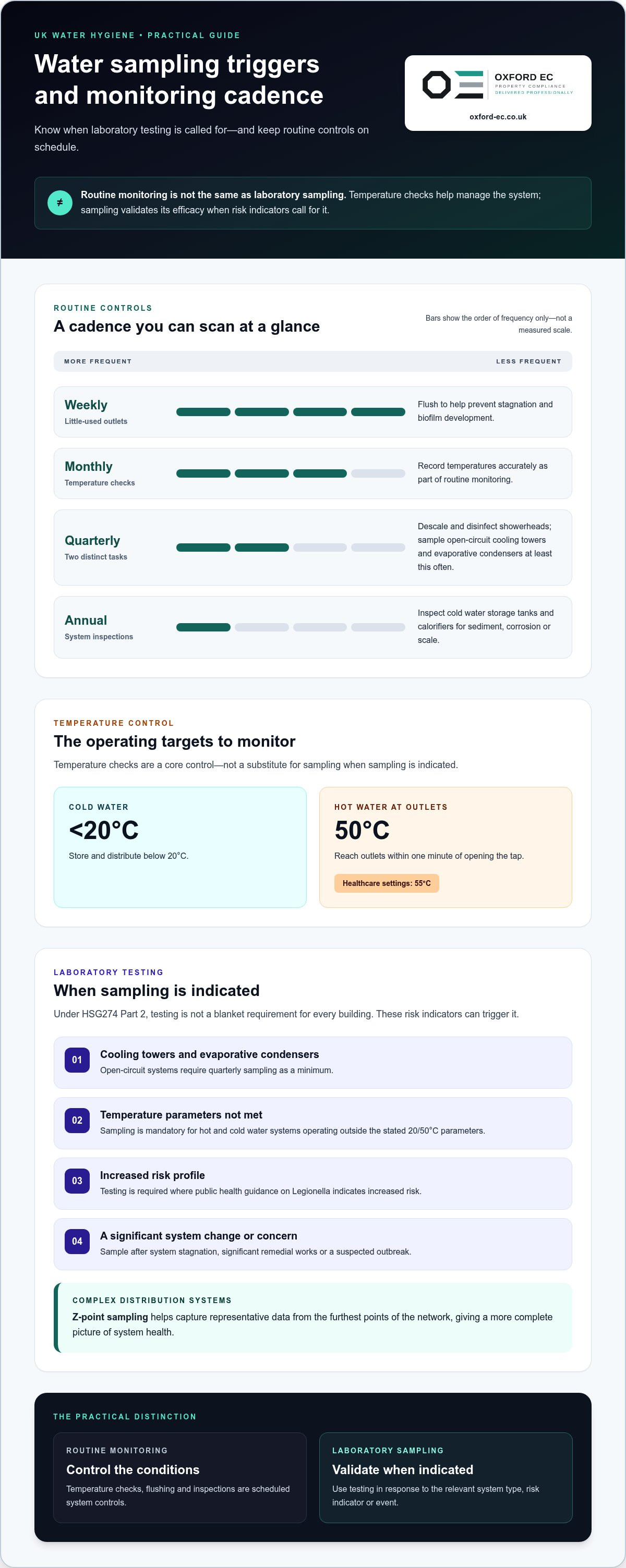
Under HSG274 Part 2, laboratory testing is not a blanket requirement for every building but is triggered by specific risk indicators. Open-circuit cooling towers and evaporative condensers require quarterly sampling as a minimum. For hot and cold water systems, testing is mandatory if the system is operating outside of the 20/50°C temperature parameters or if the Public health guidance on Legionella suggests an increased risk profile. You must also conduct sampling following system stagnation, significant remedial works, or a suspected outbreak. In complex distribution systems, "Z-point" sampling is essential to ensure that representative data is captured from the furthest points of the network, providing a complete map of system health.
Routine Monitoring: The First Line of Defence
Temperature control is your primary weapon against bacterial proliferation. Cold water must be stored and distributed below 20°C, whilst hot water must reach outlets at 50°C (55°C in healthcare settings) within one minute of opening the tap. This monthly monitoring is a fundamental aspect of the legionella testing requirements uk and must be recorded with absolute accuracy. Beyond temperature, your regime must include:
- Weekly Flushing: Little-used outlets must be flushed to prevent the stagnation that encourages biofilm development.
- Visual Inspections: Cold water storage tanks and calorifiers require annual inspections to scrutinise for sediment, corrosion, or scale.
- Showerhead Descaling: Quarterly cleaning and disinfection of spray heads to mitigate aerosol risks.
For those managing high-risk environments like care homes or commercial portfolios, the margin for error is zero. If you require technical clarity on your specific sampling obligations, you can speak with our consultancy team for expert guidance. Our approach ensures that your monitoring programme is both legally robust and operationally lean, acting as a protective shield for your building and its occupants.
Legionella Testing Methodologies and UKAS Laboratory Standards
Validating your water hygiene programme depends entirely on the integrity of the laboratory analysis. The legionella testing requirements uk mandate that samples are processed by a UKAS-accredited facility operating under ISO 17025 standards. This accreditation is your guarantee of technical competence and impartial results. Without it, your data lacks the legal weight required for HSE scrutiny. Accurate. Validated. Legally robust. In an environment of increased regulatory pressure, using non-accredited labs isn't just a technical error; it's a significant liability that undermines your entire safety framework.
The Traditional Culture Method remains the industry "Gold Standard" because it detects viable, living bacteria, which is the primary concern for risk management. Whilst Rapid Testing (PCR) offers results within hours rather than the 10-12 days required for culture, it identifies DNA from both living and dead cells. Consequently, PCR cannot replace culture methods for statutory compliance. It's an auxiliary tool for rapid screening during suspected outbreaks, but it lacks the definitive confirmation of active biological risk that culture provides. You must rely on the culture method to meet the rigorous benchmarks of ACOP L8.
The Sampling Process: Precision in the Field
Precision begins at the outlet. Aseptic sampling techniques are vital to prevent cross-contamination from the environment or the sampler's person. We utilise pre-flush samples to assess the local condition of the outlet and post-flush samples to scrutinise the health of the wider distribution network. Maintaining a robust, documented chain of custody from the property to the laboratory ensures that the sample's integrity is never compromised. Precise. Documented. Unimpeachable. This methodical approach ensures that every result is a true reflection of your system's condition, allowing for targeted and efficient remedial actions.
Understanding Action Levels and Result Thresholds
Results are reported in Colony Forming Units per Litre (CFU/L). Understanding these thresholds is critical for effective risk management. If a sample returns a result between 100 and 1000 CFU/L, it indicates a loss of control that requires immediate investigation and re-sampling to identify the source of contamination. A result exceeding 1000 CFU/L is a critical failure. This necessitates urgent system disinfection and a comprehensive review of your Water Hygiene Services and management protocols. In 2026, the expectation for immediate remedial action is absolute; there is no room for delay when these limits are breached. You must act decisively to restore control and ensure occupant safety.
Managing the Written Scheme: Record-Keeping and Remedial Actions
The Written Scheme of Control is the operational core of your water hygiene strategy. It translates the legionella testing requirements uk into a set of actionable, site-specific instructions. Without a meticulously detailed scheme, your risk assessment is merely a theoretical exercise. Audit-ready. Precise. Absolute. This document must clearly define the management structure, the technical monitoring procedures, and the emergency remedial protocols required to maintain system safety. It is the mechanism through which you move from "identified risk" to "managed risk," ensuring that every vulnerability flagged in your assessment is met with a robust, documented control measure.
By 2026, the transition from physical logbooks to digital management systems has become the industry standard for complex property portfolios. Digital records offer a level of transparency and real-time accountability that paper systems cannot match, allowing for instant notification of temperature breaches or missed inspections. Regardless of the medium, the law remains uncompromising: you must retain all records of monitoring, inspections, and legionella testing requirements uk for a minimum of five years. This statutory retention period ensures that a comprehensive audit trail exists to defend your management decisions during an HSE investigation or in the event of a civil claim.
Components of an Effective Written Scheme
Effective management begins with the correct identification of the "Responsible Person" and their designated deputies. This individual must possess the technical competence and authority to oversee the written scheme. Your scheme must also contain detailed, up-to-date schematic diagrams of the entire water system layout to ensure every asset is accounted for. Clearly defined procedures for temperature monitoring, chemical dosing, and system disinfection must be documented to provide an unambiguous roadmap for your site staff or contractors. This level of detail is essential for maintaining a safe, compliant environment.
The Audit Trail: Proving Compliance to Scrutiny
Surviving an HSE or local authority inspection requires more than just doing the work; you must prove the work was done to the required standard. A disorganised logbook is often interpreted as a lack of control, which can lead to formal notices or prosecution. Annual reviews are essential to maintain the validity of your risk assessment, particularly if there have been changes to the building's use or water system configuration. Integrating these records into a broader suite of Compliance Services creates a unified safety profile for your property, providing peace of mind through documented evidence.
Integrated Property Compliance: The Oxford Environmental Advantage
Managing property safety in 2026 requires more than isolated inspections. It demands a holistic view of risk. Fragmented safety checks often result in administrative bloat, inconsistent data, and hidden vulnerabilities that only surface during a regulatory audit. Transitioning to a unified compliance strategy provides a protective shield against legal and operational risk. Oxford Environmental Consultants (OEC) delivers this through a multi-disciplinary framework that prioritises technical precision and administrative efficiency. Meticulous. Expert. Accountable.
Our approach ensures that your legionella testing requirements uk are not managed in a vacuum but are integrated into a broader safety ecosystem. By utilising a single, dependable partner for your property's technical requirements, you eliminate the friction of managing multiple contractors and disparate reporting formats. We provide national UK coverage for all property types, delivering audit-ready reports that withstand the highest levels of scrutiny from the HSE and local authorities. This consolidation is the most efficient method for maintaining budget control whilst ensuring absolute regulatory mastery.
Consolidating Water Hygiene and Fire Safety
Identifying the overlaps in asset management is critical for modern property managers. Water storage tanks, calorifiers, and complex distribution networks often share physical space or technical dependencies with fire suppression systems and plant room infrastructure. Aligning your legionella testing requirements uk with a fire safety survey allows for a comprehensive scrutiny of these shared environments. This alignment reduces site disruption and ensures that risk mitigation strategies for one discipline do not inadvertently compromise another. You can explore our technical approach to fire safety in our guide on Fire Risk Assessments: A Comprehensive Guide to UK Compliance in 2026. Efficiency through consolidation.
Securing Your Property Portfolio
Professional consultancy is the only viable path to long-term risk reduction. A "tick-box" approach to testing provides a false sense of security that quickly evaporates when faced with a formal investigation or a significant system failure. OEC acts as the "safe pair of hands" for your property portfolio, providing evidence-based results and strategic guidance that goes beyond basic sampling. We don't just identify problems; we provide the technical roadmap to solve them. By requesting a comprehensive property compliance audit, you secure your assets against the evolving legislative landscape of 2026 and beyond.
Contact Oxford Environmental Consultants for Expert Guidance
Securing Your Statutory Compliance for 2026
Navigating the legionella testing requirements uk demands a shift from reactive maintenance to a state of permanent, audit-ready control. The legal landscape of 2026 leaves no room for ambiguity. You must ensure that your technical monitoring is validated by UKAS-accredited laboratory analysis and supported by a meticulously maintained Written Scheme of Control. This isn't just about avoiding potential fines; it's about the absolute protection of every individual within your property. Rigorous. Precise. Accountable.
Oxford Environmental Consultants provides the multi-disciplinary expertise required to consolidate your safety surveys into a single, unified strategy. With national UK coverage and a commitment to technical precision, we act as the "safe pair of hands" for your entire property portfolio. We deliver the evidence-based results and audit-ready reporting you need to withstand regulatory scrutiny.
You can achieve total peace of mind through technical mastery and a dependable partnership.
Frequently Asked Questions
Is Legionella testing a legal requirement for landlords in the UK?
Yes. Landlords bear a statutory duty of care to ensure water systems are safe and free from bacterial proliferation under the Health and Safety at Work etc. Act 1974. Whilst routine sampling isn't a blanket requirement for every domestic property, a "suitable and sufficient" risk assessment is mandatory. The Renters' Rights Act 2025 has intensified enforcement, meaning documented compliance is essential to avoid potential fines of up to £20,000.
How often should Legionella testing be carried out in commercial buildings?
Frequency is dictated by your specific risk assessment rather than a universal schedule. High-risk systems, such as open-circuit cooling towers, require mandatory quarterly sampling. For standard commercial hot and cold water systems, the focus remains on monthly temperature monitoring and weekly flushing. You must carry out additional water sampling if temperature control is lost or if the system undergoes significant modifications or prolonged stagnation. Precise. Validated. Controlled.
What is the difference between a Legionella risk assessment and water testing?
A Legionella risk assessment is a comprehensive survey designed to identify potential hazards and evaluate the level of risk within your water system. It is a legal requirement for all non-domestic premises. Conversely, water testing is the physical act of laboratory analysis to detect the presence of bacteria. Testing is a technical validation tool triggered by the findings of your assessment or specific legionella testing requirements uk for high-risk assets.
Can I carry out my own Legionella monitoring or do I need a professional?
You may conduct monitoring internally provided the individual is "suitably competent" as defined by BS 8580-1:2019. This requires sufficient technical knowledge and training to perform tasks accurately and safely. However, many duty-holders appoint a professional consultancy to ensure their programme is legally robust and audit-ready. Appointing an accountable partner provides a "safe pair of hands" for complex requirements, protecting you from the risks associated with technical oversight or administrative errors.
What happens if Legionella bacteria are found in my water system?
Immediate action is required based on the concentration of Colony Forming Units per Litre (CFU/L). If results show between 100 and 1,000 CFU/L, you must investigate the system, review control measures, and carry out re-sampling. A result exceeding 1,000 CFU/L constitutes a critical failure. This necessitates urgent system disinfection, typically through thermal or chemical shock, followed by a comprehensive review of your written scheme to restore biological control. Decisive. Urgent. Necessary.
How long do I need to keep Legionella testing and monitoring records?
You must retain all records of monitoring, inspections, and remedial actions for a minimum of five years. This statutory retention period is essential for maintaining a clear audit trail and defending your management decisions during an HSE investigation. These records should include the current risk assessment, the written scheme of control, and all signed logs of temperature checks or laboratory results. Digital systems are increasingly utilised to ensure these records remain accessible and secure.
Do I need to test for Legionella if my building is currently vacant?
Vacancy increases risk due to water stagnation and biofilm development. You don't necessarily need to test continuously, but you must maintain a regime of regular flushing for all outlets to prevent bacterial growth. Before re-occupancy, a review of your risk assessment is vital. Depending on the duration of the vacancy and the complexity of the system, laboratory sampling may be required to validate that the water is safe for occupants to use.
What are the specific action levels for Legionella detection in the UK?
Action levels are strictly defined within HSG274 Part 2. A result of less than 100 CFU/L is generally considered acceptable, provided control measures remain effective. Results between 100 and 1,000 CFU/L require a review of the legionella testing requirements uk and system disinfection if the count is sustained. Any result over 1,000 CFU/L demands immediate remedial action. This involves system-wide disinfection and a thorough investigation to identify and eliminate the source of the contamination.