
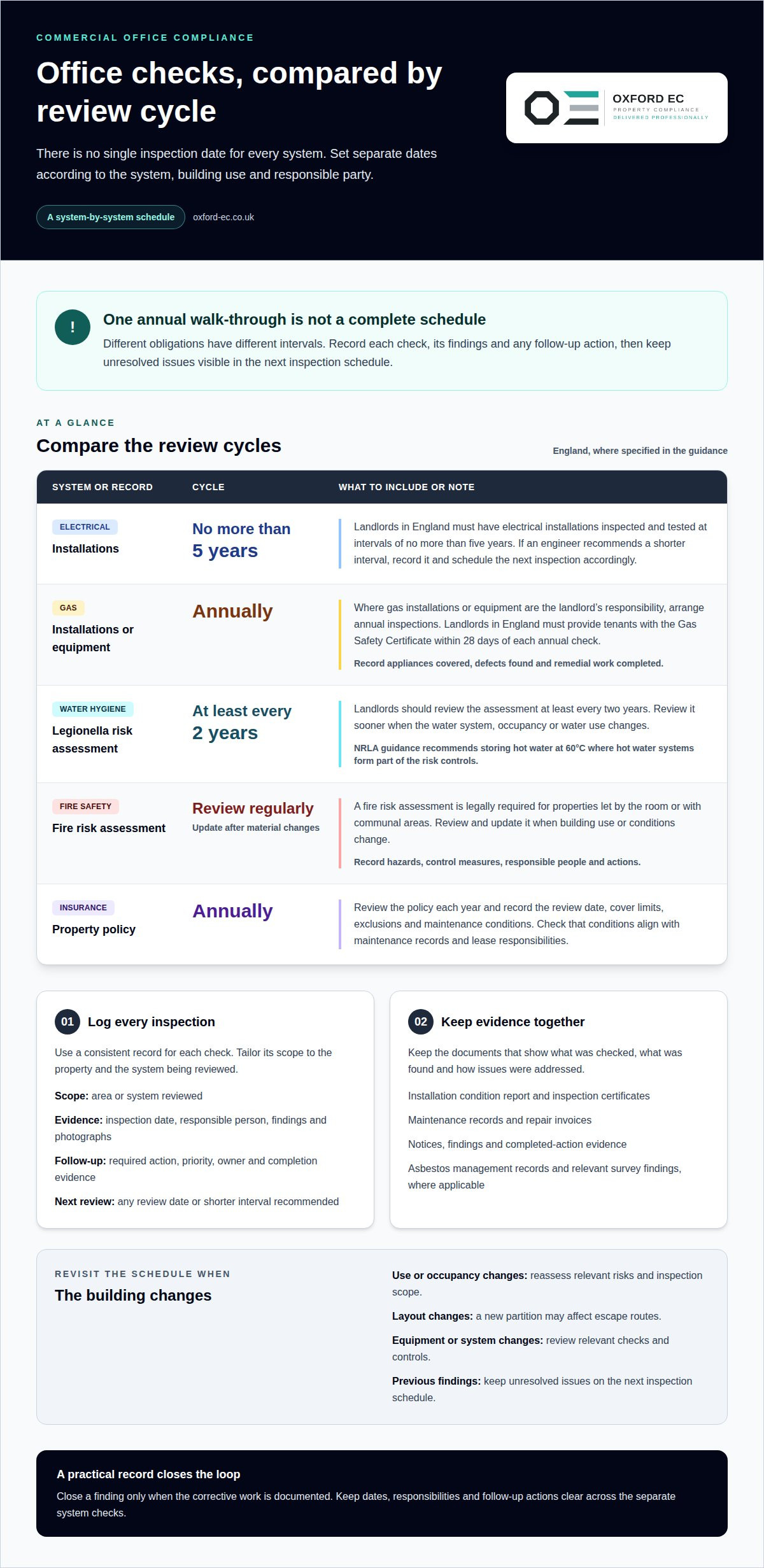
A commercial office has no single inspection date that applies to every system. An office property compliance checklist should set separate review cycles for each obligation. In England, landlords must have electrical installations inspected and tested at intervals of no more than five years, and landlords responsible for gas installations or equipment should arrange annual inspections. Fire risk assessments should be reviewed regularly and updated after material changes to the property.
Compliance can feel fragmented when routine maintenance sits alongside formal assessments. Match each check to the system, the building’s use and the responsible party, then keep a clear record of findings and follow-up actions.
This guide explains how often to inspect common office property risks and what to include. It covers health and safety assessments, insurance and maintenance records, and fire precautions, with particular attention to fire doors, escape routes and emergency lighting. Use it to build a practical inspection schedule and identify when a specialist assessment or inspection is appropriate.
Key Takeaways
- Set inspection dates by system and responsibility, rather than relying on a single annual property review.
- Keep a clear record of findings, maintenance work and follow-up actions so recurring issues are easier to identify.
- Review fire and other health and safety risks when the building’s use or condition changes.
- Check that insurance conditions align with the property’s maintenance records and the responsibilities set out in the lease.
- Give particular attention to clear escape routes, serviceable emergency lighting and fire doors that close and operate properly.
Table of Contents
How often should a commercial property be fully inspected for compliance?
There is no single interval for a full commercial property inspection. Set a schedule by system, building use, lease responsibilities and previous findings. For example, landlords in England must have electrical installations inspected and tested at intervals of no more than five years, according to UK Government. Where an engineer recommends a shorter interval, record it and schedule the next inspection accordingly.
Planning permission and permits should reflect the building’s current use, and alterations may require additional approvals. Accessibility duties include making reasonable adjustments to common parts under the Equality Act 2010; BS 8300 is a relevant accessibility standard named by the British Standards Institution.
There is no single penalty or cost for every compliance failure. Financial consequences depend on the breach, while remedial costs depend on the work required, the systems affected and access arrangements.
Build an office property compliance checklist around separate inspection dates, rather than treating one annual walk-through as sufficient. Gas installations or equipment under a landlord’s responsibility should receive annual inspections. Asbestos may be present in commercial buildings constructed before 2000, so include asbestos management records and any relevant survey findings when planning checks.
Use a consistent template for each inspection, tailoring its scope to the property. Include:
- Building areas: roof, exterior, structure, windows, doors and shared spaces.
- Services: heating, ventilation, plumbing, mechanical and electrical systems.
- Safety: fire precautions, escape routes, alarms and emergency lighting.
- Evidence: inspection date, responsible person, findings, photographs and required action.
These categories help identify gaps and compare findings over time. For example, a recurring leak near electrical equipment needs a recorded repair action and a follow-up inspection, not just a note that the area was checked.
Keep the installation condition report, inspection certificates, maintenance records, repair invoices and notices together. Record who owns each action, its priority, the completion evidence and any review date. Close a finding only when the corrective work is documented. Keep unresolved issues visible in the next inspection schedule.
Review the template when the building’s use, layout or equipment changes. A new partition may affect escape routes; a change of use may alter the inspection scope. A structured property compliance assessment can help organise the relevant checks and records around the premises.
Health and safety policies and risk assessments
Risk assessments should reflect how people use the office, including shared kitchens, corridors and plant rooms. Under the Regulatory Reform (Fire Safety) Order 2005, a fire risk assessment is legally required for properties let by the room or with communal areas, according to UK Government. Record hazards, control measures, responsible people and actions, then review the assessment when building use or conditions change.
UK office employers should maintain health and safety risk assessments, inspection records, incident reports and evidence of completed actions. Equipping appointed staff with accredited workplace health and safety courses from providers such as You Can Do It Training Ltd helps ensure assessments and inspections are conducted thoroughly. Include common areas: a blocked corridor, damaged floor covering or poorly maintained shared kitchen can create risks beyond one tenant’s workspace.
Workplace facilities should be suitable for staff and kept accessible, clean and in working order. Include toilets, handwashing facilities, drinking water, ventilation and rest areas in routine checks. Record faults, such as a leaking tap or broken extractor, and assign follow-up action.
For water hygiene, assess whether the office’s water systems could present a Legionella risk, then put proportionate controls in place. Landlords should review a Legionella risk assessment at least every two years. The review should also reflect changes to the system, occupancy or water use.
Use a documented schedule for gas and plumbing checks. Landlords in England must arrange gas safety checks annually and provide tenants with the Gas Safety Certificate within 28 days of each annual check. Record the appliances covered, defects identified and remedial work completed. Where hot water systems are part of the risk controls, NRLA guidance recommends storing hot water at 60°C.
For each inspection, record the area or system reviewed, the finding, the person responsible and the action taken. This makes follow-up traceable and helps reveal recurring problems.
- Inspect shared routes: record obstructions, damaged surfaces and faults that could affect safe access.
- Review fire precautions: document the assessment, controls and updates after relevant building changes.
- Check gas records: track each annual check and provide the certificate within the required period.
- Assess water systems: record Legionella controls and the date for the next assessment review.
- Check welfare areas: note defects affecting toilets, handwashing, drinking water or ventilation, then assign action.
Keep assessment documents alongside inspection results and action records, so duty holders can see what was identified and resolved. For a structured review of fire and water risks, discuss assessment requirements for the premises.
Insurance conditions and maintenance records
Review property insurance policies annually and record the review date, cover limits, exclusions and maintenance conditions. Commercial landlords have no blanket legal requirement to hold buildings or liability insurance. However, policy conditions may require specified inspections or prompt repairs. For example, an unattended roof leak could be relevant when a later claim is assessed.
Employers must have employer’s liability insurance if they directly employ anyone to look after the office. Keep policy documents with employment and property records so the relevant cover can be found promptly. Assign responsibility for renewal dates and policy reviews, as a missed renewal can leave a gap in cover.
Review building documents alongside the insurance schedule. UK commercial properties generally need a valid Energy Performance Certificate when sold or let. Rented commercial properties generally need an EPC rating of at least E unless a valid exemption applies, according to UK Government. File the certificate with tenancy or sale records and note its rating and validity information.
Keep a traceable record for every inspection, certificate and maintenance action. A useful file identifies the property area or system, inspection date, findings, responsible person and completion evidence. Include relevant gas safety certificates, repair invoices, warranties, building permits, utility bills and notices. If an engineer identifies a defect, retain the report and evidence showing how it was addressed.
- Insurance: retain current policy documents, renewal dates and recorded annual reviews.
- Certificates: file the EPC and relevant safety certificates with clear property identifiers.
- Maintenance: connect each invoice or work record to the defect or scheduled task.
- Actions: record who owns each remedial task and when completion evidence was added.
A digital record system can make retrieval and audit trails more consistent. Organise folders by property, system and document type, and label files with dates and versions. Restrict editing to authorised users and keep a backup so a misplaced or overwritten record does not erase the history. For example, link a heating maintenance entry to its report and invoice rather than saving them under unrelated filenames.
Review the register when a lease changes, a policy renews or building work alters an insured feature. Compare the recorded condition with policy requirements, then assign actions for gaps such as overdue maintenance or missing evidence. Dated, organised records show what was inspected, what needed attention and how follow-up was completed.
Smoke and carbon monoxide alarms
For offices with residential accommodation, distinguish domestic smoke and carbon monoxide alarms from the commercial fire alarm system. In England, landlords must fit smoke alarms on each storey with living accommodation and carbon monoxide alarms in rooms with fuel-burning appliances, excluding rooms with gas cookers, since 1 October 2022. Landlords should test both types of alarm at the start of each tenancy.
An office without living accommodation does not fit that specific domestic-alarm description. Its fire precautions still need to match the building’s fire risk assessment, layout and use. Include the alarm panel, detectors, call points, sounders and any linked suppression equipment in the maintenance schedule. Changes to partitions or room use can affect detection coverage, so record them and review the system’s suitability.
Use a documented testing process. Record the date, device or zone tested, result, fault and follow-up action. For a multi-zone system, identify each zone clearly so a failed detector is not lost in a general note. If an alarm fault remains unresolved, record interim arrangements and who is responsible for corrective work.
- Test relevant domestic alarms: record the start-of-tenancy test for smoke and carbon monoxide alarms.
- Inspect the fire alarm system: record tests and maintenance for panels, detectors, call points and sounders.
- Review coverage: note layout changes that may affect detection or audibility.
- Track faults: assign corrective action and retain evidence of completion.
Testing equipment is only one part of fire safety. The evacuation procedure must explain how occupants respond when an alarm sounds, including who raises the alert and how visitors receive instructions. Keep routes and exits usable, and account for people who may need assistance. Record fire drills and use any confusion, delayed response or missed instruction to improve the procedure.
Commercial premises may also have extinguishers, fire hoses, emergency lighting, suppression systems or dedicated first aid provisions. Sourcing appropriate emergency kit bags from providers such as First Medical Training Ltd and inspecting them regularly ensures medical equipment remains complete and in date. Include these in the same coordinated schedule, recording each device or system separately. A successful alarm test, for example, does not show that emergency lighting works during a power interruption. Record every check independently and link defects to assigned actions.
Where the system needs installation, maintenance or servicing, competent fire alarm work should align with the premises’ assessed risks and system design. Keep alarm testing, evacuation arrangements and remedial actions together in a clear record set, ready for review after building changes or faults.
Fire exits, emergency lighting and fire doors
Trace each escape route from occupied offices to its final exit. Check corridors, staircases and exit doors for stored items, locked access or damage that could delay evacuation. A delivery left beside a staircase, for example, can narrow the usable route. Record the location, defect and corrective action, then confirm the obstruction has been removed.
Check that exit signs remain visible and point towards the intended route. Include shared corridors and stairwells used by tenants, not just areas controlled by one occupier. Landlords and tenants should understand their responsibilities for shared and demised areas. Lease terms and the building’s fire arrangements help establish who reports faults and who carries out remedial work.
Keep separate inspection and testing records for emergency lighting. Check that fittings are present along escape routes, unobscured and working during the relevant test. Record the location of each failed fitting and arrange repair. A clear fire safety assessment should consider how lighting supports evacuation throughout the premises, including on staircases and changes in floor level.
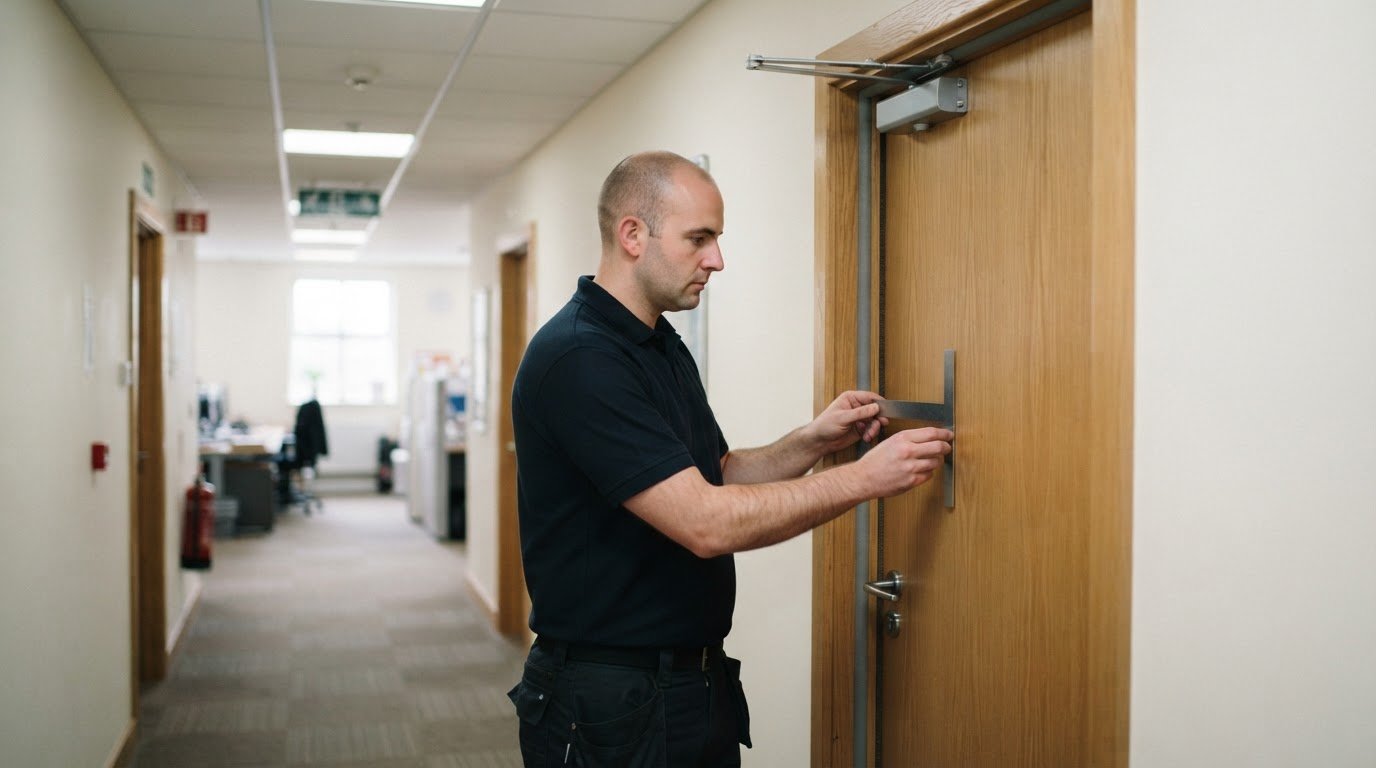
Inspect fire doors as working components, not just during a general visual walk-through. Check the leaf, frame, hinges, closer, seals and visible glazing for damage or missing parts. Confirm that the door closes properly and is not held open in a way that defeats its intended function. Record and follow up a closer that fails to shut the door or a damaged seal.
- Escape routes: record obstructions, damaged surfaces, exit access and signage visibility.
- Emergency lighting: log each test, fitting location, result and repair action.
- Fire doors: note damage, missing components and whether each door closes correctly.
- Electrical records: keep emergency-lighting results distinct from the electrical installation condition report, which covers the electrical installation.
Use a consistent record for each check: date, area, finding, action owner and completion evidence. A stairwell fault, for instance, should remain open in the log until the repair is documented. Review records after layout changes, building work or changes to escape routes, since altered partitions can affect visibility and access.
Clear routes, working lights and closing doors turn fire precautions into observable, recorded actions. Keep the findings with the premises’ health and safety records and relevant fire risk assessment.
Oxford Environmental Consultants (OEC)
Oxford Environmental Consultants (OEC) helps duty holders address specific property risks through focused assessments and inspections. Contact OEC when asbestos information needs review, water systems require a Legionella risk assessment, damp or mould concerns arise, or fire doors need inspection.
These services support a wider compliance programme; they do not replace the duty holder’s responsibility to coordinate inspection dates, maintain records and complete follow-up actions. A clear brief identifying the premises, known issues and relevant documents helps define the work required.
For an office property compliance checklist, specialist input is useful when a particular risk needs assessment or a recorded inspection. Contact Oxford Environmental Consultants (OEC) to discuss your property’s requirements.
Make your next compliance action clear
Make the office property compliance checklist a working responsibility map, not a static file. Assign each area, system and follow-up action to a named role, then record what triggers a review, such as a change in occupancy, layout or building use. This clarifies handovers when a tenant, facilities lead or duty holder changes and helps keep unresolved issues connected to their original inspection.
Where specialist assessment is needed, Oxford Environmental Consultants (OEC) provides Asbestos Management Surveys, Fire Risk Assessments and Legionella Risk Assessments. These services support duty holders who need a focused assessment of a particular property risk within their wider compliance arrangements.
Set the next action now: identify the most pressing gap, assign an owner and keep the resulting evidence with the property records. A controlled process helps each duty holder maintain oversight as the premises change.
Take the next step with a clear brief and a defined compliance priority.
Frequently Asked Questions
What documentation do inspectors most commonly cite as missing?
No single missing-document list applies to every inspection. Relevant records may include current inspection reports, maintenance evidence, repair invoices, building permits, warranties and notices about code violations. For example, a maintenance log might record a fault without showing that the repair was completed. Label documents by property, system and date so an inspector can trace each record to the equipment or area concerned.
What does landlord compliance involve?
Landlord compliance means meeting applicable duties and responsibilities agreed in the lease, rather than assuming every obligation rests with one party. For commercial properties, responsibility can depend on lease wording, shared areas and statutory duties. A tenant may control equipment in its occupied space, for example, while building-wide systems involve shared responsibilities. Document who manages each system and how the landlord and tenant share relevant inspection findings.
What is the best way to manage compliance across multiple properties?
Use a central register with a separate, clearly labelled record for each property. Assign each system an accountable owner, review trigger, current evidence and open actions. For example, a company managing several offices can use a central dashboard to flag a missing document without mixing one building’s records with another’s. Keep local building details and lease responsibilities visible, as identical schedules may not suit properties with different uses or equipment.
What legal compliance checks are required for UK office buildings?
Required checks depend on the building, its use and the duty holder’s responsibilities. Relevant areas include fire precautions, electrical safety, gas safety where applicable, asbestos management where asbestos-containing materials exist, and Legionella risks in relevant water systems. A valid EPC is generally required when a commercial property is sold or let. Rented commercial properties generally need a rating of at least E unless an exemption applies.
What are the UK fire safety requirements for offices, including risk assessments and evacuation plans?
Office fire precautions should be based on a suitable and sufficient fire risk assessment, reviewed regularly and after material property changes. Under the Regulatory Reform (Fire Safety) Order 2005, a fire risk assessment is legally required for properties let by the room or with communal areas, according to UK Government. Evacuation arrangements should reflect the building’s layout, occupants and escape routes, with clear procedures for raising the alarm and responding safely.
What electrical, gas and lift inspections are required for UK office properties, and how often?
In England, landlords must have electrical installations inspected and tested at intervals of no more than five years, according to UK Government. Landlords responsible for gas installations or equipment should arrange annual inspections by a Gas Safe registered engineer. Lifting equipment may require regular inspections under LOLER; the applicable schedule depends on the equipment and its use. Keep each report with the relevant asset record and track remedial actions.
What are the UK asbestos management requirements for office buildings?
Duty holders must identify, assess and manage asbestos-containing materials where they exist. This means keeping relevant survey information accessible, assessing the condition of identified materials and maintaining arrangements to prevent disturbance. Refurbishment work, for example, may affect materials that routine occupancy does not disturb, so asbestos information must inform work planning. Record material locations, changes in condition and actions taken, and make relevant information available to anyone who may disturb the materials.
What office property compliance documents and certificates should landlords and tenants keep?
Keep records relevant to the building and each party’s responsibilities. These may include electrical installation reports, gas safety certificates where applicable, fire risk assessment records, asbestos information, Legionella assessment documents, EPCs, maintenance logs, permits and repair invoices. Tenants should retain evidence for the systems and areas they manage; landlords should maintain records for their responsibilities. Clear property and equipment labels help distinguish shared systems from tenant-controlled items.