

In the current regulatory climate, a single overlooked fire door or an outdated asbestos register is no longer a mere clerical oversight; it is a professional liability of the highest order. The Building Safety Act 2022 and the Renters' Rights Act 2025 have fundamentally shifted the burden of proof onto the duty holder. Fragmented reporting. Outdated data. Siloed contractors. You likely recognise the escalating difficulty of maintaining a "golden thread" of information across a diverse property portfolio whilst facing civil penalties that can now reach £40,000 for non-compliance. Executing a rigorous property compliance audit has become the only certain path to secure absolute legal robustness and consolidate disparate safety streams into a single, verifiable point of truth.
This professional resource provides a definitive framework for mastering the complexities of multi-disciplinary statutory requirements. We will examine the alignment of legislative mandates, from Asbestos Management Surveys to the updated 2026 HHSRS hazard categories, to ensure your estate remains beyond reproach. By the conclusion of this guide, you'll understand how to integrate fire risk assessments, water hygiene protocols, and structural safety data into a unified management strategy. This structured approach reduces insurance premiums, mitigates personal liability, and establishes a meticulous standard of protection for both your assets and your occupants.
Key Takeaways
- Understand the rigorous mandates of the Building Safety Act 2022 and the necessity of maintaining a "golden thread" of safety information.
- Discover how a multi-disciplinary property compliance audit eliminates the systemic risks inherent in fragmented reporting and siloed contractor data.
- Access a definitive 2026 checklist of core statutory requirements, ranging from fire door inspections to asbestos management surveys.
- Learn to consolidate multi-faceted safety data into a single point of truth to ensure absolute legal robustness and regulatory alignment.
- Identify the strategic pathways to reducing professional liability and insurance premiums through meticulous, audit-ready documentation.
Table of Contents
What is a Property Compliance Audit and Why is it Essential?
Precision. Accountability. Protection. A property compliance audit represents the definitive baseline for any robust asset management strategy. It is a forensic, systematic evaluation designed to measure a property's alignment with the exhaustive requirements of UK statutory health and safety legislation. Whilst many property owners rely on disparate reports, a true audit synthesises these elements to ensure that Building Codes Explained in a regulatory context are fully adhered to across the entire estate. This process provides duty holders with an uncompromising view of their risk profile, moving beyond simple checklists to provide a verifiable "golden thread" of safety data.
The audit functions as a high-level diagnostic tool that scrutinises the intersection of physical safety measures and administrative oversight. It's not merely about whether a smoke alarm functions, but whether the maintenance record for that alarm is accessible, accurate, and legally robust. In the wake of recent legislative shifts, including the update to the Housing Health and Safety Rating System (HHSRS) in June 2026, the standard for "acceptable" has been significantly elevated. A property compliance audit ensures that duty holders aren't just meeting the minimum requirements but are achieving a state of "audit-readiness" that can withstand the scrutiny of local authorities or the Building Safety Regulator. This level of precision is what distinguishes a professional management strategy from a reactive, high-risk approach.
This commitment to precision should extend to the digital systems managing your records; SeComPass provides expert cybersecurity and privacy consultancy to ensure your compliance data is protected with the same rigour as your physical assets.
The primary goal is the proactive identification of management gaps before they manifest as legal liabilities or insurance exclusions. It's about establishing a single point of truth in an increasingly complex legislative environment. By scrutinising every facet of property safety, from gas and electrical certifications to structural integrity and environmental hazards, the audit ensures that no single point of failure remains hidden within the documentation. This systematic rigour provides peace of mind that can't be achieved through fragmented, single-discipline surveys alone; for those in the building and development sectors, utilising professional construction bookkeeping services ensures that financial oversight is handled with the same degree of technical scrutiny.
This level of transparency is vital not only for ongoing management but also for ensuring the integrity of assets during the sales process; professional auction houses like Auction Property Ltd rely on such robust documentation to provide buyers with confidence in the residential and commercial properties they list.
The Distinction Between Surveys and Audits
Surveys identify. Audits evaluate. Management confirms. A survey provides a snapshot of a specific hazard, whilst a property compliance audit examines the effectiveness of the governance systems surrounding that hazard. Having a survey without an audit often leads to compliance failure because data exists without the necessary remedial tracking or documented accountability. It's the difference between knowing a risk exists and proving you've managed it.
Who is Responsible for Property Compliance?
The legal burden is absolute. The Regulatory Reform (Fire Safety) Order 2005 identifies the "Responsible Person," whilst the Building Safety Act 2022 mandates an "Accountable Person" for high-rise assets. For directors and trustees, non-compliance carries severe personal implications. With penalties under the Renters' Rights Act 2025 reaching £40,000, the audit process is essential for identifying gaps before they become indefensible legal liabilities. Just as technical safety requires rigorous oversight, ensuring your financial and tax planning is equally robust is vital; firms like Davis & Co LLP provide the audit and assurance services needed to protect your broader business interests.
The Legislative Framework Governing UK Property Compliance
Legislative mastery. Technical precision. Total accountability. The Health and Safety at Work etc. Act 1974 remains the immutable foundation of all property safety in the United Kingdom, imposing a non-delegable duty of care upon employers and building owners alike. Building upon this bedrock, the Building Safety Act 2022 has introduced a paradigm shift for high-rise residential buildings, mandating a rigorous "Golden Thread" of information to ensure safety data is captured, stored, and accessible throughout a building's lifecycle. A professional property compliance audit must scrutinise these overlapping frameworks to ensure that the Accountable Person is not only meeting current standards but is insulated against the evolving requirements of the Building Safety Regulator.
For commercial premises, the Regulatory Reform (Fire Safety) Order 2005 dictates the primary fire safety obligations, placing the burden of risk management squarely on the shoulders of the "Responsible Person." This includes ensuring that all gas installations are maintained in a safe condition, a requirement further detailed in the Landlord Gas Safety Duties which mandate annual inspections by a Gas Safe registered engineer. Failure to produce a valid CP12 certificate or an accurate fire risk assessment during a regulatory inspection can lead to significant civil penalties or criminal prosecution. This complex landscape requires a methodical approach to data collection that leaves no room for ambiguity or technical oversight.
Fire Safety and the Golden Thread of Information
The Golden Thread is a statutory necessity for high-risk buildings, requiring a permanent digital record of all safety-critical information. Within this framework, fire risk assessments serve as the primary diagnostic tool for identifying vulnerabilities in both active and passive fire protection systems. Modern audits must now include detailed compartmentation surveys to verify that the fire-resisting integrity of walls and floors is intact. Without this evidence, the Golden Thread is broken, leaving duty holders exposed to severe legal scrutiny and insurance invalidation.
Asbestos Management and Legal Scrutiny
For any structure built or refurbished before 2000, an asbestos management survey is the absolute legal minimum required to identify asbestos-containing materials (ACMs). Regulation 4 of the Control of Asbestos Regulations 2012 defines the Duty to Manage as the legal obligation to identify the location and condition of asbestos-containing materials, assess the risk they pose, and implement a written plan to manage that risk effectively for the protection of all building occupants. Maintaining the validity of a property compliance audit requires annual reinspections to confirm that the condition of known ACMs has not deteriorated over time.
If you're concerned about your current level of legislative alignment, you can request a professional regulatory review to ensure your documentation is audit-ready and legally robust.
Single-Service vs. Multi-Disciplinary Audits: A Comparison
Fragmented data. Siloed reporting. Increased liability. Managing a property portfolio requires more than just ticking boxes; it demands a cohesive strategy that aligns with the landlord's safety responsibilities as defined by current UK legislation. When duty holders engage multiple niche contractors for separate assessments, they inadvertently create a logistical labyrinth that often masks critical safety gaps. A multi-disciplinary property compliance audit, by contrast, consolidates these disparate streams into a single, rigorous evaluation that provides an uncompromising view of the estate's safety standing. This methodical approach ensures that technical expertise is applied uniformly across all disciplines, from asbestos management to fire safety protocols.
The logistical burden of coordinating three or four separate contractors is immense, requiring repeated site access and resulting in a disjointed paper trail that is difficult to defend during a regulatory inspection. By utilising a single multi-disciplinary partner, property managers can achieve significant cost-effectiveness through consolidated site visits, reducing the "per-service" travel and administrative fees associated with individual surveys. More importantly, integrated reporting provides stakeholders with a clear, prioritised risk profile, allowing for strategic capital expenditure based on evidence-based data rather than reactive, piecemeal repairs. This streamlined flow of information is essential for maintaining the "golden thread" required for high-risk residential buildings, and you can learn more about CyberOne to understand how to protect this vital safety data from cyber threats.
Efficiency and Reduced Disruption
Operational continuity is vital for any commercial or residential estate. Consolidated audits significantly minimise access requirements for tenants and occupants by completing multiple assessments in a single, well-coordinated visit. Having a single point of contact for all your compliance requirements reduces the administrative burden on property management teams, allowing them to focus on high-level oversight rather than chasing fragmented reports. This efficiency doesn't just save time; it ensures that safety documentation is current, consistent, and readily available for audit purposes.
Holistic Risk Identification
Siloed contractors rarely communicate, which leads to "compliance gaps" where safety measures might actually conflict. A classic example occurs in the overlap between fire safety and water hygiene, such as when fire sprinkler systems or wet risers create stagnant water environments that increase Legionella risks if not managed holistically. A unified property compliance audit identifies these inter-disciplinary risks, ensuring that a remedial action plan for one hazard doesn't inadvertently create another. This bird's-eye view is the only way to guarantee absolute legal robustness across a complex multi-faceted property portfolio.
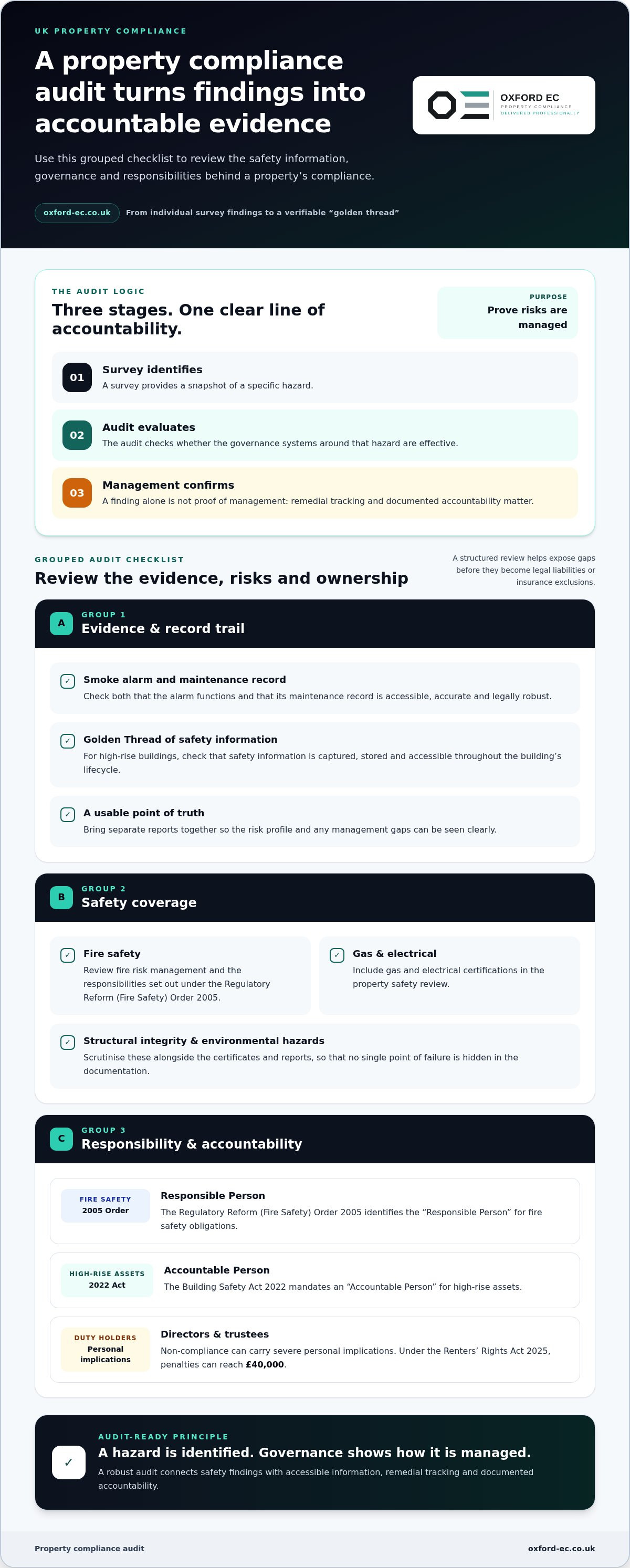
The Property Compliance Audit Checklist: 2026 Standards
Precision. Scrutiny. Alignment. A rigorous property compliance audit in 2026 must account for the recent updates to the Housing Health and Safety Rating System (HHSRS) and the stringent timelines mandated by Awaab’s Law. It's no longer sufficient to maintain a collection of individual certificates; duty holders must demonstrate a cohesive management strategy that addresses every statutory hazard within a single, unified framework. This methodical approach ensures that technical data is not just collected but is actively used to mitigate risk across the entire property lifecycle.
The core components of a modern, audit-ready estate include:
- Fire Safety: A current Fire Risk Assessment (FRA) supplemented by quarterly fire door inspections and monthly emergency lighting tests.
- Water Hygiene: Comprehensive Legionella risk assessments and regular water sampling to prevent the colonisation of domestic water systems.
- Hazardous Materials: Up-to-date Asbestos Management Surveys and a written management plan that details the location and condition of all known ACMs.
- Indoor Air Quality: Forensic damp and mould inspections that evaluate the structural causes of moisture ingress and condensation.
- Electrical and Gas Safety: Valid EICR and CP12 certifications that prove the integrity of the building’s primary utilities; for restaurant operators in other regions like South Africa, you can find out more about commercial LPG compliance and delivery.
Damp, Mould, and Awaab’s Law
Damp and mould are now categorised as high-priority structural safety issues following the June 2026 update to the HHSRS. Professional Awaab’s Law damp surveys are essential for identifying the root causes of moisture, such as inadequate ventilation or poor thermal performance, before they result in respiratory hazards for occupants. These audits must provide a clear evidence trail of identification, assessment, and remedial action within the strict statutory timeframes. Failure to address these hazards can lead to civil penalties of up to £40,000 under the Renters' Rights Act 2025.
Passive Fire Protection and Compartmentation
Passive fire protection provides a structural barrier to contain smoke and flames within a specific area, whereas active systems like alarms and sprinklers require a trigger to function during an incident. A robust audit requires annual fire door inspections for buildings over 11 metres, whilst high-rise residential buildings often require quarterly checks to maintain compliance. Compartmentation surveys are equally critical, as they verify the integrity of fire-resisting walls and floors that prevent the rapid spread of fire through hidden voids. Without this structural verification, your fire safety strategy remains fundamentally incomplete.
Instructing OEC for Your Property Compliance Audit
Precision. Accountability. Results. Oxford Environmental Consultants (OEC) operates as a disciplined guardian of compliance for duty holders across the UK. Founded in 2018, our organisation has established itself as the safe pair of hands for complex, multi-disciplinary requirements. We move beyond the surface-level checks of standard contractors, applying a high degree of technical scrutiny to every asset we inspect. By choosing OEC, you're not just instructing a surveyor; you're partnering with a meticulous expert dedicated to the absolute legal robustness of your property portfolio.
The process is methodical. It's designed to provide peace of mind through regulatory mastery. From the moment of your initial enquiry, we initiate a structured technical scoping exercise to ensure that the subsequent site audit captures every necessary data point for your specific estate. This leads to the execution of a multi-disciplinary property compliance audit, followed by the delivery of a comprehensive remedial plan. This plan provides a clear, evidence-based roadmap for addressing any identified vulnerabilities, ensuring your documentation is always audit-ready.
Our National Reach and Local Expertise
OEC provides national UK coverage, ensuring that even the most geographically diverse portfolios receive a consistent standard of excellence. Our expertise is centred on a deep understanding of UK-specific legislation, from the Health and Safety at Work etc. Act 1974 to the most recent 2026 updates to the HHSRS. We don't just provide data; we deliver clear, actionable advice. Our reports are designed to be used by property management teams to make informed, strategic decisions that reduce professional liability whilst protecting the safety of all building occupants.
Request a Compliance Consultation
Proactive management is the only defence against the escalating penalties of the modern regulatory environment. Don't wait for a regulatory inspection or an insurance claim to uncover a failure in your safety systems. OEC provides a streamlined, "one-stop" logical solution for asbestos, fire, and water hygiene requirements, eliminating the "compliance gaps" that occur when different disciplines don't communicate. We've built our reputation on transparency and evidence-based results, ensuring that your safety data is consolidated into a single, verifiable point of truth.
For property firms looking to demonstrate this transparency to clients and regulators, a bespoke digital platform is a key asset; professional web design from Webexpand can help ensure your online presence reflects the same high standard of professionalism found in your compliance strategy.
Securing Your Estate for a New Regulatory Era
The transition from fragmented safety management to a unified strategy is no longer optional. It's a statutory necessity. The Building Safety Act 2022 has redefined the standard of care expected from UK duty holders, making the "golden thread" of information an absolute requirement. Relying on siloed data from multiple contractors creates indefensible gaps in your safety record. Executing a regular property compliance audit provides the rigorous technical scrutiny required to consolidate these streams into a single point of truth; for those managing international assets, specialist firms like Methamphetamine Testing Services NZ Limited apply this same level of professional rigour to methamphetamine contamination testing.
For owners in the capital, this single point of truth should also include accurate asset appraisal; Winfields Surveyors London delivers specialist valuation services to ensure the financial standing of your property is as robust as its safety documentation.
Similarly, for developers and investors focusing on new acquisitions or redevelopments, ML Traffic Engineers UK provides the specialised traffic engineering and transport planning documentation required to secure planning consent in an increasingly regulated environment.
Furthermore, for those managing international property portfolios, navigating cross-border tax complexities is essential; to ensure your regulatory standing remains secure across multiple jurisdictions, check out CiDATax SRL.
Oxford Environmental Consultants (OEC) offers the meticulous expertise needed to navigate this complex landscape. With our national UK service coverage and multi-disciplinary proficiency across fire safety, water hygiene, and asbestos management, we ensure your portfolio remains in strict alignment with the latest legislative mandates. We don't just identify risks; we provide the remedial clarity needed to eliminate them.
Take the proactive step to insulate your assets and your reputation. Protecting your building means protecting your people.
Frequently Asked Questions
What is the difference between a property survey and a compliance audit?
A property survey typically identifies the presence and condition of a specific hazard, such as asbestos or Legionella, providing a necessary but isolated snapshot of the asset's physical state. In contrast, a property compliance audit evaluates the overarching management systems, documentation accuracy, and remedial tracking to ensure total legislative alignment. It's the difference between identifying a risk and proving its ongoing, systematic management through a verifiable paper trail.
How often should a commercial property compliance audit be carried out?
Professional standards dictate that a comprehensive audit should be conducted annually to account for deteriorating building conditions and evolving statutory requirements. Certain components, such as fire door inspections in high-rise residential buildings, may require more frequent quarterly checks to maintain safety. Regular auditing ensures that the "golden thread" of safety data remains current and defensible under the Building Safety Act 2022, providing a shield against regulatory scrutiny.
Is a property compliance audit a legal requirement in the UK?
Individual components of an audit, including fire risk assessments, asbestos management, and gas safety certifications, are strict legal mandates for all duty holders. Failure to maintain these records constitutes a direct breach of the Health and Safety at Work etc. Act 1974. A structured audit is the only reliable method to demonstrate that a duty holder has met their non-delegable legal obligations and is prepared for a local authority inspection; for broader professional protection, Engage Financial Solutions offers the financial consultancy needed to manage the risks associated with high-stakes compliance.
What happens if my property fails a compliance audit?
If a property fails to meet the required standards, a prioritised remedial action plan is immediately issued to address the identified vulnerabilities. Ignoring these findings exposes the duty holder to significant legal risk, including civil penalties of up to £40,000 for repeated breaches of the Renters' Rights Act 2025. Swift remedial action is essential to restore the property's legal robustness and ensure the continued safety of all occupants and visitors.
Does a compliance audit cover both fire safety and asbestos?
A multi-disciplinary property compliance audit is designed to integrate fire safety, asbestos management, water hygiene, and structural integrity within a single exercise. This holistic approach identifies conflicting safety measures that separate contractors might overlook, such as fire stopping issues within asbestos-containing materials. It ensures that your fire risk assessment and asbestos management plan are synchronised to provide a single, coherent point of truth for the entire estate.
How much does a professional property compliance audit cost?
The investment required for a professional audit is determined by the scale, complexity, and geographical distribution of the property portfolio. Factors such as the building's age, its specific usage, and the number of individual disciplines included will influence the final technical scope. OEC provides bespoke technical proposals tailored to the specific requirements of the duty holder's estate, focusing on delivering high-level scrutiny and long-term liability reduction.
Can OEC manage the remedial works identified in an audit?
OEC provides comprehensive remedial advice and delivery across multiple technical disciplines. Our capabilities include asbestos removal, fire alarm maintenance, and the installation of passive fire protection systems to resolve any identified deficiencies. This integrated approach ensures that the transition from risk identification to hazard mitigation is handled by a single, accountable partner, reducing the administrative burden on your internal property management teams.
What documentation do I need to provide for a compliance audit?
Duty holders should provide all existing safety documentation, including previous asbestos surveys, fire risk assessments, and maintenance logs for active safety systems. Access to training records, gas safety certificates, and electrical installation condition reports is also essential for a forensic evaluation of your estate. This data allows our auditors to verify the continuity and accuracy of your current safety management systems against the latest statutory standards.