
Did you know that as of May 2026, a Housemark survey revealed that only 4% of social landlords described themselves as "very prepared" for the rigorous expansion of Awaab’s Law? This statistic highlights a precarious gap in sector readiness, particularly as a professional awaab's law damp survey now serves as the primary defensive mechanism against the escalating risk of legal action and regulatory intervention. Audit-ready. Legally robust. Technically precise.
You likely recognise the immense operational pressure created by the 10-working-day investigation window for significant hazards, yet the core challenge often lies in translating complex site findings into a compliant written summary within the mandatory three-day timeframe. This professional guide promises to demystify the technical requirements and strict legislative timeframes mandated by the Hazards in Social Housing (Prescribed Requirements) (England) Regulations 2025. We will examine the specific criteria for emergency 24-hour responses, the expanded hazard categories arriving in November 2026, and the strategic steps required to ensure your property portfolio remains a safe, compliant, and meticulously managed asset.
Key Takeaways
- Master the mandatory 14-day investigation and reporting cycle to ensure your organisation remains fully aligned with the Hazards in Social Housing Regulations 2025.
- Discover how a professional awaab's law damp survey utilises advanced thermal imaging and moisture meters to provide the technical evidence required for a robust legal defence.
- Identify the specific criteria that constitute an 'emergency hazard' to ensure your team correctly triggers the 24-hour repair rule for immediate risk mitigation.
- Implement a high-level triage protocol using a risk-based matrix to prioritise urgent cases and manage large property portfolios with absolute precision.
- Recognise the strategic value of a multi-disciplinary compliance approach that integrates damp and mould assessments with fire, asbestos, and water safety audits.
Table of Contents
- Understanding Awaab’s Law and Mandatory Damp Survey Timeframes
- The Technical Requirements of a Professional Damp and Mould Survey
- Navigating Emergency Hazards and the 24-Hour Repair Rule
- Establishing a Compliant Triage and Investigation Protocol
- Professional Property Compliance: Why Technical Precision Matters
Understanding Awaab’s Law and Mandatory Damp Survey Timeframes
The tragic death of Awaab Ishak in 2020 served as a profound catalyst for a fundamental shift in UK housing standards, culminating in the formalisation of the Hazards in Social Housing (Prescribed Requirements) (England) Regulations 2025. This legislation, enacted as a pivotal amendment to the Social Housing (Regulation) Act 2023, fundamentally alters the duty of care social landlords owe to their residents. It's no longer a matter of internal policy; it's a statutory mandate. A professional awaab's law damp survey is now the baseline for regulatory adherence. Rigorous. Transparent. Compliant.
While the legislation eventually encompasses all 29 hazards identified within the Housing Health and Safety Rating System (HHSRS), the immediate priority remains focused on damp and mould. Failure to act doesn't just risk tenant health; it invites aggressive litigation. Tenant-led legal action is rising. Reputational damage is permanent. Compliance is non-negotiable. Landlords must move beyond reactive maintenance toward a model of technical precision that stands up to legal scrutiny.
The Statutory Investigation Window
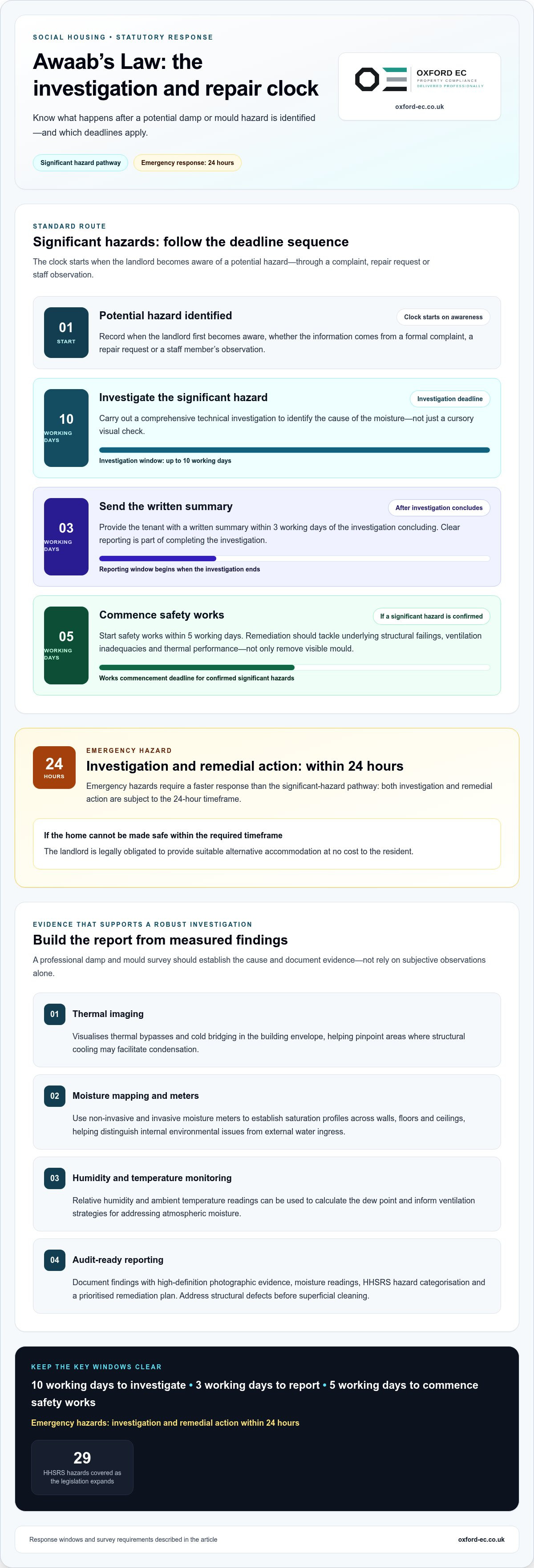
The clock starts the moment a landlord becomes aware of a potential hazard, whether via a formal complaint, a repair request, or an observation by a staff member. Under current requirements, landlords must investigate significant hazards within 10 working days. This investigation cannot be a cursory visual check. It must be a comprehensive technical audit that identifies the root cause of the moisture ingress. Within 3 working days of the investigation concluding, a written summary must be provided to the tenant. Surface-level 'patch and mend' fixes are insufficient. They fail the test of technical scrutiny. A robust property compliance strategy requires evidence-based reporting that documents every finding with absolute clarity.
Repair Deadlines and Safe Re-habitation
If a significant hazard is confirmed, safety works must commence within 5 working days. For emergency hazards, the timeframe is even tighter: 24 hours for both investigation and remedial action. If the property cannot be made safe within these windows, landlords are legally obligated to provide suitable alternative accommodation at no cost to the resident. Comprehensive remediation must move beyond superficial mould removal to address structural failings, ventilation inadequacies, and thermal performance. This is where specialist damp and mould surveys become essential for long-term asset protection. We don't just identify the problem; we provide the technical roadmap for its permanent resolution.
The Technical Requirements of a Professional Damp and Mould Survey
A superficial visual assessment is no longer a viable strategy for risk management. In the current legal climate, a professional awaab's law damp survey must be an evidence-led technical audit that withstands the scrutiny of both the Housing Ombudsman and the courts. Identifying mould is simple. Identifying the cause is complex. Identifying the solution is critical. Landlords must move away from subjective observations and adopt a methodology rooted in instrumentation and structural analysis. Technical precision is the only way to ensure tenant safety whilst protecting the organisation from the rising tide of disrepair claims.
Instrumentation and Data Collection
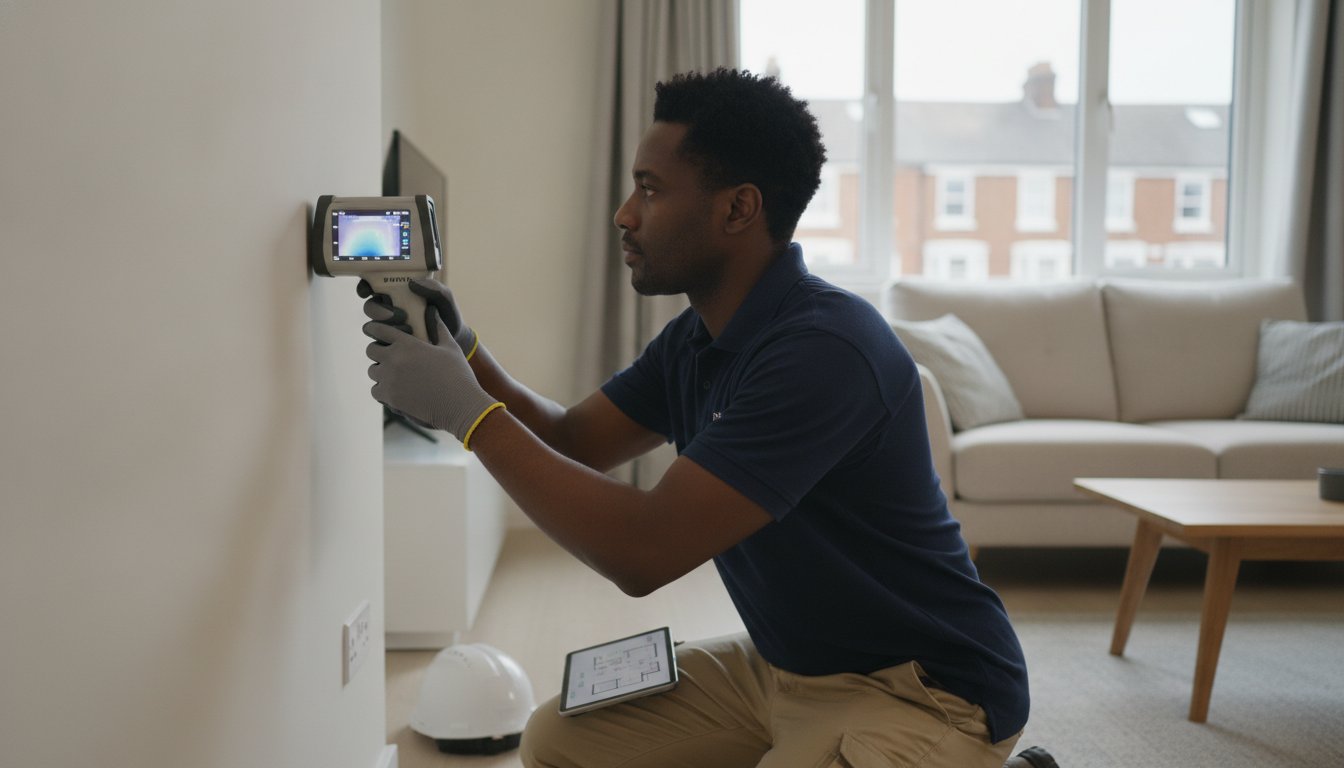
Technical mastery requires the right tools. High-resolution thermal imaging allows our surveyors to visualise thermal bypasses and cold bridging within the building envelope, pinpointing exactly where structural cooling facilitates condensation. This is supplemented by moisture mapping, where non-invasive and invasive moisture meters are used to establish saturation profiles across walls, floors, and ceilings. These data points allow for a clear distinction between internal environmental issues and external water ingress. Relative humidity represents the amount of water vapour present in the air compared to the maximum amount the air could hold at that specific temperature, directly influencing the likelihood of mould spores germinating on cold surfaces. By monitoring these levels alongside ambient temperatures, we can calculate the dew point and implement precise ventilation strategies that address the root cause of atmospheric moisture.
Reporting Standards for Regulatory Alignment
The Official Guidance for Social Landlords dictates that an investigation is only complete when a written summary is provided to the tenant, making the quality of the reporting as important as the survey itself. Every specialist damp and mould survey we conduct produces an audit-ready document that categorises hazards using the HHSRS framework. This ensures that 'Category 1' hazards are immediately flagged for the 24-hour emergency response while 'Category 2' issues are scheduled within the statutory 10-day window. Reports must include high-definition photographic evidence, moisture readings, and a prioritised remediation plan that addresses structural defects before attempting superficial cleaning. If your organisation requires support in scaling these technical requirements across a large portfolio, please contact our technical department to discuss a structured compliance partnership.
Rigorous documentation serves as your primary legal shield. By maintaining a detailed record of every inspection, reading, and remediation recommendation, you create a transparent audit trail that proves your commitment to the Social Housing (Regulation) Act 2023. This proactive approach reduces the risk of protracted litigation and ensures that resources are directed toward the most critical property failures. Expertise. Evidence. Compliance.
Navigating Emergency Hazards and the 24-Hour Repair Rule
Identify. Act. Protect. The 24-hour repair rule represents the most stringent requirement within the current regulatory framework, demanding an immediate operational response to hazards that pose an imminent risk to life or health. Whilst significant hazards permit a 10-day investigation window, emergency hazards collapse this timeframe, requiring landlords to both investigate and complete safety works within 24 hours of becoming aware of the issue. This mandate necessitates a robust, pre-emptive strategy that ensures technical resources are available at all times. A professional awaab's law damp survey serves as the critical diagnostic tool in these high-stakes scenarios, providing the technical justification for emergency interventions. Rapid. Precise. Compliant.
The distinction between 'making safe' and 'permanent repair' is vital for maintaining compliance during these compressed windows. Making safe involves immediate actions to remove the imminent threat, such as providing industrial dehumidification, isolating compromised electrical circuits, or, in extreme cases, relocating the resident to alternative accommodation. According to the Awaab's Law Tenant Guidance, once the property is made safe, the landlord must still adhere to the wider repair timeframes for the permanent resolution of the underlying defect. Failure to document this transition from emergency mitigation to permanent remediation creates a significant void in the audit trail.
Identifying Emergency Thresholds
Determining what constitutes an 'emergency hazard' requires a sophisticated understanding of the Housing Health and Safety Rating System (HHSRS) and the specific vulnerabilities of the occupants. Emergency thresholds are typically reached when mould growth is extensive in habitable rooms like bedrooms or when dampness compromises the structural integrity or electrical safety of the dwelling. Risk is amplified significantly if the household includes individuals with pre-existing respiratory conditions, cardiovascular disease, or weakened immune systems. A competent person must evaluate these factors during the triage process to ensure Category 1 hazards are prioritised correctly. We provide the technical expertise to differentiate between nuisance mould and life-threatening environmental conditions.
Immediate Response Protocols
Executing a 24-hour response requires a logistical framework that can deploy specialist surveyors and remedial contractors nationally at short notice. Documentation remains the cornerstone of this process; every action taken within that 24-hour window must be recorded with contemporaneous notes and photographic evidence to prove compliance with the Hazards in Social Housing Regulations 2025. Our damp and mould survey services are designed to integrate seamlessly with your emergency protocols, providing the rapid data collection required for high-speed decision-making. By establishing clear lines of communication between the tenant, the surveyor, and the maintenance team, you ensure that 'making safe' is not just a gesture but a technically sound intervention that protects the resident and the organisation's legal standing.
Establishing a Compliant Triage and Investigation Protocol
Managing a large property portfolio under the Hazards in Social Housing (Prescribed Requirements) (England) Regulations 2025 requires more than just a maintenance queue; it demands a technically literate filter. A professional awaab's law damp survey cannot be deployed for every minor maintenance request without a robust triage process. Categorise. Prioritise. Resolve. This protocol must be overseen by a 'competent person' who possesses the technical literacy to distinguish between surface condensation and structural saturation. By implementing a high-level triage framework, landlords ensure that resources are allocated where the risk to life or health is most acute, maintaining full property compliance through every stage of the tenant lifecycle. Training front-line staff to recognise early warning signs, such as localized salt efflorescence or pervasive musty odours, is a regulatory safeguard that prevents significant hazards from escalating into emergency crises.
Developing a Risk-Based Triage Matrix
A compliant matrix must evaluate three critical vectors: hazard severity, building age, and occupant vulnerability. Digital tracking systems are essential for monitoring the 10-working-day investigation window, providing automated alerts before statutory breaches occur. Every report must trigger a formalised workflow that documents the triage decision, creating an audit-ready trail that justifies why specific cases were prioritised for immediate inspection. This evidence-based approach protects the organisation from claims of negligence. Precision. Accountability. Safety. If your organisation requires a bespoke triage framework to manage portfolio-wide risks, contact our compliance experts to arrange a technical consultation.
Multi-Disciplinary Safety Integration
Dampness rarely exists in isolation; it often intersects with other safety criticalities such as compromised insulation or historical building materials. Integrating damp and mould assessments into a wider multi-disciplinary audit allows for a 'single visit' solution that reduces resident disruption and operational costs. For instance, when investigating moisture ingress in older stock, it is vital to consult A Complete Guide to Asbestos Management Surveys to ensure that remedial works do not inadvertently disturb hazardous materials. This holistic approach ensures that fire safety, water hygiene, and dampness are managed as a single, cohesive safety pillar. By consolidating these inspections, duty holders gain a clearer view of the total risk profile of their assets, moving from fragmented repairs to a streamlined, logical solution for property management.
Professional Property Compliance: Why Technical Precision Matters
The financial and reputational consequences of regulatory failure are absolute. Fines. Litigation. Disrepair claims. Whilst some landlords view the Hazards in Social Housing Regulations 2025 as a logistical burden, proactive duty holders recognise it as a framework for long-term asset protection. A technically deficient awaab's law damp survey doesn't just fail the tenant; it leaves the organisation exposed to aggressive legal challenges and escalating remediation costs. Technical precision is your only shield against the rising tide of disrepair litigation. OEC delivers a rigorous, audit-ready survey programme designed to provide total peace of mind through technical mastery and regulatory alignment. Proactive. Precise. Protected.
Moving from reactive repairs to a model of proactive asset management is no longer optional. With Phase 2 of Awaab’s Law set to expand into further hazard categories by 30 November 2026, the need for a "safe pair of hands" has never been more acute. By integrating technical data into your long-term investment plans, you don't just fix symptoms; you eliminate the environmental conditions that cause property failure. This strategic shift reduces the total cost of compliance by preventing the recurrence of Category 1 hazards and minimising the need for emergency 24-hour interventions.
Defending Your Position with Expert Evidence
In a court of law, a visual inspection by a generalist contractor carries little weight compared to an evidence-based audit by a multi-disciplinary consultancy. Professional surveys provide a robust defence by proving that 'reasonable steps' were taken to identify and mitigate hazards within statutory timeframes. By utilising an independent, third-party assessment, you demonstrate a commitment to transparency that general maintenance records cannot match. This level of scrutiny ensures that every remediation plan is technically sound and legally defensible. We don't just find mould; we document the structural and environmental conditions that allowed it to thrive, providing the evidence required to close cases definitively.
Streamlining Compliance Nationally
Standardising quality across geographically dispersed portfolios is a significant operational challenge for social housing providers. Partnering with a national consultancy ensures that every damp and mould survey is conducted to the same exacting standards, regardless of location. This consistency allows for better data aggregation and more effective long-term asset management. Our multi-disciplinary expertise means we can identify hidden risks, such as asbestos in damp-damaged plaster or legionella risks in poorly ventilated bathrooms, during a single site visit. It's time to move beyond reactive repairs and secure your organisation's future through technical rigour. Contact Oxford Environmental Consultants to secure your portfolio compliance and ensure your property assets meet the highest standards of safety and legality.
Securing Your Portfolio Against Regulatory Escalation
Rigorous. Transparent. Compliant. Awaab’s Law has fundamentally redefined property management by transforming damp investigations into high-stakes technical audits that demand absolute precision. Implementing a professional awaab's law damp survey is no longer just a preventative measure; it's a statutory necessity required to satisfy the 10-working-day investigation window and the 24-hour emergency repair rule. As national property compliance experts, OEC provides the audit-ready technical reporting and comprehensive multi-disciplinary safety surveys required to protect your residents and your organisation from the rising risk of disrepair litigation.
We act as your safe pair of hands, ensuring every remediation plan is evidence-based and fully aligned with the Social Housing (Regulation) Act 2023. Don't wait for a regulatory breach to evaluate your current triage and investigation protocols. By adopting a proactive, multi-disciplinary approach now, you can safeguard your assets well ahead of the Phase 2 hazard expansions scheduled for November 2026. Ensure your portfolio is Awaab's Law compliant with OEC today. We look forward to helping you maintain the highest standards of building safety and resident welfare.
Frequently Asked Questions
What is the primary purpose of Awaab’s Law?
The primary purpose of Awaab’s Law is to mandate that social housing landlords investigate and rectify health hazards, specifically damp and mould, within legally defined timeframes. It ensures that the Hazards in Social Housing (Prescribed Requirements) (England) Regulations 2025 are strictly enforced to protect tenant health. This legislation effectively shifts the burden of accountability onto the landlord to demonstrate that a property is technically safe and habitable. Rigorous. Mandatory. Accountable.
How long does a landlord have to investigate a damp report under Awaab’s Law?
Landlords must investigate any potential significant hazard within 10 working days of becoming aware of the issue. Awareness is triggered the moment a tenant reports a problem or a staff member identifies a potential hazard during a property visit. Following the conclusion of the investigation, a written summary of the findings must be delivered to the tenant within three working days to maintain full legal compliance.
Does Awaab’s Law apply to private landlords in 2026?
As of July 2026, Awaab’s Law applies strictly to social housing landlords in England, including local councils and housing associations. Whilst the UK Government has stated an intention to extend these standards to the private rented sector, mandatory requirements for private providers are expected to be finalised later this year. Private landlords should prepare for equivalent awaab's law damp survey obligations to become a statutory requirement in the near future.
What constitutes an emergency hazard that requires a 24-hour response?
An emergency hazard is any condition that poses an imminent risk to the health or safety of the residents. In the context of dampness, this includes moisture ingress affecting electrical installations, structural instability, or extreme mould growth in habitable rooms occupied by vulnerable individuals. Both the technical investigation and the 'making safe' works must be completed within 24 hours of the landlord becoming aware of the hazard.
Can a landlord refuse a damp survey if they believe the issue is 'lifestyle-related'?
No, a landlord cannot refuse to investigate based on the assumption that an issue is caused by tenant behaviour. The Housing Ombudsman is clear that landlords must first rule out structural defects, ventilation failures, or penetrating damp through a professional awaab's law damp survey. Blaming lifestyle without technical evidence is a significant regulatory failure that often results in successful legal action and disrepair claims against the landlord.
What information must be included in the written summary provided to tenants?
The written summary must explicitly state whether a hazard exists, its categorisation under the HHSRS, and the specific safety works required to resolve it. It must also provide a clear schedule for when these works will commence and conclude. This document is a critical component of your audit trail and must be provided to the resident within three working days of the investigation's conclusion to satisfy statutory requirements.
What happens if a landlord fails to meet the repair deadlines?
Failure to meet the 24-hour emergency or 5-working-day significant hazard repair windows exposes the landlord to immediate legal action and intervention by the Regulator of Social Housing. Tenants have the right to take disrepair cases to court if these statutory timeframes are breached. Beyond the financial impact of fines and legal fees, the organisation faces the risk of a 'finding of severe maladministration' by the Housing Ombudsman.
How often should damp and mould surveys be conducted as part of general maintenance?
Whilst Awaab’s Law is reactive to reports, professional damp and mould surveys should be integrated into your annual stock condition surveys or multi-disciplinary compliance audits. This proactive approach allows you to identify early signs of moisture ingress before they escalate into significant hazards. Regular monitoring of high-risk property archetypes ensures your portfolio remains safe and significantly reduces the frequency of emergency 24-hour interventions.