
A failed Legionella test is a trigger to investigate, not a diagnosis of an outbreak. The right remedial actions for a failed legionella test depend on what the laboratory result shows, where the sample was taken and how the finding relates to the building’s water system and current risk assessment. A single positive result does not, by itself, mean people have become ill. It does require a considered response.
If you are unsure what the result means, or concerned that a generic disinfection treatment could miss the underlying cause, the next steps should be clear and evidence-led. This guide explains how to interpret the result in context, prioritise proportionate action and maintain appropriate operational controls while the issue is investigated.
You will also learn how to identify possible system or control failures, decide when measures such as resampling, disinfection or restricting access may be appropriate, and record corrective work and follow-up evidence. The objective is straightforward: address the cause, manage the risk and verify that controls are effective.
Key Takeaways
- Read a failed result alongside the laboratory report, sampling context and building risk assessment before deciding what it means.
- Use a structured first response to identify affected outlets, involve the responsible person and record decisions.
- Choose remedial actions for a failed legionella test that address the likely cause and are proportionate to the system and risk.
- Plan corrective work, assign responsibilities and keep clear evidence of completion, follow-up sampling and monitoring.
- Recurring results or system-wide defects may call for competent specialist support, including Legionella risk assessments, sampling and remedial works.
Table of Contents
- Failed Legionella Test: Meaning and Initial Actions
- How to interpret a Legionella test alongside the risk assessment
- Which remedial actions may address the cause of a failed Legionella test?
- How to implement, record and verify Legionella remedial actions
- When professional Legionella remedial support can help
Failed Legionella Test: Meaning and Initial Actions
A concerning Legionella result calls for a prompt response, but that response must be proportionate. A laboratory finding needs to be interpreted by someone competent to do so, in context and alongside the site’s risk assessment and water-system conditions.
A failed test is a signal to investigate and review controls, not a diagnosis of illness or an outbreak by itself. The result identifies a finding in a particular sample; on its own, it does not establish the extent or cause of a problem across the system. The Legionella bacteria overview provides background on the organism, but decisions about a building’s controls must be based on its own evidence and competent interpretation.
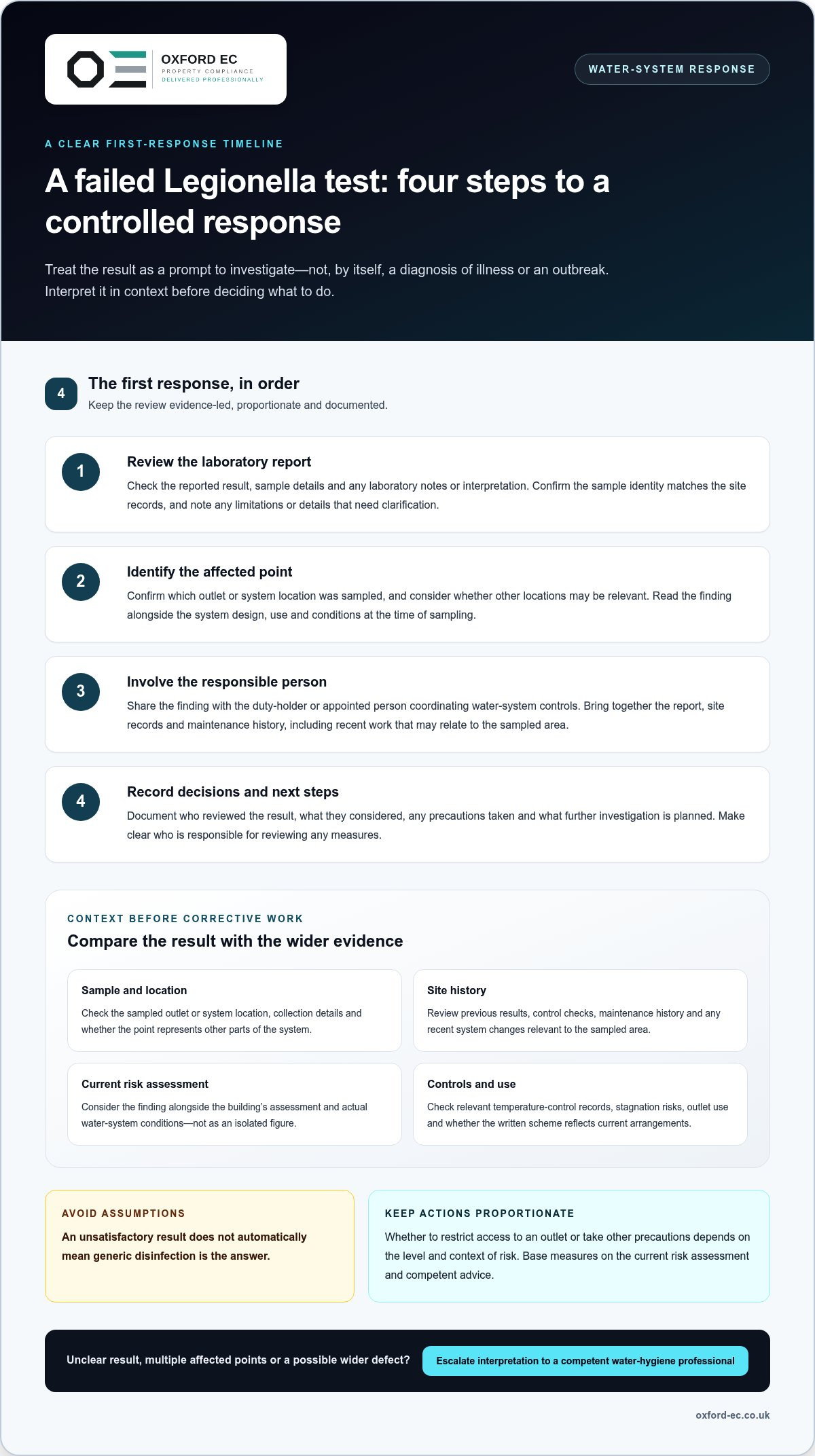
Start with a controlled first response:
- Review the report. Check the reported result, sample details, laboratory notes and any interpretation provided.
- Identify the affected points. Confirm which outlet or system location was sampled and whether other locations may be relevant.
- Consult the responsible person. Share the finding with the duty-holder or appointed person coordinating water-system controls.
- Document decisions. Record who reviewed the result, what they considered, any precautions taken and what further investigation is planned.
Do not apply a generic response simply because a result is described as unsatisfactory. Whether to restrict access to an outlet or take other precautions depends on the level and context of risk. Base any measures on the current risk assessment and competent advice, and make clear who is responsible for reviewing them.
What to check on the laboratory report
Confirm the sampled outlet or system location, collection date and reported result. Check that the sample identity matches the site records, then read the laboratory’s notes for any limitations or interpretation supplied. Sampling conditions can affect how a result should be understood, so do not treat a figure in isolation.
Compare the report with monitoring records and the current risk assessment. Check relevant information such as previous results, control checks and maintenance history for the sampled area. This can help establish whether the finding is new, recurring or potentially linked to a known system issue. Record any gaps that need clarification before deciding on corrective work.
Who should coordinate the initial response?
The duty-holder or appointed responsible person should coordinate the initial review, ensuring the relevant people have the same information and that decisions are traceable. Bring together the laboratory report, site records and maintenance history, including details of recent work that may relate to the sampled outlet or wider system.
Escalate technical interpretation to a competent water-hygiene professional where the result is unclear, affects multiple points or may indicate a wider defect. The resulting scope should follow the evidence, not assumptions. Investigation and appropriately scoped Legionella remedial works can then form part of a documented response, with decisions linked to the site’s actual conditions.
How to interpret a Legionella test alongside the risk assessment
A laboratory result is one piece of evidence, not a complete assessment of exposure or system risk. Its meaning depends on where and how the sample was collected, the system it represents and the conditions at the time. A result from one outlet, for example, may need to be considered differently from findings across several outlets or parts of a larger system.
Remedial decisions should follow competent interpretation of the result and the risks presented by the water system. A single threshold or treatment cannot determine the right response for every building. The appropriate next step depends on the laboratory report, the risk assessment and relevant site conditions.
Why a result cannot be read in isolation
Consider the sample location alongside system design and use. An outlet at the end of a little-used pipework run may raise different questions from a frequently used outlet close to the plant. Review the finding against temperature-control records, stagnation risks, maintenance history and any recent changes to the system or the way the building is occupied.
ACoP L8 provides the management framework for Legionella control, while HSG274 Part 2 gives technical guidance for hot and cold water systems. BS 8580-1:2019 is a code of practice for Legionella risk assessments. These references support a structured review, but the actual result still needs to be interpreted against the building’s circumstances and current assessment.
When to review the Legionella risk assessment
An unexpected result can be a reason to reassess whether hazards and controls have been identified accurately. Check whether the written scheme still reflects the system as it operates now, including outlet use, temperature monitoring, maintenance arrangements and who is responsible for each control. A scheme based on an earlier layout or operating pattern may not address present conditions.
Review the monitoring regime as well. Check whether the affected point is represented appropriately, whether records indicate a recurring issue and whether existing controls were completed and recorded. The review should determine whether further investigation, revised controls or remedial work is warranted, rather than presuming that disinfection is always the answer.
For further context on how an assessment informs ongoing controls, see this Legionella risk assessment and water hygiene guidance. A competent assessment should connect test evidence to system-specific hazards and controls. That connection gives the duty-holder a sound basis for deciding what to do next and recording why the chosen response is proportionate.
Which remedial actions may address the cause of a failed Legionella test?
The appropriate response depends on what the investigation identifies. A result may point to a local issue at one outlet, a wider control failure or conditions within the system that need correction. Select remedial actions for a failed legionella test using the evidence and risk assessment, rather than applying a standard package.
Separate treatment of an immediate condition from work that addresses its underlying cause. Cleaning or disinfection may be considered where indicated, but it will not correct a design, maintenance or operational problem that allows an issue to persist. The following are examples, not a prescription for every building:
| Stage | Possible response | Purpose |
|---|---|---|
| Investigate | Review affected outlets, system use, control records and relevant maintenance history. | Identify whether the finding is local or may relate to wider system conditions. |
| Correct | Address an identified defect, such as a control or component issue, where assessment supports this. | Remove or reduce the cause, rather than treating only the symptom. |
| Treat | Clean or disinfect where a competent, system-specific assessment recommends it. | Respond to the identified condition using a suitable method. |
| Verify | Complete follow-up checks, sampling or monitoring as advised. | Provide evidence that actions were completed and controls are being maintained. |
Correcting conditions that may support bacterial growth
Start with targeted checks for stagnation, infrequently used outlets and redundant pipework. Depending on the system’s design and use, these conditions may warrant changes to flushing arrangements or removal of redundant sections. Address temperature-control, insulation or component issues where the assessment identifies them as relevant. Any alteration needs competent scoping and suitable operational controls during the work.
When cleaning or disinfection may be considered
Cleaning or disinfection may form part of the response following a competent assessment of the system, laboratory evidence and identified risk. The decision should account for the treatment scope and how the system will be managed during and afterwards. Treatment is not the end of the process: control measures, maintenance and monitoring must continue in line with the site’s arrangements and competent advice.
Oxford Environmental Consultants provides Legionella remedial works to connect investigation of a defect with scoped corrective work. Its Water Hygiene service includes Legionella risk assessments, sampling and routine monitoring, supporting a joined-up view of the issue and subsequent controls.
No single intervention guarantees a negative result or removes future risk. The aim is to address the identified cause, apply any indicated treatment and verify that ongoing controls are suitable. The next section explains how to implement and document that work.
How to implement, record and verify Legionella remedial actions
Once the response has been scoped, turn it into a controlled work plan. Clear ownership and a documented close-out help the duty-holder demonstrate what was decided, what changed and how the site will check that controls remain effective. Completed work is not the same as verified ongoing control.
Use a sequence that links the identified risk to the work and its verification:
- Scope the actions. Define the affected locations, the defect or control gap to address, any required precautions and the evidence needed to close the task.
- Assign responsibility. Name the person coordinating the work and those responsible for implementation, operational controls and follow-up.
- Implement and manage controls. Record when work starts and finishes, and document temporary measures or changes to system operation.
- Record completion. Gather work details and supporting evidence, then note any outstanding actions rather than marking them complete prematurely.
- Verify and review. Follow competent advice and the site’s written scheme for appropriate checks, follow-up sampling and monitoring. Review the evidence before closing the action.
Build a clear remedial action record
Keep a traceable record of the original result, affected locations, assessment findings and rationale for the selected response. Include assigned actions, responsible persons, relevant dates and a description of the work completed. Add completion evidence, such as applicable work records, and note any limitations or outstanding tasks that need further management.
Where the findings change control arrangements, update relevant site procedures, responsibilities and the risk assessment. The record should make the sequence clear to someone reviewing it later: what was found, why that response was chosen, what was done and what evidence supports the decision.
Verify outcomes and maintain control
Agree suitable verification with a competent person. Follow their advice and the site’s written scheme for follow-up sampling and monitoring; do not assume every system or result calls for the same sampling plan. Consider subsequent results alongside temperature records, routine monitoring, maintenance information and how the system is operating.
A satisfactory follow-up sample is useful evidence, but it is not permanent assurance that conditions will remain controlled. Keep established control measures active, complete scheduled monitoring and act on new concerns. If verification identifies a continuing issue, review the findings and determine whether further investigation or corrective work is needed.
A structured Legionella remedial works process can connect scoped corrective action with completion evidence and follow-up review. This helps ensure the record reflects both the work carried out and how ongoing control will be maintained.
When professional Legionella remedial support can help
Some findings are difficult to resolve through routine site procedures alone. Competent specialist support may be appropriate where results recur after corrective work, several outlets or parts of a system are affected, or the investigation points to a wider defect. It can also help when the result, sampling context and system records do not provide a clear basis for choosing proportionate next steps.
The purpose is not to apply a standard treatment to every failed result. It is to connect the evidence to the condition of the system, identify what needs attention and define how the work will be managed and reviewed. A clear scope helps the duty-holder understand what is proposed, why it is relevant and what evidence will be needed afterwards.
What coordinated support can cover
Oxford Environmental Consultants’ Water Hygiene service includes Legionella risk assessments, sampling, routine monitoring and remedial works. Assessment and sampling findings can inform a tailored scope, linking identification of a defect with corrective work and oversight. This coordinated approach can help clarify responsibilities, operational controls and the records needed to track actions through to review.
OEC provides audit-ready reporting to ISO 9001-aligned standards. This gives the duty-holder a structured record of findings, agreed work and follow-up evidence, without guaranteeing a particular test result or audit outcome. The objective is transparent documentation and a clear account of the actions taken.
Taking the next step after an unsatisfactory result
For a focused review, bring together the laboratory report and relevant system records, including the current risk assessment, monitoring information and maintenance history. These documents help frame the issue and identify what may need further investigation. If records are incomplete, note that too, as gaps can form part of the initial review.
Where the evidence points to corrective work, the scope should reflect the system-specific findings rather than assume a single intervention will resolve every cause. Oxford Environmental Consultants provides Legionella remedial works as part of a response that connects defect identification, scoping and oversight of the work. Set any follow-up sampling or monitoring in line with competent advice and the site’s written scheme.
Bring the result and relevant records together to clarify the site’s circumstances and practical next steps. A clear review can establish what is known, what still needs investigation and how to plan a proportionate response.
Turn the test result into a clear next step
A Legionella result is most useful when it leads to a defined decision: what needs attention, who will take responsibility and what evidence will show that the response is complete. Keep the focus on the building’s actual conditions. The right remedial actions for a failed legionella test are those supported by competent interpretation and a clear understanding of the system, not a treatment selected by default.
If you are preparing for a review, bring the laboratory report and relevant site records together. A focused assessment can clarify which issues need further attention and how to progress them, without assuming the same approach suits every system. From there, agree a practical scope and keep the next steps visible to those responsible for water-system controls.
A measured, evidence-led response gives you a sound basis for action. Keep the building’s ongoing control at the centre of every decision.
Frequently Asked Questions
What should I do first after a positive Legionella test?
Start by confirming the result, sample location and collection date on the laboratory report, then alert the person responsible for the water system. Compare the finding with the relevant risk assessment and recent control records. For example, a positive sample from one outlet should be considered alongside results and conditions at nearby points, not assumed to represent every outlet. Record the initial review and seek competent advice before deciding on technical measures.
Does a positive Legionella test always mean the water system must be disinfected?
No. Disinfection is not automatic: the decision depends on the result, sampling context, system conditions and risk assessment. For hot and cold water systems, HSG274 Part 2 indicates that results above 100 and up to 1,000 cfu/l call for an immediate review of controls; what follows depends partly on how many samples are positive. The appropriate remedial actions for a failed legionella test should be determined by competent interpretation, not a one-size-fits-all treatment.
Can I keep using showers or taps after a failed Legionella test?
There is no universal answer. The responsible person should assess the result and decide whether any outlet needs temporary restriction, taking competent advice and following the site’s risk controls. Showers deserve particular attention because Legionella can spread in inhaled water droplets; drinking water is not the usual route of infection. Do not assume all taps and showers present the same risk, and communicate any restrictions clearly to building users until the decision is reviewed.
How soon should remedial action be taken after Legionella is detected?
Act promptly, with urgency guided by the result and system risk. For hot and cold water systems, HSG274 Part 2 calls for an immediate review of controls and the risk assessment when results are above 100 cfu/l. Above 1,000 cfu/l, it calls for immediate action, including urgent review and resampling, with disinfection likely to be considered. These action levels do not replace competent interpretation or apply as a universal rule to every system.
Do I need another Legionella test after remedial work?
Follow-up sampling may be appropriate, but the timing, locations and purpose should be set by competent advice and the site’s written scheme. Sampling should help assess whether the corrective work and control measures are effective, rather than simply produce a new result. For example, if work addressed a specific branch or outlet, consider the sampling plan in relation to that scope and the wider system. Continue routine monitoring as directed, even after a satisfactory follow-up result.
What records should I keep after Legionella remedial work?
Keep the laboratory report and any updated risk assessment, together with the reason for the chosen response and the locations affected. Retain the agreed scope, names of responsible persons, dates of work and records showing what was completed. Add follow-up sampling results and relevant monitoring records, such as temperature checks, so a reviewer can trace the issue from initial finding to ongoing management. Update the written scheme if responsibilities or control arrangements have changed.
Can a Legionella test fail even if routine temperature checks are satisfactory?
Yes. Temperature checks provide evidence about control conditions at the points and times measured; they do not establish the result at every outlet or rule out other contributing conditions. A sample may identify Legionella at a particular location despite satisfactory readings elsewhere, or conditions may vary with outlet use and operation. Compare the sample location and collection context with temperature records, maintenance information and system use, then ask a competent person to assess the combined evidence.