

A fire safety enforcement notice sets out alleged fire-safety failures and the action an authority requires. If you’re responding to a fire safety enforcement notice, first establish what must change, who could be at risk and the dates stated in the document. Acting before you understand the requirements can leave hazards unresolved or affect your options to challenge the notice.
It’s understandable to feel uncertain. An enforcement notice, prohibition notice and alterations notice impose different requirements, and the responsible person must take the steps that apply to their premises. In England and Wales, an appeal against a notice under the Regulatory Reform (Fire Safety) Order 2005 generally has to be made within 21 days. Check the notice and current requirements to confirm the service date, appeal route and whether an appeal affects compliance. The applicable procedure can vary by notice and jurisdiction.
This guide explains how to identify the notice and its requirements, protect occupants while you respond, and keep clear records of corrective action. It also covers when to contact the enforcing authority, seek help from a competent fire-safety professional or consult a solicitor. Act promptly, document decisions and check deadlines.
Key Takeaways
- Map each finding in the notice to the action required, the cited legal provision, the relevant evidence and the stated deadline.
- When responding to a fire safety enforcement notice, assess immediate risks to occupants separately from any decision to challenge it.
- Organise remedial work in a controlled sequence: address urgent risks, assign responsibilities, complete actions and retain evidence.
- Use a suitably scoped fire risk assessment and relevant inspections to review hazards, prioritise controls and document progress.
- Seek technical fire-safety advice to clarify deficiencies and evidence needs. Consult a solicitor about legal rights, appeals or disputes.
Table of Contents
- Responding to a fire safety enforcement notice: what it means
- How to review a fire safety enforcement notice and its legal basis
- Can you challenge a fire safety enforcement notice?
- How to organise remedial work and demonstrate compliance
- Get expert support responding to a fire safety enforcement notice
Responding to a fire safety enforcement notice: what it means
A fire safety notice is a formal regulatory document that identifies alleged fire-safety contraventions and specifies actions the recipient must take, or restrictions they must observe. It should identify the premises, the authority’s findings, the measures required and relevant dates. Read the notice carefully: general guidance cannot confirm your specific obligations, how a deadline is calculated or which procedure applies to your case.
The legal framework and terminology vary across the UK. In England and Wales, the principal legislation for fire safety in non-domestic premises is the Regulatory Reform (Fire Safety) Order 2005, which sets out different notice powers. Scotland and Northern Ireland have separate fire-safety regimes. Check the legislation and authority identified on your notice, and confirm they apply to your premises and jurisdiction before deciding what to do.
Who may receive a notice, and who enforces it?
The responsible person is generally the employer, building owner or another person with control of the premises, such as a managing agent, depending on the circumstances. More than one person may have responsibilities. The enforcing authority also depends on the premises and where they are located, so don’t assume every notice comes from a fire and rescue authority. Check the issuing body and its stated legal basis on the document. A suitably scoped fire risk assessment can help review hazards and prioritise control measures. Oxford Environmental Consultants provides fire-safety services, but does not decide regulatory matters or appeals.
Which type of fire safety notice have you received?
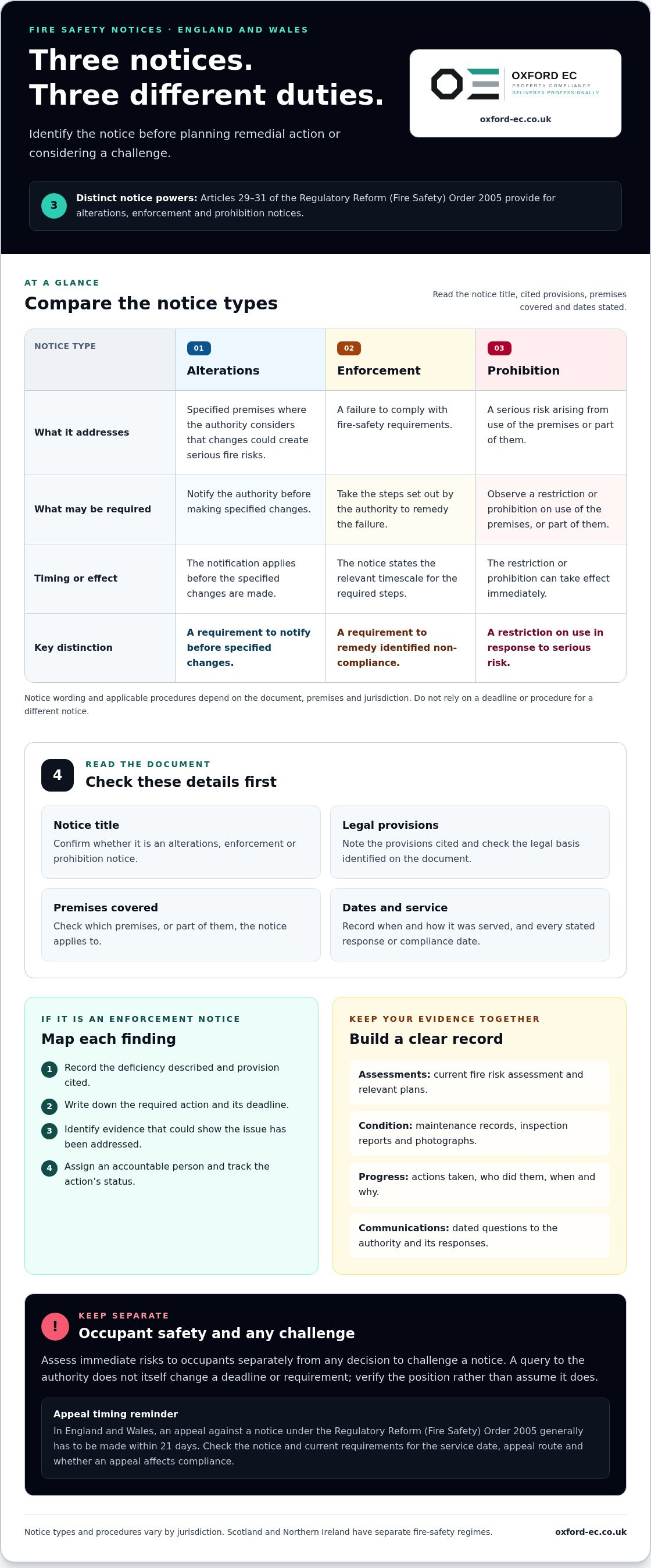
In England and Wales, Articles 29-31 of the Regulatory Reform (Fire Safety) Order 2005 provide for three distinct notices:
- Alterations notice: applies to specified premises where the authority considers that changes could create serious fire risks. It can require the responsible person to notify the authority before making specified changes.
- Enforcement notice: identifies a failure to comply with fire-safety requirements and sets out the steps the authority requires to remedy it, together with the relevant timescale.
- Prohibition notice: addresses serious risk and can restrict or prohibit use of premises, or part of them, with immediate effect.
The notice type determines the requirements and procedural steps, so identify it before planning remedial action or considering a challenge. When responding to a fire safety enforcement notice, confirm its title, cited legal provisions, the premises it covers and every stated date. Don’t rely on a deadline quoted for a different notice or jurisdiction.
How to review a fire safety enforcement notice and its legal basis
Before arranging works or replying, establish exactly what the notice requires. Record when and how it was served, retain the original notice and any covering documents, and note every response or compliance date stated. Don’t rely on a standard deadline: requirements and time limits depend on the notice, applicable law and wording.
Review each finding separately. For every item, record the provision cited, the deficiency described, the action required, the deadline and the evidence that could show the issue has been addressed. If anything is unclear, ask the issuing authority for clarification promptly and keep a dated copy of your question and its response. A query does not itself change a deadline or requirement, so verify the position rather than assume it does.
Build a clear notice-and-evidence file
Use a tracker to assign an accountable person and status to each action. Gather the current fire risk assessment, relevant plans, maintenance records, inspection reports and photographs. These records can help establish the condition of fire precautions and provide context for the authority’s findings.
- Immediate controls: identify any steps needed to reduce an urgent risk to occupants.
- Remedial works: plan repairs or other corrective measures against the notice and competent technical advice.
- Administration: track communications, appointments, decisions, evidence and completion dates.
Update records as events occur. Note what was done, by whom, when and why. Don’t alter, backdate or selectively omit material. If a measure cannot be completed as planned, record the reason and ask the authority what it requires next. Organised records make it easier to show progress and identify outstanding actions.
Check the law that applies to your premises
The Regulatory Reform (Fire Safety) Order 2005 applies to fire-safety duties in relevant premises in England and Wales. Scotland and Northern Ireland have different legislative frameworks. The premises category can also affect which rules and guidance are relevant. Check the legislation and guidance for the nation and type of premises involved, then compare them with the provisions cited in your notice. GOV.UK provides official government guidance on enforcement and appeals for workplace fire safety in England and Wales.
Where technical findings need assessment, a suitably scoped fire risk assessment or relevant inspection may help clarify hazards, priorities and supporting evidence. Oxford Environmental Consultants provides fire-safety services that may assist with this technical review. The appropriate support depends on the notice and premises. Technical advice does not replace legal advice or a decision by the enforcing authority.
Can you challenge a fire safety enforcement notice?
A notice may be open to formal challenge, but challenging it does not remove the need to assess and control immediate risks to occupants. Treat safety action and legal procedure as separate workstreams: address urgent hazards while promptly checking your options and any deadline.
Appeal rights, the appropriate forum and the time limit depend on the notice type and the legislation that applies to the premises. Don’t rely on a deadline quoted for another notice or nation. Check the notice, confirm the applicable law and obtain current, jurisdiction-specific advice promptly. Also verify whether an appeal affects the notice’s requirements or compliance deadline. Don’t assume it pauses either.
When might a formal challenge be considered?
A challenge may warrant consideration if you believe a finding is factually wrong, the cited legal basis does not apply, the required measures do not address the identified issue, or the proposed timescale appears unreasonable. Gather relevant records and evidence, then take legal advice on the merits, procedure and strategy, particularly where liability or substantial remedial work is disputed.
Asking the issuing authority to clarify wording or discussing evidence may help resolve a factual or technical question. That communication is not necessarily a formal appeal, and it does not guarantee that the authority will vary or withdraw the notice. Keep correspondence and confirm any agreed change in writing. The official UK government guidance explains enforcement under the Fire Safety Order in England and Wales. It should not be treated as a substitute for checking the regime that applies to premises in Scotland or Northern Ireland.
What happens if you miss a deadline or do not comply?
The consequences depend on the notice, governing law and circumstances. Non-compliance may lead to further enforcement action or other legal consequences under the applicable regime. Check the position against the actual notice and relevant legislation. A conversation with the authority does not automatically extend a deadline or suspend enforcement.
If a deadline is approaching or has passed, contact the issuing authority promptly to explain the position and ask what it requires next. Seek advice from a solicitor without delay, especially if you dispute the notice, may have missed an appeal deadline or cannot complete required work in time. Continue protecting occupants and document decisions and actions. Don’t wait for a legal discussion before addressing an immediate safety concern.
How to organise remedial work and demonstrate compliance
Turn each requirement in the notice into a controlled action. Assign a named owner, set a target date and identify the evidence that will show what has been done. Prioritise work according to the notice, the current fire risk assessment and competent professional advice. If work affects shared areas or occupants, agree access arrangements, responsibilities and how people will be kept informed before it begins.
Use this sequence to manage delivery:
- 1. Control urgent risks. Put appropriate interim measures in place where needed to protect occupants while permanent work is arranged. Record what was done and why.
- 2. Assign actions. Break each notice requirement into a clear task, name the person responsible and track dependencies, access and completion dates.
- 3. Appoint competent support. Select suitably qualified professionals for the specific work or assessment required. Clarify the scope and expected evidence before appointing them; for instance, if dealing with building compliance or occupancy sign-offs overseas in North American jurisdictions, you can discover Cornerstone Permit Company to assist with complex municipal clearances.
- 4. Complete the work. Check that the measure addresses the deficiency identified, rather than only its visible symptoms.
- 5. Verify and record. Obtain appropriate inspection or commissioning evidence, update the action tracker and retain the records with the notice.
Match remedial evidence to the notice
Evidence should relate directly to the finding and completed measure. Depending on the work, it may include dated photographs, inspection findings, commissioning records and invoices. For each item, note interim controls, outstanding actions, the responsible party and anticipated completion date. Don’t mark a deficiency as resolved until suitable evidence supports that conclusion. If evidence is incomplete, record the gap and next step accurately.
Bring related fire-safety systems into view
Check whether a finding involves fire doors, fire alarms, emergency lighting or compartmentation, and whether the remedy could affect other precautions. For example, work on service penetrations through a fire-resisting wall may need to be considered alongside the integrity of that compartment. A suitably scoped fire risk assessment can help review hazards and prioritise controls, while relevant inspections or surveys may provide evidence about specific defects. Oxford Environmental Consultants provides fire-safety services, including fire door inspections, fire alarm servicing, emergency light testing and compartmentation surveys.
Keep the notice, action tracker, correspondence, work records and verification evidence together. This makes it easier to review progress, identify unresolved requirements and provide the enforcing authority with a clear account of your response. Technical support can help assess findings and evidence, but it does not replace legal advice or determine whether the authority considers a notice satisfied.
Get expert support responding to a fire safety enforcement notice
Technical advice can help when a notice describes a deficiency that needs further investigation, when the right remedial measure is unclear, or when you need to identify evidence that could show work has been completed. A suitably scoped fire risk assessment can review hazards and help prioritise control measures. Specific inspections or surveys may also help clarify the condition of fire doors, alarms, emergency lighting or compartmentation, depending on the notice’s findings.
Oxford Environmental Consultants provides fire risk assessments and related fire-safety services, including fire door inspections, fire alarm servicing, emergency light testing and compartmentation surveys. The appropriate scope depends on the premises and issues identified. Technical findings can inform your decisions and records, but they do not determine whether an authority considers a notice satisfied.
What a fire-safety consultant can and cannot do
A competent consultant can assess relevant conditions, explain technical findings and advise on potential remedial priorities and supporting evidence. They cannot withdraw a notice, decide a formal appeal or guarantee that an enforcing authority will accept a particular response. Those decisions remain with the relevant authority or appeal body.
Keep the roles distinct. If you need advice on how legislation applies to your circumstances, potential liability, appeal rights or representation in formal proceedings, consult a suitably qualified solicitor. If you are preparing to represent yourself in court or at a tribunal hearing, check out Find a McKenzie Friend for lay support and courtroom guidance. Technical consultancy can support the factual assessment of fire-safety issues, but it is not a substitute for legal advice.
Prepare before requesting professional support
Clear records help a professional understand the scope of the work and focus on the issues that need technical attention. Gather the notice, current fire risk assessment, relevant plans and available inspection or maintenance records. Then prepare a short status list covering:
- the notice’s stated requirements and deadlines;
- actions already completed, with supporting evidence;
- unresolved findings and any interim controls in place; and
- questions about technical wording, risk controls or the evidence needed.
Share the relevant documents securely and identify any access arrangements or building stakeholders who need to be involved. This gives the consultant a clearer basis for discussing scope and priorities. It also helps separate technical questions from legal or procedural issues that should be referred elsewhere.
If you need technical help reviewing the premises or notice requirements, Oxford Environmental Consultants can discuss whether its fire-safety assessment and inspection services are relevant to your situation. No assessment or inspection can guarantee a particular regulatory outcome.
Take clear, documented steps towards compliance
Responding to a fire safety enforcement notice starts with understanding the exact requirements, relevant dates and legal basis stated in the document. Keep immediate occupant safety in focus as you organise remedial actions, assign responsibility and retain evidence that relates directly to each finding.
If you’re considering a challenge, verify the applicable procedure and deadline promptly. A technical fire-safety consultant can help assess conditions, prioritise controls and clarify evidence needs, but legal questions, formal appeals and decisions about the notice belong with the appropriate legal professional or authority.
Oxford Environmental Consultants provides fire risk assessments and related fire-safety services across the UK, including fire door inspections, alarm servicing, emergency-light testing and compartmentation surveys. The right support depends on your premises and the issues identified in the notice.
With the requirements mapped, actions recorded and suitable advice in place, you can move forward with greater clarity and keep occupant safety at the centre of your response.
Frequently Asked Questions
What is a fire safety enforcement notice?
A fire safety enforcement notice is a formal document issued when an enforcing authority considers that fire-safety requirements have been breached. It should identify the authority’s findings and the action required, and may state a compliance period. The precise powers and wording depend on the notice type and the law that applies to the premises. Read the document carefully, check its dates and cited provisions, and ask the issuing authority or a solicitor about unclear requirements.
Who can issue a fire safety enforcement notice in the UK?
The enforcing authority depends on the premises and the UK nation where they are located. A fire and rescue authority is responsible for many premises, but other authorities may enforce fire-safety requirements in particular cases. Don’t assume the issuer or legal framework based on a general guide. Check the authority named on the notice, the premises type and the applicable legislation. Contact the issuing authority if you need clarification.
How long do I have to respond to a fire safety enforcement notice?
There is no safe universal response period to assume. The notice and applicable law set the relevant compliance date and any appeal deadline, which may differ. When responding to a fire safety enforcement notice, record when and how it was served, then verify every date promptly against the document and current legislation. Contact the issuing authority or a solicitor if anything is unclear. Don’t assume informal discussions extend a deadline or pause requirements.
Can I appeal a fire safety enforcement notice?
A formal appeal may be available, but the route, grounds and deadline depend on the notice and applicable jurisdiction. Check the appeal information on the document and seek prompt legal advice if you’re considering a challenge. Continue assessing immediate fire risks and taking appropriate protective steps. Don’t assume that lodging an appeal suspends required action or changes a compliance date. Verify the effect for your specific notice with a solicitor or the relevant authority.
What happens if I do not comply with a fire safety enforcement notice?
Consequences depend on the notice, governing legislation and circumstances, and may include further enforcement action or prosecution. Don’t ignore the document or wait until a deadline has passed. If a requirement is unclear or completion is at risk, contact the issuing authority promptly and seek legal advice where appropriate. Take suitable immediate steps to protect occupants, and keep a clear record of decisions, interim measures, remedial work and communications.
Should I update the fire risk assessment after receiving a notice?
Review the current fire risk assessment against the notice’s findings and the premises’ present condition, then establish whether a competent person should revise it. A notice may identify hazards or shortcomings in control measures that need prompt attention. Keep any revised assessment aligned with actions taken and supporting records. An updated document alone does not prove that a risk is controlled: check that required measures have been implemented and retain evidence of their condition.
Can a fire safety consultant help me respond to a notice?
Yes. A suitably competent consultant can review relevant fire-safety conditions, clarify technical findings and inform remedial planning or evidence gathering. Share the notice and supporting records, explain the deadlines and identify the questions you need answered. Check that the proposed scope addresses the actual requirements. Technical consultancy does not replace legal advice, determine a formal appeal or control the enforcing authority’s decision. Consult a solicitor about liability or appeal strategy.