

A property risk rarely sits in one place, and a completed assessment alone doesn’t show that the issue is controlled. How do you identify what matters most, decide what to address first and demonstrate that action has followed? Risk mitigation for property owners means bringing building hazards, responsibilities and follow-up into one reviewable process, rather than relying on disconnected reports and reminders.
When a property has multiple systems, unclear priorities can leave important hazards unresolved. Fragmented records can also make it difficult to show that risks are being monitored. The responsibilities that apply depend on factors such as the property type, the duty-holder’s role and the relevant UK jurisdiction.
This practical checklist will help you identify relevant hazards, prioritise proportionate controls and assign an accountable person to each action. It also explains how to organise assessment findings, completed work and review dates as clear evidence of compliance. Specialist assessments for asbestos, fire, water hygiene, and damp and mould can inform the plan and give you a structured basis for decisions and follow-up.
Key Takeaways
- Build a clear picture of property risks by considering the building’s use, condition, occupants and management arrangements.
- Use a consistent assessment process to turn inspection findings into prioritised controls, recorded actions and planned reviews.
- Compare reactive, siloed and coordinated approaches to see how a risk register can improve oversight and evidence of follow-up.
- Use a practical checklist to organise records, assign responsibility and review controls when circumstances change.
- Specialist assessments can strengthen risk mitigation for property owners by identifying hazards and informing proportionate next steps.
Table of Contents
- Risk mitigation for property owners starts with a clear view of building risks
- How property risk assessments turn hazards into prioritised controls
- Property risk mitigation strategies: compare reactive, siloed and coordinated approaches
- A property owner’s checklist for prioritising and reviewing risk controls
- How OEC supports risk mitigation for property owners across the UK
Risk mitigation for property owners starts with a clear view of building risks
Effective risk mitigation for property owners is a working process, not a single report or repair. Identify hazards, assess who or what could be exposed and how serious the potential harm could be, then apply suitable controls. Record the decisions and review any risk that remains.
Risk mitigation is the documented, reviewed process of identifying property hazards, assessing exposure, applying controls and managing residual risk. A hazard is something with the potential to cause harm, such as a damaged fire door or water conditions that could support Legionella growth. Likelihood describes how probable harm is; potential impact describes its severity. A control measure reduces risk, while residual risk is what remains after controls are applied.
These distinctions help owners prioritise action instead of treating every finding as equally urgent. The risk management principles of identifying, evaluating and prioritising risks provide a useful foundation, but the practical assessment must reflect the building. One policy or assessment cannot automatically cover every hazard, system or duty.
Which property risks belong on an owner’s radar?
Consider fire safety, asbestos, water hygiene, damp and mould, and the condition of the building fabric and services. Other relevant concerns can include contractor activity, occupancy, access to restricted areas, maintenance arrangements and whether records are current and easy to find. Partnering with professional facilities management and maintenance specialists such as CH Enviro can help ensure critical drainage and plumbing systems remain properly managed. For example, planned refurbishment can change the significance of asbestos information, while changes in occupancy may affect how fire precautions are managed.
Risk categories and legal responsibilities vary with the property’s use, condition and management arrangements. A residential building, workplace and mixed-use site won’t necessarily present the same exposures or obligations. For commercial sites, this includes duty of care requirements around commercial refuse, where waste management providers such as Greenline Environmental help mitigate environmental and fire risks through regular trade waste collection. Treat this list as a prompt for a property-specific review, not as a universal checklist of statutory requirements.
Who is responsible for identifying and controlling risks?
Responsibility depends on the role and applicable legal framework. An owner may oversee the building and its maintenance; a landlord has responsibilities connected with letting; an employer must consider risks to staff; and a managing agent may carry out agreed management tasks. A statutory duty-holder has responsibilities defined by the relevant requirements. These roles can overlap, so establish who controls each area and who receives the findings.
Delegating inspections or actions doesn’t automatically remove the need for appropriate oversight. Keep clear records of assigned responsibilities, recommendations, decisions and completion evidence, and review unresolved actions. For a wider view of how building hazards and compliance duties fit together, see our commercial building safety and compliance information.
How property risk assessments turn hazards into prioritised controls
A useful assessment does more than identify defects. It connects each finding to the people who could be affected, the controls already in place and the next action required. Scope the review around the property’s use, condition, occupancy and planned works. For example, refurbishment can introduce risks that a routine operational review won’t cover.
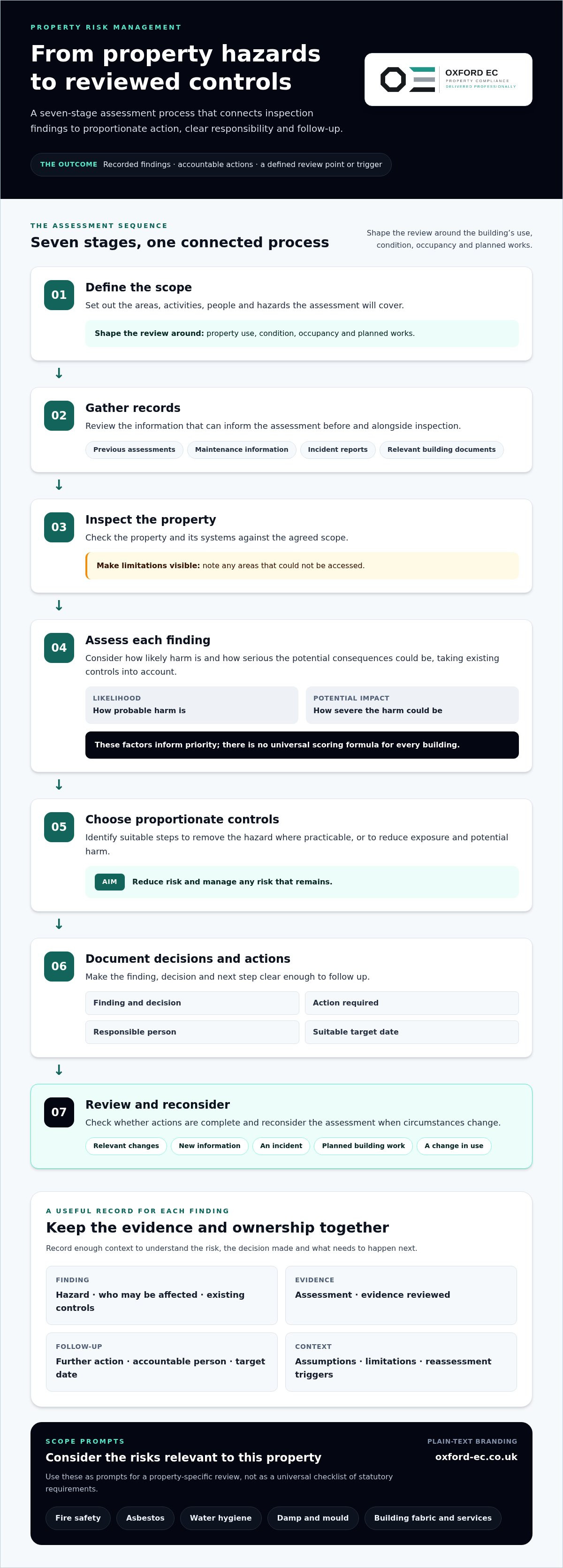
A property risk assessment should produce recorded findings, accountable actions and a defined point or trigger for review. Use this sequence to make the process consistent:
- 1. Define the scope. Set out the areas, activities, people and hazards the assessment will cover.
- 2. Gather records. Review previous assessments, maintenance information, incident reports and relevant building documents.
- 3. Inspect. Check the property and its systems against the scope, noting any areas that could not be accessed.
- 4. Assess. Consider how likely harm is and how serious the potential consequences could be, taking existing controls into account. These factors inform priority; there’s no universal scoring formula for every building.
- 5. Control. Identify proportionate steps to remove the hazard where practicable, or to reduce exposure and potential harm.
- 6. Document. Record findings, decisions, actions, responsible people and suitable target dates.
- 7. Review. Check completion and reconsider the assessment after relevant changes, new information or an incident.
What should a property risk assessment record?
For each finding, record the hazard, who may be affected, existing controls and the evidence reviewed. Add the assessment, any further action, the accountable person and a target date. Note assumptions, limitations such as inaccessible areas, and events that should prompt reassessment, such as planned building work or a change in use. Landlords may also find the NRLA’s landlord risk assessment guides useful when organising topic-specific records.
How do specialist surveys support risk decisions?
Specialist assessments provide evidence about distinct hazards; they don’t replace one another. An asbestos management survey helps identify and assess asbestos-containing materials that could be disturbed during normal occupation or maintenance. A fire risk assessment considers fire hazards and relevant precautions, while a Legionella risk assessment addresses risks associated with water systems. Enter the findings into the same action-tracking process so they can be reviewed alongside other property risks. Explore asbestos management surveys, fire risk assessments and Legionella risk assessments as inputs to a coordinated property review.
Property risk mitigation strategies: compare reactive, siloed and coordinated approaches
Owners can manage building risks in different ways, but each approach provides a different level of visibility and follow-up. A repair made after a fault is found may solve the immediate problem, but it won’t necessarily reveal related hazards, outstanding actions or changing exposure elsewhere in the property. For risk mitigation for property owners, the aim is to connect findings and decisions without assuming every building needs the same controls or inspection schedule.
An assessment identifies and evaluates risks at a point in time; ongoing risk management tracks controls, actions and changing conditions over time. The Housing Health and Safety Rating System (HHSRS) is official guidance for landlords on assessing health and safety risks in residential properties. Its context is specific, so it shouldn’t be treated as a universal assessment method for every property type or hazard.
| Approach | Strengths | Limitations | Evidence produced | Suitable circumstances |
|---|---|---|---|---|
| Reactive repairs | Addresses a visible fault or reported concern promptly. | May leave hidden hazards, repeat issues or wider exposure unidentified until another problem arises. | Work orders, repair records and incident notes. | A discrete defect requiring immediate attention, alongside appropriate risk review. |
| Siloed activity | Allows a specific hazard to receive focused assessment and specialist attention. | Separate records can obscure overlaps, open actions or dependencies between systems. | Individual survey reports, certificates and action lists. | Managing a defined hazard, provided findings are also considered in wider property oversight. |
| Coordinated risk register | Brings findings, responsibilities, evidence and review dates into one oversight process. | Needs active ownership and doesn’t replace specialist assessments or advice on legal duties. | A consolidated record of risks, actions, decisions and review history. | Properties with multiple hazards, teams or ongoing compliance activities. |
When is a reactive approach insufficient?
Responding only after damage or a complaint can leave developing risks unnoticed. A change in occupancy might alter how people use shared areas; planned refurbishment can affect how asbestos information is applied; and deteriorating building fabric may create new maintenance concerns. These are prompts to review relevant risks, not reasons to impose identical inspection intervals on every property.
What does a coordinated risk-management approach add?
A shared register makes it easier to see whether actions are complete, overdue or dependent on other work. For example, planned building work may need to be considered alongside asbestos information and fire precautions. Coordination improves visibility, but it doesn’t mean one inspection can cover every hazard or duty. Specialist surveys remain important where expertise is required, and applicable legal responsibilities depend on the property and duty-holder. A multidisciplinary building compliance approach can help connect relevant findings with accountable follow-up.
A property owner’s checklist for prioritising and reviewing risk controls
Turn assessment findings into actions that can be assigned, tracked and evidenced. This checklist supports risk mitigation for property owners by making records and follow-up part of a repeatable review, while allowing controls to be tailored to the building and its risks.
- Set the priority. Address immediate life-safety concerns and significant exposure first. Record why an issue takes priority, including the potential harm, people affected and controls already in place.
- Check the evidence. Gather current assessments, inspection findings, maintenance records and relevant building information. Note gaps or outdated documents that may affect decisions.
- Confirm the hazard and control. Check that findings describe the location, people potentially exposed and existing precautions. Identify any further control or investigation needed.
- Assign each action. Name an accountable person and set a suitable completion date. Distinguish actions that are underway from those completed.
- Verify closure. Retain evidence such as a completed work record, updated assessment or inspection finding. Close an action only when the outcome has been checked and recorded.
- Set review triggers. Revisit relevant risks after building alterations, incidents, changes in use or occupancy, new assessment findings, or overdue control measures.
What records should property owners organise?
Keep assessment reports, inspection results, maintenance records and relevant building information together with the action log, completion evidence and responsible-person details. Make records accessible to the people who need them to manage the property. Where practical, cross-reference each item by building, area, system and review date. A clear index helps connect a finding to its action and supporting evidence.
When should a property risk register be reviewed?
Review it when something material changes, not only at a routine review point. Alterations, changes in occupation or use, new management arrangements, incidents, defects and fresh assessment findings can all affect existing controls. Reopen actions if evidence is missing or a measure has become overdue. Don’t impose one review interval across every property; follow applicable requirements and competent advice for the building and its risks.
For related support coordinating property hazards and compliance actions, see our property compliance services.
How OEC supports risk mitigation for property owners across the UK
Effective risk mitigation for property owners depends on accurate findings and accountable follow-up. Oxford Environmental Consultants provides multidisciplinary property compliance services across the UK, including specialist assessments covering asbestos, fire safety, water hygiene, and damp and mould. Each assessment addresses its own hazards. Together, their findings can inform a more joined-up view of building risks and help owners determine proportionate next steps.
Which OEC services may support property risk reduction?
OEC conducts asbestos management surveys to identify and assess asbestos-containing materials, providing relevant information for managing risks during normal occupation and maintenance. Fire risk assessments examine fire-related hazards and precautions, while fire door inspections focus on the condition and functionality of fire doors. Legionella risk assessments identify and assess risks in water systems, and damp and mould surveys help identify the causes of dampness and mould growth. These assessments are distinct, not substitutes for one another. Their findings can be brought into a shared action process, with responsibilities, decisions and completion evidence tracked by the owner or appointed management team.
OEC’s property compliance services bring multidisciplinary expertise to buildings with different assessment needs. A coordinated programme can help owners see where findings relate without blurring the scope of each specialist assessment.
Assessment and consultancy findings support decision-making; they don’t transfer the owner’s ongoing management responsibilities. The appropriate duty-holder must consider the duties that apply to the property and role, decide how recommendations will be addressed, assign actions and retain evidence of follow-up. Clear findings make that oversight more structured, but don’t replace it.
What information helps scope a property compliance enquiry?
Prepare a concise picture of the building and its current position to help define the relevant support and next steps:
- Property details: building type, use and areas included.
- Existing information: relevant assessment reports, inspection records and known concerns.
- Planned changes: refurbishment, altered occupancy or changes in use, where applicable.
- Open actions: outstanding recommendations, defects and any work already completed.
This context helps scope the assessment around the property’s needs and feed recommendations into the owner’s risk register. The owner can then assign accountable people, record target dates and review progress as conditions change.
Put your property risk plan into action
Effective risk mitigation for property owners turns hazards into prioritised actions, with named responsibilities, completion evidence and review triggers. A coordinated risk register brings separate findings together, while specialist assessments provide the detail needed for informed decisions.
Oxford Environmental Consultants supports property owners across the UK with multidisciplinary compliance expertise. Assessments covering asbestos, fire safety, water hygiene, and damp and mould can help identify hazards and inform proportionate next steps. The responsible owner or duty-holder remains central to ongoing oversight: assign actions, track completion and review controls when circumstances change.
Start with the records and concerns you already have. Identify which findings need attention, decide who will take them forward and record how completion will be evidenced. A clear, documented process makes oversight more manageable and gives your decisions a stronger evidence trail.
With appropriate assessments and accountable follow-up, you can build a more organised approach to protecting people and managing building risks.
Frequently Asked Questions
What does risk mitigation mean for property owners?
Risk mitigation for property owners is the process of identifying hazards, assessing their likelihood and potential impact, selecting suitable controls, assigning actions and reviewing whether those controls remain effective. It doesn’t mean eliminating every risk. The right approach depends on the building’s use, occupants, condition and applicable responsibilities. Keep clear records of assessment findings, decisions, actions and follow-up so oversight can be demonstrated and outstanding issues tracked.
What are the main risks property owners should assess?
Common areas to consider include fire safety, asbestos, water hygiene, damp and mould, maintenance defects, contractor activity and building security. The relevant risk profile depends on the property type, use, condition and occupancy. For example, planned refurbishment may make asbestos information especially relevant, while water systems bring separate hygiene considerations. This isn’t an exhaustive list, and it doesn’t mean every owner has identical duties. A suitable assessment determines which hazards and responsibilities apply.
How often should a property risk assessment be reviewed?
There isn’t one review interval suitable for every property or assessment. Follow applicable legal requirements, competent advice and the recommendations recorded in the assessment. Review sooner if circumstances change, such as after building works, a change in use or occupancy, an incident, a newly identified hazard, or evidence that an existing control isn’t working effectively. Record the reason for review, any revised findings and the actions needed to keep risk controls appropriate.
Who is responsible for property risk management?
Responsibility depends on the property, the activities taking place and applicable legislation. Owners, employers, landlords, managing agents and other statutory duty-holders may have distinct or overlapping responsibilities. Delegating an inspection or maintenance task doesn’t automatically remove the need for appropriate oversight. Set out who is responsible for each action, who reviews findings and how completion is evidenced. If the applicable duties are unclear, seek competent advice for the property and relevant UK jurisdiction.
Can one property survey identify every building risk?
No. Surveys and assessments have defined purposes and scopes, so one shouldn’t be assumed to identify every hazard or address every duty. An asbestos survey, for example, doesn’t replace a fire risk assessment or a Legionella risk assessment. A coordinated programme can bring separate findings together in one action-tracking process while preserving each assessment’s scope and recommendations. This helps owners gain wider oversight without treating specialist assessments as interchangeable.
How can property owners prioritise risks and track corrective actions?
Consider potential harm, likelihood, existing controls and the urgency identified by competent assessors. Address significant life-safety concerns appropriately, and record the reasons for the order of priority rather than relying on a universal scoring formula. For each action, name an accountable person, set a target date and retain evidence of completion. Review unresolved actions regularly, escalate concerns where appropriate and reassess if building conditions, use or occupancy change.
Do UK property safety requirements differ across the country?
Yes. Some building and fire safety requirements differ between England, Wales, Scotland and Northern Ireland, and their application can depend on building type and the responsible person’s role. Don’t assume that one rule applies throughout the UK. Check current legislation and guidance for the relevant jurisdiction and property circumstances, and obtain competent advice where interpretation is uncertain. Record which requirements were considered and the basis for decisions, particularly where responsibilities are shared.