What if a school building safety checklist identifies a hazard, but nobody knows who must act or where the evidence is recorded? A review is useful only when findings lead to clear, owned actions. For schools, that means looking beyond general building checks to the spaces, term-time routines and people who may be affected across the site.
Responsibilities and records can sit across premises, estates and leadership teams. This practical guide brings the main checks together, including fire precautions, asbestos, water hygiene, damp and mould, fire doors, escape routes and emergency lighting. It also explains how to record findings, assign responsibility and prioritise follow-up.
Some issues need more than a routine visual check. Use this checklist to identify when a specialist assessment may be appropriate and to connect findings with the right records and actions. It is a management tool, not a substitute for legal advice or competent specialist assessment. Clear checks. Accountable actions. Reliable records.
Key Takeaways
- Adapt your school building safety checklist to the different risks of classrooms, laboratories, kitchens, sports areas and plant rooms.
- Use the requirements and records that apply to your school’s UK nation, premises, activities and legal arrangements.
- Compare routine observations with evidence on fire precautions, asbestos, water hygiene, damp and mould, and building condition.
- Turn findings into actions by recording evidence, assessing risk, assigning an owner and setting a review point.
- Use specialist assessments where checks identify complex concerns, including fire risk assessments, fire door inspections and emergency lighting.
Table of Contents
- What a school building safety checklist should cover
- Which UK duties and records should inform a school safety checklist?
- School building safety checklist: compare the main risk areas
- How to complete the checklist and prioritise school safety actions
- How OEC can support a school building safety review
What a school building safety checklist should cover
A school building safety checklist is a structured review of premises risks, controls and records. It helps the school capture findings, name the person responsible for each action and track follow-up. It does not prove that every applicable legal duty has been met. Use it as a management tool alongside legal advice where needed, specialist assessments, statutory inspections and planned maintenance.
Coverage should reflect how each space is used. In a classroom, check the general condition, access and safe circulation. A laboratory may involve specialist equipment and materials, while a kitchen has different equipment and operational risks. Sports areas, external spaces and plant rooms also need checks suited to their layout, access arrangements and activities. A broad overview of school safety can provide context, but the school’s premises and routines should shape the review.
Separate routine observations from formal assessments and inspections. Staff can note visible damage, blocked routes or other defects and report them through the school’s maintenance process. Specialist surveys and statutory inspections need appropriate scope, competence and records. The checklist should point to relevant reports, certificates and maintenance logs, not try to replace them. Where the review identifies a need for a formal fire assessment, a school fire risk assessment can examine relevant precautions in more detail.
Who should coordinate school premises safety checks?
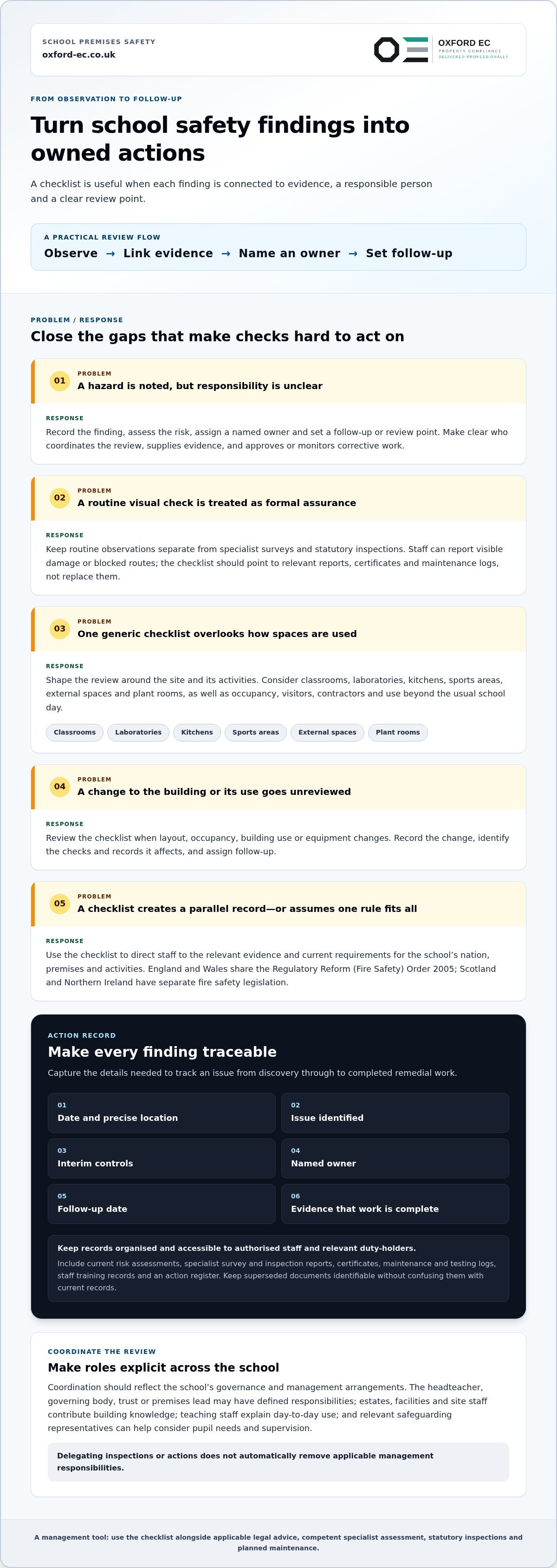
Set coordination around the school’s governance and management arrangements. The headteacher, governing body, trust or premises lead may have defined responsibilities, while estates, facilities and site staff contribute building knowledge. Teaching staff can explain how spaces are used day to day, and relevant safeguarding representatives can help consider pupil needs and supervision. Make responsibilities explicit: delegating inspections or actions does not automatically remove applicable management responsibilities. Record who coordinates the review, who supplies evidence, and who approves or monitors corrective work.
How should the checklist reflect school use?
Assess exposure in context. Consider pupils’ ages and needs, occupancy at different times, visitors, contractors and activities beyond the usual school day. Include temporary classrooms, playgrounds and other external areas, as well as cupboards, roof spaces and plant rooms that are accessed less often. Restricted access does not mean a space can be ignored. It may affect who checks it and how access is controlled.
Review the checklist when building use, layout, occupancy or equipment changes. Converting a room, introducing new machinery or changing how an area is occupied may alter hazards and controls. Record the change, identify which checks or records it affects, and assign follow-up. A useful review is specific, traceable and aligned with how the school operates.
Which UK duties and records should inform a school safety checklist?
A school building safety checklist should reflect the duties that apply to the school, rather than act as a universal legal template. Requirements can depend on whether the premises are in England, Wales, Scotland or Northern Ireland, how the buildings are used, the activities taking place and the school’s governance and legal arrangements. Check current legislation and guidance for the relevant nation, then identify which records show how each risk is assessed and managed.
Some frameworks have different territorial scope. For example, the Regulatory Reform (Fire Safety) Order 2005 applies in England and Wales; Scotland and Northern Ireland have separate fire safety legislation. Health and safety and asbestos requirements also need to be checked against the applicable jurisdiction. A school operating across UK nations, or occupying premises with unusual arrangements, should not assume that one reference, duty-holder or inspection interval applies everywhere.
A checklist supports risk assessment by organising observations and actions; it does not replace the assessment, competent judgement or any inspection required for the premises. Use it to connect hazards with relevant evidence: fire precautions with the current fire risk assessment and maintenance records; suspected asbestos concerns with the asbestos register and management information; and water hygiene risks with the relevant assessment and monitoring records. The checklist should direct staff to evidence, not create a parallel record that conflicts with it.
What should the school’s safety records make easy to find?
Keep an organised set of records that authorised staff and relevant duty-holders can access. It should include current risk assessments, specialist survey and inspection reports, certificates, maintenance and testing logs, staff training records and an action register. For each finding, record the date, precise location, issue, interim controls, named owner, follow-up date and evidence that remedial work is complete. Keep superseded documents identifiable without confusing them with current records.
How do legal requirements differ across the UK?
Build a jurisdiction check into document reviews. Confirm the current fire safety, education premises, health and safety and asbestos references for the nation where each site is located. England and Wales share some frameworks, including the Fire Safety Order, while Scotland and Northern Ireland operate under separate arrangements. Check the scope and wording against current official guidance. Do not transfer a duty or inspection frequency from one nation to another without confirming that it applies.
For practical coordination, use an evidence map with columns for hazard, applicable requirement, assessment or inspection, supporting record, review point and action owner. This makes gaps visible, such as an assessment with no linked follow-up record or a completed repair without evidence attached. If specialist findings leave actions unclear, discussing the property compliance requirements can help establish a proportionate next step.
School building safety checklist: compare the main risk areas
Use this comparison to connect staff observations with the records that provide a fuller picture. A visual check can flag concerns, but it cannot establish hidden defects or replace a required inspection, survey or specialist assessment. Record the exact location and escalate concerns that need competent investigation.
| Risk area | Routine observation | Evidence to review | Escalation trigger |
|---|---|---|---|
| Fire precautions | Look for obstructed escape routes, inaccessible exits, damaged fire doors or unclear signage. | Current fire risk assessment, fire alarm and emergency lighting inspection, testing and maintenance records. | Any escape route or fire safety control appears unavailable, damaged or inconsistent with assessment findings. |
| Asbestos information | Note damaged materials or signs of disturbance, without touching or sampling them. | Asbestos register, management arrangements, survey information and records of actions. | Information is missing, materials may be disturbed, or work could affect the fabric of the building. |
| Water hygiene | Record visible leaks, unusual discolouration or outlets that appear unused. | Water risk assessment, control measures, monitoring records and remedial actions. | Controls are not being followed, records show an unresolved issue or conditions have changed. |
| Damp and mould | Note visible growth, staining, condensation or musty odours, with the room and extent recorded. | Damp and mould survey findings, inspection records and evidence of investigation or remedial work. | Conditions persist, spread or recur, or their cause is unclear. |
| Building condition | Look for visible damage, deterioration, trip hazards and access difficulties. | Maintenance records, relevant inspection reports and outstanding work orders. | Defects appear structural, affect safe access or require electrical or other specialist judgement. |
Fire precautions, escape routes and emergency systems
Check that routes and exits remain accessible during lessons, breaks and events. Note damaged doors, missing signs and obstructions, then compare the findings with the current fire risk assessment. Follow up any control that the assessment identifies as needing attention. Review records for fire alarm and emergency lighting inspection, testing and maintenance. The fire risk assessment guidance and services can support a more detailed review where findings need specialist input.
Asbestos, water hygiene, damp and mould
Before intrusive work or disturbance, make sure relevant asbestos information and management arrangements are considered. For water hygiene, compare current site conditions with the risk assessment, control measures and monitoring records, then track remedial actions to closure. Log damp or mould by location and visible condition, including any immediate action taken. Do not treat a visual observation as a diagnosis of the underlying cause.
Building fabric, access and school-specific spaces
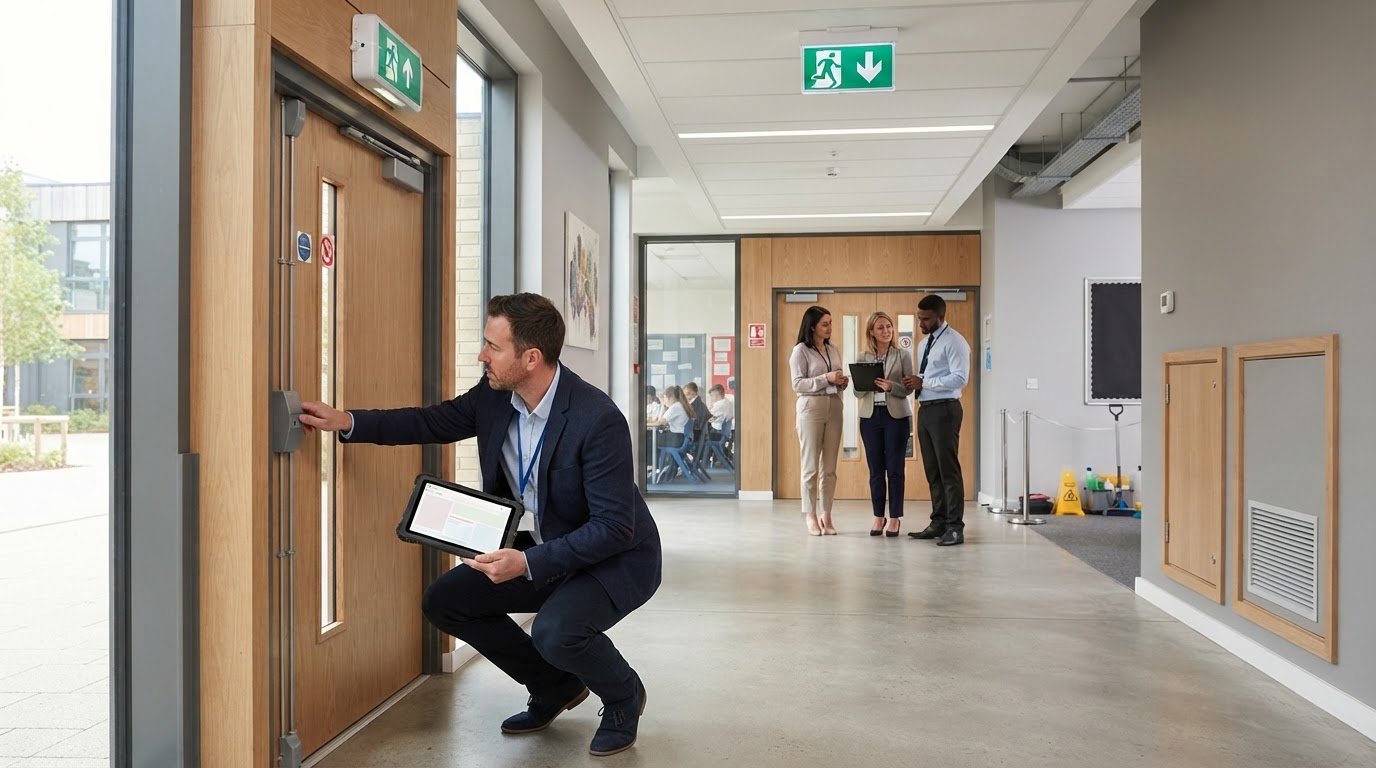
Include laboratories, workshops, kitchens, sports facilities, storage and plant areas where they form part of the site. Note visible defects and access concerns, then route structural, electrical or other specialist issues through appropriate competent channels. The school building safety checklist should help staff identify and record concerns, not encourage them to test systems or investigate concealed defects themselves.
How to complete the checklist and prioritise school safety actions
A consistent process turns observations into accountable follow-up. Use the school building safety checklist across the whole site, adapting the inspection plan to building use, known hazards, previous findings and the school’s arrangements. A clear sequence helps prevent concerns from being lost between teams.
- Scope the site. Confirm which buildings, external areas and activities are included, who will take part, and which existing assessments or reports should inform the review.
- Inspect. Carry out agreed routine observations safely and use appropriate access arrangements. Do not open equipment, disturb materials or investigate beyond the inspector’s competence.
- Record. Log each finding against its precise location, with the date, a clear description and a photograph where suitable. Link it to supporting evidence.
- Assess. Consider the credible risk, who may be affected, their likely exposure, and whether existing controls are suitable and working.
- Assign. Name an accountable owner and set a proportionate completion date, taking account of risk, operational constraints and applicable requirements.
- Verify. Check evidence that the action is complete, such as a work record or updated assessment. Record any residual risk or monitoring needed.
- Review. Revisit open actions and update the review when a material change, new concern or further assessment affects the risk picture.
Prioritise actions using evidence, not simply by which defect is easiest to fix. A concern affecting an occupied space, involving repeated exposure or indicating that an existing control has failed may need prompt attention. Separate immediate hazards requiring urgent control from planned improvements, but do not apply a universal response time where the risk, duty or site circumstances determine what is proportionate. Record the reason for the priority and any interim measures.
What should an inspection record include?
Make each record useful to the person carrying out the work and the manager tracking it. Include the observation, exact location, date, relevant photograph or report, immediate controls, named owner, required expertise and planned completion date. When the action is closed, retain evidence of remedial work and note whether any residual risk remains, who will monitor it and when that monitoring will be reviewed.
When should a finding trigger specialist assessment?
Escalate suspected asbestos disturbance, deficient fire precautions and unresolved water hygiene concerns. Routine observations cannot determine the full extent of these issues. Specialist input is also appropriate when a defect is concealed, technically complex or beyond staff competence. For suspected asbestos, use the relevant register and consider whether an asbestos management survey is needed. Damp or mould that persists or has an unclear cause may warrant a dedicated inspection.
Keep decisions visible: record why the issue was escalated, who is arranging the next assessment and how interim controls will be maintained. The checklist supports coordination, but it does not replace competent assessment or required inspections.
How OEC can support a school building safety review
A completed checklist can show where a routine observation needs to become a specialist assessment or inspection. Oxford Environmental Consultants provides property compliance support across the UK in fire safety, asbestos, water hygiene, and damp and mould. Matching the next step to the recorded finding helps schools focus on the issue, use relevant existing records and connect follow-up with the wider site review.
For fire-related findings, OEC carries out fire risk assessments and fire door inspections, as well as emergency light inspection and testing. These services help examine concerns identified during a school’s review, such as a fire door that appears damaged or emergency lighting that needs assessment. OEC’s fire safety services can form part of a proportionate response to relevant findings.
Match specialist support to the recorded risk
Use the nature of the concern to identify a suitable assessment. Asbestos management surveys help identify and assess asbestos-containing materials within properties. For water hygiene concerns, a Legionella risk assessment can identify relevant risks and control measures. Visible damp or mould may warrant a Damp & Mould Survey to investigate the reported conditions. The checklist remains a useful starting point, but it cannot establish the full extent or cause of a complex issue.
Link specialist findings back to the school’s action record. Note the affected area, relevant assessment, recommendations, action owner and evidence required for closure. Where several issues overlap, coordinated property compliance expertise can help the school understand how assessment findings relate to its wider premises review. One survey does not replace another where separate risks need assessment.
Prepare for a focused compliance discussion
Before discussing support, gather site details, relevant existing assessments, inspection and maintenance records, and the outstanding action list. Identify concerns that are urgent, recurring or unresolved, and note any connection to planned building works or changes in use. This keeps the discussion practical: what has been observed, what evidence is available and what assessment or inspection may clarify the next step.
Schools can discuss their premises and property compliance requirements with OEC to identify relevant specialist support. Clear records help focus attention on risks that need assessment and maintain a traceable route from finding to follow-up. A school building safety checklist works best as part of that wider process: structured review, suitable expertise and accountable action.
Make your next premises review a clear step forward
A school building safety checklist is most valuable when it becomes part of an ongoing management routine, rather than a document completed and filed away. Use the findings to shape the next review: check whether assigned actions are complete, whether evidence is on record and whether a change to a building, activity or occupancy calls for an earlier reassessment.
Keep the process practical. Make responsibilities visible, retain the records that support decisions and keep unresolved concerns in view. If findings point to a risk that needs specialist attention, a focused discussion can help clarify the appropriate assessment or inspection and how it fits into the school’s wider premises priorities.
Oxford Environmental Consultants supports schools with property compliance requirements across the UK, with expertise in fire safety, asbestos, water hygiene, damp and mould. Discuss your school’s requirements with OEC to identify the relevant support for your premises and outstanding actions.
With clear ownership and a considered plan, your school can keep building safety actions moving forward with confidence.
Frequently Asked Questions
How often should a school building safety checklist be completed?
There is no single review interval that suits every school. Set a schedule that reflects the site’s risk assessments, activities, inspection arrangements and applicable duties, and record why that frequency is appropriate. Revisit the checklist after significant building work, a change in room use, an incident or a newly identified hazard. For example, converting a store room into a teaching space may call for an earlier review of the area and its controls.
Who is responsible for school building safety?
Responsibility depends on the school’s governance, ownership, management and legal arrangements. Identify who holds the relevant duties, who coordinates premises checks and who can authorise actions or confirm their completion. A written responsibility map can prevent gaps when staff change roles or a site is managed by a trust or other organisation. Make delegated tasks clear, with appropriate oversight and a process for escalating unresolved issues.
Does a school safety checklist replace a fire risk assessment?
No. A checklist can help staff identify visible concerns, but it is not automatically a suitable and sufficient fire risk assessment. Keep the assessment current and consider whether changes, incidents or new information mean it needs review. Its findings should inform relevant checks, precautions, training and remedial work. For example, a change to how a hall is occupied may need consideration in the assessment, not just a note on a routine checklist.
What should a school do if it suspects asbestos-containing material is damaged?
Restrict access to the affected area and do not touch, disturb or clean the material. Follow the school’s asbestos management arrangements and report the concern to the person responsible for managing it. Check the relevant asbestos information and record the location and actions taken. Before planned intrusive work, ensure suitable asbestos information and controls are in place. If the material may have been disturbed, seek appropriate assessment rather than relying on a visual check.
Are schools responsible for Legionella risk assessments?
Who holds relevant responsibilities depends on the premises, water systems and management arrangements. Schools should ensure water hygiene risks are assessed and managed with suitable controls, monitoring and records where required. A checklist can flag changes such as altered water use or unresolved actions, but it cannot establish that a system is safe. A competent assessment can help determine appropriate controls for the particular system and circumstances.
What records should a school keep after completing a building safety checklist?
Keep the completed checklist with relevant assessments, inspection and maintenance records, photographs where useful, action assignments and evidence of completed work. Entries should make clear which building or room was checked, when, what was found, who owns the next step and whether follow-up is required. Link specialist reports to the relevant checklist finding so authorised staff can trace the decision and supporting evidence. A tick alone is not proof of compliance.
When should a school arrange a specialist building safety assessment?
Arrange specialist input when a concern needs technical evaluation, involves a hazardous material or complex system, or falls outside staff competence. Examples include suspected asbestos disturbance, fire precautions that may be deficient, unresolved water hygiene concerns, or damp and mould that persists despite action. A specialist assessment can clarify the issue and inform proportionate controls. Oxford Environmental Consultants provides relevant assessments across fire safety, asbestos, water hygiene, and damp and mould.