
In March 2026, a Legionnaires' disease outbreak in London resulted in eight confirmed cases, a stark reminder that water safety is a continuous life-safety requirement rather than a static administrative task. For duty holders and property managers, the fundamental question remains: what is a legionella risk assessment and how does it safeguard both occupants and the organisation from legal liability? Precision. Accountability. Protection. Whilst the Health and Safety at Work etc. Act 1974 and ACoP L8 mandate strict control measures, the technical reality of identifying hidden risks in complex pipework often leads to significant regulatory anxiety.
You understand that maintaining a safe environment is a non-negotiable duty, yet the dense technicality of legislative frameworks can be difficult to translate into practical maintenance. This comprehensive guide provides the technical clarity you require to master legal requirements, technical processes, and safety standards for absolute property compliance. We will examine the specific steps of a professional assessment, the implications of the latest 2026 safety trends, and the necessary components of a robust written scheme of control to ensure your water systems remain within strict safety parameters.
Key Takeaways
- Define what is a legionella risk assessment as a mandatory technical survey required to identify bacterial proliferation risks and maintain absolute legal compliance.
- Master the specific regulatory requirements of ACoP L8 and COSHH 2002 to protect your organisation from unlimited fines and potential criminal liability.
- Understand the inspection process including asset identification, temperature profiling at sentry points, and the rigorous evaluation of water storage capacity.
- Recognise high-risk environmental factors such as stagnant dead legs and organic contamination that compromise technical water safety standards.
- Implement a structured written scheme of control to transition from reactive maintenance to a proactive, audit-ready safety culture.
Table of Contents
- Understanding the Fundamentals: What is a Legionella Risk Assessment?
- Legal Obligations and Regulatory Compliance in the UK
- The Risk Assessment Process: What to Expect During an Inspection
- Identifying High-Risk Factors and Control Measures
- Professional Compliance Management with Oxford Environmental Consultants
Understanding the Fundamentals: What is a Legionella Risk Assessment?
Identify. Evaluate. Control. A Legionella risk assessment is a rigorous technical survey designed to scrutinise a building’s water infrastructure for the potential proliferation of Legionella bacteria. This document serves as a formal audit of man-made water systems, focusing on the prevention of Legionnaires’ disease. This severe and potentially fatal form of pneumonia occurs when individuals inhale contaminated water droplets. For property owners and duty holders, understanding what is a legionella risk assessment is the first step toward achieving total regulatory compliance and ensuring occupant safety. The process involves a detailed analysis of environmental factors that allow bacteria to multiply amongst stagnant water and lukewarm temperatures, creating a blueprint for risk mitigation.
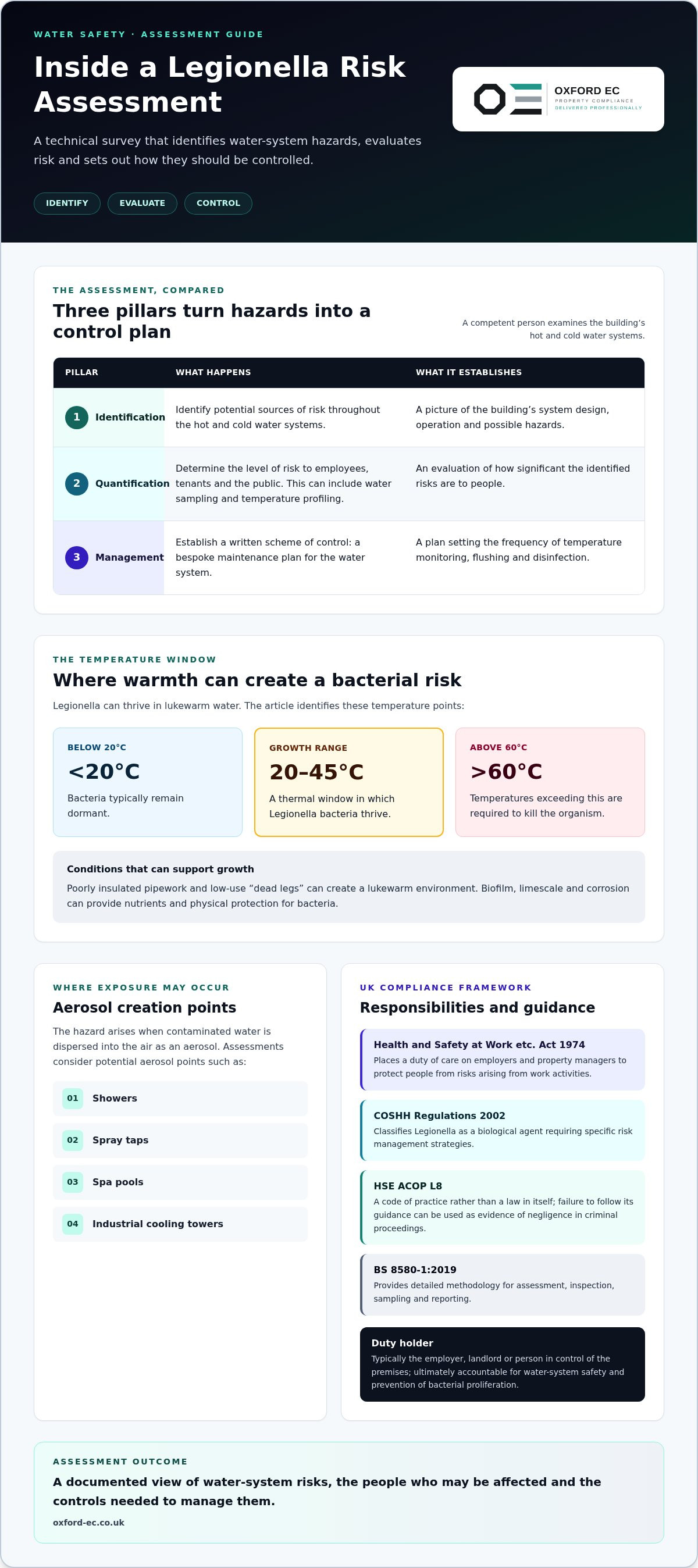
The primary hazard arises when contaminated water is dispersed into the air as an aerosol. Risk assessments must therefore evaluate every potential aerosol creation point within a facility. Common culprits include showers, spray taps, spa pools, and industrial cooling towers. If a system allows water to sit undisturbed at specific temperatures, the risk of a significant outbreak increases. A comprehensive Legionnaires' disease overview highlights that while the bacteria are common in natural environments, they only become a public health threat when they colonise building services where people are exposed to fine mists.
The Science of Legionella Bacteria
Legionella bacteria are opportunistic organisms that thrive within a specific thermal window of 20°C to 45°C. Below 20°C, the bacteria typically remain dormant, whilst temperatures exceeding 60°C are required to kill the organism. In many modern buildings, poorly insulated pipework or low-usage "dead legs" create the perfect lukewarm environment for rapid colonisation. Bacterial growth is further accelerated by the presence of biofilm, a slimy layer of microorganisms that attaches to internal pipe surfaces. This biofilm, along with limescale and corrosion, provides essential nutrients and physical protection for the bacteria, making them resistant to standard chemical treatments if the system isn't managed with precision.
Primary Objectives of the Assessment
The assessment process is governed by three core pillars: identification, quantification, and management. First, a competent person must identify all potential sources of risk within the hot and cold water systems. This isn't a mere visual check; it requires a deep technical understanding of system design and operation. Second, the assessor must determine the level of risk to employees, tenants, and the public, often through detailed water sampling and temperature profiling. Finally, the assessment establishes a "written scheme of control." This is a bespoke maintenance plan that dictates the frequency of temperature monitoring, flushing, and disinfection. Oxford Environmental Consultants delivers these findings through our specialised water hygiene services, providing the meticulous expert scrutiny required to transform a complex technical requirement into a manageable safety plan.
Legal Obligations and Regulatory Compliance in the UK
Compliance. Accountability. Scrutiny. In the United Kingdom, the legal framework governing water safety is uncompromising. The Health and Safety at Work etc. Act 1974 places a clear duty of care on employers and property managers to protect individuals from risks arising from work activities. Under the Control of Substances Hazardous to Health (COSHH) Regulations 2002, Legionella is classified as a biological agent, requiring specific risk management strategies. When businesses ask what is a legionella risk assessment, they aren't just requesting a technical survey; they're fulfilling a statutory obligation to identify and control these biological hazards.
Rigorous adherence to the HSE ACOP L8 (Approved Code of Practice) is essential for any duty holder. This document holds a unique legal status; whilst not a law in itself, failure to comply with its guidance is often used as evidence of negligence in criminal proceedings. Whilst many general guides focus solely on the ACOP, professional standards are further defined by BS 8580-1:2019. This British Standard provides the detailed methodology for conducting the assessment, ensuring that the "Competent Person" follows a standardised approach to inspection, sampling, and reporting that withstands regulatory scrutiny.
The Duty Holder’s Legal Responsibility
The "Duty Holder" is typically the employer, landlord, or person in control of the premises. They bear ultimate accountability for the safety of the water systems and the prevention of bacterial proliferation. A critical requirement under ACoP L8 is the appointment of a "Competent Person" who possesses the necessary technical knowledge and experience to oversee the assessment and subsequent control measures. For many organisations, the complexity of modern plumbing systems necessitates external expertise. Engaging professional water hygiene services ensures that the technical scrutiny applied to your building meets the highest regulatory standards.
Consequences of Statutory Non-Compliance
Negligence in water safety management carries severe penalties. Fines for non-compliance are now unlimited, and in cases of extreme failure leading to a fatality, corporate manslaughter charges or individual imprisonment are realistic outcomes. Beyond the courtroom, a lack of a documented risk assessment can invalidate professional indemnity or buildings insurance, leaving the organisation financially vulnerable. Maintaining an "audit-ready" compliance trail is the only way to prove that risks have been managed to a level that is "as low as reasonably practicable." If you're concerned about your current compliance status, you should speak with a technical consultant to review your documentation.
The Risk Assessment Process: What to Expect During an Inspection
Systematic. Evidence-based. Rigorous. A professional inspection is a forensic examination of your building’s water infrastructure. When determining what is a legionella risk assessment in a practical sense, one must look at the sequence of technical actions performed by the consultant to identify vulnerabilities. The process begins with a comprehensive site survey and asset identification, where every water-related component—from cold water storage tanks to calorifiers—is mapped and logged into a technical asset register. This ensures no part of the system remains unmonitored, providing a baseline for all future safety management activities.
Temperature control is the primary line of defence against bacterial proliferation. During the inspection, the assessor performs detailed temperature profiling at "sentry points," which include the nearest and furthest outlets from the heat source, as well as the storage tanks themselves. These measurements must be taken in strict alignment with HSE technical guidance HSG274 to ensure the water remains outside the 20°C to 45°C danger zone. Beyond physical measurements, the consultant reviews your existing management records and maintenance logs to verify that previous control measures have been consistently applied and documented.
Technical Inspection Components
The technical scrutiny extends to the physical integrity of the plant. Assessors look for "dead legs"—redundant lengths of pipework where water can stagnate—and evaluate the risk of aerosol generation from spray heads and cooling systems. They also inspect the cleanliness and insulation of tanks to prevent heat gain and nutrient accumulation. For a deeper analysis of these technical requirements, you can refer to our detailed Water Hygiene Risk Assessment documentation, which outlines how these findings are synthesised into a property compliance strategy.
Water Sampling and Laboratory Analysis
Whilst a risk assessment is primarily a qualitative and observational process, water sampling provides the empirical data necessary to confirm system safety. Sampling is legally required in specific scenarios, such as when a system is treated with biocides or following a suspected outbreak, but it's frequently recommended as a precautionary measure for high-risk environments like healthcare facilities. We collect samples using aseptic techniques for analysis at a UKAS-accredited laboratory. Once results are returned, the consultant interprets the colony-forming unit (CFU) counts to determine if immediate remedial actions, such as a system disinfection or thermal shock, are required to regain control of the water hygiene standards.
Identifying High-Risk Factors and Control Measures
Monitor. Mitigate. Manage. A robust water hygiene strategy relies on the identification of specific environmental catalysts that facilitate bacterial growth. When asking what is a legionella risk assessment, duty holders must recognise that it's essentially a diagnostic tool used to determine system performance against safety benchmarks. One critical factor is the evaluation of water storage capacity relative to actual daily throughput. Oversised storage tanks in buildings with low occupancy lead to excessive residence times, allowing water to stagnate and temperatures to equalise with the ambient environment, which often falls within the danger zone. The assessment also scrutinises material suitability, identifying components like rubber washers or certain sealants that may provide nutrients for bacterial colonisation.
While temperature control remains the primary method for managing risks in the UK, some complex infrastructures require a comparison of thermal strategies versus chemical dosing. Thermal control is often the most cost-effective and reliable method, provided the system can consistently maintain 60°C at the heat source and 50°C at the outlets. However, in systems where pipework runs are exceptionally long or insulation is compromised, chemical dosing may be necessary as a supplementary barrier. It's vital that the risk assessment is viewed as a dynamic document; any significant modification to the pipework or building use necessitates an immediate review to ensure the written scheme of control remains fit for purpose.
Common "Red Flags" in Water Systems
Technical experts look for specific vulnerabilities that signal a breakdown in hygiene standards. Redundant pipework and infrequently used outlets are primary concerns, as they create pockets of stagnant water that bypass regular disinfection cycles. Temperature "creep" in cold water storage is another significant red flag, often caused by tanks being located in warm roof voids or placed too close to uninsulated hot water pipes. Without adequate thermal insulation, cold water can quickly rise above the safe 20°C threshold, creating an ideal incubation chamber for bacteria amongst the sediment and biofilm.
Implementing Effective Control Schemes
Once risks are identified, they must be managed through a rigorous programme of planned preventative maintenance. This typically involves monthly temperature monitoring at sentry points and annual inspections of cold water storage tanks to check for signs of ingress or corrosion. Quarterly protocols should include the descaling and disinfection of showerheads and spray taps to eliminate the build-up of organic matter. For those managing residential portfolios, obtaining professional Legionella Certificates ensures that landlord-specific control measures are documented and legally defensible.
Professional Compliance Management with Oxford Environmental Consultants
Precision. Accountability. Integrity. Managing the complexities of modern property safety requires a partner capable of delivering absolute regulatory mastery across multiple disciplines. Oxford Environmental Consultants (OEC) serves as the "safe pair of hands" for duty holders who require more than just a cursory survey. When you ask what is a legionella risk assessment in the context of professional consultancy, you're requesting a rigorous technical audit that aligns with the highest safety standards. Our national coverage ensures that whether you manage a single site or a multi-faceted portfolio, the level of technical scrutiny remains consistent, providing you with prioritised remedial action plans that translate complex legislative requirements into manageable tasks.
Transparency. Scrutiny. Results. Our reporting methodology is designed for clarity and legal robustness, ensuring that every identified hazard is categorised by its risk level to allow for efficient resource allocation. This evidence-based approach removes the ambiguity often associated with water hygiene, giving you the confidence to demonstrate total compliance during any external audit. By choosing a multi-disciplinary partner, you ensure that your water safety strategy is synchronised with other critical safety pillars, such as asbestos management and fire safety, preventing the fragmented approach that often leads to hidden liabilities.
Integrating Water Hygiene with Property Compliance
Safety requirements are rarely isolated. By incorporating water hygiene into a broader compliance audit, organisations can significantly streamline their management processes and reduce the administrative friction of coordinating disparate contractors. OEC’s ability to deliver Asbestos Management Surveys and Fire Risk Assessments alongside our water hygiene services provides a unified, high-level view of property risk. This holistic perspective is invaluable for complex refurbishments, as our consultants can identify where different safety requirements intersect, such as ensuring that new fire-stopping measures don't inadvertently create inaccessible "dead legs" in your water distribution network.
Next Steps for Duty Holders
Implementing a professional assessment is a non-negotiable statutory obligation for anyone in control of premises. Whilst there's no fixed expiry date for a report, industry standards and HSE guidance suggest that you should review your assessment every two years, or immediately following any significant modification to your water system or building use. To begin the process of mastering your legal requirements and understanding exactly what is a legionella risk assessment for your specific facility, you can contact OEC for a tailored property safety strategy. Our team of meticulous experts will guide you through the asset identification phase and establish the robust written scheme of control necessary to protect occupant health and ensure your organisation remains within the bounds of the law.
Mastering Your Property Compliance Strategy
Water safety is a dynamic obligation. It requires constant vigilance and expert oversight. Understanding what is a legionella risk assessment ensures that you transition from a reactive maintenance posture to a state of absolute, audit-ready compliance. By identifying high-risk factors such as stagnant dead legs and thermal gain, you protect occupant health whilst shielding your organisation from the severe penalties of statutory non-compliance. It's the most effective way to ensure total peace of mind.
As multi-disciplinary property compliance experts, Oxford Environmental Consultants provides comprehensive safety audits across the UK. We offer expert guidance on ACoP L8 and COSHH to ensure every technical detail is addressed with precision. Our team acts as your dedicated guardian, providing the rigorous scrutiny required to manage complex water systems effectively.
Take control of your water hygiene today. Your property’s safety and legal robustness are our priority.
Frequently Asked Questions
How often should a Legionella risk assessment be carried out?
Industry best practice dictates that a review should occur every two years. You must also conduct a reassessment if there are significant changes to the water system, building usage, or if a suspected outbreak occurs. This ensures your written scheme of control remains technically accurate and legally defensible. Regular reviews prevent the documentation from becoming obsolete and ensure you maintain a robust shield against potential legal liability.
Is a Legionella risk assessment a legal requirement for landlords?
Landlords are legally required to assess and control the risk of exposure to Legionella for their tenants. This statutory duty is enforced under the Health and Safety at Work etc. Act 1974 and the COSHH Regulations 2002. It's a mandatory step in providing a safe habitable environment. Failure to comply can result in unlimited fines or criminal prosecution, making precise documentation a critical component of property management.
Do I need a Legionella risk assessment if I only have a small office?
Every employer or person in control of premises must conduct a risk assessment regardless of the building's size. When considering what is a legionella risk assessment for a small office, the focus is on identifying simple hazards like infrequently used taps or poorly insulated tanks. Even simple systems require a formal evaluation to prove that risks have been considered and managed to a level that is as low as reasonably practicable.
Can I carry out my own Legionella risk assessment?
You may only conduct the assessment if you are a competent person with the required technical knowledge and experience. Most duty holders appoint external consultants to ensure the technical scrutiny and documentation withstand regulatory audits. Professional assessors provide the expertise needed to identify hidden risks that an untrained individual might overlook, such as redundant pipework or stagnant dead legs within complex plumbing infrastructures.
What happens during a Legionella risk assessment inspection?
The assessor conducts a thorough site survey to identify all water assets and potential aerosol creation points. They perform temperature profiling at sentry points and review your maintenance records to ensure alignment with ACoP L8 safety standards. This process results in a comprehensive report that provides a clear action plan for managing identified risks, ensuring your building remains safe for all occupants and visitors.
Is water sampling always necessary during an assessment?
Water sampling is not always mandatory but is required for high-risk systems or when temperature controls are not consistently achieved. It serves as a secondary validation tool to confirm the effectiveness of your hygiene regime. Sampling is particularly important in healthcare settings or where occupants are vulnerable. It provides the empirical data necessary to prove that your water systems are not colonised by harmful bacteria.
What are the symptoms of Legionnaires’ disease?
Common symptoms include a high fever, chills, a persistent cough, and shortness of breath. Because Legionnaires' disease is a severe form of pneumonia, it often requires hospitalisation and can be fatal if not treated promptly. Other symptoms may include muscle aches, headaches, and mental confusion. Early diagnosis is essential for effective treatment, highlighting why preventing bacterial growth through rigorous risk management is so critical.
Who is responsible for Legionella compliance in a rented building?
The duty holder, typically the landlord or the person in control of the premises, is ultimately responsible for compliance. Responsibilities for specific maintenance tasks, such as monthly temperature checks, may be delegated to tenants through formal lease agreements. However, the duty holder must ensure these tasks are completed correctly. Understanding what is a legionella risk assessment helps all parties clarify their roles in maintaining a safe and legally compliant water system.