
Between 2005 and 2024, UK courts handed down £8.6 million in fines across 28 separate Legionella-related prosecutions, with a single penalty reaching £1.8 million. These figures represent more than just financial loss; they signify a systemic failure in water safety management and a breach of the Health and Safety at Work etc. Act 1974. Scrutiny. Accountability. Precision. Understanding the specific legionella testing requirements uk is no longer a matter of administrative preference but a mandatory pillar of corporate risk mitigation. Whilst many duty holders recognise the gravity of the Control of Substances Hazardous to Health Regulations 2002 (COSHH), the practical application of ACOP L8 and HSG274 often remains shrouded in technical ambiguity.
You likely feel the pressure of balancing the escalating costs of laboratory analysis against the non-negotiable requirement to protect building occupants from foreseeable harm. You don't want to leave compliance to chance. This guide provides the definitive roadmap to mastering the complex landscape of UK water hygiene regulations, ensuring you identify exactly when, where, and how often your premises require sampling. We will examine the updated BS 7592:2022 standards, clarify the thresholds for significant contamination, and establish a methodical schedule for water monitoring that keeps your operations audit-ready and legally robust.
Key Takeaways
- Identify the core legal duties under the Health and Safety at Work etc. Act 1974 and COSHH, ensuring your compliance strategy is built on a robust regulatory foundation.
- Determine the precise frequency for sampling, including the mandatory quarterly requirements for cooling towers and the risk-based approach for hot and cold water systems.
- Master the technical standards of BS 7592:2022 to ensure every water sample is collected with the precision required for accurate, audit-ready laboratory analysis.
- Interpret complex CFU/L results with confidence, allowing you to distinguish between systems under control and those requiring immediate remedial disinfection or review.
- Align your premises with the specific legionella testing requirements uk to mitigate the risk of HSE prosecution and avoid the significant financial penalties associated with non-compliance.
Table of Contents
The Statutory Framework: Understanding UK Legionella Law
The Health and Safety at Work etc. Act 1974 provides the primary legislative bedrock for all workplace safety. It places an unequivocal duty on employers and those in control of premises to ensure the health, safety, and welfare of employees and others. This includes the management of risks associated with Legionella bacteria, which are classified as biological agents under the Control of Substances Hazardous to Health Regulations 2002 (COSHH). Precise. Absolute. Non-negotiable. These regulations mandate that risks must be identified and either prevented or adequately controlled through a systematic approach to water safety.
Duty Holder Responsibilities and Liability
The duty holder carries the ultimate legal burden for compliance. This role involves appointing a "Responsible Person" with sufficient authority and competence to oversee the written scheme of control. Assess the risk. Implement the scheme. Maintain the records. A "suitable and sufficient" risk assessment is the starting point for meeting legionella testing requirements uk, as it identifies potential colonisation areas and aerosol-generating points. Failure to align with these standards can lead to severe penalties, including unlimited fines and custodial sentences. Between 2005 and 2024, the UK saw 28 prosecutions resulting in £8.6 million in fines, proving that the Health and Safety Executive (HSE) prioritises rigorous enforcement over leniency for those who neglect their statutory obligations.
ACOP L8 vs. Technical Guidance HSG274
Whilst ACOP L8 (Fourth Edition) provides the Approved Code of Practice, HSG274 offers the technical specifications for various water systems. ACOP L8 holds a unique legal status; if you're prosecuted for a breach and it's proved you didn't follow its provisions, you'll need to show you complied with the law in some other way. Scrutiny. Evidence. Verification. HSG274 is divided into three distinct pillars: Part 1 for cooling towers and evaporative condensers, Part 2 for hot and cold water systems, and Part 3 for "other" systems such as spa pools and misters. Adhering to these technical standards is essential for building a robust defence, as ignorance of the guidance is never accepted as a valid legal justification in a court of law. For organisations managing complex estates, integrating these requirements into a broader water hygiene strategy ensures that every tap, shower, and cooling unit remains within the safe parameters defined by the HSE.
Monitoring Frequency: When is Testing Mandatory?
Determining the necessity for microbiological sampling requires a nuanced understanding of system architecture and risk profile. Whilst a site-specific risk assessment forms the basis of any control scheme, the legionella testing requirements uk for high-risk assets are explicitly defined to prevent widespread aerosol exposure. Identify. Sample. Validate. For most standard hot and cold water systems, routine testing is not a legal mandate provided that temperature controls remain effective, yet for high-risk assets, the requirement for regular laboratory verification is absolute.
Open Systems and High-Risk Assets
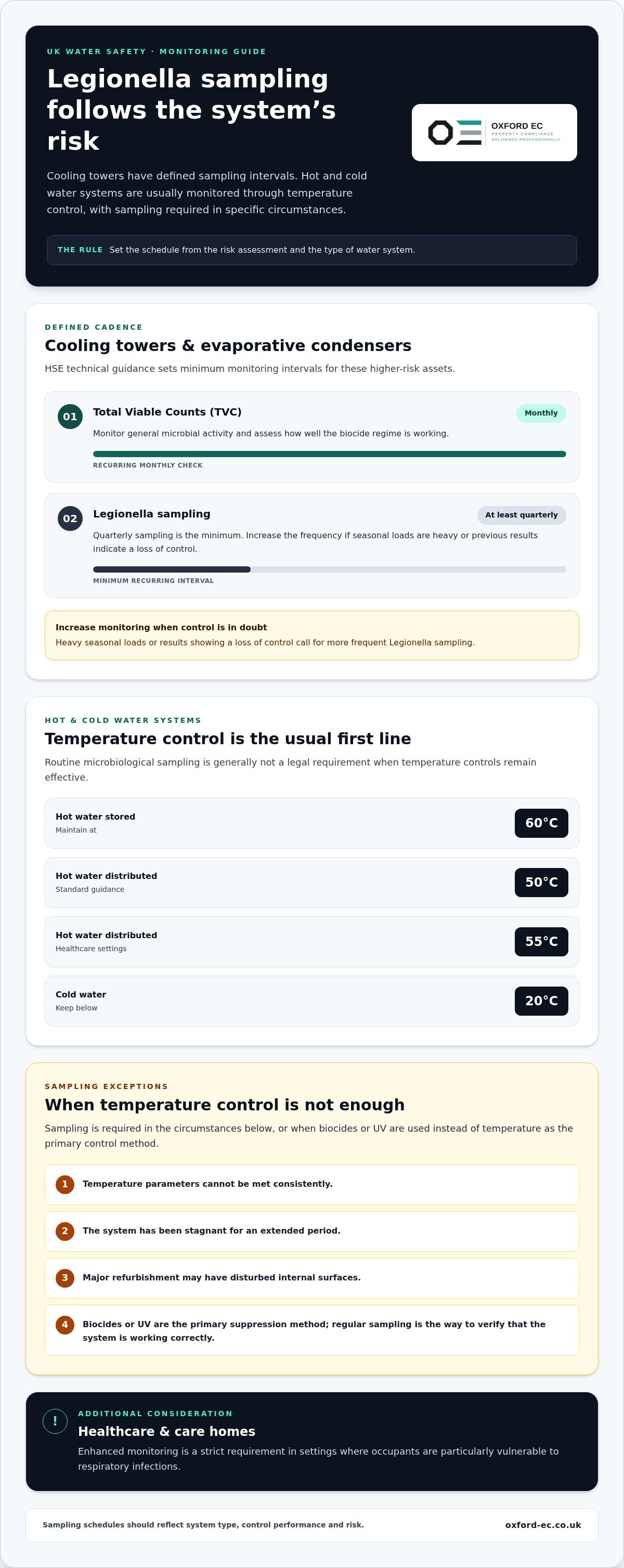
Cooling towers and evaporative condensers represent a significant risk for large-scale outbreaks due to their ability to distribute aerosols over wide areas. According to HSE's technical guidance, duty holders must conduct Legionella sampling at least quarterly as a minimum requirement. This frequency must increase if the system is subject to heavy seasonal loads or if previous results indicate a loss of control. In addition to quarterly Legionella tests, monthly Total Viable Counts (TVC) are essential to monitor general microbial activity and assess the efficacy of the biocide regime. Scrutiny. Precision. Evidence. These metrics provide the data-driven assurance required to maintain an audit-ready compliance profile.
Hot and Cold Water Systems: The Exception Rules
In standard property water systems, the primary control method is temperature. Keeping hot water stored at 60°C and distributed at 50°C (55°C in healthcare) whilst ensuring cold water remains below 20°C usually negates the need for routine sampling. However, legionella testing requirements uk stipulate that sampling becomes mandatory under specific "exception" conditions. You must conduct sampling if temperature parameters cannot be consistently met, if the system has been stagnant for extended periods, or following major refurbishment works that may have disturbed internal surfaces. If your facility uses biocides or UV light as the primary method of suppression rather than temperature, regular sampling is the only valid way to verify that these systems are functioning correctly. If you are uncertain about the specific sampling schedule for your portfolio, you can contact our technical team for expert advice on aligning with statutory standards.
Enhanced monitoring is also a strict requirement for healthcare and care home environments where occupants are particularly vulnerable to respiratory infections. For these settings, HSG274 Part 2 recommends a more rigorous sampling regime, often involving biannual testing of sentinel outlets even when temperatures appear compliant. Similarly, spa pools and whirlpool baths require monthly microbiological testing due to the high temperatures and heavy organic loads which create an ideal breeding ground for bacteria. For these assets, a "Not Detected" result is the only acceptable outcome for maintaining public safety. Integrating these tests into a broader water hygiene management plan ensures that no asset is left unmonitored.
Sampling Methodology: BS 7592 and Professional Standards
Adhering to BS 7592:2022 ensures that the data used to justify your safety decisions is technically sound and legally defensible. This British Standard governs the entire sampling lifecycle, from site preparation to laboratory submission. Precision. Scrutiny. Accountability. To meet the specific legionella testing requirements uk, duty holders must ensure that the methodology employed is capable of detecting bacteria at a limit of 100 Colony Forming Units per litre (CFU/L). This quantitative threshold is the benchmark for determining whether a system is under control or requires immediate remedial intervention.
The Technical Sampling Process
The distinction between pre-flush and post-flush sampling is critical for diagnostic accuracy. Pre-flush samples reflect the microbial condition at the point of use, identifying local contamination within taps, showerheads, or flexible hoses. Conversely, post-flush samples are taken after the water has run for a set duration, providing a snapshot of the systemic water quality within the calorifier or main distribution loops. Evidence. Verification. Result. Every sample bottle must be pre-dosed with a neutralising agent, such as sodium thiosulfate, to immediately arrest the action of any residual biocides. If this chemical action is not halted at the point of collection, the bacteria may be killed during transit, leading to a false negative result that leaves your premises and occupants at risk.
Maintaining a robust chain of custody is equally vital for statutory compliance. Samples must be transported in temperature-controlled conditions and submitted to the laboratory within a strict 24-hour window to prevent microbial growth or die-off during transit. This logistical discipline ensures the integrity of the data remains intact from the moment the water leaves the outlet to the moment it reaches the incubator. Any breach in this protocol can invalidate the results, rendering your compliance records useless in the event of an HSE audit or investigation.
Selecting a Competent Specialist
Choosing a specialist involves more than just selecting a low-cost service provider. It requires an accountable partner who understands that testing is a verification of control rather than a mere tick-box exercise. A competent technician must demonstrate a thorough understanding of the hydraulic layout of your building and the specific risks identified in your water hygiene risk assessments. Scrutiny. Expertise. Delivery. For results to be considered audit-ready and legally robust, they must be analysed by a laboratory accredited to ISO 17025 by the United Kingdom Accreditation Service (UKAS). This accreditation provides the assurance that the testing methods are subject to rigorous external scrutiny, ensuring that your compliance records can withstand the highest levels of regulatory investigation.
Interpreting Results: CFU/L Thresholds and Remedial Action
Laboratory results are expressed in Colony Forming Units per litre (CFU/L). This quantitative measurement represents the concentration of culturable bacteria within the water sample. Scrutiny. Accuracy. Accountability. Interpreting these figures correctly is a core component of legionella testing requirements uk, as the data dictates the urgency of your remedial response. A "Not Detected" result indicates that the concentration is below the laboratory's limit of detection, usually 100 CFU/L, providing evidence that your current control scheme is functioning effectively. It validates your efforts. It provides peace of mind.
When results fall between 100 and 1,000 CFU/L, the system is considered borderline. You shouldn't ignore these findings. Instead, carry out a thorough review of your temperature logs and biocide dosing records to identify where the control regime might be slipping. If two or more consecutive samples return results in this range, it's often a precursor to a more significant colonisation event, necessitating a preemptive disinfection of the affected outlets or pipework. Precision in these early stages prevents the escalation of risk and the potential for a full-scale outbreak.
Action Levels for Cooling Towers
Cooling towers require immediate, aggressive intervention if results exceed 1,000 CFU/L. Scrutinise the biocide levels. Disinfect the system. Resample immediately. If a result exceeds 10,000 CFU/L, the system must be shut down or isolated whilst emergency disinfection is carried out. This is a critical safety threshold. Duty holders must maintain meticulous records of these actions to demonstrate compliance during an inspection. If a cluster of cases is linked to the site, reporting to the local authority or the HSE becomes a statutory requirement under RIDDOR, making your laboratory data the primary evidence in any subsequent investigation.
Action Levels for Domestic Hot and Cold Systems
In domestic-style systems, a positive result often signals a failure in temperature control or the presence of stagnant "dead legs" where water has sat undisturbed. If bacteria are detected, you must conduct a full water hygiene risk assessment to identify the root cause of the colonisation. Remediation typically involves thermal disinfection, where water is raised to 60°C or higher and flushed through all outlets for at least five minutes, or a chemical "shock" treatment using high-strength chlorine. These methods must be verified with follow-up sampling after the system has returned to normal operation. Transparency is essential. Communicate clearly with tenants and employees about the findings and the corrective steps being taken. Providing factual, evidence-based updates prevents unnecessary panic whilst demonstrating that you are a responsible and proactive duty holder who prioritises occupant safety.
Achieving Total Compliance with Oxford Environmental Consultants
Precision. Accountability. Integrity. Oxford Environmental Consultants (OEC) operates as a disciplined, high-level consultancy designed to serve as a protective shield against the risks of regulatory non-compliance. Whilst many providers offer isolated sampling services, our approach is fundamentally built on the principle of total property hygiene, ensuring that every statutory obligation is met with absolute technical exactness. Managing the evolving legionella testing requirements uk requires more than a tick-box mindset; it demands an uncompromising commitment to standards. From the initial identification of risk to the delivery of remedial action, we provide a streamlined, logical solution that eliminates the confusion often associated with managing complex, multi-faceted property requirements across national portfolios.
Our Water Hygiene Services
Our methodology begins with comprehensive Legionella risk assessments that are meticulously tailored to the unique hydraulic architecture of your building, whether you manage a single commercial unit or a diverse national estate. We facilitate professional water sampling and analysis via UKAS-accredited laboratory partners, ensuring that your data is not only accurate but also capable of withstanding the highest levels of regulatory scrutiny. By aligning your monitoring regime with the specific legionella testing requirements uk, we provide the Responsible Person with the evidential support needed to prove that the written scheme of control is being executed with due diligence. Scrutiny. Evidence. Results. This methodical approach ensures that every sample taken is a valid verification of your control measures rather than a wasted administrative exercise.
The OEC Advantage: A Single Point of Accountability
Fragmented compliance leads to gaps in safety and an increased administrative burden for duty holders. OEC mitigates this risk by acting as a single point of accountability, integrating water hygiene with broader disciplines such as fire safety and asbestos management to create a unified compliance profile. This holistic oversight ensures your property remains audit-ready at all times, protecting you from the threat of prosecution whilst providing peace of mind through a safe pair of hands. Our reports are designed to be clear, evidence-based, and actionable, moving beyond simple data collection to provide a strategic roadmap for long-term risk management. Secure. Dependable. Rigorous. Contact our expert team today for a bespoke compliance consultation and ensure your premises meet the highest standards of UK safety legislation.
Securing Your Statutory Future: The Path to Absolute Water Safety
Mastering legionella testing requirements uk demands a shift from reactive sampling to a proactive, evidence-based control regime. Compliance is anchored in the Health and Safety at Work etc. Act 1974, requiring a meticulous alignment between site-specific risk assessments and the technical rigour of BS 7592:2022. Identify. Manage. Comply. Whether you're overseeing a single cooling tower or a complex national estate, the integration of quarterly sampling with robust temperature monitoring is the only way to ensure your premises remain audit-ready and legally defensible at all times.
Oxford Environmental Consultants provides the safe pair of hands needed to navigate this high-stakes landscape. Precision. Accountability. Protection. With UKAS-accredited laboratory analysis and national UK coverage for commercial portfolios, we deliver expert multi-disciplinary property compliance that protects both your occupants and your professional reputation. We move beyond simple data collection to provide a strategic roadmap for long-term risk mitigation and statutory alignment.
Take the definitive step towards total regulatory mastery and secure the long-term safety of your property portfolio today.
Frequently Asked Questions
Is Legionella testing a legal requirement in the UK for all buildings?
No, Legionella testing is not a universal legal requirement for every building in the UK. The primary legal mandate is to conduct a "suitable and sufficient" risk assessment under ACOP L8. Whilst high-risk assets like cooling towers require quarterly sampling, standard office buildings only require testing if the risk assessment identifies a specific threat or if temperature control measures fail. Precision. Scrutiny. Accountability. Your testing schedule should always be data-driven rather than arbitrary.
How often should Legionella testing be carried out in a commercial office?
Routine sampling is generally not required for commercial offices if hot and cold water temperatures remain within the parameters defined by HSG274. You should only initiate testing if there is a breakdown in the control regime, such as a calorifier failure or prolonged stagnation. Meeting legionella testing requirements uk in an office environment usually focuses on monthly temperature monitoring and annual risk assessment reviews rather than constant microbiological sampling.
What is the difference between a Legionella risk assessment and Legionella testing?
A risk assessment is a mandatory survey to identify potential hazards, whereas testing is the physical collection of water for laboratory analysis. The assessment establishes the written scheme of control and identifies "dead legs" or aerosol risks. Testing acts as the verification of that scheme. Assessment. Implementation. Verification. You cannot have a compliant testing regime without a robust risk assessment to define where and why samples are being collected.
Do landlords of domestic properties need to test the water for Legionella?
Landlords are legally required to assess the risk of Legionella in domestic rental properties but rarely need to carry out routine water testing. For most simple domestic hot and cold systems, the risk is considered low. You must ensure tenants are advised on showerhead descaling and that water is stored at 60°C. Testing is only necessary if the property has been vacant for months or features complex assets like spa pools.
What happens if Legionella bacteria are found in my water system?
Discovery of bacteria necessitates an immediate review of your control measures and potential remedial disinfection. If results exceed 100 CFU/L, you must investigate the cause; if they exceed 1,000 CFU/L, the system requires urgent cleaning and resampling. Scrutinise. Act. Resample. This process ensures that any colonisation is arrested before it poses a significant threat to health, maintaining your status as a responsible duty holder who prioritises safety.
Can I take my own water samples for Legionella testing?
Whilst you can technically collect samples yourself, it is not recommended for meeting statutory legionella testing requirements uk. Professional technicians follow BS 7592:2022 standards, ensuring correct volumes, neutralisation of biocides, and a secure chain of custody. Inaccurate sampling by an untrained individual can lead to false negatives, leaving you legally exposed and building occupants at risk. Expert collection provides the "audit-ready" data required for a robust defence.
How long do Legionella test results take to come back from the lab?
Standard culture method results typically take between 10 and 12 days to return from a UKAS-accredited laboratory. This duration is necessary to allow any bacteria present to grow on the agar plates for accurate quantification. Rapid PCR tests are available for quicker screening, but the culture method remains the gold standard for regulatory compliance under ACOP L8. Plan your monitoring schedule to account for this technical incubation window.
What is the minimum detection limit for a valid Legionella test?
The minimum detection limit for a valid Legionella laboratory test is 100 Colony Forming Units per litre (CFU/L). Any result below this threshold is reported as "Not Detected," indicating that the system is under effective control. Accuracy. Reliability. Results. Ensuring your laboratory uses this detection limit is essential for aligning with HSE action levels and providing a clear, evidence-based picture of your building's water hygiene status.