

Property owners and duty holders across the United Kingdom face an increasingly complex regulatory landscape in 2026. Building compliance services have evolved from tick-box exercises into strategic risk management programmes that demand specialist expertise, robust documentation, and coordinated oversight across multiple disciplines. The consequences of non-compliance now extend beyond financial penalties to include criminal prosecution, enforcement notices, and reputational damage that can fundamentally alter an organisation's operational capacity. Understanding how to structure, deliver, and maintain comprehensive compliance programmes has become essential for anyone responsible for commercial property, social housing, or mixed-use estates.
The Regulatory Framework Driving Building Compliance Services
The statutory obligations underpinning building compliance services in the UK stem from overlapping legislation that creates layered accountability for property stakeholders. The Health and Safety at Work etc. Act 1974 establishes the foundational duty of care, requiring employers and those in control of premises to ensure the safety of employees, visitors, and occupants. This broad principle is supported by specific regulations covering fire safety, asbestos management, water quality, and structural integrity.
The Building Safety Act 2022 introduced significant reforms for higher-risk buildings, creating the Accountable Person role and imposing mandatory occurrence reporting requirements. These provisions have fundamentally changed how building compliance services must be structured, particularly for residential buildings exceeding 18 metres or seven storeys. The regulatory burden now includes safety case reports, resident engagement strategies, and continuous improvement plans that demand professional coordination.
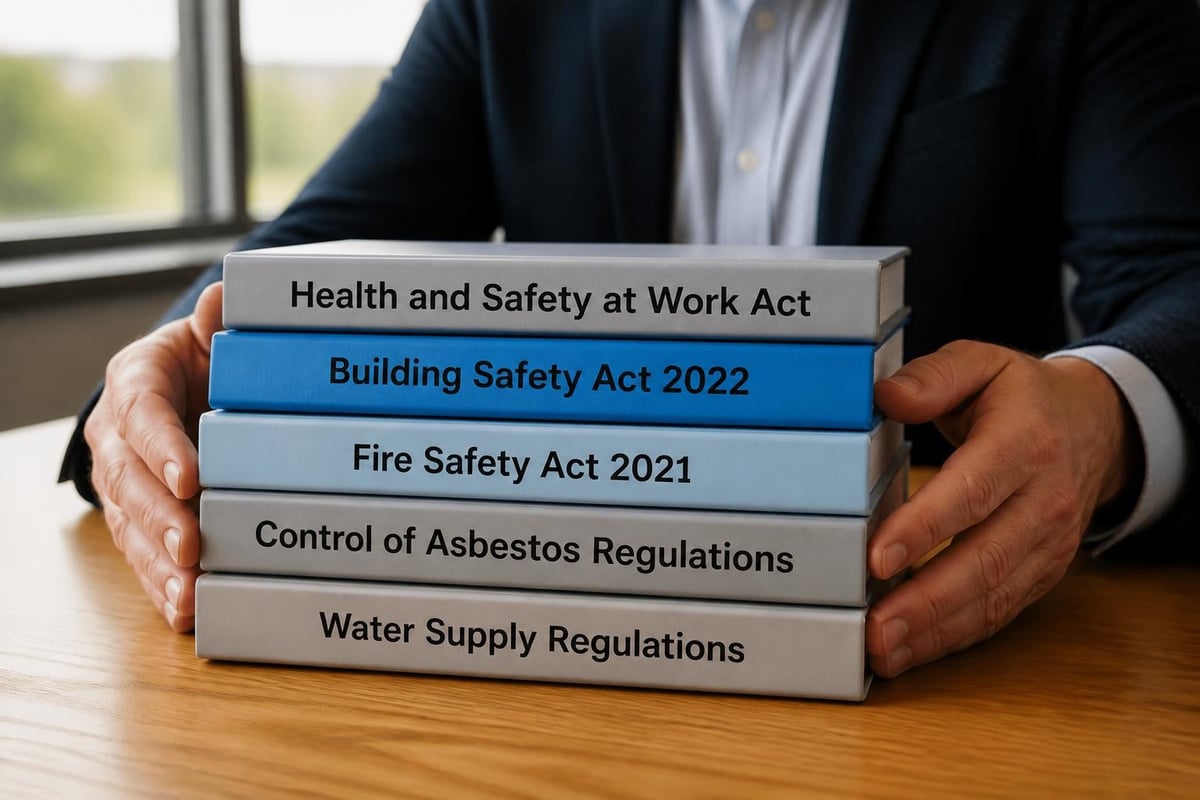
Fire safety obligations derive primarily from the Regulatory Reform (Fire Safety) Order 2005, as amended by the Fire Safety Act 2021. These regulations require responsible persons to conduct suitable and sufficient fire risk assessments, implement appropriate fire safety measures, and maintain audit-ready documentation. The expansion to include external wall systems and flat entrance doors has increased the scope of fire safety compliance considerably since 2021.
Multi-Discipline Compliance Requirements
Building compliance services must address hazards across distinct technical domains, each governed by specialist regulations and industry standards. According to building code frameworks, these disciplines require different competency levels, inspection frequencies, and documentation protocols.
| Compliance Area | Primary Regulation | Typical Inspection Cycle | Key Deliverable |
|---|---|---|---|
| Asbestos | Control of Asbestos Regulations 2012 | Annual re-inspection | Asbestos Register & Management Plan |
| Fire Safety | RR(FS)O 2005 | Annual review | Fire Risk Assessment |
| Water Hygiene | HSE ACoP L8 | Monthly to quarterly | Written Scheme of Control |
| Emergency Lighting | BS 5266 | Annual duration test | Test Certificate |
| Fire Alarms | BS 5839 | Quarterly service | Logbook & Certificate |
The interaction between these disciplines creates complexity that single-service providers struggle to manage effectively. A refurbishment project, for example, triggers asbestos survey requirements, compartmentation reviews, emergency lighting design validation, and water system commissioning simultaneously. Building compliance services that operate in silos often generate conflicting recommendations, duplicated site visits, and fragmented documentation that fails audit scrutiny.
Structuring Effective Building Compliance Services
The architecture of a robust compliance programme begins with accurate asset registers and baseline surveys across all relevant disciplines. Property managers must establish what compliance obligations apply to their specific portfolio, which requires understanding building use classification, occupancy patterns, construction dates, and previous modification history. This diagnostic phase prevents the common error of applying inappropriate standards or missing entire categories of risk.
The Asset Register Foundation
A comprehensive asset register should catalogue every component requiring periodic inspection, testing, or maintenance. For fire safety alone, this includes:
- Fire alarm systems (including detection zones and call points)
- Emergency lighting luminaires and battery packs
- Fire doors with self-closing devices and intumescent seals
- Fire extinguishers and hose reels
- Firefighting shafts and dry risers
- Compartmentation elements and fire-stopping
- External escape staircases and refuges
When multiplied across asbestos, water systems, and building safety, the data management challenge becomes substantial. Building compliance services increasingly rely on cloud-based compliance management platforms that link inspection records to physical assets, trigger scheduled tasks automatically, and maintain version-controlled documentation that survives staff turnover and organisational change.

The International Code Council emphasises that effective compliance requires interpretation of code intent rather than mechanical application of prescriptive rules. This principle applies equally in the UK context, where Approved Documents provide guidance but allow alternative solutions that achieve equivalent safety outcomes.
Coordinated Survey Programming
Property managers who engage multiple single-discipline contractors typically experience scheduling inefficiencies, duplicated mobilisation costs, and occupant disruption that damages tenant relationships. Building compliance services should coordinate survey programmes to minimise site visits whilst respecting the technical requirements of each discipline.
A well-structured annual compliance programme might combine:
- Quarter 1: Fire risk assessment updates and emergency lighting duration tests
- Quarter 2: Asbestos re-inspections and water temperature monitoring
- Quarter 3: Fire door inspections and compartmentation audits
- Quarter 4: Legionella sampling and fire alarm servicing
This sequencing allows findings from earlier surveys to inform subsequent inspections. Asbestos discoveries during Q2 re-inspections, for example, can trigger targeted fire-stopping reviews in Q3 where ACM removal has disturbed compartmentation. Multi-discipline approaches deliver not just cost efficiency but technical coherence that single-service models cannot replicate.
Risk Prioritisation and Remedial Strategies
Building compliance services generate significant volumes of recommendations, defects, and improvement opportunities. Without systematic prioritisation, duty holders struggle to allocate remedial budgets effectively and may inadvertently defer critical safety work whilst addressing lower-priority observations. Professional compliance services should apply transparent risk-scoring methodologies that combine likelihood and consequence assessments.
The prioritisation framework used in building inspection systems provides a useful model. High-priority defects present immediate danger and require urgent action, typically within 24-48 hours. Medium-priority issues represent significant risk that must be addressed within defined timeframes, often 3-6 months. Low-priority observations are recorded for future capital planning but do not compromise immediate safety.
Actionable Compliance Reporting
The value of building compliance services lies not in the volume of documentation produced but in the clarity of actionable recommendations provided. Effective compliance reports should specify:
- Defect location: Precise asset identification with floor plans and photographic records
- Regulatory context: The specific requirement breached and relevant code section
- Risk rating: Standardised scoring that enables portfolio-wide comparison
- Remedial specification: Sufficient technical detail for competitive tendering
- Responsibility assignment: Clear identification of duty holder obligations
Poor-quality compliance reports often list observations without adequate context, using vague language like "recommend repair" without specifying the standard to be achieved or the urgency required. This ambiguity creates legal liability for both the compliance provider and the client, as demonstrated in negligence cases where inadequate professional advice contributed to subsequent incidents.
For building safety compliance under the new regime, the safety case report represents the apex document tying together all compliance streams. This strategic-level document must demonstrate how individual compliance activities (fire risk assessments, structural surveys, emergency planning) integrate into a coherent building safety management system. Building compliance services that cannot articulate this integration fail to meet the standard expected of competent persons under the Building Safety Act.
Technology and Audit-Ready Documentation
The 2026 compliance landscape demands digital-first documentation systems that support real-time updates, multi-user access, and audit trail integrity. Paper-based systems and static PDF reports no longer satisfy the evidential requirements imposed by regulators, insurers, and enforcement authorities. Building compliance services must deliver structured data that can demonstrate continuous improvement and trend analysis across reporting periods.
Modern compliance platforms employ several technological capabilities:
- Cloud-based repositories with role-based access controls
- Mobile inspection applications enabling offline data capture
- Automated workflow triggers for scheduled tasks and overdue actions
- Integration with building management systems for live monitoring
- Photographic evidence with GPS and timestamp metadata
- Version control maintaining historical records of all document iterations
Recent research into automated compliance checking using large language models suggests that artificial intelligence will increasingly support compliance professionals by identifying regulatory conflicts, suggesting appropriate standards, and flagging inconsistencies in documentation. Whilst human expertise remains essential for risk judgment and contextual interpretation, technology augmentation enhances both efficiency and accuracy.
The Audit Trail Imperative
When enforcement authorities investigate safety incidents or issue improvement notices, the quality of compliance documentation determines whether duty holders can demonstrate reasonable practicability and due diligence. Building compliance services must create evidence trails that prove:
- Competent persons conducted surveys using appropriate methodologies
- Findings were communicated to relevant duty holders within reasonable timeframes
- Risk-based prioritisation allocated resources to the highest hazards
- Remedial actions were completed and verified
- Management plans were reviewed and updated following material changes
The Building Control Body framework in the UK emphasises independent verification as a cornerstone of building safety assurance. This principle extends beyond new construction into the operational phase, where building compliance services must demonstrate professional independence from commercial pressures that might compromise safety recommendations.

Competency and Professional Accreditation
The effectiveness of building compliance services depends fundamentally on the competency of personnel conducting surveys, interpreting findings, and specifying remedial works. The Building Safety Act introduced competency requirements for higher-risk buildings, but professional standards apply across all property types regardless of statutory thresholds.
For asbestos services, the United Kingdom Accreditation Service (UKAS) provides the recognised standard for laboratory analysis and surveying organisations. Surveyors should hold P402 (building surveys) or P403 (project management) qualifications as a minimum, with continuing professional development maintaining current knowledge of HSG 264 guidance and case law developments.
Fire risk assessors typically demonstrate competency through certification by bodies such as the Institution of Fire Engineers or through third-party schemes aligned to PAS 79-1 and PAS 79-2 standards. The complexity of modern building safety requires assessors to understand not just fire dynamics but building construction, human behaviour, management systems, and the interaction between active and passive fire protection measures.
Water hygiene specialists should hold City & Guilds qualifications in Legionella control and operate under organisational certification such as Legionella Control Association membership. The technical knowledge required spans microbiology, hydraulic engineering, building services, and risk assessment methodology, with different competency levels required for sampling operatives versus risk assessors.
Professional accreditation provides external validation that building compliance services maintain appropriate quality management systems, professional indemnity insurance, and technical oversight. Duty holders should verify that compliance providers hold relevant accreditations and can demonstrate continuing compliance with scheme requirements through surveillance audits and annual assessments. Accreditation frameworks provide assurance that goes beyond individual practitioner competency to encompass organisational capability and resilience.
Commercial Models and Service Level Agreements
Building compliance services are typically procured through several commercial structures, each offering different risk and cost profiles. Understanding these models helps property managers select arrangements that align with their risk appetite, budget constraints, and organisational capabilities.
Fixed-Price Annual Programmes
This model suits portfolios with stable compliance requirements where asset registers are accurate and inspection frequencies predictable. The provider commits to delivering specified surveys, inspections, and certifications for a fixed annual fee, typically paid in quarterly instalments. Advantages include budget certainty and simplified procurement, though scope variations and additional surveys usually trigger supplementary charges.
Key SLA provisions should specify:
- Maximum response times for urgent defects identified during routine surveys
- Report delivery timeframes following site inspections
- Escalation procedures for critical safety issues
- Document format and digital platform specifications
- Competency requirements for survey personnel
- Professional indemnity insurance levels
Retainer-Based Consultancy
Larger organisations often engage building compliance services on retained consultancy terms, securing dedicated resource allocation and priority response. This arrangement provides strategic compliance advice beyond routine inspections, supporting project management for complex remedial programmes and liaison with enforcement authorities during regulatory engagement.
Retainer models work particularly well where the duty holder maintains in-house facilities teams but requires specialist expertise for periodic reviews, audit preparation, and technical interpretation of complex regulatory requirements. The financial commitment secures expert availability without the overhead of full employment, whilst maintaining continuity of knowledge about specific buildings and their compliance history.
Reactive Call-Off Arrangements
Smaller property portfolios may prefer reactive engagement, purchasing building compliance services as required rather than committing to ongoing programmes. Whilst this reduces fixed costs, it typically results in higher unit rates, compromised continuity, and increased risk that compliance obligations slip beyond required timeframes.
According to ICC evaluation standards, establishing baseline compliance before adopting reactive models is essential. One-off surveys create snapshots that quickly become outdated without systematic review programmes, leaving duty holders exposed to prosecution if conditions deteriorate between infrequent inspections.
Integration with Capital Planning
Forward-looking building compliance services connect inspection findings directly to capital expenditure planning, enabling property managers to align safety improvements with planned maintenance cycles and refurbishment programmes. This integration prevents wasteful spending where compliance works are carried out in isolation then disrupted by subsequent capital projects.
A medium-term compliance strategy (typically five years) should map:
| Year | Fire Safety | Asbestos | Water Hygiene | Major Works Alignment |
|---|---|---|---|---|
| 2026 | Type 3 FRA refresh | Management surveys complete | TMV2 installation | Façade works programme |
| 2027 | Door replacement Phase 1 | R&D survey for roof works | Monthly monitoring established | Roof replacement |
| 2028 | Compartmentation remediation | ACM removal linked to roof | Tank replacement | Lift modernisation |
| 2029 | Emergency lighting upgrade | Annual re-inspections resume | L8 gap analysis | Window replacement |
| 2030 | Type 4 FRA for cladding | - | WSC update | External decoration |
This planning matrix ensures that intrusive asbestos surveys precede destructive works, fire-stopping remediation follows asbestos removal, and water systems are commissioned after plumbing modifications. Building compliance services that operate without reference to capital programmes inevitably generate abortive costs and duplicated disruption.
The compliance management process should incorporate lessons learned from project delivery, updating risk assessments and management plans to reflect as-built conditions rather than theoretical design intent. This feedback loop closes the gap between compliance documentation and physical reality, which often diverges significantly in older buildings with complex modification histories.
Compartmentation surveys exemplify this integration requirement. Identifying fire-stopping defects is valuable only if remedial specifications account for asbestos-containing materials that may be present in existing penetrations, accessibility constraints that affect installation methodology, and coordination with mechanical and electrical trades whose services pass through compartment boundaries.
When water hygiene programmes identify deadlegs, poorly-insulated pipework, or inadequate TMV coverage, the remedial works often require building fabric modifications that trigger fire safety considerations. A truly integrated approach to building compliance services recognises these interdependencies and sequences works to avoid rework and minimise disruption to occupants.
Occupant Communication and Stakeholder Management
Building compliance services increasingly recognise that technical competence alone is insufficient. The Building Safety Act explicitly requires resident engagement for higher-risk buildings, but effective communication benefits all property types by building trust, managing expectations, and securing cooperation during intrusive surveys and remedial programmes.
Communication strategies should be tailored to stakeholder sophistication and risk exposure:
- Board members and trustees: Strategic summaries emphasising regulatory obligations, financial exposure, and governance responsibilities
- Facilities managers: Technical detail sufficient for operational decision-making and contractor liaison
- Occupants and tenants: Plain-language explanations of what inspections involve, why they matter, and what actions are required
- Enforcement authorities: Audit-ready documentation demonstrating systematic risk management and continuous improvement
Transparency about compliance status helps manage stakeholder expectations and demonstrates responsible building management. Publishing anonymised compliance data (such as percentage of fire doors meeting required standards or proportion of asbestos ACMs in good condition) shows proactive safety management rather than defensive concealment.
Following significant incidents or enforcement action elsewhere in the sector, building compliance services should support duty holders in communicating proactive measures taken. When major fire safety cases reach the courts or new regulatory guidance is published, residents and occupants rightly expect their building managers to confirm compliance or explain remediation timelines. Professional compliance providers should support this communication rather than viewing transparency as commercially disadvantageous.
Building compliance services in 2026 demand integrated expertise, robust documentation systems, and strategic coordination that single-discipline contractors cannot deliver efficiently. For property managers seeking audit-ready precision across asbestos, fire safety, water hygiene, and building safety, partnering with a multi-discipline specialist eliminates fragmented procurement whilst ensuring regulatory obligations are met with professional competency. Discover how oxford-ec.co.uk delivers comprehensive risk management, nationwide, through a unified compliance framework that protects occupants, satisfies enforcement authorities, and provides defensible evidence of duty holder diligence.