

Rigorous. Technical. Accountable. Non-compliance is no longer a manageable risk; it's a legal liability that carries the weight of unlimited fines and custodial sentences under the latest enforcement frameworks. Since the Building Safety Regulator became an independent body in January 2026, the scrutiny on passive fire protection has reached an unprecedented level of intensity across the United Kingdom. For property managers overseeing complex portfolios, determining an accurate fire door inspection cost is often complicated by the technical disparity between basic visual checks and comprehensive, Regulation 10-compliant surveys.
You likely recognise that maintaining a robust "Golden Thread" of information is essential for both life safety and legal indemnity, yet unpredictable pricing models often make annual budgeting feel like guesswork. This guide provides an authoritative breakdown of the current financial landscape for UK fire door compliance, including the variables that influence per-door versus per-site rates. We'll examine the technical requirements of BS 8214:2026, outline the mandatory inspection frequencies for residential buildings over 11 metres, and provide a clear roadmap for aligning your safety spend with the latest statutory obligations.
Key Takeaways
- Regulatory Alignment. Master the requirements of the Fire Safety (England) Regulations 2022 and BS 8214:2026 to ensure your inspection programme withstands the rigorous scrutiny of the Building Safety Regulator.
- Budgetary Precision. Identify the technical variables that dictate your fire door inspection cost, from volume-based discounts for large portfolios to the complexity of high-risk healthcare or industrial environments.
- Survey Scrutiny. Learn to distinguish between interim visual checks and comprehensive professional surveys to ensure your "Golden Thread" of documentation remains robust, accurate, and audit-ready.
- Strategic Integration. Explore the financial advantages of multi-disciplinary audits, specifically how combining fire door inspections with compartmentation surveys reduces site visit overheads and administrative friction.
Table of Contents
Analysing Fire Door Inspection Costs in 2026
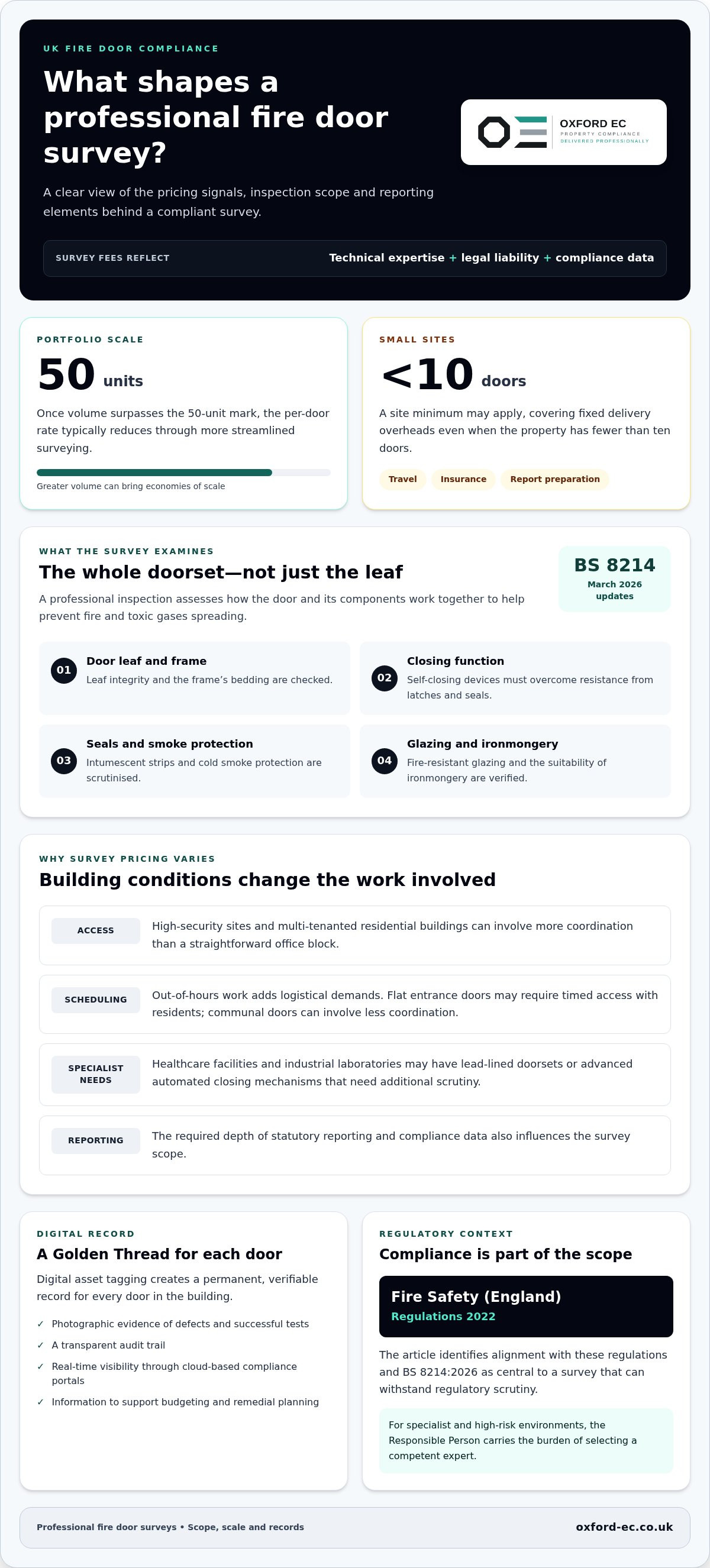
Audit-ready. Precise. Absolute. A professional survey is a technical audit of a life-safety asset, not a cursory glance at a wooden leaf. In the current regulatory climate, the fire door inspection cost reflects the depth of scrutiny required to satisfy the Building Safety Regulator and ensure alignment with the March 2026 updates to BS 8214. Professional fees are structured to account for the technical expertise of the inspector, the legal liability assumed by the consultancy, and the comprehensive nature of the resulting compliance data. Whilst volume-based discounts are standard for large-scale housing portfolios or commercial estates, bespoke surveys for complex high-rise structures require a more intensive allocation of resources.
Small-scale inspections often carry a "site minimum" fee to cover the fixed overheads of professional delivery. This baseline ensures that even for properties with fewer than ten doors, the deployment of a qualified inspector remains viable after accounting for travel, insurance, and the administrative rigour of report generation. It's a pragmatic approach that guarantees the same level of precision for a single HMO as is provided for a national hospital trust. For larger sites, the pricing model typically shifts to a per-unit rate, where the economy of scale reduces the individual cost per asset without compromising the depth of the technical evaluation.
The Baseline: What is Included in the Fee?
Frames. Seals. Ironmongery. Every professional survey must encompass a methodical examination of the entire doorset to be considered valid under fire safety legislation. Understanding What is a Fire Door? is the first step in recognising that the inspection covers far more than the leaf itself. A compliant survey includes a rigorous assessment of the frame's bedding, the integrity of the leaf, and the functionality of self-closing devices that must be capable of overcoming the resistance of latches and seals. Inspectors scrutinise the condition of intumescent strips and cold smoke protection, alongside the verification of fire-resistant glazing and the suitability of all ironmongery, ensuring every component works in unison to prevent the spread of fire and toxic gases.
Digital Reporting and Asset Tagging
The transition to a digital "Golden Thread" of information has fundamentally altered how data is captured and valued. Modern inspection fees often incorporate the use of specialised software for digital asset tagging, which provides a permanent, verifiable record for every door within a building. This methodology includes high-resolution photographic evidence of defects and successful tests, creating a transparent audit trail that is essential for annual budgeting and remedial planning. By utilizing cloud-based compliance portals, property managers gain real-time visibility into their risk profile, allowing for a more strategic, data-driven approach to long-term property management and statutory alignment.
Primary Variables Influencing Professional Survey Pricing
Logistical. Technical. Variable. Determining a definitive fire door inspection cost requires a nuanced understanding of the building's operational reality. Pricing is rarely static. It shifts according to the accessibility of the assets, the logistical burden of out-of-hours work, and the specific reporting depth required for statutory compliance. Whilst a standard office block might offer straightforward access, a high-security facility or a multi-tenanted residential complex presents unique challenges that require additional time and surveyor expertise. The final fee isn't merely a reflection of the time spent on-site but an investment in the legal robustness of the resulting data.
Asset Volume and Economies of Scale
Tiered. Efficient. Scalable. For large-scale portfolios, tiered pricing structures allow for significant economies of scale. The per-door rate typically sees a notable reduction once the volume surpasses the 50-unit mark. This is due to the streamlined workflow a surveyor can maintain within a single building. You'll find that communal doors in high-rise blocks often require less logistical coordination than flat entrance doors, where timed access arrangements with residents add a layer of administrative complexity to the survey. Portfolio managers who consolidate their requirements often benefit from a more competitive fire door inspection cost by reducing the frequency of site minimum fees across multiple locations.
Specialist Environments and High-Risk Sites
Specialised. Intensive. Critical. Sites such as healthcare facilities or industrial laboratories involve doorsets with unique technical specifications, including lead-lining for radiation protection or advanced automated closing mechanisms. These environments necessitate a higher level of scrutiny and often require the inspector to have integrated knowledge of passive fire protection to ensure the door’s frame and bedding align with the surrounding fire-rated walls. The Fire Safety (England) Regulations 2022 place the burden of competency on the Responsible Person, making the selection of a meticulous expert essential for these high-risk areas. If your property portfolio includes complex or high-occupancy assets, you can request a technical consultation to discuss a tailored compliance strategy.
Reporting depth remains a final, critical variable. A standard audit might confirm a simple pass or fail status, yet a professional survey delivers a comprehensive remedial schedule. This includes precise specifications for components, photographic evidence of non-compliance, and an itemised roadmap for necessary repairs. Choosing a more detailed reporting level often saves significant costs during the procurement of remedial works by providing contractors with exact requirements, thereby eliminating the risk of over-specification or hidden costs during the repair phase.
Visual Inspections vs. Detailed Fire Door Surveys
Systematic. Evidence-based. Statutory. Building owners must distinguish between interim visual monitoring and the technical rigour of a professional survey to maintain legal alignment. A visual check is a preliminary exercise, typically performed quarterly by a competent person to identify overt damage or functional failures such as broken hinges or missing seals. Whilst the fire door inspection cost for these frequent checks is lower, they don't replace the requirement for a comprehensive annual audit. Leading UK fire safety guidance emphasises that regular inspections are a critical component of a proactive safety culture, ensuring that minor defects don't escalate into life-threatening failures between professional assessments.
A professional survey is a detailed technical evaluation that moves beyond surface-level observations. It involves precise measurements of gaps, assessments of the door's core integrity, and verification of the bedding between the frame and the wall structure. These surveys are essential for the "Responsible Person" to demonstrate due diligence under the Building Safety Act, providing a robust evidentiary trail that visual checks alone cannot deliver. When budgeting for your annual compliance, it's vital to ensure the level of inspection matches the risk profile of your building and the specific mandates of current legislation.
The Scope of a Professional Survey
Precision. Compliance. Accountability. A professional audit includes full gap measurements against the strict 2mm to 4mm tolerances defined in BS 8214, alongside a detailed examination of fire-resistant ironmongery and intumescent performance. The resulting report provides a prioritised remedial schedule, categorising actions based on their impact on life safety. For a deeper understanding of these technical parameters, you can explore our guide on Fire Door Integrity Testing and Safety Standards, which details the exact criteria used during a high-level survey.
When to Opt for a Type 4 Assessment
Intrusive. Definite. Structural. In complex builds where the fire-stopping between the doorset and the compartment wall is obscured, a visual inspection may be insufficient to confirm safety. A Type 4 assessment involves destructive sampling, allowing surveyors to inspect the hidden bedding materials and verify that the installation meets the original fire test evidence. This level of scrutiny is often integrated with Type 4 Fire Risk Assessments to provide absolute structural proof of compartmentation integrity. Whilst the initial fire door inspection cost for intrusive sampling is higher, it eliminates the liability of making assumptions about the hidden fire protection within the building's fabric.
Mitigating Risk: The Cost of Non-Compliance
Serious. Legal. Absolute. The financial implications of neglecting fire safety extend far beyond the initial fire door inspection cost. Under the Regulatory Reform (Fire Safety) Order 2005 and the Fire Safety Act 2021, the "Responsible Person" carries personal liability for the integrity of a building's passive fire protection. Since the Building Safety Regulator became an independent body in January 2026, enforcement has reached a new level of intensity. A modest investment in a professional survey is a negligible expense when compared to the prospect of unlimited fines or a two-year custodial sentence for a documented breach of duty.
Regulation 10 and Residential High-Rise Costs
Compliance is a cadence, not a one-off event. The Fire Safety (England) Regulations 2022 mandate quarterly checks for communal doors and annual inspections for flat entrance doors in buildings exceeding 11 metres. This increased frequency requires a structured budgetary approach that accounts for more than just the surveyor's time. You must factor in the administrative labour involved in resident liaison and access coordination, which often represents a significant hidden variable in the total fire door inspection cost for residential portfolios. By integrating these requirements into a long-term compliance roadmap, property managers can avoid the friction of reactive, last-minute spending whilst ensuring absolute statutory alignment.
Asset Protection and Life Safety
Protection. Continuity. Resilience. Beyond the legal mandate, fire doors serve as the primary barrier against business interruption and total property loss. A failed doorset during a real-world event doesn't just risk lives; it often leads to the total invalidation of property insurance. Most insurers require evidence of rigorous maintenance and professional certification to honour claims. A comprehensive fire door inspection, conducted alongside other statutory requirements such as Fire Risk Assessments, ensures that your risk profile remains within acceptable limits. Professional scrutiny reduces the long-term cost of remedial works by identifying component failures before they necessitate a full doorset replacement.
Selecting a multi-disciplinary consultancy like OEC provides a "safe pair of hands" for complex requirements. Our Professional Indemnity cover and technical mastery across asbestos, fire, and water hygiene offer a layer of protection that smaller, single-service providers cannot match. We act as your guardian of compliance, ensuring every audit is meticulous, every report is legally robust, and your "Golden Thread" of information is beyond reproach.
Strategic Budgeting and Multi-Disciplinary Efficiency
Integrated. Efficient. Streamlined. Managing a complex property portfolio requires more than just technical precision; it demands a strategic approach to procurement that minimises the administrative friction of multiple site visits. By adopting a multi-disciplinary model, property managers can significantly optimise their fire door inspection cost through the consolidation of statutory audits. Integrating fire door assessments with Compartmentation Surveys ensures a holistic view of the building's passive fire protection strategy, identifying breaches in walls and floors that might otherwise compromise the performance of a compliant doorset.
Oxford Environmental Consultants (OEC) specialises in reducing the "compliance burden" by deploying dual-qualified surveyors who can scrutinise multiple risk areas in a single deployment. This "one-stop" solution eliminates redundant site visit fees and simplifies the logistical challenge of resident liaison. Beyond immediate savings, the high-resolution data captured during these surveys allows for long-term asset management. Instead of facing a sudden, unbudgeted capital expenditure for remedial works, managers can use our detailed, risk-prioritised lists to phase costs over several financial years, ensuring that life-safety critical actions are addressed as an immediate priority.
Combining Fire and Asbestos Compliance
Coordinated. Practical. Robust. The logistical advantages of having a single consultant manage Asbestos Management Surveys alongside fire safety audits are substantial. In buildings constructed before 2000, fire doors and their surrounding structures often contain asbestos-containing materials (ACMs) within the fire-stopping or the door core itself. Coordinating these surveys prevents the risk of accidental disturbance and ensures that all property risks are managed through a single, consolidated dashboard. This approach reduces occupant disruption and provides a unified "Golden Thread" of information that satisfies both fire and health and safety regulators simultaneously.
Securing a Bespoke Compliance Quote
Precise. Transparent. Fixed. To secure an accurate, fixed-price quote that reflects the true scope of your requirements, providing comprehensive building data is essential. Clear asset lists, detailed floor plans, and previous fire risk assessments allow our technical team to estimate the survey duration with absolute certainty. This transparency reduces the need for contingency pricing and ensures your fire door inspection cost remains predictable. For portfolios with diverse building types or restricted access requirements, a technical consultation is the first step toward a streamlined compliance programme.
Securing Your Statutory Alignment for 2026
Precision. Accountability. Legal robustness. Maintaining a compliant property portfolio in 2026 requires more than just meeting minimum standards; it demands a meticulous approach to data and reporting. You've seen that the fire door inspection cost is a strategic investment in risk mitigation that protects the "Responsible Person" from the severe liabilities of the Building Safety Act. By leveraging multi-disciplinary audits, you can streamline your safety spend whilst building a comprehensive "Golden Thread" of information that satisfies both regulators and insurers.
As multi-disciplinary property compliance experts with national UK coverage, Oxford Environmental Consultants provides the technical mastery and authoritative reporting your estate requires. Our focus on rigorous precision ensures your buildings remain safe, compliant, and operationally resilient. It's time to move beyond reactive repairs and establish a proactive, data-driven roadmap for your passive fire protection.
Take the final step toward absolute property peace of mind today.
Frequently Asked Questions
Is a fire door inspection a legal requirement in the UK?
Mandatory. Rigorous. Indisputable. The Regulatory Reform (Fire Safety) Order 2005 and the Fire Safety Act 2021 place a strict legal duty on the "Responsible Person" to ensure all fire doors are fit for purpose. Failure to maintain these life-safety assets is a criminal offence. Since the Building Safety Regulator became an independent body in January 2026, enforcement has intensified, making documented professional surveys an essential component of your legal indemnity and statutory alignment.
How often should fire doors be inspected in a commercial building?
Six-monthly. Consistent. Proactive. Whilst specific residential mandates exist for high-rise buildings, BS 8214:2026 recommends professional inspections every six months for most commercial environments. High-traffic areas, such as hospital corridors or school entrances, may require more frequent monthly visual checks to account for accelerated wear. Establishing a methodical inspection cadence ensures that your fire door inspection cost remains a predictable part of your annual safety budget rather than an emergency expense.
What is the typical cost for a single fire door inspection report?
Variable. Technical. Evidence-based. Industry averages for a professional survey typically range from £10 to £65 per door, depending on the volume of assets and the complexity of the building. Basic visual checks sit at the lower end, whilst detailed audits with photographic evidence and digital asset tagging command higher rates. Most consultancies also apply a site minimum fee, typically ranging from £200 to £800, to cover the professional overheads of deployment and technical reporting.
Does the inspection cost include the price of repairs or remedial works?
No. Auditing. Scrutiny. Independence. The inspection fee covers the technical evaluation and the generation of a legally robust compliance report. It does not include the labour or materials required for remedial works. Maintaining a clear separation between the auditor and the repair contractor is often considered best practice to ensure an unbiased assessment of the building's risk profile. A professional report will provide the precise specifications needed to obtain accurate remedial quotes from qualified contractors.
Can a Fire Risk Assessor also carry out the fire door inspection?
Competency. Detail. Alignment. A Fire Risk Assessor can perform fire door checks if they possess the specific technical competency required by the Fire Safety Act. However, a standard Fire Risk Assessment often only includes a representative sample of doors within a building. A dedicated fire door survey is a more intensive exercise that examines every individual doorset. For comprehensive compliance, property managers often commission a separate, detailed survey to build a robust "Golden Thread" of information.
What happens if my fire doors fail the professional inspection?
Remediation. Prioritisation. Accountability. If a door fails, the inspector provides a detailed remedial schedule categorising defects by their impact on life safety. You must address "Category A" failures immediately to maintain the building's fire compartmentation. Once repairs are completed by a competent person, the assets should be re-inspected to confirm they meet BS 8214 standards. This documented cycle of inspection and repair is critical for satisfying both the Building Safety Regulator and your property insurers.
Are there specific costs for high-rise residential fire door checks?
Statutory. Frequent. Administrative. For residential buildings over 11 metres, Regulation 10 mandates quarterly checks of communal doors and annual checks of flat entrance doors. This increased frequency naturally raises the annual fire door inspection cost compared to standard commercial sites. You must also factor in the administrative time required to coordinate access with residents, which is often a significant logistical variable that professional consultancies include within their bespoke, multi-disciplinary compliance quotes.
How long does a professional fire door survey take to complete?
Methodical. Efficient. Structured. A thorough inspection typically takes between 15 and 30 minutes per doorset, depending on the condition of the asset and the accessibility of the frame. A site with 50 doors might require a full day of on-site data collection, followed by several hours of technical reporting and quality assurance. Providing accurate floor plans and asset lists before the surveyor arrives can significantly streamline the process and reduce the overall time spent on-site.