

Could an asbestos survey be on file while your premises still fall short of the law? For anyone responsible for non-domestic premises, the control of asbestos regulations 2012 for duty holders require more than a report. Regulation 4 calls for asbestos risks to be identified and managed over time. Incomplete or outdated records, or information that isn’t shared with people who may disturb materials, can leave important gaps.
If you’re unsure whether the duty sits with you, your organisation or another party, resolve that uncertainty. Responsibility generally rests with whoever has maintenance and repair obligations for the premises, and it can be shared where duties overlap. Appointing a surveyor or consultant can inform your decisions, but it doesn’t transfer the legal duty.
This guide explains who may be a duty holder in Great Britain, what Regulation 4 requires and which records support an effective management approach. It also covers when routine monitoring may be appropriate, when work calls for further action, and when competent asbestos advice or a survey may be needed. The aim is practical clarity: know who is accountable, what evidence to maintain and how to manage asbestos risks as an ongoing process.
Key Takeaways
- See how the control of asbestos regulations 2012 for duty holders apply to non-domestic premises and relevant common parts of domestic buildings.
- Follow a clear sequence for identifying asbestos, assessing its condition, planning controls and reviewing arrangements.
- Understand how responsibilities differ between duty holders, employers, maintenance teams, contractors and advisers.
- Review your asbestos register, management plan, communication arrangements and monitoring to identify gaps.
- Recognise when uncertain materials, incomplete records or planned work may call for competent asbestos advice or a survey.
Table of Contents
- What the Control of Asbestos Regulations 2012 mean for duty holders
- What Regulation 4 requires a duty holder to identify, assess, and manage
- Duty holder, employer, contractor, or consultant: who is responsible for what?
- How to check asbestos records, communication, and controls are working
- When to commission asbestos expertise and strengthen compliance
What the Control of Asbestos Regulations 2012 mean for duty holders
The Control of Asbestos Regulations 2012 provide the legal framework for protecting people from asbestos exposure in Great Britain. Regulation 4 places a duty to manage asbestos in relevant non-domestic premises. Those responsible must take reasonable steps to find out whether asbestos-containing materials (ACMs) are present, assess their condition and manage the risk. The Asbestos Law Overview provides broader context on asbestos legislation, but duty holders should refer to applicable legislation and official guidance when making compliance decisions.
This is a management duty, not an instruction to remove every ACM. Where material is in good condition and unlikely to be disturbed, managing it in place may be appropriate, with suitable controls and information for anyone who could disturb it. The priority is preventing exposure. A survey or register is useful evidence, but neither replaces active management.
Who can be the duty holder under Regulation 4?
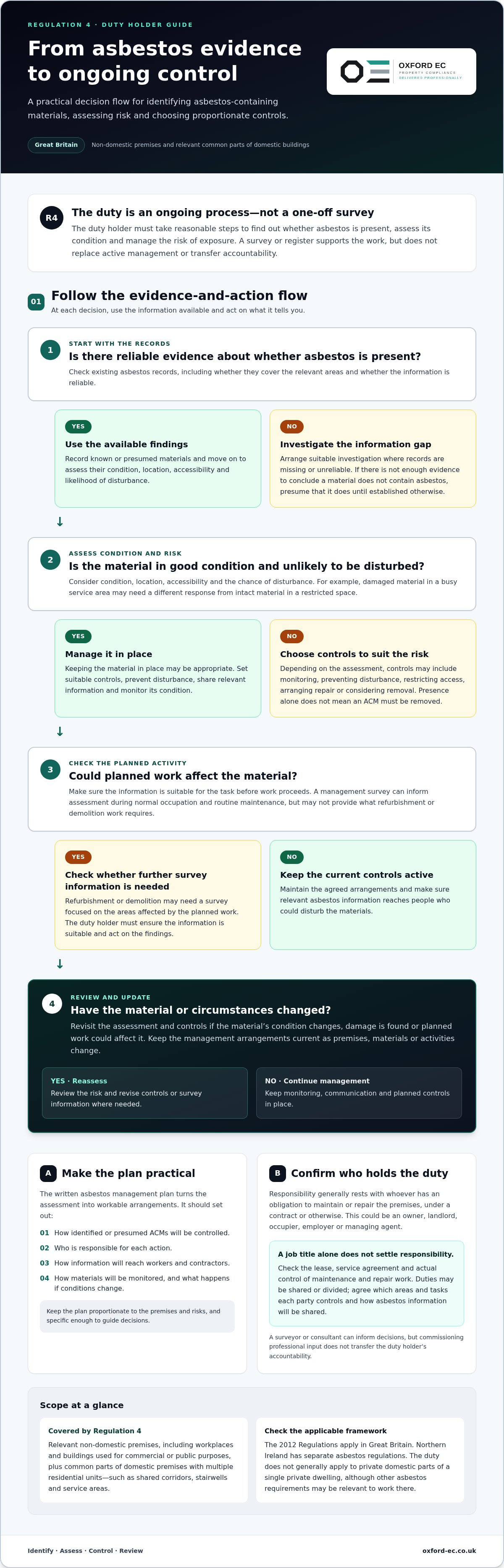
The duty holder is determined by who has an obligation to maintain or repair the premises, whether under a contract or otherwise. Depending on the arrangements, this could be an owner, landlord, occupier, employer or managing agent. A job title alone doesn’t settle responsibility. The lease, service agreement and actual control of maintenance and repair work all matter.
Responsibilities can be shared or divided. For example, a landlord may control the building structure while a tenant manages repairs within a leased area. Each party should establish which areas and tasks it controls, agree how asbestos information will be shared, and make sure there are no gaps between responsibilities. The control of asbestos regulations 2012 for duty holders therefore call for a clear, documented understanding of who acts and where.
Which premises and jurisdictions are covered?
Regulation 4 applies to non-domestic premises, including workplaces and buildings used for commercial or public purposes. It also covers the common parts of domestic premises with multiple residential units, such as shared corridors, stairwells and service areas. The duty does not generally apply to the private domestic parts of a single private dwelling, although other asbestos requirements may be relevant to work carried out there.
The 2012 Regulations apply in Great Britain. Northern Ireland has its own separate asbestos regulations, so property owners and managers should confirm which framework applies to their premises and check current guidance. If the scope or condition of ACMs is uncertain, an asbestos management survey or consultancy advice can inform decisions. Oxford Environmental Consultants provides asbestos management surveys and asbestos consultancy services. Professional input supports the process but doesn’t transfer the duty holder’s accountability.
What Regulation 4 requires a duty holder to identify, assess, and manage
Regulation 4 sets out an ongoing process, not a one-off survey exercise. A duty holder must take reasonable steps to determine whether asbestos-containing materials (ACMs) are present, assess their condition and manage the risk of exposure. The control of asbestos regulations 2012 for duty holders require decisions to be based on available evidence and reviewed as premises, materials or planned activities change.
Work through the duty in sequence:
- Determine whether asbestos is present. Review existing records and arrange suitable investigation where information is missing or unreliable. If there isn’t sufficient evidence to conclude that a material doesn’t contain asbestos, presume it does until established otherwise.
- Assess condition and risk. Consider the material’s condition, location, accessibility and likelihood of disturbance. For example, damaged material in a busy service area may need a different response from intact material in a restricted space.
- Set proportionate controls. Depending on the assessment, this may mean monitoring and preventing disturbance, restricting access, arranging repair or considering removal. Asbestos doesn’t have to be removed simply because it is present.
- Review the arrangements. Revisit the assessment and controls if the material’s condition changes, damage is found or planned work could affect it.
Identify ACMs and assess their condition
Existing asbestos records can help identify known materials, but check their coverage and reliability. Where a suitable management survey is needed, it can inform the assessment of ACMs during normal occupation and routine maintenance. It may not provide the information required before refurbishment or demolition. Those projects may need a survey focused on the areas affected by the planned work. The duty holder must ensure the information is suitable for the task and act on the findings. Commissioning a survey doesn’t complete the ongoing duty.
Prepare and maintain an asbestos management plan
The written management plan turns the assessment into practical arrangements. It should record how identified or presumed ACMs will be controlled, who is responsible for each action, how information will reach workers and contractors, and how materials will be monitored. Keep the plan proportionate to the premises and risks, but specific enough to guide decisions. It should also make clear what happens if conditions change.
For more detail on how survey information contributes to asbestos management, read this guide to asbestos management surveys. If you need help interpreting findings or deciding whether further survey work is appropriate, Oxford Environmental Consultants provides asbestos surveys and consultancy services to inform the duty holder’s decisions. Explore asbestos survey and consultancy services.
Duty holder, employer, contractor, or consultant: who is responsible for what?
Several parties may have a role in asbestos safety, but their tasks aren’t interchangeable. Under the control of asbestos regulations 2012 for duty holders, the duty to manage rests with those who have the relevant maintenance or repair obligations. Others may help put controls into practice, but appointing them doesn’t automatically transfer accountability.
- Duty holder: Establishes whether asbestos is present or should be presumed, ensures risks are assessed, and puts suitable management arrangements in place for the areas they control.
- Employer: Protects employees through appropriate workplace arrangements and ensures relevant asbestos information is considered when work is planned. An employer may also be a duty holder if it has maintenance or repair responsibilities.
- Maintenance team: Follows the premises’ asbestos controls and checks relevant information before carrying out tasks that could disturb materials.
- Contractor: Works within the agreed scope and follows the information and controls provided. The duty holder must make relevant asbestos information available before work that could disturb ACMs.
- Surveyor or adviser: Provides survey findings or advice within the agreed scope. That input supports the duty holder’s decisions; it doesn’t replace them.
Ensuring that duty holders, employers, and maintenance teams understand their statutory responsibilities often requires wider health and safety education. To train staff on workplace compliance and risk management, explore Per-Course Enrollment and Corporate Licensing Fees.
A clean appearance or lack of access isn’t, by itself, a sound reason to exclude an area from consideration. The duty holder needs a reasoned basis for the assessment. If an area can’t be inspected and reliable information is unavailable, address the uncertainty rather than treating it as proof that asbestos isn’t present.
How contracts and control affect duty-holder responsibility
Look beyond ownership. Establish who arranges and controls maintenance and repair in practice, then compare that with the lease, service agreement and contractor’s scope. For instance, a landlord may retain responsibility for shared services while an occupier controls repairs inside its unit. Where roles overlap or areas are divided, record who assesses materials, maintains the relevant information, communicates it and reviews controls. Clear agreements help prevent gaps, but don’t override the responsibilities each party actually holds. If you need to source building specialists or connect with qualified trades for ongoing property maintenance, learn more through construction directories and industry networks.
What competent contractors and advisers contribute
Specialists can provide surveys, advice or practical work within the scope they’ve been appointed to deliver. Their findings are useful only if the duty holder provides accurate information about the premises and proposed activities, then acts on relevant recommendations. Before work starts, confirm that the people carrying it out can access current asbestos information for the work area. After appointing a specialist, retain oversight: check that agreed actions are completed and management arrangements remain suitable. Oxford Environmental Consultants provides asbestos surveys and consultancy services to support evidence-led decisions, while responsibility remains with the duty holder.
How to check asbestos records, communication, and controls are working
A register and management plan are effective only if they reflect current conditions and guide day-to-day decisions. Use this review sequence to check whether arrangements are usable, understood and recorded. The control of asbestos regulations 2012 for duty holders require active management, not simply survey documents on file.
- Check the survey information and register. Confirm the records cover the relevant areas, identify known or presumed asbestos-containing materials (ACMs), and describe their locations and condition clearly enough for people to act on.
- Compare the register with the management plan. Check that the plan sets out controls for each relevant material, including any access restrictions or monitoring arrangements. Confirm that planned actions have been completed or assigned.
- Confirm responsibilities. Make sure it’s clear who maintains the records, communicates asbestos information, arranges controls and responds to damage or changes.
- Test communication and access. Verify that maintenance staff and contractors can obtain current information for their work areas before starting tasks that could disturb ACMs. A register that exists but can’t be accessed when needed won’t support safe decisions.
- Review monitoring and decisions. Record checks, changes in condition, concerns raised, decisions taken and follow-up actions, including who is responsible for completing them.
What records should the duty holder be able to produce?
Keep survey information, the asbestos register, the management plan and records of reviews and actions available. Together, they should show what was known, how risks were assessed, which controls were selected, who was assigned each task and how relevant information was shared with contractors. If a survey doesn’t cover an area or activity that needs assessing, document how the gap will be resolved. Where professional survey input is needed, see asbestos management survey services.
When do work and changing conditions require further action?
Review the assessment and records if materials become damaged, asbestos is newly identified, building use changes or planned work could disturb an ACM. Refurbishment or demolition requires appropriate survey information for the scope of work before it begins. A routine management survey may not be enough for intrusive work. Don’t rely on old records without checking that they cover the planned area and activity. There’s no universal review interval for every situation. Set monitoring and review arrangements that reflect the material, premises and risk, and record the reasons for them.
When to commission asbestos expertise and strengthen compliance
Seek competent asbestos input when the available evidence no longer supports a confident management decision. Survey information may be missing, may not cover the relevant area or may conflict with what is visible on site. Unidentified materials, damaged suspected asbestos, a proposed change of use or planned work that could disturb asbestos are also reasons to pause and assess what information is needed before proceeding.
Choosing the right survey or consultancy input
Match the survey to its purpose. A management survey supports day-to-day asbestos management during normal occupation and routine maintenance. Refurbishment or demolition work may require a survey focused on the areas affected by the project, completed before work begins. When discussing a survey or consultancy service, ask:
- Scope: Which areas and materials will the work cover, and what will remain outside its scope?
- Reporting: Will the findings clearly identify material locations and condition, and provide information that can inform the asbestos register and risk assessment?
- Competence: What relevant experience and qualifications do the people undertaking the work have?
- Recommendations: Will the report explain practical next steps and identify any limitations or areas where further investigation may be needed?
Oxford Environmental Consultants provides asbestos consultancy and survey services to support property owners and managers with evidence for their asbestos management decisions. Confirm the required scope before commissioning work, particularly if the building is due to be altered or demolished.
Survey findings inform the duty holder’s decisions; they don’t make those decisions or transfer statutory accountability. The duty holder remains responsible for considering the evidence, setting appropriate controls, communicating relevant information and reviewing arrangements as circumstances change. Link the report and resulting actions to the management plan, and record responsibilities and completion.
Move from legal duties to a documented management process
Use specialist input to resolve a defined uncertainty: what is present, what condition it is in, whether planned work could disturb it, or what further assessment is appropriate. Then turn the findings into clear actions. Identify the responsible person, update relevant records, communicate controls to those carrying out work and review the outcome. This is how the control of asbestos regulations 2012 for duty holders become an evidence-led process rather than a collection of disconnected documents.
Make your asbestos management arrangements clear and defensible
Effective asbestos management is a continuing process: identify and assess materials, set proportionate controls, share information with people who may disturb them, and review arrangements when conditions or planned work change. Under the control of asbestos regulations 2012 for duty holders, knowing who is responsible matters as much as having survey information. Where responsibilities are shared, document who manages each area and action.
Check that your records reflect the premises and give staff and contractors usable information before work begins. If survey coverage is uncertain, materials are damaged or refurbishment is planned, competent advice can help establish what further information or action is appropriate. Professional input supports your decisions; accountability remains with the duty holder.
Oxford Environmental Consultants provides asbestos management surveys and asbestos consultancy services, supporting property compliance clients nationally across the UK. If you have a question about survey coverage or asbestos management, contact OEC to discuss the support you need.
With responsibilities understood, reliable records in place and suitable expertise when needed, you can manage asbestos risks with greater confidence.
Frequently Asked Questions
Who is the duty holder under the Control of Asbestos Regulations 2012?
The duty holder is generally the person or organisation responsible for maintaining or repairing non-domestic premises, whether that responsibility arises through a contract or otherwise. Ownership alone doesn’t necessarily determine who holds the duty. A landlord, occupier or managing agent may have responsibilities, and more than one party can hold duties for different areas or tasks. Review leases and service agreements alongside who controls maintenance and repair in practice.
What does Regulation 4 require a duty holder to do?
Regulation 4 requires the duty holder to take reasonable steps to determine whether asbestos is present or should be presumed present, assess its condition and manage the risk. This includes preparing and implementing a written management plan and arranging suitable monitoring. The control of asbestos regulations 2012 for duty holders require measures to reflect the premises and materials. Keep records current, assign actions and share relevant information with people who may disturb asbestos. A survey alone isn’t sufficient.
Do landlords have a duty to manage asbestos in residential buildings?
Regulation 4 applies to relevant common parts of domestic buildings, such as shared corridors and stairwells, rather than treating every private dwelling as covered in the same way. The responsible party depends on who holds maintenance or repair obligations and control of those areas. A landlord, managing agent or another party may have a role. Check the building’s layout, agreements and applicable jurisdiction before deciding which asbestos duties apply.
Does commissioning an asbestos survey make a duty holder compliant?
No. A suitable survey can identify asbestos-containing materials and inform the risk assessment, but the duty holder must still consider the findings, maintain and implement a management plan, communicate relevant risks and monitor controls. The survey’s scope should match the building and purpose. Planned refurbishment or demolition may require different information from routine management. Reassess and update records if materials are damaged, new information emerges or work could disturb asbestos.
How often must an asbestos management plan be reviewed?
There isn’t a universal annual review rule that applies in every situation. The duty holder should establish monitoring and review arrangements that reflect the materials, their condition and the premises, following current HSE guidance. Review the plan when materials deteriorate, the building or its use changes, new asbestos information emerges or work is planned that could cause disturbance. Record the review, decisions and resulting actions so the reasons for changes, or for retaining existing controls, are clear.
Can a duty holder remove asbestos-containing materials to meet the regulations?
Removal isn’t automatically required simply because asbestos is present. The duty is to manage the risk, and managing material in place may be appropriate where its condition, location, accessibility and likelihood of disturbance support that approach. Damaged materials or planned work affecting them may call for further action, including repair or removal. Assess the circumstances and arrange any work in line with applicable requirements and competent advice. Don’t disturb suspected asbestos while deciding what action is needed.
Do the Control of Asbestos Regulations 2012 apply throughout the UK?
The Control of Asbestos Regulations 2012 are the primary asbestos legislation in Great Britain; Northern Ireland has a separate regulatory framework. Don’t assume the same regulation title or guidance applies in both jurisdictions. Establish where the premises are and check the current legislation and official guidance for that nation before making a compliance decision. If responsibility or the applicable requirements remain uncertain, obtain competent advice specific to the premises and jurisdiction.