
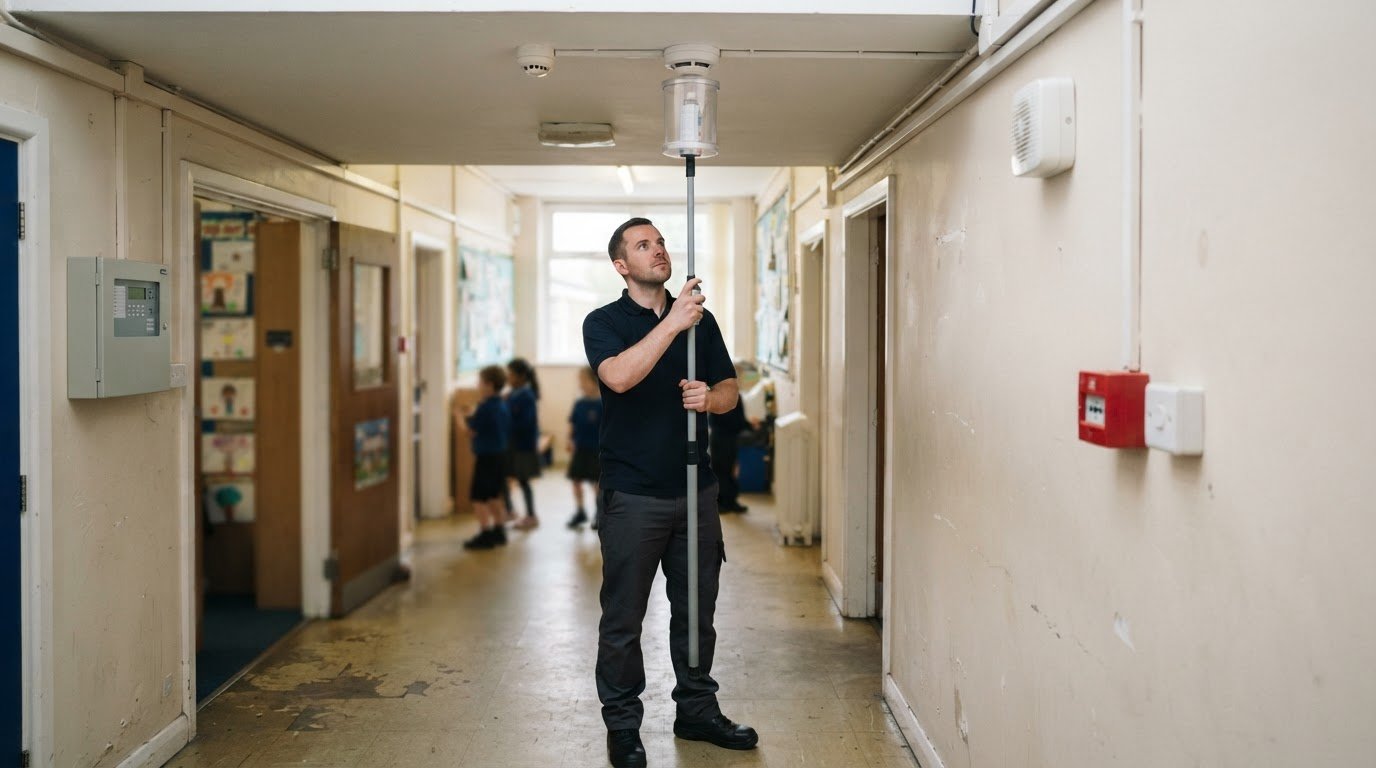
A weekly fire alarm test doesn’t replace professional servicing. The fire alarm servicing standards in the UK recommend service visits at intervals no longer than six months under BS 5839-1, alongside weekly testing by the responsible person. Both checks matter: one helps identify system issues between visits, while the other provides a more thorough inspection and maintenance of the equipment.
It can be difficult to distinguish a recommended standard from a legal duty, or to know who should arrange each check. This guide explains the servicing intervals, the responsible person’s role and what BS 5839-1 recommends, then sets out what to look for in a service provider. You’ll also see how regular records and clear reporting help demonstrate that the system is being maintained. The aim is practical clarity: understand the schedule, know who is accountable and make an informed decision about servicing your premises.
Key Takeaways
- In England and Wales, according to Legislation.gov.uk, the Regulatory Reform (Fire Safety) Order 2005 requires the responsible person to keep fire safety equipment in efficient working order and in good repair.
- Keep records of fire alarm tests, inspections and maintenance so there is a clear account of system checks and any outstanding defects.
- Larger premises may need quarterly servicing, with the schedule shaped by the building’s risks and operational demands.
- Choose a competent service provider with detailed knowledge of fire alarm systems; third-party certification can help demonstrate competence.
- Expect service documentation to record faults and necessary repairs, giving the responsible person a clear basis for follow-up.
Table of Contents
- How Often Should Fire Alarm Systems Be Serviced?
- Who is Responsible for Fire Alarm Maintenance Requirements?
- Recommended fire alarm servicing intervals under BS 5839-1
- Servicing frequency for large premises
- Selecting a fire alarm service provider
- Oxford Environmental Consultants (OEC): Fire Alarm Installation, Maintenance and Servicing
How Often Should Fire Alarm Systems Be Serviced?
Routine checks follow different intervals. Check the control and indicating equipment daily, and have the responsible person carry out a weekly user test. These checks support, but do not replace, professional servicing.
Daily Panel Checks and Weekly Tests
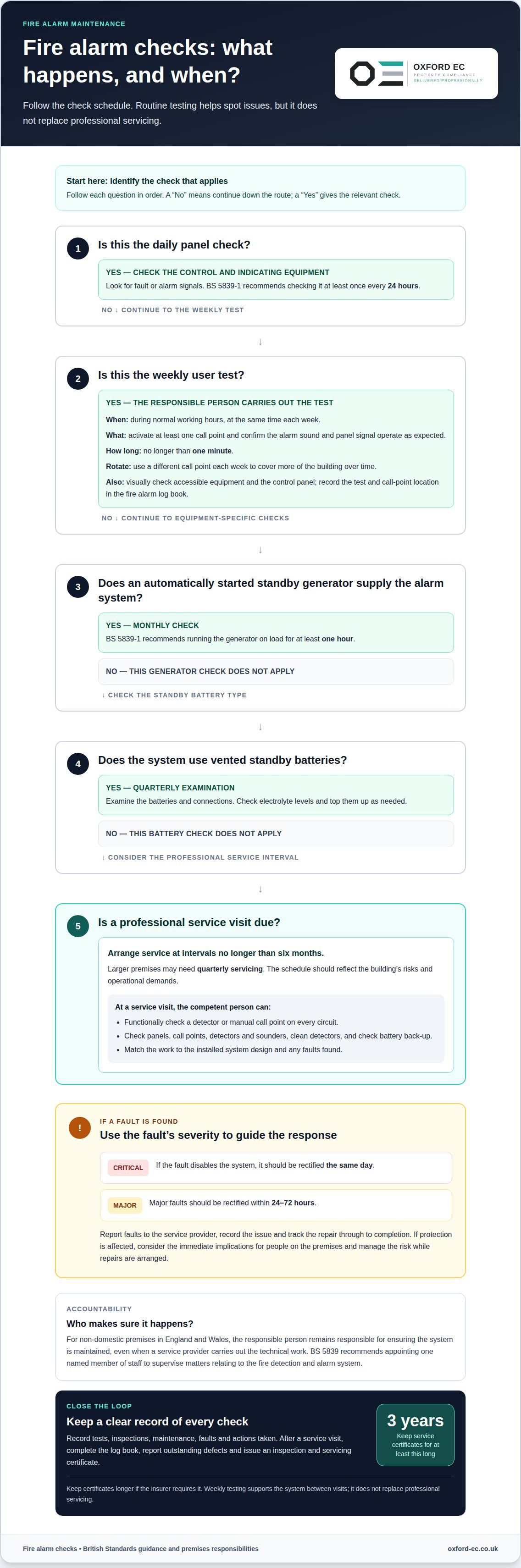
Daily panel checks review the control and indicating equipment for fault or alarm signals; BS 5839-1 recommends checking it at least once every 24 hours. The weekly test confirms that a call point, alarm sound and panel signal operate as expected, helping staff spot a problem between service visits.
Carry out the weekly test during normal working hours, at the same time each week. Activate at least one call point and keep the test to no longer than one minute. Use a different call point each week to cover more of the building over time.
Weekly and Monthly In-House Checks
Combine the weekly call-point test with a visual check of accessible equipment and the control panel. Record each successful test in the fire alarm log book, including the call point’s location. Clear entries make missed checks easier to spot and show which points have been tested.
Monthly checks depend on the system’s equipment. Where an automatically started standby generator supplies the alarm system, BS 5839-1 recommends running it on load for at least one hour during the monthly check. Vented standby batteries need quarterly examination of batteries and connections, with electrolyte levels checked and topped up as needed.
Servicing Different Alarm System Types
Conventional, addressable, wireless and monitored systems differ in how devices connect, display faults and communicate. Service checks must therefore match the installed design. Whatever the system type, routine testing and servicing are still necessary. System documentation helps the competent person identify the relevant components and functions.
At each service visit, functionally check a detector or manual call point on every circuit. The visit can also include tests of the panels, call points, detectors and sounders, cleaning detectors to remove dust or dirt, and checking battery back-up. The precise work depends on the equipment and any faults found.
Record and retain tests, inspections and maintenance activities. After a service visit, complete the log book, report outstanding defects and issue an inspection and servicing certificate. Keep service certificates for at least three years, or longer if the insurer requires it.
Who is Responsible for Fire Alarm Maintenance Requirements?
For non-domestic premises in England and Wales, maintaining fire alarms forms part of the responsible person’s fire safety duties. A service provider can carry out technical work, but responsibility for ensuring the system is maintained remains with the responsible person.
Responsible Person Duties
According to Legislation.gov.uk, the Regulatory Reform (Fire Safety) Order 2005 requires the responsible person in England and Wales to maintain fire safety equipment in efficient working order and in good repair. Legislation.gov.uk defines the responsible person in Article 3 of the Regulatory Reform (Fire Safety) Order 2005.
The responsible person may be an employer, building owner, landlord or another person who controls the premises. They must ensure the alarm system is tested and maintained, but do not have to carry out every technical check themselves. They should also ensure faults are reported, service visits are arranged and relevant records are accessible.
BS 5839 recommends that premises management appoint a single named member of staff to supervise matters relating to the fire detection and alarm system. A named lead can coordinate staff tests, record issues and communicate with the service provider. This makes responsibilities clearer when different people manage the building, equipment and maintenance arrangements.
Premises Management Responsibilities
Premises management turns the responsible person’s duties into an organised programme of checks and follow-up. For example, management can assign the weekly user test to a named employee, maintain the log book and ensure service findings reach the person responsible for decisions.
Records should cover tests, inspections and maintenance, as well as faults and the actions taken. After each service visit, complete the log book, report outstanding defects and issue an inspection and servicing certificate. Keep service certificates for at least three years, or longer if the insurer requires it.
Fire safety legislation varies across the UK. The Fire Safety Order applies to non-domestic premises in England and Wales, while similar legislation applies in Scotland and Northern Ireland. Premises managers should follow the requirements relevant to their location rather than assume one legal framework applies throughout the UK.
Faults need prompt attention, particularly where an alarm system becomes non-functional. Critical faults that disable the system should be rectified the same day; major faults should be rectified within 24-72 hours. Management should report faults to the service provider, record the issue and track the repair through to completion.
If a fault affects protection, management should consider the immediate implications for people using the premises and act to manage the risk while repairs are arranged. Clear communication matters: staff need to know about relevant changes, and the responsible person needs an accurate record of the fault, its impact and the corrective work. The fire safety services information explains how fire alarm maintenance fits within wider premises safety arrangements.
Recommended fire alarm servicing intervals under BS 5839-1
BS 5839-1:2017 recommends servicing visits at intervals no longer than six months for fire detection and alarm systems. These fire alarm servicing standards in the UK provide a practical framework, but the appropriate interval can be shorter where the premises’ risk assessment, insurer or enforcing authority requires it.
The standard is a British code of practice for systems in non-domestic premises. It sets out recommendations for design, installation, commissioning and maintenance, giving premises managers practical guidance for organising inspection and servicing. It informs how the system should be maintained, while fire safety legislation sets out the responsible person’s legal duties.
What the six-month interval means
A maximum interval of six months means professional service visits should be planned so no more than six months pass between them. Fire alarm servicing standards UK businesses need to follow are not automatically the same for every building. The assessment should account for the premises, the system and any relevant requirements set by an insurer or enforcing authority.
Quarterly servicing is a common arrangement for UK businesses. It creates more frequent opportunities to examine the system and address defects, while the six-month limit remains the outer recommended interval for visits under BS 5839-1. Higher-risk environments may need inspections more often than twice per year.
Inspection and detector testing
Servicing involves more than a brief visual inspection. A visit checks system operation and components, and records the work alongside any faults or necessary repairs. At every visit, functionally check at least one detector or manual call point on each circuit, sampling equipment across the system.
BS 5839-1 also recommends testing every automatic fire detector over each 12-month period. The test should use the phenomenon the detector is designed to identify, such as smoke or heat. With quarterly servicing, testing 25% of detectors at each visit allows the full detector population to be tested annually.
The annual detector cycle does not mean professional servicing happens only once a year. Detector tests are distributed across visits, while the interval between service visits remains no longer than six months. To apply fire alarm servicing standards UK premises managers can use to plan visits, coordinate the risk-based schedule with the detector-testing programme. More frequent visits can provide a shorter cycle for detector testing.
Which part of BS 5839 applies?
BS 5839-1 addresses fire detection and alarm systems in non-domestic premises, including workplaces and other business buildings. BS 5839-6:2019+A1:2020 is the code of practice for designing, installing, commissioning and maintaining systems in domestic premises, including HMOs.
Identify the premises type before applying a servicing schedule. A business building and a domestic property may fall under different parts of BS 5839, so the applicable recommendations depend on the system’s setting and purpose. The risk assessment, system records and any insurer or enforcing authority requirements help shape the final inspection programme.
Servicing frequency for large premises
Large premises should plan professional fire alarm servicing quarterly. This means four planned visits over the year, rather than treating the system as a single annual maintenance task. Larger buildings may have multiple areas and system components, so account for the installed system and the practical arrangements for each visit.
Quarterly servicing is a recommendation for large premises, not a replacement for regular in-house checks. The responsible person should keep a calendar of the four planned visits and identify who will coordinate access. For example, a site with separate operational areas can arrange access for each visit, helping the technician complete the planned inspection and functional checks.
Two service visits a year are also a usual UK arrangement for spreading annual servicing work across visits. This should not be confused with the recommendation for quarterly servicing in large premises. The appropriate frequency depends on the premises and its fire risk assessment. The assessment, insurer or enforcing authority may require shorter intervals.
The Regulatory Reform (Fire Safety) Order 2005 provides the legal context for fire safety responsibilities in England and Wales. The responsible person should ensure the servicing plan remains aligned with the premises’ fire risk assessment and any relevant requirements. If the building’s use, layout or fire risks change, the assessment may affect how frequently professionals need to inspect the alarm system.
Good scheduling helps make each service visit more effective. Keep system information, previous service reports and the log book available so the technician can understand the maintenance history and identify outstanding faults. For a large site, coordinate access to relevant areas and record which checks were completed. The service report then gives the responsible person a clear account of findings and follow-up work.
Do not treat the calendar as the whole maintenance programme. Daily panel checks and weekly user tests are separate tasks from professional maintenance, which examines system operation and components. Quarterly visits give large premises regular opportunities to identify defects, review system condition and organise repairs. Report faults promptly rather than waiting for the next scheduled appointment.
In practice, set the professional servicing frequency using three considerations: the quarterly recommendation for large premises, the fire risk assessment findings, and any requirements set by the insurer or enforcing authority. Record the reason for the chosen schedule and review it if building conditions change. This connects the maintenance plan to the actual premises rather than a generic calendar.
Selecting a fire alarm service provider
A suitable provider should demonstrate competence in fire detection systems, explain the inspection scope and produce clear service records. The work involves more than routine maintenance: installation history, system design, recurring faults and false alarms can all affect what the technician needs to examine.
BS 5839-1 identifies third-party certification by a UKAS-accredited certification body as one way to assure a servicing organisation’s competence. It is not itself a legal requirement. The central requirement is competent work: the person servicing the system should have detailed knowledge of fire alarm systems and how they operate. Ask for a clear description of the relevant experience and technical work included in the service.
Check that the proposed visit reflects the installed system and its maintenance history. Conventional, addressable and wireless systems have different arrangements, so the inspection should account for the equipment in place. The service provider should identify the detectors, manual call points, control equipment and circuits covered, and explain any access or testing limitations in the report.
A useful service visit includes functional checks, inspection of relevant components, cleaning detectors where needed and checking battery back-up. At every visit, functionally check at least one detector or manual call point on each circuit. The provider should record findings, report outstanding defects, complete the system log book and issue an inspection and servicing certificate.
Response arrangements matter when faults occur between planned visits. A servicing contract should provide technician attendance on a 24-hour basis, with normal attendance within 8 hours of a call. Clear fault procedures help the responsible person understand how to report an issue and what information to provide, such as the panel indication, affected area and any loss of alarm function. Where alarm monitoring is integrated with out-of-hours keyholding, reviewing established security companies Bracknell can help premises managers ensure emergency access and site protection remain coordinated.
For recurring false alarms, choose a provider that investigates the causes rather than simply resetting the panel. A thorough review should consider event history, affected devices, building activity and relevant fire risk assessment findings. This can help distinguish an equipment fault from an environmental or operational trigger and identify whether corrective maintenance is needed.
Before agreeing the routine schedule, align the service scope with the premises’ risk assessment and applicable inspection frequency. Confirm how the provider records defects, recommends repairs and documents completed work. A clear report lets the responsible person track each issue to closure and retain evidence of system maintenance. Choose for competence, defined scope and accountable records, not response language alone.
Oxford Environmental Consultants (OEC): Fire Alarm Installation, Maintenance and Servicing
Oxford Environmental Consultants (OEC) provides fire alarm installation, maintenance and servicing, including planned maintenance arrangements. Turn to OEC when installing an alarm, arranging routine servicing or addressing maintenance needs identified during a service visit.
A clear maintenance programme helps the responsible person organise professional visits, record findings and follow up reported defects. OEC’s fire alarm services support this work as part of managing fire safety across your premises.
Contact Oxford Environmental Consultants (OEC) to discuss your fire alarm installation, maintenance or servicing requirements.
Make your next maintenance decision with confidence
Turn fire alarm servicing standards in the UK into a maintenance plan that stays relevant as your premises change. Changes in occupancy, layout or building use can affect how the alarm system serves the site. Include system information and maintenance arrangements in operational handovers.
Continuity matters when a new manager takes responsibility or a site changes. A clear handover preserves the background to maintenance decisions and gives the person overseeing fire safety a sound basis for future planning. Treat the system as an active part of premises management, not a file to revisit only when a service visit is due.
For fire alarm installation, maintenance and servicing, contact Oxford Environmental Consultants (OEC) to discuss your premises’ requirements.
A considered next step can help keep your maintenance arrangements aligned with your building’s needs and the people who use it.
Frequently Asked Questions
Is BS 5839 the same as the Regulatory Reform (Fire Safety) Order 2005?
No. The Regulatory Reform (Fire Safety) Order 2005 is legislation applying to non-domestic premises in England and Wales, while BS 5839 is a British Standard code of practice for fire detection and alarm systems. The Order sets legal duties for the responsible person; BS 5839 gives technical recommendations for system design, installation, commissioning and maintenance. They serve different purposes, so following the standard supports, but does not replace, legal duties.
What do UK Government regulations say about fire alarms?
UK Government guidance recommends installing and maintaining fire alarm and detection systems in accordance with BS 5839. The appropriate system depends on the business and premises, including their type and size. For example, a small office and a larger, complex building may need different arrangements. The fire risk assessment helps establish what protection is appropriate and informs the responsible person’s management of fire safety measures.
What UK standards apply to fire alarm servicing, including BS 5839-1?
BS 5839-1:2017 covers fire detection and alarm systems in non-domestic premises. BS 5839-6:2019+A1:2020 concerns systems in domestic premises, including HMOs. Other parts address specialist systems: BS 5839-8:2013 covers voice alarm systems, and BS 5839-9:2021 covers emergency voice communication systems. Identify the premises and system type first, then apply the relevant recommendations rather than treating every installation as the same.
How often should fire alarm systems be serviced and inspected in the UK?
Under BS 5839-1, professional servicing visits should be no more than six months apart. Quarterly visits are recommended for large premises, and a risk assessment, insurer or enforcing authority may require a shorter interval. For example, if a building’s use or risk profile changes, review whether its existing schedule remains suitable. This planned servicing is separate from routine user testing and detector testing over the annual cycle.
What weekly and monthly fire alarm user checks are required under UK guidance?
For the weekly user test, activate at least one call point and check that the alarm sounds and the panel registers the signal. Test at the same time during normal working hours, use a different call point each week and keep the test within one minute. Check the control panel at least once every 24 hours. Where an automatically started standby generator supplies the system, its monthly check includes a one-hour on-load run.
Who is qualified to service fire alarm systems in the UK, and what third-party certification is recognised?
Servicing should be carried out by a competent person with detailed knowledge of fire alarm systems and their operation. BS 5839-1 identifies third-party certification by a UKAS-accredited certification body as one way to provide assurance about an organisation’s competence. It is not itself a legal requirement. In practice, competence should be relevant to the installed system, its components and the maintenance work being undertaken.
What are the legal duties of UK employers and responsible persons for fire alarm maintenance?
In England and Wales, the responsible person may be an employer, owner, landlord or another person controlling non-domestic premises. The Regulatory Reform (Fire Safety) Order 2005 requires that person to maintain fire safety equipment in efficient working order and good repair. If several people manage a site, a named staff member can oversee alarm-related matters, coordinate records and escalate defects to the responsible person.
What are the risks and penalties for failing to maintain a fire alarm system?
A neglected or faulty alarm may fail to provide an effective warning, leaving occupants without the protection the system is intended to provide. In England and Wales, failure to maintain fire safety equipment can also mean the responsible person is not meeting their duties under the Fire Safety Order. Legal consequences depend on the circumstances and applicable enforcement process; a maintenance lapse does not carry one universal penalty.