
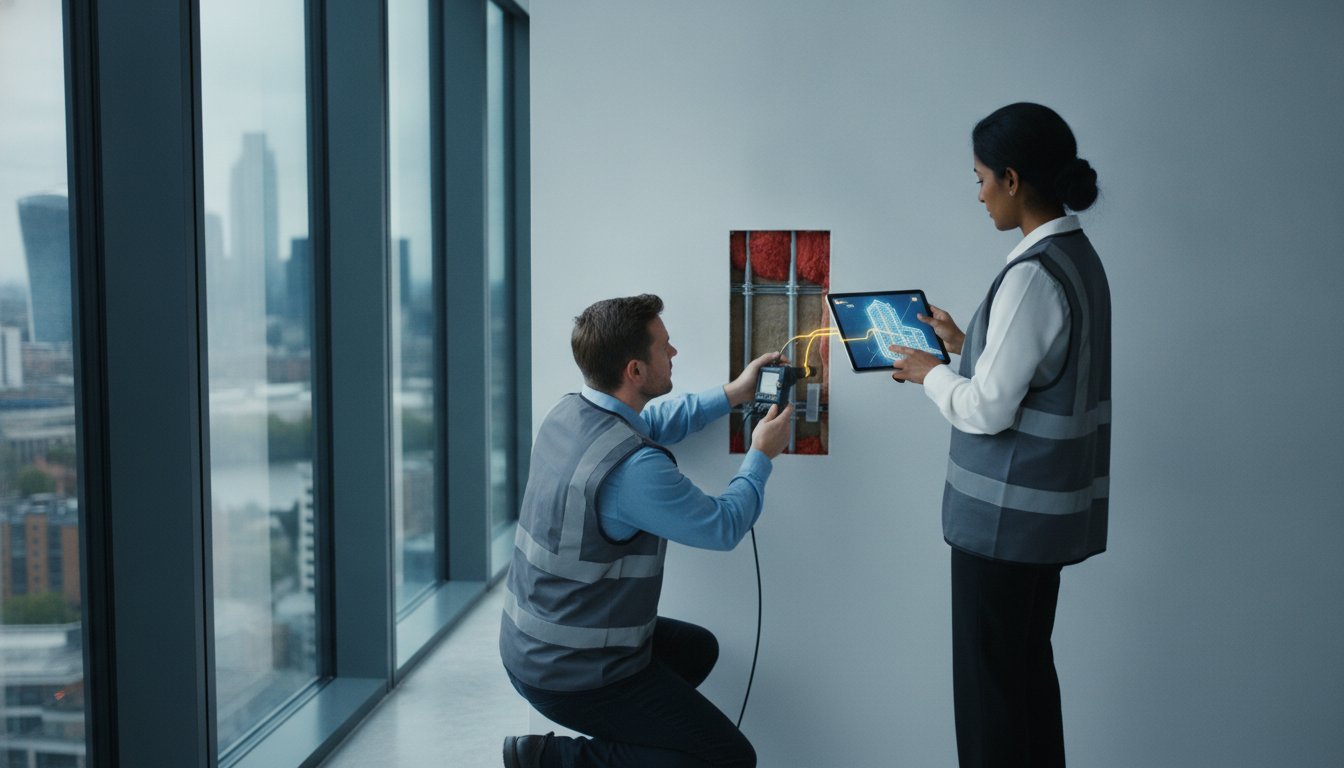
A type 4 fire risk assessment is not a routine inspection; it is a forensic, structural intervention that leaves no room for ambiguity. Rigorous. Intrusive. Uncompromising. Whilst standard surveys only scratch the surface, this level of scrutiny demands the destructive sampling of building fabric to verify the hidden reality of fire compartmentation. It's the only definitive method to satisfy the stringent 'Golden Thread' requirements mandated by the Building Safety Act 2022 and the latest BS 9792:2025 standards.
You likely recognise that managing occupied dwellings whilst coordinating potential asbestos disturbance is a logistical minefield that risks significant operational friction. This guide provides an authoritative framework for property managers to navigate these complex multi-disciplinary requirements, ensuring your safety programme remains both legally robust and technically precise. We'll examine the strategic alignment of fire and asbestos teams, the necessity of competent structural auditing, and the streamlined methodology required to secure a definitive record of your building’s compartmentation integrity.
Key Takeaways
- Absolute Legal Compliance. Understand how the Building Safety Act 2022 and BS 9792:2025 position the type 4 fire risk assessment as the definitive framework for high-rise residential safety.
- Intrusive Technical Rigour. Explore the forensic requirements of destructive sampling, focusing on the verification of compartmentation integrity within service risers and private dwellings.
- Risk-Based Selection. Learn to navigate the Type 1 to 4 framework to determine when structural uncertainty necessitates a move from non-destructive to intrusive auditing.
- Safety Crossover Management. Discover the essential coordination between fire safety and asbestos consultancy to ensure destructive works do not compromise health or legal standing.
- Streamlined Portfolio Governance. Identify the benefits of a multi-disciplinary approach in maintaining the 'Golden Thread' and reducing the logistical burden of property compliance.
Table of Contents
- Type 4 Fire Risk Assessment: The Definitive Standard for Building Safety in 2026
- The Anatomy of a Type 4 Survey: Destructive Sampling and Private Dwellings
- Type 4 vs. Types 1, 2, and 3: Choosing the Correct Level of Scrutiny
- Managing the Complexities: Asbestos Risks and CDM Regulations
- National Property Compliance: Why OEC is the Trusted Partner for Type 4 FRAs
Type 4 Fire Risk Assessment: The Definitive Standard for Building Safety in 2026
Forensic. Definitive. Uncompromising. A type 4 fire risk assessment represents the most exhaustive tier of building safety auditing, transcending the limitations of standard visual inspections through the systematic, destructive sampling of a building's fabric. Whilst lower-level surveys provide a snapshot of communal safety, the Type 4 methodology requires the physical opening of ceilings, floors, and service risers to verify the hidden reality of compartmentation within both common parts and private dwellings. It's the gold standard for property managers who require absolute certainty regarding the structural integrity of their assets.
The regulatory environment of 2026 demands a decisive shift from passive observation to evidence-based assurance. The Building Safety Regulator (BSR) now expects those responsible for high-rise residential buildings (HRBs) to prove, rather than assume, the integrity of structural barriers. This rigorous approach aligns with fundamental fire safety principles, ensuring that the 'Golden Thread' of information is supported by physical evidence of compliance rather than historical guesswork. In 2026, the BSR's scrutiny of HRBs has intensified, with a clear focus on the 'Safety Case' methodology which requires a proactive, documented demonstration of risk management.
Transitioning to a digital 'Golden Thread' necessitates more than just digital filing; it requires an accurate, verified record of the building's physical state. By conducting a type 4 fire risk assessment, property managers can bridge the gap between architectural plans and structural reality, providing the BSR with a comprehensive dataset that includes photographic evidence of fire-stopping, cavity barriers, and floor-to-wall junctions. A visual survey simply can't account for what lies behind a plasterboard ceiling or within a service duct, making the intrusive nature of a Type 4 survey indispensable for high-risk portfolios.
The Legal Duty of the 'Accountable Person'
Under the Building Safety Act 2022, the 'Accountable Person' carries personal liability for the building's safety case. Precise. Documented. Defensible. A Type 4 assessment is frequently the only viable route to satisfy a Building Safety Case report, providing the forensic data required to demonstrate that all reasonable steps have been taken to mitigate risk. Failing to identify latent structural defects whilst managing complex, multi-occupied assets can lead to severe statutory penalties or even criminal prosecution. Utilising expert fire safety consultancy ensures that this duty is met with the required technical rigour.
When is a Type 4 Assessment Mandatory?
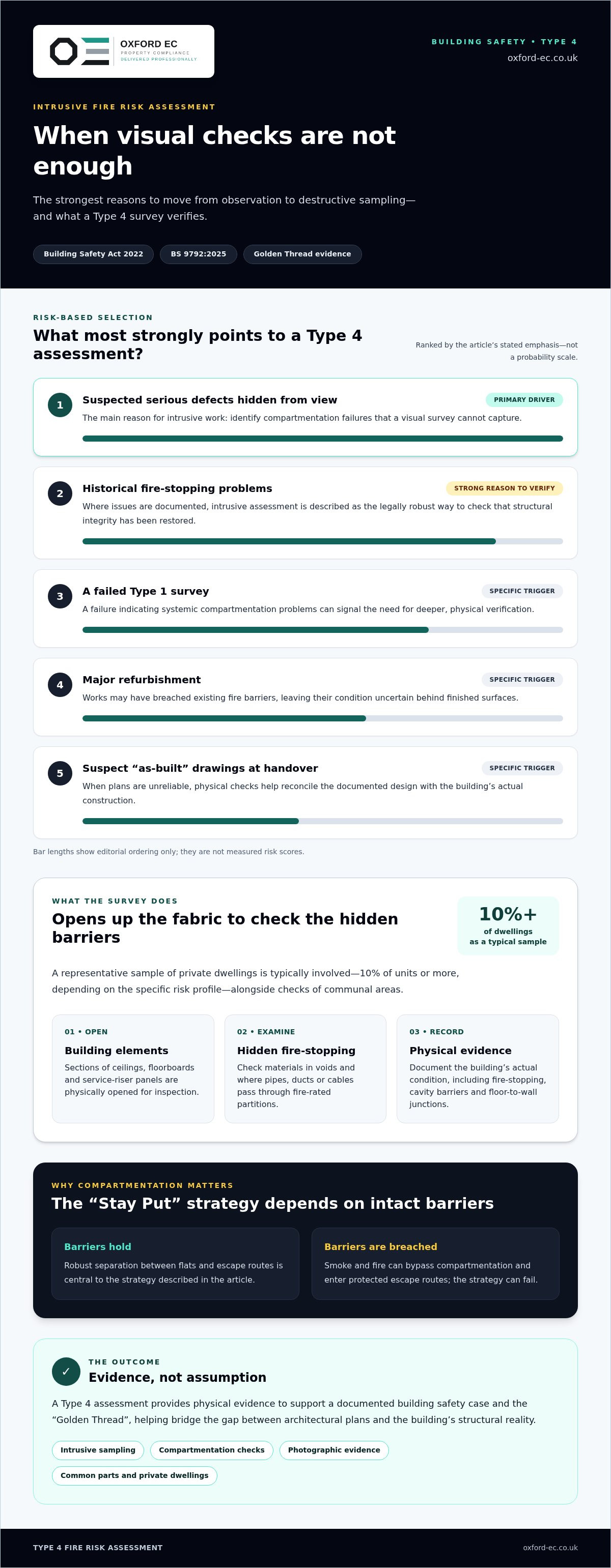
Specific trigger points necessitate this level of scrutiny. These include post-construction handovers where 'as-built' drawings are suspect, major refurbishments that may have breached existing barriers, or following a failed Type 1 survey that indicates systemic compartmentation failure. Identifying 'serious defects' that visual surveys cannot capture is the primary driver for these intrusive works. Where a building has a documented history of historical fire-stopping issues, a type 4 fire risk assessment is the only legally robust method to verify that structural integrity has been restored to the required standard.
The Anatomy of a Type 4 Survey: Destructive Sampling and Private Dwellings
A type 4 fire risk assessment is distinguished by its intrusive nature, extending the audit beyond communal corridors and into the very fabric of the flats themselves. It requires a representative sample of private dwellings, typically involving 10% of units or more depending on the specific risk profile, to ensure the construction separating individual homes from escape routes remains robust. This level of scrutiny is essential for verifying the 'Stay Put' strategy. If the structural barriers between flats are compromised, the strategy fails, as smoke and fire can bypass designated compartmentation and enter protected escape routes. Precise. Forensic. Decisive.
The methodology of destructive sampling involves the physical opening of building elements to inspect hidden voids. Technicians carefully remove sections of ceilings, floorboards, and service riser panels to examine the quality of fire-stopping materials within. This aligns with official government guidance, which highlights that intrusive sampling is necessary when there is reason to suspect serious defects in the building's cavities. Without this physical evidence, an 'Accountable Person' is merely guessing at the safety of their residents, a risk that is no longer acceptable under current 2026 regulatory frameworks.
Structural Compartmentation and Fire-Stopping
Hidden voids. Service penetrations. Cavity barriers. These are the primary focus areas during an intrusive survey. We scrutinise the quality of fire-resisting materials where pipes, ducts, or cables pass through fire-rated partitions. Common failure points often include improperly installed fire dampers or breached partitions that were hidden by previous refurbishments. Utilising professional compartmentation surveys as part of a Type 4 audit allows for the validation of building fabric safety, ensuring that every hidden penetration is sealed to the required standard.
Access and Tenant Management
Managing the human element is often the most complex part of a type 4 fire risk assessment. Property managers must balance the need for technical rigour with the comfort of their residents. Transparent communication is the key to success. We recommend providing tenants with clear, written explanations of the safety benefits, framing the survey as a vital investment in their personal protection. The 'make-good' process must be equally disciplined; ensuring properties are returned to their original decorative state immediately after sampling is a non-negotiable requirement for maintaining tenant trust. If you are managing a high-rise portfolio and require a coordinated approach to intrusive works, you can contact our technical team for a consultation on best-practice delivery.
Type 4 vs. Types 1, 2, and 3: Choosing the Correct Level of Scrutiny
Types 1 and 2 assessments are strictly limited to communal areas. Type 1 is the baseline; it's visual and non-destructive. Type 2 introduces destructive sampling but remains confined to the common parts. For many high-rise residential buildings, these levels are fundamentally insufficient because they ignore the internal compartmentation of the dwellings themselves. Type 3 expands the scope to include private flats but remains non-destructive, which means it cannot identify failures within hidden cavities or floor-to-wall junctions. A type 4 fire risk assessment is the only tier that combines the breadth of dwelling access with the depth of intrusive sampling.
Choosing this level of scrutiny early in a building's lifecycle or prior to major remedial works often proves more cost-effective than a reactive approach. It eliminates the risk of discovering systemic compartmentation failures mid-way through a refurbishment project, allowing for a fixed-scope remedial programme rather than a series of expensive, unplanned variations. This proactive auditing provides a definitive baseline of safety. Precise. Scalable. Compliant. By identifying the exact extent of required works, property managers can secure accurate tenders from passive fire protection contractors, avoiding the "open-cheque" scenario often associated with discovered defects.
The Risk of Under-Assessment
Relying on a Type 1 survey for a complex structure creates a dangerous gap in the building safety case. Visual checks don't reveal if a fire-stopping collar was never installed behind a service riser or if a cavity barrier is missing in a timber-frame facade. The financial risk of hidden defects being discovered during a real fire event is catastrophic, both in terms of life safety and subsequent litigation. Whilst a Type 1 assessment relies solely on visual observations within communal corridors, a type 4 fire risk assessment executes a forensic structural audit that verifies the presence of cavity barriers and fire-stopping through physical penetration of the building fabric.
Evaluating Asset Portfolios
For property managers with diverse national portfolios, a structured framework for prioritisation is essential. Buildings constructed between 1990 and 2010 often require higher scrutiny due to historical inconsistencies in building control oversight. Height and occupancy density are also critical factors. Implementing a consistent, national strategy ensures that all assets are professionally managed to a uniform standard of excellence. This methodical approach provides the 'Accountable Person' with a defensible audit trail that satisfies both the Building Safety Regulator and insurance underwriters, ensuring that capital expenditure is directed where it is most critically needed.
Managing the Complexities: Asbestos Risks and CDM Regulations
The 'Asbestos Crossover' represents a critical point of failure in fragmented compliance programmes. Destructive sampling is, by definition, construction work. It's high-risk. It's regulated. A type 4 fire risk assessment cannot be conducted in isolation; it must be preceded or accompanied by a professional asbestos survey to prevent the accidental disturbance of asbestos-containing materials (ACMs) within hidden cavities. Under the Construction (Design and Management) Regulations 2015 (CDM), this intrusive work requires a formal health and safety plan to protect both the surveyor and the building's residents.
The appointment of a Principal Designer is a statutory requirement for projects involving more than one contractor. They coordinate health and safety. They manage risk. They ensure accountability. In the context of a Type 4 survey, this role is vital for aligning the fire risk assessor's structural requirements with the asbestos consultant's safety findings. This coordination ensures that when a technician opens a service riser to inspect fire-stopping, they aren't inadvertently releasing fibres from historical pipe lagging or asbestos insulating board (AIB) partitions. Without this oversight, the 'Accountable Person' risks significant legal exposure under both fire and environmental health legislation.
Integrated Asbestos and Fire Scrutiny
Managing multiple contractors for intrusive works creates unnecessary administrative friction and increases the likelihood of safety gaps. It's inefficient. It's risky. By utilising a single, multi-disciplinary compliance partner, property managers can ensure that asbestos management surveys are perfectly synchronised with the fire safety audit. This integrated approach ensures that every destructive sampling point is pre-cleared for ACMs, providing 'audit-ready' documentation that satisfies the Health and Safety Executive whilst maintaining the integrity of the 'Golden Thread' for the Building Safety Regulator.
Remedial Actions and Passive Fire Protection
The output of a type 4 fire risk assessment serves as a definitive roadmap for structural remediation. It prioritises the most critical breaches in compartmentation, such as missing cavity barriers or failed service penetrations. This forensic data often highlights the necessity for comprehensive fire door inspections to ensure the final line of defence in a 'Stay Put' policy is fully functional. It's vital that these remedial works don't compromise other areas of building health; for instance, sealing service risers must be done with precision to avoid creating stagnant air pockets that lead to damp and mould issues within the building fabric.
National Property Compliance: Why OEC is the Trusted Partner for Type 4 FRAs
National coverage. Technical mastery. Absolute accountability. Oxford Environmental Consultants (OEC) serves as the definitive partner for property managers requiring a type 4 fire risk assessment across extensive UK portfolios. Since our inception in 2018, we've focused on providing a protective shield against regulatory risk through precision-led auditing and a rigorous commitment to legal robustness. Our national reach ensures that whether you manage a single high-rise property or an extensive multi-site residential portfolio throughout the country, you receive a consistent, high-standard methodology that meets the exact requirements of the Building Safety Regulator (BSR).
Our authoritative reporting is designed to withstand the most rigorous scrutiny, providing the evidence-based assurance necessary for complex Safety Case reports. We don't just identify risks; we provide a structured, logical roadmap for remediation that is both technically precise and legally defensible. By managing the intersection of fire safety, asbestos consultancy, and building integrity, we eliminate the logistical friction of coordinating multiple contractors for intrusive works. This integrated model ensures that every structural penetration is executed with full knowledge of potential asbestos risks, whilst simultaneously considering the broader health of the building fabric. It's a streamlined solution to a fragmented problem.
Streamlining Property Compliance
Centralising your compliance requirements with OEC significantly reduces the administrative burden on your management teams. Beyond fire safety, our technical divisions provide expert damp and mould inspection services to maintain building fabric health and protect resident welfare. We also provide proactive management of Legionella risks, ensuring that your water hygiene audits are synchronised with your fire safety schedule. This holistic oversight provides a single point of accountability for all high-stakes property requirements, allowing for a more efficient allocation of capital expenditure across your assets.
Secure Your Asset's Future
Technical excellence. Evidence-based results. Peace of mind. We assist duty-holders in meeting every facet of UK safety legislation by providing a "safe pair of hands" for even the most intrusive structural audits. Our meticulous experts thrive on detail and order, ensuring that your assets remain compliant, safe, and audit-ready at all times. This disciplined approach ensures that your building safety case is supported by forensic data rather than assumptions. Contact our expert team today to organise your type 4 fire risk assessment and secure the long-term integrity of your property portfolio.
Securing the Future of Your Building Safety Case
The 2026 regulatory landscape leaves no room for structural assumptions. Rigorous evidence. Physical verification. Definitive compliance. By executing a type 4 fire risk assessment, property managers move beyond the limitations of visual surveys to secure a forensic record of their building's compartmentation. This process is the only way to satisfy the Building Safety Regulator's demand for a comprehensive Safety Case whilst ensuring the 'Stay Put' strategy is supported by structural reality rather than architectural guesswork.
OEC provides the technical precision and multi-disciplinary mastery required to manage these complex intrusive works. Our national service coverage ensures consistent governance across your entire portfolio, whilst our integrated teams manage the high-stakes intersection of fire safety, asbestos management, and water hygiene. We deliver audit-ready reporting that provides absolute peace of mind for every 'Accountable Person' tasked with maintaining the 'Golden Thread' of information.
Take the decisive step toward total asset protection today.
Frequently Asked Questions
What is the difference between a Type 3 and a Type 4 fire risk assessment?
Type 3 assessments are non-destructive surveys that include private dwellings but rely on visual inspection alone. In contrast, a type 4 fire risk assessment involves destructive sampling of the building fabric to verify hidden compartmentation. Whilst Type 3 identifies visible risks within flats, Type 4 exposes latent defects behind ceilings and walls. This intrusive methodology provides the forensic evidence required for complex high-rise safety cases.
Is a Type 4 fire risk assessment a legal requirement for all blocks of flats?
No, a Type 4 assessment is not a universal legal requirement for every residential block. It is typically mandated for high-rise residential buildings (HRBs) when a Type 1 survey indicates systemic failures or when historical construction data is unreliable. The Building Safety Regulator may require this level of scrutiny to satisfy a Building Safety Case. It's a risk-based intervention rather than a routine statutory obligation for standard assets.
How much does a Type 4 fire risk assessment typically cost?
Costs for these assessments are determined on a case-by-case basis due to the requirement for specialist contractors and reinstatement works. Unlike standard communal surveys, the price reflects the technical rigour of destructive sampling and the professional time required for forensic reporting. Factors influencing the final fee include the building’s height, the number of sample flats required, and the complexity of the internal construction. Detailed quotations are provided following a preliminary asset review.
Does a Type 4 assessment involve disturbing asbestos?
Destructive sampling carries a high risk of disturbing asbestos-containing materials within hidden cavities. It is essential that a type 4 fire risk assessment is coordinated with a recent asbestos survey to ensure any sampled areas are pre-cleared. At OEC, our integrated teams manage this crossover to prevent accidental fibre release. This multi-disciplinary approach ensures that fire safety audits remain compliant with both the Regulatory Reform (Fire Safety) Order and the Control of Asbestos Regulations.
What happens if structural defects are found during the destructive sampling?
Identified defects are categorised by risk level within the final report to guide immediate remedial actions. If systemic compartmentation failure is discovered, the 'Accountable Person' must implement a prioritised programme of passive fire protection works. This may include installing missing cavity barriers or resealing service penetrations. The forensic data provided by the survey ensures that subsequent remedial expenditure is targeted with absolute precision, avoiding unnecessary work on compliant areas.
Who is qualified to carry out a Type 4 fire risk assessment in 2026?
In 2026, assessors must demonstrate competence aligned with the BS 8674:2025 framework for fire risk assessors. This standard defines the high-level expertise required to manage complex residential audits. For Type 4 works, the assessor must also possess the technical mastery to coordinate destructive sampling and interpret structural findings. OEC ensures all surveyors are suitably qualified and experienced in high-rise environments, providing a "safe pair of hands" for rigorous regulatory compliance.
How often should a Type 4 assessment be reviewed?
Review frequencies are determined by the building's specific risk profile and the requirements of the Building Safety Regulator. For high-rise residential buildings, an annual review of the overarching fire risk assessment is standard practice. However, a full destructive Type 4 survey is typically a one-off forensic audit or repeated only after major structural refurbishments. Regular Type 1 reviews should monitor any changes to the building's state following the initial intrusive investigation.
How do I prepare residents for a Type 4 assessment in their flats?
Effective tenant management requires transparent, early communication regarding the safety benefits of intrusive sampling. Residents should receive formal notice outlining the scope of works and the 'make-good' process to ensure their property is returned to its original state. Highlighting that the survey protects their individual safety helps secure cooperation for flat access. Professional coordination ensures that the disruption caused by opening ceilings or floorboards is minimised through efficient, disciplined site management.