

Seventy-five per cent of fire doors across the UK are currently failing inspections due to critical technical defects. This represents a staggering failure rate. It constitutes a severe risk to life. It exposes duty-holders to significant legal liability. Whilst you likely strive for excellence in your safety protocols, the transition to BS 8214:2026 and the replacement of BS 476-22 with BS EN 1634-1 have fundamentally redefined the benchmarks for fire door integrity testing.
We recognise that the complexities of the Building Safety Act 2022 often lead to confusion regarding the "Golden Thread" of documentation and the necessity for a complete, coordinated doorset approach. You require a dependable partner to demystify these rigorous standards and provide a shield against regulatory risk. This guide will equip you with a technical roadmap for statutory compliance, detailing the mandatory quarterly check frequencies for buildings over 11 metres and the specific criteria for third-party accredited inspections. You'll gain a clear understanding of the new British Standards and the confidence to ensure your property remains a safe, audit-ready environment.
Key Takeaways
- Statutory alignment. Precision. Legal robustness. Align your safety strategy with the Building Safety Act 2022 to establish a digital "Golden Thread" of information for every fire doorset.
- Technical benchmarks. Rigour. Compliance. Master the transition from BS 476 to BS EN 1634-1 to ensure your fire door integrity testing adheres to the latest fire resistance standards.
- Failure identification. Scrutiny. Risk management. Recognise critical vulnerabilities such as the "4mm rule" and compromised intumescent seals that frequently result in audit failures.
- Maintenance protocols. Accountability. Protection. Establish a rigorous inspection frequency and a structured 5-point check system to maintain the passive fire protection of your property.
Table of Contents
Understanding Fire Door Integrity Testing and UK Legislation
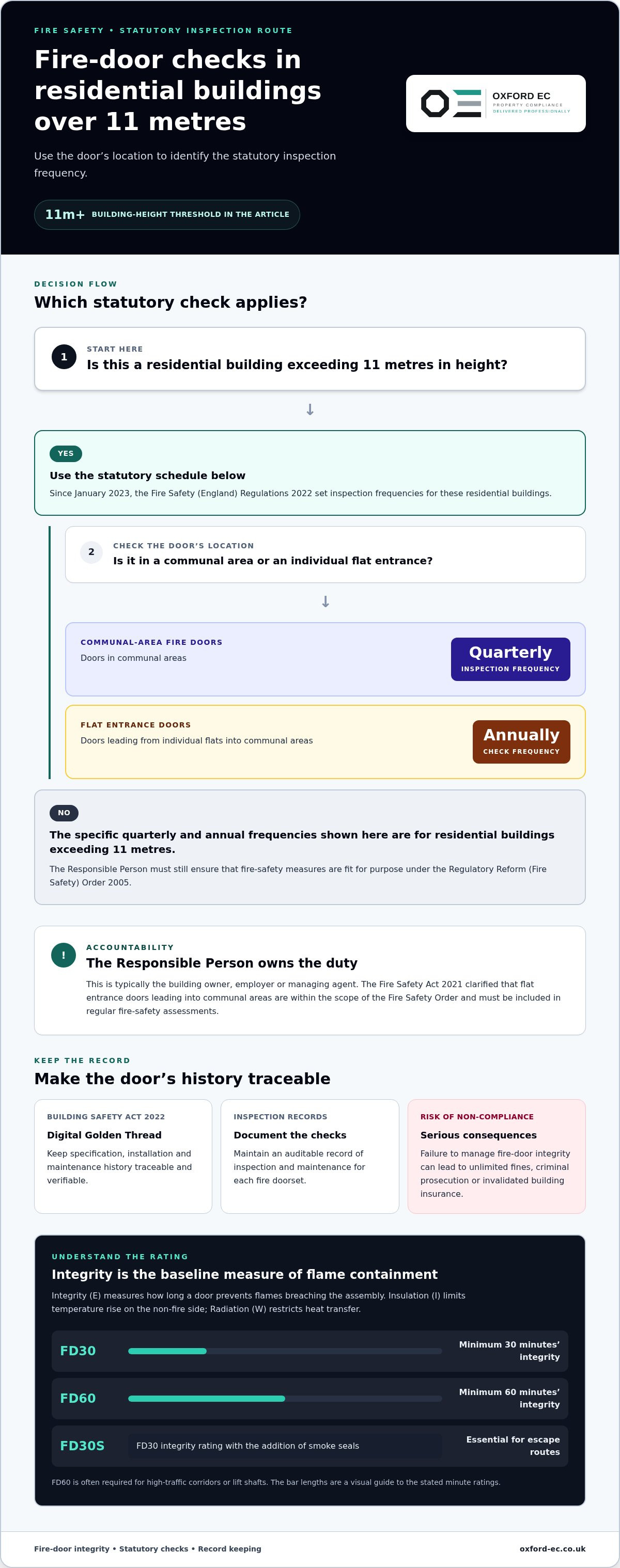
Fire door integrity testing is not merely a box-ticking exercise. It is a critical life-safety protocol. It is a legal mandate. In technical terms, integrity refers to the capacity of a complete doorset assembly to maintain its structural stability and resist the passage of flames and hot gases during a fire event. Under the Regulatory Reform (Fire Safety) Order 2005, the Responsible Person must ensure that all fire safety measures are fit for purpose, a requirement that has been significantly sharpened by the Fire Safety Act 2021. This specific amendment clarifies that entrance doors leading from individual flats into communal areas are strictly within the scope of the Fire Safety Order, meaning they must be included in regular fire safety assessments.
The Building Safety Act 2022 introduces a more rigorous regime for high-risk residential buildings. It demands a digital Golden Thread of information. This ensures that every fire door's specification, installation, and maintenance history is traceable and verifiable. It eliminates ambiguity. It enforces accountability. It protects lives. Oxford Environmental Consultants understands that fire door integrity is a vital component of a building’s overall compartmentation strategy; if a single door fails, the entire fire-resistant barrier is compromised.
The Legal Duty of the Responsible Person
The burden of compliance rests squarely on the Responsible Person, typically a building owner, employer, or managing agent. Failure to manage fire door integrity testing can lead to unlimited fines, criminal prosecution, or the total invalidation of building insurance. Since January 2023, the Fire Safety (England) Regulations 2022 have mandated quarterly inspections of fire doors in communal areas and annual checks of flat entrance doors for residential buildings exceeding 11 metres in height. These are not suggestions; they are statutory requirements enforced by the Building Safety Regulator to prevent the systemic failures seen in previous decades.
Integrity vs. Insulation vs. Radiation
Understanding the Fire door fire-resistance rating requires a distinction between three performance metrics: Integrity (E), Insulation (I), and Radiation (W). Integrity is the primary baseline. It measures how long a door prevents flames from breaching the assembly. Whilst Insulation limits temperature rise on the non-fire side and Radiation restricts heat transfer, Integrity remains the fundamental metric for smoke and flame containment. These metrics define the common classifications used across the UK:
- FD30: Provides a minimum of 30 minutes of fire integrity.
- FD60: Provides a minimum of 60 minutes of fire integrity, often required for high-traffic corridors or lift shafts.
- FD30S: Denotes the addition of smoke seals to the integrity rating, which is essential for protecting escape routes.
Technical Standards: BS 476 and BS EN 1634-1 Procedures
Rigorous laboratory validation. Technical precision. Absolute accountability. Historically, BS 476 Part 22 served as the definitive British Standard for fire resistance testing, but the landscape has shifted towards more stringent European harmonised standards. As of 2026, BS 476-22 has been withdrawn and replaced by BS EN 1634-1:2014+A1:2018. This modern benchmark is significantly more demanding, treating the door leaf, frame, hardware, and seals as a single, coordinated system rather than a collection of individual components. The British Woodworking Federation has long advocated for this systemic approach, noting that third-party certification is essential to prove that an installed doorset will perform exactly as it did during factory testing.
The Role of UKAS (United Kingdom Accreditation Service) is central to this process. It ensures that the test houses conducting fire door integrity testing operate with total technical competence and impartiality. Without UKAS accreditation, a test report lacks the legal weight required to satisfy the Building Safety Regulator. For duty-holders, choosing doorsets with third-party certification, such as the BM TRADA Q-Mark, provides a "linguistic handshake" of quality, ensuring the product is manufactured to a consistent standard that matches the original fire-tested design. If you are unsure whether your current assets meet these updated criteria, you can request a professional technical audit from our team.
The Fire Door Testing Procedure
During a laboratory test, a full-scale doorset is mounted into a furnace and subjected to temperatures exceeding 1000°C to simulate a fully developed fire. The test rig maintains positive pressure conditions to force smoke and hot gases against the door's seals and joints, mimicking the real-world behaviour of a building fire. Technicians use the "Cotton Pad" test to verify integrity; if a non-flaming breach occurs, a cotton pad is held against the gap. If the pad ignites or glows, the door's integrity has failed. This level of scrutiny ensures that only the most robust assemblies reach the market.
Interpreting FD Ratings (FD30S to FD120)
Fire door ratings are expressed in minutes of proven resistance. An FD30 rating guarantees 30 minutes of integrity, whilst an FD60 provides an hour of protection, typically required for high-risk areas or vertical shafts. The "S" suffix is arguably the most critical addition for life safety, as it denotes that the door has been tested for smoke leakage control at both ambient and medium temperatures. These ratings must be precisely matched to the specific risk levels identified in your latest fire risk assessment to ensure the building's compartmentation remains intact during an emergency.
Identifying Critical Failure Points in Fire Door Integrity
Precise. Accountable. Uncompromising. A fire door is a life-safety asset that only functions when every component aligns perfectly with its original test evidence. During fire door integrity testing, the most frequent failure point is the "Millimetre Rule." Gaps between the door leaf and the frame must typically remain between 2mm and 4mm; if these tolerances are exceeded, the intumescent seals cannot expand sufficiently to bridge the void during a fire. This breach allows flames to bypass the assembly, compromising the building's entire compartmentation strategy and exposing occupants to lethal temperatures.
Intumescent seals are the chemical engine of the door. They react to heat, expanding to many times their original size to create a fire-tight barrier. Whilst these protect against flames, smoke seals are required to stop the "silent killer" before a fire fully develops. If these seals are painted over, damaged, or missing, the door’s ability to restrict the passage of toxic gases is nullified. Every component, from the hinges to the glazing, must be certified to work in unison. Uncertified hardware often fails under thermal stress, causing the door to warp or drop, which leads to immediate integrity failure.
Common Ironmongery and Glazing Issues
Mechanical reliability. Structural stability. Hardware compatibility. The use of non-fire-rated hinges, locks, or handles is a common defect that invalidates a door's certification. Glazing is another area where misconceptions persist; wired glass is not a universal substitute for fire-resistant glazing (FRG), as FRG is specifically engineered to maintain integrity under intense furnace conditions. Self-closing devices are statistically the most frequent point of mechanical failure. If a door fails to latch or close fully into the rebate, it ceases to be a fire door and becomes a liability.
Environmental and Usage Wear
Timber is a hygroscopic material. It reacts to moisture. It responds to temperature. In high-traffic environments, constant usage can lead to "leaf drop" or warping, which alters the critical gap dimensions required for safety. Floor clearances must not exceed 10mm for effective smoke control unless a threshold seal is present. Regular fire door inspections are necessary to monitor these environmental shifts and ensure that wear and tear hasn't compromised the passive fire protection of the property.
Professional Fire Door Inspections vs. Initial Type Testing
Laboratory benchmarks. Real-world performance. Statutory accountability. Initial Type Testing provides the necessary evidence that a specific door design can resist fire under furnace conditions, but it does not guarantee the safety of the door currently hanging in your corridor. In-situ fire door integrity testing is the process of verifying that the installed assembly continues to match its primary test evidence. Industry-wide data from 2024-2025 reveals that up to 75% of fire doors fail inspection due to defects that occurred post-manufacture. These failures typically stem from incompetent installation or a lack of structured maintenance, rendering the original factory certificate effectively void.
The digital Golden Thread of information is now a mandatory requirement under the Building Safety Act 2022. This traceable record must span from the point of manufacture through to current 2026 maintenance logs, ensuring that every modification or repair is documented with precision. Without this evidence, the integrity of the door is technically unproven. Oxford Environmental Consultants acts as a "safe pair of hands" for duty-holders, bridging the gap between factory certification and long-term asset compliance through meticulous on-site scrutiny and technical reporting.
The Importance of Compartmentation Surveys
Structural integrity. Fire containment. Passive protection. A fire door is an integral component of a building’s fire-resistant barrier, but its efficacy is entirely dependent on the surrounding substrate. Our compartmentation survey service ensures that the wall construction provides the same level of fire resistance as the door assembly itself. We frequently identify "bridging" risks where neglected service penetrations or poor jointing around the door frame create a path for smoke and flame. If the compartment wall fails, the door's integrity rating becomes irrelevant, as fire will simply bypass the assembly through the structural void.
Competence and Accreditation in 2026
Technical mastery. Independent scrutiny. Risk mitigation. A "competent person" in 2026 is defined by their ability to interpret complex test evidence and recognise subtle mechanical failures that an untrained eye would miss. Oxford Environmental provides independent, multi-disciplinary expertise that eliminates the conflicts of interest often found with "inspect and repair" contractors. By separating the audit from the remediation, we ensure that our findings are driven by safety standards rather than commercial gain. This independent approach provides the transparency and legal robustness required by the Building Safety Regulator to ensure a building is truly safe.
Implementing a Robust Fire Door Maintenance Programme
Methodical scheduling. Strategic oversight. Risk mitigation. A robust maintenance programme is the final pillar of statutory alignment. Whilst legislation sets the baseline, operational reality dictates that high-traffic environments require fire door integrity testing at more frequent intervals than the legal minimum. We recommend six-monthly professional inspections for communal corridors and lift lobbies where mechanical wear is accelerated. Between these formal audits, site managers should utilise a simplified 5-point check framework to identify obvious defects:
- Certification: Verifying the presence of a fire-rated label or plug on the door leaf.
- Gaps: Ensuring clearances around the top and sides remain within the 2mm to 4mm tolerance.
- Seals: Checking that intumescent and smoke seals are intact and free from paint.
- Hinges: Confirming that all three hinges are securely fixed with no visible oil leakage.
- Closing: Testing that the door closes firmly into the rebate from any angle of opening.
Remedial actions must be prioritised through a risk-based categorisation system. Category A failures represent an immediate breach of compartmentation and require urgent intervention, whilst Category B issues may be managed through planned maintenance cycles. Digital record keeping is no longer optional; duty-holders must maintain audit-ready documentation to satisfy the Fire and Rescue Service during a spot inspection. This evidence-based approach ensures that your safety protocols are transparent, accountable, and legally robust.
Oxford Environmental Consultants: Precision Compliance Auditing
Rigorous. Professional. Compliant. Our approach to fire safety services is built upon technical mastery and a national delivery model that ensures consistent standards across fragmented UK property portfolios. Oxford Environmental Consultants provides a streamlined, one-stop solution to multi-faceted compliance requirements. By integrating fire door audits with our expertise in asbestos management and water hygiene, we eliminate the administrative burden of managing multiple contractors whilst ensuring that every life-safety asset is scrutinised by a meticulous expert.
Next Steps for Duty-Holders
The transition to the 2026 regulatory landscape requires immediate action. Duty-holders should begin by reviewing their existing Fire Risk Assessment to ensure it reflects the latest Fire Safety (England) Regulations 2022 and the updated BS 8214:2026 standards. Scheduling a professional integrity audit is the only way to identify hidden vulnerabilities that compromise your building's safety and your legal standing. We invite you to contact Oxford Environmental Consultants to discuss a comprehensive property compliance audit, providing you with the evidence-based results and peace of mind that only a "safe pair of hands" can deliver.
Securing Your Statutory Compliance Roadmap
Rigorous standards. Absolute precision. Unwavering compliance. Navigating the 2026 legislative landscape requires more than a cursory glance at your assets; it demands a deep technical understanding of the transition to BS EN 1634-1 and the implementation of a digital Golden Thread as mandated by the Building Safety Act 2022. We've established that the staggering failure rate of fire doors often stems from poor installation and a lack of competent in-situ maintenance, proving that factory type testing is merely the baseline of a lifelong safety journey.
Establishing a structured maintenance programme supported by professional fire door integrity testing is the only way to safeguard your property and satisfy the stringent requirements of the Building Safety Regulator. Oxford Environmental Consultants provides the meticulous oversight needed for large-scale property portfolios, utilising UKAS-aligned methodology and comprehensive multi-disciplinary safety audits to deliver peace of mind across your entire national estate.
You now possess the technical roadmap to achieve total regulatory mastery. Protect your building, your occupants, and your legal standing by securing a safe pair of hands for your next audit.
Frequently Asked Questions
How often should fire door integrity testing be carried out in a commercial building?
BS 8214:2026 recommends six-monthly inspections as a minimum for most commercial properties. High-use areas such as hospital corridors or school entrances require more frequent scrutiny to manage accelerated wear. It's a matter of risk. It's a matter of diligence. It's a matter of safety.
Can I carry out fire door inspections myself or do I need a professional?
Legal competence is the benchmark. Whilst site managers can perform basic 5-point checks, the Responsible Person must engage a competent professional for statutory audits. This ensures that technical nuances like hardware compatibility and seal expansion rates are assessed with absolute precision and legal robustness.
What is the maximum allowable gap for a fire door to maintain its integrity?
Clearances between the leaf and frame must typically remain between 2mm and 4mm. Gaps at the threshold must not exceed 10mm for smoke control unless a drop seal is fitted. Precision is vital. Accuracy is mandatory. Compliance is essential.
Does a fire door need to be replaced if it fails an integrity test?
Remediation is often possible through certified repairs. If fire door integrity testing identifies faulty hardware or damaged seals, these can frequently be replaced to restore compliance. However, structural damage to the door core or significant warping usually necessitates a full doorset replacement to ensure fire resistance.
What is the difference between FD30 and FD30S fire door ratings?
The "S" suffix denotes smoke leakage control. Whilst an FD30 door provides 30 minutes of fire integrity, an FD30S door also includes smoke seals tested to restrict the passage of toxic gases. These are mandatory for doors protecting escape routes and lift shafts.
Are fire door inspections a legal requirement for residential blocks in 2026?
Statutory inspections are mandatory for multi-occupied residential buildings over 11 metres in height. The Fire Safety (England) Regulations 2022 require quarterly checks of communal fire doors and annual inspections of flat entrance doors. This is a legal burden. This is a life-safety requirement.
What are the most common reasons for a fire door failing an integrity test?
Excessive gaps and faulty self-closers are the primary causes of failure. Other frequent defects include damaged intumescent seals, non-fire-rated ironmongery, and uncertified glazing replacements. These basic mechanical issues account for the majority of audit failures across the UK.
How does the Building Safety Act 2022 affect fire door testing for high-rise assets?
The Act enforces a digital Golden Thread of information for high-risk residential buildings. This requires duty-holders to maintain traceable evidence of fire door integrity testing, installation records, and maintenance history. It prioritises evidence. It enforces accountability. It protects the structural integrity of the asset.