

Fire safety responsibility follows control of the premises. In England and Wales, the responsible person may be an employer, owner, occupier or person in control, and must assess fire risks and put appropriate precautions in place. With the Fire Safety Order 2005 explained, the central rule is clear: responsibility includes managing risks, not simply completing paperwork.
It’s understandable to want a clear account of who must do what, particularly where a building has several occupiers or people share control. This guide explains who counts as the responsible person, what the assessment must consider and how to keep fire safety measures under review.
It also explains how training, equipment maintenance and cooperation between responsible persons fit into their duties. The Fire Safety Order applies in England and Wales; Scotland and Northern Ireland have separate fire safety regimes.
Key Takeaways
- Identify who controls the premises and clarify how fire safety responsibilities are shared between occupiers.
- Use a suitable fire risk assessment to identify hazards, people at risk and the precautions needed.
- Keep the assessment under review when changes could affect fire safety, and maintain a clear record of findings.
- Make sure staff receive appropriate fire safety information and training, and that precautions and equipment are maintained.
- Where you need a professional assessment, Oxford Environmental Consultants (OEC) provides Fire Risk Assessments to support your fire safety arrangements.
Table of Contents
- Fire risk assessments and reviews
- What is the fire safety order (Regulatory Reform (Fire Safety) Order 2005)?
- Fire safety responsibilities of the Responsible Person
- General fire precautions, training and maintenance
- The Regulatory Reform (Fire Safety) Order 2005
- Oxford Environmental Consultants (OEC): Asbestos Management Surveys
Fire risk assessments and reviews
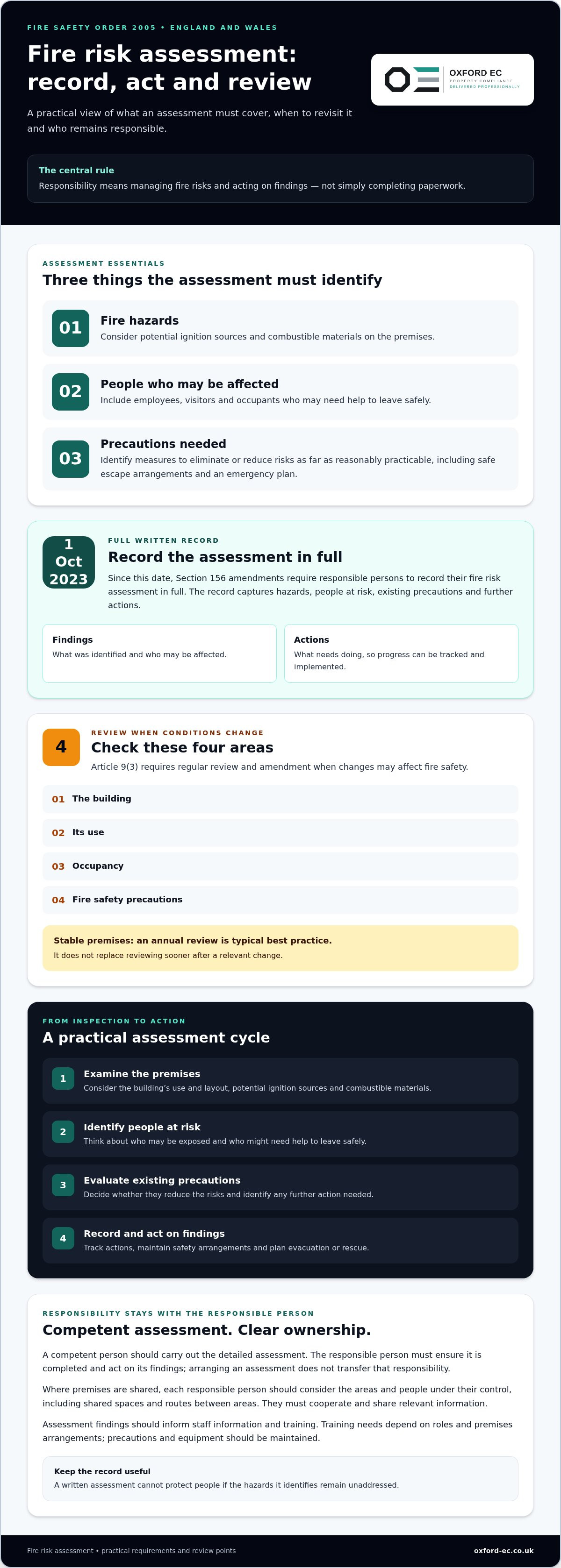
A fire risk assessment identifies hazards, people at risk and precautions needed to reduce fire risk. Under the Fire Safety Order, the responsible person must ensure an assessment is completed and kept under review.
To have fire safety order 2005 explained in practical terms, begin with the assessment: examine the premises, identify who could be harmed, evaluate risks, then record and act on findings. This gives the responsible person a basis for maintaining safety arrangements and planning evacuation or rescue.
Carrying out a fire risk assessment
A fire risk assessment is a structured examination of fire hazards, people who may be exposed and measures to prevent or limit harm. A written assessment alone cannot protect people if the hazards it identifies remain unaddressed.
Begin by examining the premises and identifying potential ignition sources, combustible materials and people who may be especially at risk. Consider employees, visitors and occupants who might need help to leave safely. Then assess whether existing precautions reduce the risks and identify any further action needed.
A competent person should carry out the detailed assessment, taking account of the building’s use and layout. A change in room use, for example, could affect escape arrangements or introduce new hazards. Record the findings and required actions so the responsible person can track and implement them.
Assessment requirements and reviews
The assessment must identify fire hazards, people who may be affected and the precautions needed to eliminate or reduce risks as far as reasonably practicable. Its findings should inform practical controls, including safe escape arrangements and an emergency plan.
Since 1 October 2023, Section 156 amendments require responsible persons to record their fire risk assessment in full. A full record captures identified hazards, people at risk, existing precautions and further actions, helping responsible persons track what needs to be done. For organisations seeking to modernise how they manage these obligations, Be-Safe Technologies Ltd provides guidance on transitioning from traditional paper documentation to digital risk assessment workflows.
Article 9(3) requires the responsible person to review the assessment regularly and amend it when changes may affect fire safety. Review it after changes to the building, its use, occupancy or precautions. For stable premises, an annual review is typical best practice, not a substitute for reviewing sooner after a relevant change.
For managers needing fire safety order 2005 explained against their actual premises, the review process is central: compare current conditions with the assessment, then revise actions where conditions have changed.
Responsible persons and assessments
The responsible person has the duty to ensure the assessment is completed, even when a competent person carries it out. Arranging an assessment does not transfer responsibility for acting on its findings.
Where premises are shared, each responsible person should consider the areas and people under their control, including routes between those areas and shared spaces. They must cooperate and share relevant information. For example, work by a tenant that affects a shared escape route should be communicated to the other responsible persons.
Assessment findings should connect to staff information and training, so people understand relevant fire procedures and their duties. Training needs depend on roles and premises arrangements. Keep the findings under review as circumstances change. Oxford Environmental Consultants’ fire safety services include Fire Risk Assessments, supporting premises where an assessment is needed.
What is the fire safety order (Regulatory Reform (Fire Safety) Order 2005)?
The Order is the main fire safety legislation for applicable premises in England and Wales. Local fire and rescue authorities can inspect premises and require action where fire risks are not adequately managed.
Premises covered by the Order
The Order generally applies to non-domestic premises, workplaces and the common parts of buildings containing two or more domestic premises in England and Wales. Landlords, employers and people managing housing should note that fire safety duties can apply to shared areas even where individual homes are not covered.
For example, a block of flats may have common corridors and stairs covered by the Order, while private dwellings are generally excluded. Premises that accept paying guests can also fall within its scope, even when the owner lives there. Scotland and Northern Ireland have separate fire safety regimes, so the Order does not set their general rules.
Fire authority enforcement
In England and Wales, local fire and rescue authorities enforce the Order through routine, risk-based fire safety audits. An audit may examine whether the responsible person has assessed fire risks and maintained appropriate precautions. The authority’s approach takes account of the premises’ condition and use.
During an inspection, an authority may identify shortcomings and require action under the legislation. Landlords and business operators should be prepared to explain how their fire safety arrangements address the premises and the people who use them. Blocked escape routes or unmanaged fire hazards, for example, may prompt scrutiny of existing precautions and the assessment.
Enforcement and prohibition notices
An enforcement notice specifies fire safety improvements required by the authority and sets a deadline for completing them. It may follow a finding that serious fire risks are not being managed. The responsible person should review each required action, address the identified deficiencies and keep evidence of the work completed.
A prohibition notice is more urgent: it can restrict or prohibit access when the authority considers the risk sufficiently serious. It may take effect immediately, making continued use of the affected premises or area impermissible. An alterations notice may also apply where premises present high safety risks, or would do so if their use changed.
These notices serve different purposes. An enforcement notice requires specified improvements by a deadline; a prohibition notice restricts access in response to a sufficiently serious risk. An alterations notice highlights that proposed changes of use require particular attention to fire safety. Changing a building’s use, for example, may affect its hazards, occupants or escape arrangements.
Non-compliance can have serious legal consequences. According to the UK Government, a breach of the Order can result in up to two years’ imprisonment following conviction on indictment in the Crown Court. The authority’s response depends on the identified breach and risk, so promptly addressing notice requirements is central to restoring compliance and protecting people.
Fire safety responsibilities of the Responsible Person
In England and Wales, fire safety duties fall to the person responsible for applicable premises. The UK Government states that the Fire Safety Order’s definition of “responsible person” is set out in Article 3.
Businesses can organise compliance by identifying who controls each area, assessing fire risks, putting precautions in place, informing staff and coordinating arrangements for shared spaces.
Identifying the responsible person
The responsible person is generally an employer, owner, landlord, occupier or person who controls the premises. The Order places duties on those with practical control, rather than assigning responsibility solely by job title.
In a workplace, an employer may be responsible for fire safety arrangements, while a landlord or building manager may control shared areas. For example, a business may control its unit while another person manages communal corridors. The relevant roles depend on who manages or operates each part of the premises.
In residential buildings, different people may control the dwellings and common parts. Recording who manages each area helps prevent gaps, such as leaving responsibility for a shared exit unassigned. The responsible person can appoint competent people to assist but remains accountable for ensuring the duties are addressed.
Responsible person duties
The responsible person must ensure a suitable fire risk assessment is completed and take appropriate precautions to protect relevant people. The findings must inform real arrangements, not remain in a document without action.
Those arrangements include reducing fire risks, planning for emergencies and providing employees with adequate fire safety information and training. The responsible person must maintain fire safety equipment in good working order and provide appropriate firefighting equipment. Identified defects need attention to ensure precautions remain effective.
The Order also requires competent people to assist with fire safety duties where needed. If the responsible person employs five or more people, they must record the fire safety arrangements. They should ensure employees understand relevant risks and procedures, and consult them on fire safety matters. These duties connect management decisions with everyday workplace practice.
Shared premises and cooperation
Where several responsible persons share premises, each must address risks within their control and cooperate with the others. Coordination matters because one occupier’s decisions can affect another’s safety, especially around shared routes and facilities.
Article 22 concerns cooperation and coordination in shared premises. Responsible persons should exchange information about hazards, precautions and changes affecting common areas. For example, work that obstructs a shared escape route needs coordination between the people managing the affected areas.
In multi-occupied premises, each employer or occupier should assess risks connected with its occupancy and routes to and from its area. Cooperation helps align arrangements, identify conflicting procedures and clarify who maintains shared precautions. A landlord, tenant and building manager may each have relevant responsibilities.
Steps for business compliance
Compliance is an ongoing management process: establish responsibility, assess risk, implement precautions and keep arrangements effective. A defined sequence helps businesses turn legal duties into tasks they can assign and monitor.
- Identify who owns, manages, operates or controls each relevant area.
- Arrange a competent assessment that considers hazards, occupants and escape arrangements.
- Put suitable precautions and emergency arrangements in place, then address identified actions.
- Provide employees with fire safety information, consultation and appropriate training.
- Maintain equipment and coordinate with other responsible persons where areas are shared.
For example, a business moving into premises should clarify who controls its unit and shared routes before setting procedures. Review responsibilities when occupancy, use or management arrangements change. Clear assignment, communication and follow-through help each responsible person understand their role.
General fire precautions, training and maintenance
In England and Wales, general fire precautions connect risk controls with staff readiness and functioning equipment. Article 4 of the Fire Safety Order sets out the meaning of general fire precautions.
These measures work together: staff need clear instructions, equipment needs maintenance and emergency arrangements need practice.
Staff fire safety information and instruction
The responsible person must give employees appropriate fire safety information and consult them on fire safety matters. Clear instructions help employees understand which precautions apply to their work and premises.
Information should explain fire procedures, how to raise the alarm and what to do when it sounds. For example, staff need to know their escape route and assembly point, as set out in the premises’ emergency arrangements. Explain any changes to the layout, work activities or precautions so instructions stay aligned with actual conditions.
Consultation gives employees a way to raise practical concerns, such as an obstructed exit or a change that could affect evacuation. The responsible person can use this feedback to identify issues requiring action. Keep instructions consistent with the fire risk assessment and emergency plan, rather than relying on informal assumptions about how people should respond.
Employee training and duties
Fire safety training helps employees understand relevant hazards, precautions and emergency procedures. Written arrangements are effective only when staff know how to act on them.
Under Article 21(1) and (2), employees must receive adequate fire safety training when they commence employment, with refresher training as appropriate. Induction should cover general fire awareness and the actions staff need to take during an alarm. Refresher or additional training is appropriate when operational changes increase fire risk.
Training should reflect each person’s duties. Employees working in areas with particular hazards need instruction relevant to that environment, while staff expected to assist with evacuation need to understand their assigned roles. Record training and update it when procedures change. A new shift pattern, for example, may mean different employees need to understand the same emergency arrangements.
Fire safety staff roles
People assigned fire safety duties need training suited to their tasks. Fire wardens and those supporting assessments need role-specific knowledge, not just general awareness.
Fire wardens should understand relevant procedures, including how to support evacuation and communicate concerns. People conducting fire risk assessments need suitable competence to identify hazards and consider who could be harmed. Training should also help responsible persons understand fire safety law and their ongoing duties.
Equipment maintenance is another essential control. Suggested routine checks include testing fire alarm systems at least weekly, testing emergency lighting monthly and servicing it annually. Fire drills are advised quarterly, and extinguishers should be serviced annually. These are operational recommendations, not intervals set by the Order for every premises. Keep records of checks, servicing and defects, then arrange corrective action so faults do not undermine fire precautions.
The Regulatory Reform (Fire Safety) Order 2005
The Regulatory Reform (Fire Safety) Order 2005 sets fire safety duties for relevant premises in England and Wales. Its central principle is practical: the person responsible must assess fire risk and maintain suitable precautions.
The Order came into force on 1 October 2006 and was made under the Regulatory Reform Act 2001. It is a statutory instrument identified as 2005 No. 1541. These details matter because the Order is legislation, not simply a recommended fire safety standard. The responsible person must translate its requirements into controls suited to the premises, the people using them and the activities taking place there.
The Order covers workplaces and the common parts of buildings containing two or more domestic premises. A shared stairwell in a block of flats is one example. Residents’ individual homes are generally treated differently from shared corridors, entrances and other common areas. This distinction helps landlords and building managers identify which parts need arrangements under the Order, while recognising that other legal duties may apply to domestic areas.
The Fire Safety Act 2021 clarified how the Order applies to certain residential buildings. According to the UK Government, it covers external walls and flat entrance doors in buildings with two or more sets of domestic premises. External walls include features such as cladding, balconies and windows in common areas. For a responsible person, this means considering relevant building features, not only internal rooms and escape routes.
This distinction does not remove the need to assess the actual premises. Changes to a building’s use, layout or features can affect hazards and the precautions needed. Alterations near a shared escape route, for instance, may change how people reach safety. The Order requires precautions to reflect the building’s actual conditions and use, not a generic checklist.
The Order also operates alongside other fire safety legislation. The Fire Safety (England) Regulations 2022 introduced additional duties for responsible persons under the Order. Scotland and Northern Ireland have separate fire safety regimes, so the 2005 Order is not the general framework for those nations. Businesses operating across borders need to distinguish the relevant legal regime for each premises.
In practice, map the building, identify which areas and features fall within scope, then align the assessment and precautions accordingly. Record how shared areas, external walls and relevant doors are managed. This helps enforcement authorities examine whether fire safety measures reflect the building’s actual risks.
Oxford Environmental Consultants (OEC): Asbestos Management Surveys
Oxford Environmental Consultants (OEC) provides Fire Risk Assessments to support premises’ fire safety arrangements. This can be a practical next step when the responsible person needs a clear assessment of fire risks and actions to inform ongoing management.
For other property compliance needs, OEC also provides Asbestos Management Surveys, Legionella Risk Assessments and Damp & Mould Surveys. An asbestos management survey can inform how asbestos is managed in a building, while a fire assessment addresses fire hazards and precautions. Each assessment focuses on its own distinct risks.
Contact Oxford Environmental Consultants to discuss your property compliance requirements.
Make fire safety part of everyday decisions
With the Fire Safety Order 2005 explained in context, the next step is to embed fire safety ownership into routine business decisions. A sound arrangement should remain connected to how people use and manage the premises, rather than sitting apart from operational planning.
Build fire safety into internal handovers, project planning and management reviews. When a decision could affect building use or safety arrangements, assign someone to consider the implications and communicate necessary updates to those affected. This helps keep responsibilities visible as work and management arrangements evolve.
Oxford Environmental Consultants (OEC) supports organisations with property compliance. To discuss your requirements, get in touch using the contact option below.
A clear next step can make ongoing fire safety management more deliberate, consistent and easier to sustain.
Frequently Asked Questions
What are your responsibilities?
Your responsibilities depend on your control of the premises and the activities taking place there. As the responsible person, make sure fire safety arrangements are assigned, understood and maintained, rather than treated as a one-off task. For example, a manager taking over a workplace should establish who handles outstanding actions and how staff receive updated instructions. Maintain clear oversight, even when others help with specific tasks.
Where will I find guidance about the required standards for my building?
Use fire safety guidance relevant to your building type, because the appropriate recommendations depend largely on the premises. Guidance published under Article 50 of the Fire Safety Order is intended to help responsible persons meet their duties. GOV.UK fire safety guides are non-statutory and include best-practice recommendations, which may go beyond the Order’s scope. Compare the guidance with your building’s use, layout and occupants when interpreting practical measures.
What about if I share the premises with other businesses or individuals?
Agree how you will coordinate fire safety arrangements with other responsible persons. Share changes that could affect others, such as work near a common corridor or a revised emergency procedure. Set out who communicates with staff, manages shared areas and escalates concerns. In a multi-tenant building, clear coordination helps prevent separate procedures from conflicting during an evacuation.
What are the penalties for non-compliance?
Penalties can include prosecution and imprisonment. According to the UK Government, breaching the Fire Safety Order can result in up to two years’ imprisonment following conviction on indictment in the Crown Court. A fire and rescue authority may also serve a notice requiring specified improvements. If you receive a fire safety notice, an appeal may be made to the local magistrates’ court within 21 days of receiving it.
What are the rules?
The Regulatory Reform (Fire Safety) Order 2005 is the principal fire safety framework for relevant premises in England and Wales. It covers workplaces and shared parts of buildings containing two or more domestic premises, rather than generally regulating individual homes. The Fire Safety Act 2021 clarified its application to external walls and flat entrance doors in buildings with two or more sets of domestic premises. Scotland and Northern Ireland operate separate fire safety regimes.
What does ‘adequate fire safety training’ mean?
Adequate training gives employees the knowledge they need for their work and the premises’ emergency arrangements. It should cover relevant fire hazards, how to raise the alarm, escape procedures and each employee’s assigned responsibilities. New employees need training when they commence employment, with refresher training as appropriate. Staff given evacuation duties, for example, need instruction suited to those duties, not only general fire awareness.
What happens if you aren't compliant?
A fire and rescue authority can inspect premises and take enforcement action if it finds fire safety duties are not being met. An enforcement notice specifies improvements and sets a deadline; a prohibition notice can restrict access where the authority considers the risk sufficiently serious. Treat any notice as a formal direction: identify each required action, assign responsibility and record the work completed.
What if my premises has a new extension or other planned alteration?
Plan fire safety into the design of an extension or alteration, rather than assessing it only after work finishes. Planned building work to existing business premises should comply with building regulations, including fire safety. Consider how the proposal could affect escape routes, compartmentation and the existing arrangements for occupants. Construction (Design and Management) Regulations 2015 may also apply to construction sites, alongside the Fire Safety Order.