

A compliant property portfolio cannot be managed with one checklist applied to every address. To understand how to ensure a property portfolio is compliant, map the legal, safety and documentation requirements for each property, then track inspections, certificates, licences and review dates in one consistent system. Requirements vary, so portfolio-wide oversight must preserve property-level detail.
A shared calendar and a folder of certificates may seem sufficient, but reliable oversight also depends on knowing which obligations apply at each address, keeping evidence accessible and acting when a document expires or a property’s condition changes.
This guide explains the responsibilities involved, landlord and tenant requirements, statutory documents to track, and practical ways to organise records across multiple properties. It also shows how property-specific assessments can identify issues that need attention, helping you manage the portfolio with greater clarity and control.
Key Takeaways
- Build a property-by-property compliance register, since requirements can vary by address, use and building characteristics.
- Map each property’s safety, licensing and energy obligations to the documents and actions needed to evidence them.
- Keep records in a structured, accessible system, with clear ownership of actions and a reliable backup.
- Schedule regular portfolio reviews to identify overdue documents, recurring maintenance issues and upcoming requirements.
- Reassess compliance when a property is acquired, its use changes or local rules apply, rather than relying on one portfolio-wide checklist.
Table of Contents
- 1. Property management companies’ compliance responsibilities
- 2. What Is Portfolio Compliance?
- 3. Landlord-tenant regulations and statutory documentation
- 4. Ongoing portfolio reviews and record-keeping
- 5. Compliance monitoring across multiple properties
- Oxford Environmental Consultants (OEC): Asbestos Management Surveys
1. Property management companies’ compliance responsibilities
Property managers coordinate legal and regulatory compliance, safety standards and statutory documents across rental properties. Their responsibilities include identifying requirements for each address, assigning actions and retaining evidence of completion. Start with a property-level register covering building use, known hazards, inspections, certificates and outstanding work. This gives managers a clear view of each asset instead of assuming one checklist suits the entire portfolio.
Scale makes that distinction essential. A housing provider managing 10,000 properties may need oversight across several compliance disciplines at once, while each property retains its own condition and requirements. Grouping records only by service or inspection date can obscure which address needs action. Assign each record a unique property reference, responsible person, due date and status. Then managers can identify overdue work and distinguish a portfolio-wide issue from a defect affecting one building.
Facilities managers also need visibility of the compliance evidence behind planned and completed work. For each task, record the property, relevant asset or location, assessment findings, action owner and completion evidence. A fire-safety action, for example, should be traceable to the building and area, rather than buried as an unallocated task in a general maintenance log. This structure supports clear reporting, follow-up on open actions and effective handovers to colleagues responsible for contractors or resident communication.
Stock condition information supports decisions beyond immediate repairs. Government stock condition modelling considers Decent Homes compliance, Category 1 HHSRS hazards and damp. Property teams can use survey findings to compare recorded condition with maintenance history, identify recurring failures and prioritise investigation. For example, repeated reports of damp in one block should prompt review of that property’s condition data and completed remedial work. Accurate records help distinguish a resolved issue from one that requires further attention.
Centralised compliance management brings property registers, inspection reports and action logs together in an accessible system. Give every record a named owner and clear status, such as scheduled, in progress or completed. Managers can then filter by property, requirement or upcoming review date. Back up the system and update records consistently when work is finished. Reports should show both the evidence held and actions still open, not just completed certificates.
Energy standards are also part of asset oversight. The UK Government identifies an EPC rating of E as the current Minimum Energy Efficiency Standards threshold for the properties discussed. Record each property’s certificate and rating, then flag assets that need review. Linking this information with stock condition findings helps teams plan maintenance and energy improvements together, rather than treating inspections, repairs and compliance records as separate tasks.
2. What Is Portfolio Compliance?
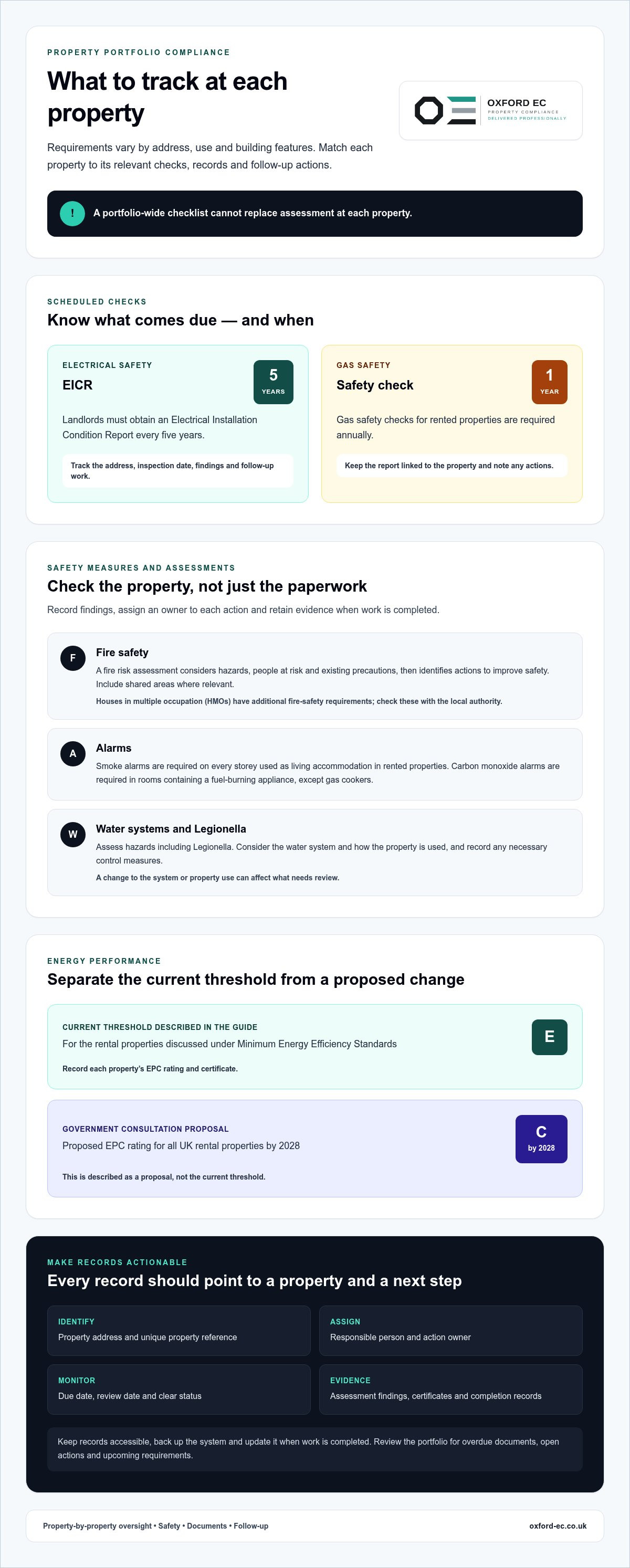
Portfolio compliance means meeting the legal, regulatory and safety requirements that apply to each property. A rental flat, shared house and building with communal areas may have different obligations. Record each property’s use, location, occupants and relevant building features, then match those details to applicable inspections, documents and safety measures. A portfolio-wide checklist cannot replace assessment at each property.
Fire safety is a key part of that assessment. The Regulatory Reform (Fire Safety) Order 2005 is a key piece of UK guidance for landlords, according to The National Archives. A fire risk assessment considers hazards, people at risk and existing precautions, then identifies actions for improving safety. Record the findings and assign each action to a responsible person. For a building with shared areas, include those spaces in the review.
Houses in multiple occupation (HMOs) have additional fire-safety requirements, which landlords can check with their local authority. Requirements may also depend on a building’s layout and use. Consider a fire alarm system, escape route or fire door in context, rather than as an isolated item. If an assessment identifies a gap, record the required repair or action, its owner and the completion evidence.
Core safety records should be tracked against the property they cover. UK Government says landlords must obtain an Electrical Installation Condition Report (EICR) every five years. Gas safety checks for rented properties are required annually. Keep each report with its address, inspection date, findings and follow-up work. Smoke alarms are required on every storey used as living accommodation in rented properties. Carbon monoxide alarms must be installed in rooms containing a fuel-burning appliance, except gas cookers.
Water systems also need property-specific attention. Landlords are required to assess hazards including Legionella. The assessment should consider the water system and how the property is used, with any necessary control measures recorded. A change to the system or property use can affect what needs review. Track findings and actions alongside other safety documents, rather than leaving them in a disconnected file.
For rental properties discussed under Minimum Energy Efficiency Standards, the current threshold is an EPC rating of E, according to the UK Government. A government consultation proposed requiring all UK rental properties to achieve EPC C by 2028. Record each property’s EPC rating and use it when reviewing planned repairs and energy improvements.
Where fire-safety records identify unresolved hazards, a fire risk assessment can clarify the findings and actions needed. Discuss your property compliance requirements to establish a suitable next step.
3. Landlord-tenant regulations and statutory documentation
Landlords need records that cover both the condition of a home and the tenancy itself. The Homes (Fitness for Human Habitation) Act 2018 covers aspects of a home including its structural integrity, heating and plumbing, according to The National Archives. Keep inspection findings and repair records together so problems can be traced from report to completed work. A clear file also helps show how issues affecting a tenant were handled.
Licensing depends on the property and its location. Depending on the relevant requirements, a property may be subject to HMO, mandatory or selective licensing rules. Schemes can vary between local authorities and change over time. To establish what applies, identify the council responsible for the property, check its licensing scheme and record the licence conditions and renewal dates. Also consider whether local rules, such as Article 4 directives, affect the property.
Tenant checks and tenancy documents need a consistent process. Landlords are legally required to check tenants’ rights to live in the country. Keep evidence of Right to Rent checks with the relevant tenancy record, along with clear documentation that the check was completed. Protect tenancy deposits and record the protection details. When acquiring a property in a new area, review local licensing requirements before letting it instead of relying on procedures used elsewhere.
Non-compliance can result in legal consequences, financial penalties and reputational damage. Serious failures may also expose property owners and company directors to imprisonment. Consequences depend on the obligation breached and the circumstances, so retain evidence of actions taken, correspondence and completed repairs. A property file should make it easy to see which requirement applied and how the landlord responded.
Geographic and tenant-profile diversification can broaden a portfolio, but it also increases the range of local requirements and tenancy needs to manage. Record each property’s council area, applicable scheme and tenant documentation separately. Reputation is shaped by practical matters, including responding to repair reports and keeping homes suitable for occupation. Consistent handling across properties supports tenant confidence and can help landlords retain tenants between tenancy periods.
Void periods also affect portfolio planning. The average void period across UK rental properties is reported as two to three weeks. Local demand, property condition and the time needed for repairs can influence how quickly a home is ready for a new tenant. Track vacancy dates alongside maintenance and licensing actions to identify preventable delays and inform decisions about future acquisitions.
4. Ongoing portfolio reviews and record-keeping
Schedule a comprehensive property portfolio audit annually, then use its findings to update each property’s compliance records. Compare the documents held against the property’s actual condition and any open actions. The Safety and Quality Standard places greater focus on accurate property-level information based on physical assessment. Inspection evidence matters: records should reflect the building, not simply repeat an earlier entry. Assign each review a named owner and record the date, findings and follow-up actions.
Keep a central record for each address, using consistent fields for assessments, certificates, defects, completed work and review dates. Add the document date, property reference, responsible person and next action where relevant. This makes it easier to distinguish current evidence from superseded reports. A structured system also helps managers identify portfolio-wide gaps without losing the detail needed to act at an individual property.
Digital records should trace each finding through to resolution. Store the assessment, action allocation, work record and completion evidence together. If an inspection identifies a defect, for example, log its location, required action, owner and status, then attach evidence when the work is complete. This creates a traceable record for internal reviews and external auditors. Keep notes factual and dated so another manager can understand the decision and progress without relying on informal updates.
Back up the central system and control access by role. Property teams may need to update actions, while senior managers may need portfolio-level reports. Set permissions so staff can find relevant records without altering evidence outside their remit. Cloud storage can keep portfolio information accessible if a computer breaks or an office floods. A separate backup adds resilience if the main system becomes inaccessible, while routine access reviews help remove unnecessary permissions.
Reminders turn records into proactive management. Set calendar prompts for each review date and route them to the person responsible for arranging the assessment or action. When responsibility for a property changes internally, transfer open tasks with the records, not just the documents. Review overdue actions at regular management meetings and record the decision, revised task owner and next step. This keeps unresolved items visible when staff responsibilities change.
Managers asking how to ensure a property portfolio is compliant can use audit findings to spot patterns as well as individual omissions. Compare recurring defects, delayed actions and repeated recommendations across properties. If the same issue appears at several addresses, investigate whether it reflects a shared building type, maintenance process or record-keeping gap. Record the decision and any portfolio-wide action in the audit trail.
To ensure a property portfolio is compliant, maintain a clear review cycle, dependable records and assigned actions. These controls support consistent oversight across multiple properties.
5. Compliance monitoring across multiple properties
Monitoring works best when portfolio-level oversight highlights exceptions without obscuring differences between properties. Review each property’s status regularly, then filter for overdue actions, missing evidence and upcoming assessments. A dashboard should show the address, requirement, responsible person and current action. This helps managers identify where intervention is needed, particularly when properties fall under different local authorities.
Use location as a monitoring category, not merely an address field. Landlords may need to monitor Article 4 directives in areas where they own property. Record the relevant council area and any applicable directive against each property. When adding an asset in a new area, include a local-rule review in the acquisition process. This prevents an existing property’s compliance assumptions being applied automatically to another location.
Build an exception process that prompts action, rather than producing reports no one uses. For each flagged item, identify the decision-maker, next step and evidence needed to close it. Keep a property with an unresolved inspection recommendation visible until the action is completed and recorded. Review open items at management meetings and escalate those affecting safety, occupation or planned repairs. Document decisions so responsibility remains clear when staff change.
Compare similar properties to reveal patterns, while tailoring the response to each building. For example, recurring damp reports in one property type may warrant a review of condition data, maintenance history and inspection findings. Where indoor-air concerns need investigation, mould spore air monitoring can provide relevant evidence. Link findings to the affected property and resulting action, rather than treating a portfolio trend as proof that every address has the same issue.
Monitoring should connect compliance decisions with asset planning and rental income. Review maintenance trends to identify components that repeatedly fail or need replacement, then plan work before urgent repairs disrupt occupancy. Where significant upgrades or building remediation are required across a portfolio, engaging dedicated construction expertise—such as that offered by PK Services—helps ensure complex works are executed to the highest quality standards. Track property performance metrics quarterly. Use results to identify assets that need investigation, not to postpone safety work because income or performance appears strong. Keep compliance actions distinct from investment decisions in the records.
Test the monitoring process with sample checks. Select properties across different locations, building types and tenancy arrangements, then trace each requirement from its record to supporting evidence and follow-up. Log gaps, assign corrective actions and assess whether the same failure affects other properties. This shows whether reports reflect actual conditions, rather than simply confirming completed fields. For managers asking “how to ensure a property portfolio is compliant”, this test checks whether oversight works in practice.
Revisit how to ensure a property portfolio is compliant whenever a new property, changed use or recurring issue alters the monitoring picture. Update the relevant records and actions so oversight reflects current property conditions.
Oxford Environmental Consultants (OEC): Asbestos Management Surveys
Oxford Environmental Consultants (OEC) provides Asbestos Management Surveys to help property owners understand asbestos-related information across their buildings. A survey is relevant when managing a property where asbestos-containing materials may be present, and its findings can inform records and ongoing management decisions. In a portfolio, link each survey to the correct address and use its findings to guide relevant actions, rather than applying information from one property to others.
For other property concerns, OEC also offers Legionella Risk Assessments, Damp & Mould Surveys and Fire Door Inspections. Each addresses a distinct area of property safety or condition, helping teams direct issues to the appropriate assessment.
Contact Oxford Environmental Consultants (OEC) to discuss your property portfolio requirements.
Turn compliance findings into your next actions
Your next step is to turn outstanding findings into a prioritised work plan. Identify decisions needing management attention, assign responsibility and set a review point for each action. This helps you see how to ensure your property portfolio is compliant as buildings, occupancy and operational needs change. Keep the plan practical: distinguish urgent risks from routine follow-up and record the evidence needed to close each item.
Where specialist assessment is needed, Oxford Environmental Consultants (OEC) offers Asbestos Management Surveys, Fire Risk Assessments and Legionella Risk Assessments. These services support investigations into specific property risks and provide findings for compliance records. Match the assessment to the issue, then incorporate its recommendations into the relevant property action plan.
A disciplined process turns separate compliance documents into accountable decisions. Start with the next unresolved property action and build from there.
Frequently Asked Questions
What Is Portfolio Compliance?
Portfolio compliance means keeping each property aligned with the requirements that apply to its location, use and condition. For example, two flats managed by the same landlord may have different licensing conditions or building features that affect their safety actions. Treat the portfolio as one oversight system, but assess and document compliance property by property. This helps prevent a valid document for one address being mistakenly relied on for another.
What legal and safety checks must UK landlords complete for each rental property?
Landlords should establish each property’s applicable safety, licensing and tenancy obligations, then maintain evidence for them. This includes checking whether local licensing applies, arranging gas and electrical safety checks, assessing relevant hazards such as Legionella, and ensuring required alarms are installed. They must also carry out Right to Rent checks, protect tenancy deposits and hold an Energy Performance Certificate for each property. The register should reflect the property’s use and local rules.
What certificates and inspections are required for UK rental properties, and how often?
Frequency depends on the document and the property requirement. The UK Government states that landlords must obtain an Electrical Installation Condition Report every five years, while gas safety checks are required annually. Landlords should keep relevant safety records current. Record inspection dates, findings and follow-up work against the correct address. Manage other assessment timings according to the applicable duty and any findings that require action.
What are the current UK rules for gas, electrical, fire and carbon monoxide safety in rented homes?
Landlords must arrange gas safety checks annually and obtain an Electrical Installation Condition Report every five years, according to the stated UK requirements. Smoke alarms are required on every storey used as living accommodation in rented properties. Carbon monoxide alarms must be installed in rooms containing a fuel-burning appliance, except gas cookers. Fire precautions should reflect the building’s risks. HMOs have additional fire-safety requirements that landlords can check with their local authority.
How can landlords audit and manage compliance across a property portfolio?
Use a property-by-property audit trail: select an address, compare its recorded obligations with the available evidence, and trace open findings through to completed actions. Schedule comprehensive portfolio audits annually, then use exceptions to direct attention between reviews. For example, filter records for missing reports, overdue tasks or repeated defects, assign an owner and document the resolution. Keep the system accessible to relevant staff and maintain a backup, so evidence remains usable during staff changes or external scrutiny.
What are the penalties for landlord non-compliance in the UK?
Non-compliance can lead to legal consequences, financial penalties and reputational damage. Serious failures may expose property owners and company directors to imprisonment. Consequences depend on the obligation breached and the circumstances.
Which local council rules and licensing requirements apply to a specific UK property?
Requirements vary by property and location. Identify the responsible council, check its licensing scheme and any applicable HMO, mandatory or selective licensing rules, and record licence conditions and renewal dates; also check whether local rules such as Article 4 directives apply.