

Water safety belongs at the centre of workplace compliance, not at the edges. In the UK, businesses with 5 employees or more require a competent person for health and safety. Integrated safety and compliance solutions in the UK can bring audits, documentation, regulatory updates and water risk management into a more coherent process.
It’s understandable to want clear evidence that responsibilities are being managed, especially when legal duties touch different parts of a building and its operation. This article explains how health and safety audits support compliance with the Health and Safety at Work Act 1974, what records and updates help keep arrangements organised, and why Legionella risk management deserves specific attention.
You’ll also learn how assessments identify risks, inform proportionate actions and support ongoing oversight of workplace and building safety. The focus is practical: understand what needs attention, establish the relevant evidence and see how specialist support fits into a structured compliance approach.
Key Takeaways
- Use audits to identify gaps between workplace risks, existing controls and the evidence needed to demonstrate compliance.
- Businesses with 5 employees or more require a competent person for health and safety; define responsibilities and make them clear in practice.
- Keep risk assessments, actions and review records organised so they can support consistent decision-making and scrutiny.
- Track regulatory and standards updates, then assess whether they affect your procedures, documentation or site-specific risks.
- Bring fragmented safety records into a clearer system, with particular attention to water risks such as Legionella.
Table of Contents
- Health and safety compliance and legal audits
- Compliance with the Health and Safety at Work Act 1974
- Compliance documentation and British Standards
- Compliance updates
- What are the risks of using disconnected safety and compliance systems?
- Oxford Environmental Consultants (OEC): Asbestos Management Surveys
Health and safety compliance and legal audits
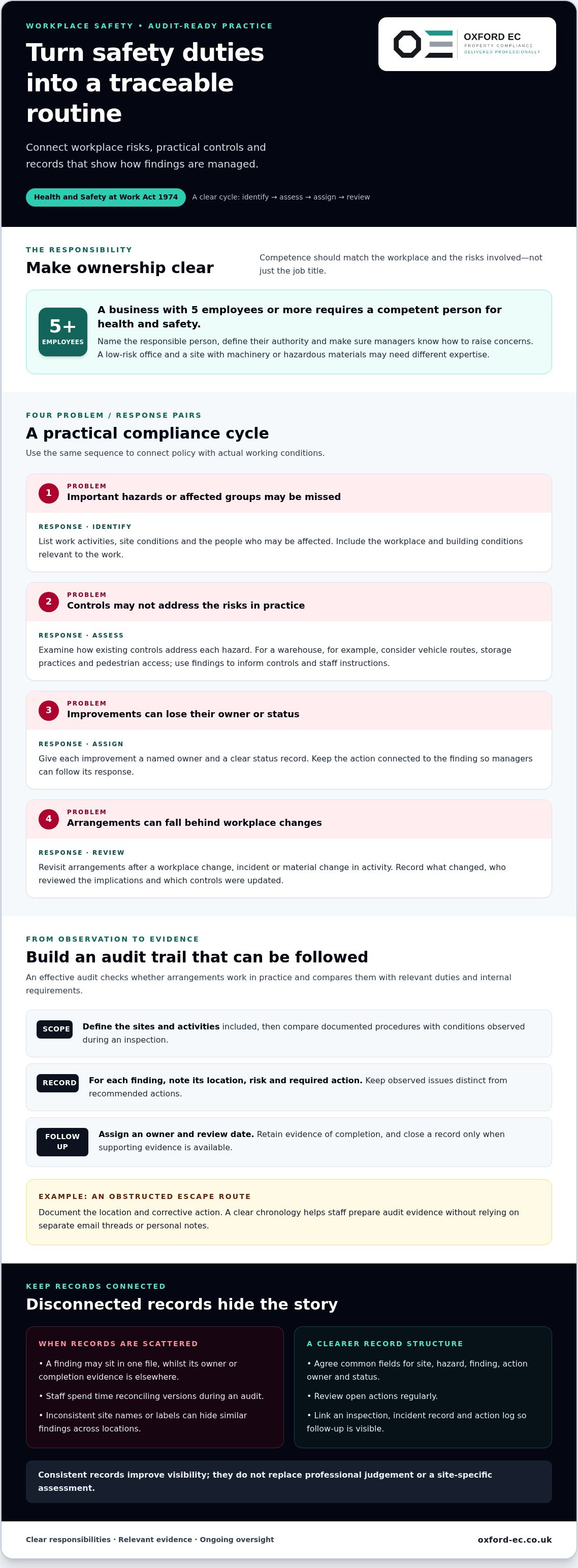
A useful audit connects workplace hazards, technical controls and records showing how risks are managed. Define the sites and activities in scope, then compare documented procedures with conditions observed during an inspection.
Health and safety audit processes
A health and safety audit examines whether an organisation’s arrangements work in practice. A compliance audit also compares them with relevant regulatory duties and internal requirements. Review the scope, evidence and findings. A report should distinguish observed issues from recommended actions.
For example, an audit at a site with offices and plant rooms might review access routes, maintenance records and staff procedures. Record each finding with its location, risk and required action. Assign an owner and review date, then retain evidence of completion. This creates a traceable process, not just a list of observations.
Supporting UK inspections and incident reporting
Integrated solutions support UK audits, inspections and incident reporting by linking records, findings and follow-up actions in a consistent process. An inspection can identify an issue, an incident record can capture what happened, and an action log can track the response. Together, these records help managers see whether hazards recur across locations or activities.
Use a standard reporting sequence: record the date and location, describe the event or observed condition, note immediate controls and assign follow-up. If an inspection finds an obstructed escape route, for instance, document its location and the corrective action. A clear chronology helps staff prepare audit evidence without relying on separate email threads or personal notes.
Inspection planning should also reflect the building’s systems and physical condition. Fire door inspections, for example, generate findings that can be recorded by door location and followed through to completion. A consistent record structure makes it easier to assemble relevant evidence during a site review. Information on compliance services relates to this wider coordination of safety requirements.
Risks of disconnected systems
Separate spreadsheets, paper forms and email records can break the link between an inspection and corrective action. A finding may be in one file, while its owner or completion evidence is elsewhere. During an audit, staff then spend time reconciling versions instead of presenting a clear account of the issue and response.
Disconnected systems can also hide patterns. If similar findings occur at several sites, inconsistent labels or location names may prevent managers from recognising the connection. Agree on common fields for site, hazard, finding, action owner and status. Review open actions regularly, and close a record only when supporting evidence is available. This improves visibility without replacing professional judgement or site-specific assessment.
Compliance with the Health and Safety at Work Act 1974
The Health and Safety at Work Act 1974 provides a central framework for workplace health and safety. For practical compliance, translate responsibilities into clear arrangements that reflect the work, people and environments involved.
A business with 5 employees or more requires a competent person for health and safety. That person helps the business identify relevant risks and organise suitable management arrangements. Competence should match the workplace: a low-risk office and a site with machinery or hazardous materials may need different expertise. Name the responsible person, define their authority and ensure managers know how to raise concerns.
Turn the general duty to manage safety into a repeatable workplace process. For each activity, record the hazard, who could be affected, existing controls and any further action. A warehouse review, for example, might consider vehicle routes, storage practices and pedestrian access. Use the findings to inform practical controls, staff instructions and follow-up, rather than leaving them in a document detached from daily operations.
A clear compliance routine can be organised around four actions:
- Identify: list work activities, site conditions and groups who may be affected.
- Assess: examine how existing controls address the hazards identified.
- Assign: give each improvement a named owner and a clear record of its status.
- Review: revisit arrangements after a workplace change, incident or material change in activity.
These steps connect policy with actual working conditions. A process change, for instance, can affect access, equipment use or who is exposed to a hazard. Record what changed, who reviewed the implications and which controls were updated. This gives managers a coherent basis for decisions and helps staff follow current procedures rather than outdated instructions or informal handovers.
Specialist input is useful when workplace or building-related risks require focused assessment. Let the hazard guide the decision: identify the expertise needed, define the assessment scope and record how recommendations relate to existing controls. Keep evidence proportionate and relevant, including the assessment, actions taken and reasons for any outstanding work. This provides a practical account of risk management without treating paperwork alone as proof of safe conditions.
For organisations coordinating several compliance requirements, compliance services can support a more structured approach to responsibilities and evidence. Start by mapping the workplace activities, existing controls and unresolved actions. That review helps establish where specialist assessment can add value and where managers need clearer ownership or follow-through.
Compliance documentation and British Standards
Compliance documentation should show what was assessed, which controls were selected and how actions progressed. British Standards can provide technical reference points for specific activities, but a document’s value depends on how it relates to the building, equipment and work being managed. Keep its purpose and scope clear.
Begin with a controlled record structure. Give each document a title, site or system reference, owner, review status and revision date. Link risk assessments to relevant procedures, inspection results and remedial actions. For example, a finding about a building system should connect to its location, the assessment that identified it and the follow-up record. This makes evidence easier to retrieve and interpret.
Useful records often include:
- Assessment documents: scope, observations, relevant hazards and recommended controls.
- Action records: the task, responsible role, progress and evidence of completion.
- Technical records: equipment details, inspection findings, maintenance activity and installation information.
- Review history: the reason for an update and the changes made to the current version.
For British Standards, identify the technical reference informing the work and record how it was applied. A standard’s name alone is not evidence. A useful file explains the relevant requirement, the system or task in scope, and the inspection or maintenance evidence supporting the approach. If a competent specialist partner provides technical advice, record that advice and the decisions that follow.
Fire alarm installation, maintenance and servicing show why records need to connect. Keep system information alongside installation details, service findings and outstanding actions. If a maintenance visit identifies a fault, record its location, reported condition and the action taken. The next reviewer can then follow the technical history without relying on an isolated certificate or informal handover.
Apply document control consistently. Mark superseded versions clearly, limit editing to appropriate roles and make current procedures accessible to the people who use them. When a site layout or system changes, identify and update all affected records together. This helps prevent a current assessment from being paired with an obsolete plan or maintenance instruction.
For fire-related records, organise evidence around the specific system and task, rather than filing every document under a broad safety label. A structured approach to fire safety documentation can help connect technical records with inspection and maintenance activity. Review the file as a set: scope, findings, assigned actions and completion evidence should tell a coherent account.
Compliance updates
A compliance update matters when it changes how a business assesses or controls a workplace risk. Use a defined review process: identify the update, assess which sites or activities it affects, assign an owner, then revise relevant procedures and records. At commercial premises, a change affecting building systems may call for a different response from one affecting staff instructions.
Turn updates into controlled actions
Maintain a dedicated register for regulatory and technical changes. Record the source, subject, review date, affected business areas and decision. If a change does not affect a particular site, document why. If it does, name the action owner and track the revised assessment, procedure or maintenance record through to completion.
If revised technical guidance affects a building system, for example, the responsible manager can identify relevant sites, consult a competent specialist and record the resulting decision. This ties the response to the specific system instead of prompting an unsupported organisation-wide change. A review trail also shows who assessed the update and which documents changed.
A practical update workflow can follow four stages:
- Capture: log the update and its source in the register.
- Screen: identify affected locations, activities, equipment and teams.
- Assess: compare current arrangements with the relevant change.
- Implement: assign actions, revise records and communicate changes to affected staff.
Apply the same workflow across UK locations without assuming every building has identical risks. A shared register helps managers compare decisions while preserving site-specific context. An update relevant to one site’s equipment, for instance, may not apply to another with different systems. Record the local rationale, then make any required procedure or training changes clear to the people doing the work.
Set review triggers and ownership
Calendar reviews alone can miss changes prompted by an incident, refurbishment or new equipment. Define these events as review triggers and assign a responsible role for each compliance area. When a trigger occurs, review affected assessments, operating procedures and technical records together. This creates a direct link between the change and the documents and controls staff use.
Close an update only after revised records are accessible and relevant people have received the new instructions. For a procedure change, record its version and explain what staff must do differently. Keep superseded documents identifiable so managers can distinguish current controls from historical material. A consistent update cycle makes regulatory change management traceable, specific and actionable.
What are the risks of using disconnected safety and compliance systems?
Separate systems can break the link between a safety finding and the action intended to address it. An inspection report might identify a defect, a spreadsheet hold the action owner, and an email record the repair. Staff then have to reconcile three records to establish the current position.
Conflicting records and missed actions
Different procedure versions can circulate when teams store files locally. One department may follow a revised instruction while another relies on an older copy. Set one controlled location for current documents, assign an owner and mark superseded versions clearly. This gives staff a single record to use and managers a defined route for approving changes.
Action tracking can also fail during handover. A manager may leave, work may be completed, or an inspection may generate follow-up without anyone updating the central record. Give each action a named owner, status and completion evidence. A closed maintenance task, for instance, should link to the finding and the record of work carried out.
Weak visibility across sites and risks
Disconnected records make it harder to compare similar findings across buildings. If one site labels an issue “access” and another calls it “escape route”, a combined report may miss the common concern. Use consistent categories for hazards, locations and actions. Managers can then identify recurring themes and focus on the controls or sites needing review.
Fragmentation can also distort priorities. A spreadsheet might show an action as complete while an inspection file still records the original defect. Before reporting status, compare the finding, assigned action and closure evidence. If records conflict, keep the issue open until the documented position is resolved. This prevents a summary dashboard from appearing more complete than its underlying evidence.
Incident records without a clear timeline
Incident reporting is less useful when accounts, photographs and follow-up actions are stored separately. A clear chronology connects the event, location, immediate response, investigation findings and later control changes. For example, records of a recurring equipment fault should show whether earlier reports led to inspection or maintenance, not just list unlinked entries.
To improve coordination, map where each record is created, who maintains it and which other records depend on it. Standardise shared fields such as site, system, finding, action owner and status. Then review a sample file from initial observation through closure. This practical test exposes gaps before managers rely on the system in an audit or operational review.
Oxford Environmental Consultants (OEC): Asbestos Management Surveys
Oxford Environmental Consultants (OEC) carries out Asbestos Management Surveys to help businesses identify and manage asbestos-containing materials in buildings. Arrange a survey when you need a clearer understanding of asbestos risks during a property’s normal occupation and use. The findings can inform a management plan and provide site-specific evidence for ongoing decisions.
When planned building work may disturb materials, a management survey may not be the right assessment. OEC also provides asbestos refurbishment and demolition surveys, alongside asbestos consultancy services. Other relevant assessments include Legionella Risk Assessments, Damp & Mould Surveys and Fire Door Inspections, each addressing distinct building safety concerns.
Review the survey scope and findings alongside your existing property records, then use the recommendations to guide management actions. Explore asbestos survey services or contact Oxford Environmental Consultants (OEC) to discuss your property’s requirements.
Make your next compliance decision count
Turn your compliance priorities into a defined work plan. Identify which site, system or assessment needs attention first, then set out the evidence and decisions your team needs. This ties the next action to a practical operational need, rather than adding paperwork without a clear purpose.
For organisations seeking integrated safety and compliance solutions UK businesses can use, Oxford Environmental Consultants (OEC) provides Asbestos Management Surveys, Fire Risk Assessments and Legionella Risk Assessments. These services address distinct building and workplace risks, helping you focus specialist assessment on the needs of your premises and responsibilities.
Start with the issue that needs clarification, whether it concerns asbestos records, fire risks or water management. A well-defined scope gives the discussion a clear starting point and helps connect assessment findings with your existing compliance arrangements.
Take the next step with a clear priority and a more organised path forward.
Frequently Asked Questions
What are integrated safety and compliance solutions in the UK?
OEC coordinates relevant assessments, technical services and compliance records around a business’s buildings and activities. The aim is to make responsibilities and findings easier to manage across different risk areas, rather than treating every assessment as an isolated task. A property manager, for example, may need distinct expertise for asbestos, fire safety and water hygiene, with clear records connecting each assessment to the relevant site.
Which UK providers offer integrated health and safety compliance solutions?
Oxford Environmental Consultants (OEC) provides multidisciplinary property compliance services for UK businesses and property managers. Its services include Asbestos Management Surveys, Fire Risk Assessments and Legionella Risk Assessments, alongside other building safety assessments. Match expertise to the risk being assessed: water-system concerns call for water hygiene expertise, while asbestos concerns require asbestos assessment.
What services are included in an integrated safety and compliance platform?
The scope depends on whether you mean software, consultancy or coordinated technical services. A platform may organise tasks and records, while specialist assessments provide site-specific findings. OEC’s relevant services include Asbestos Management Surveys, Fire Risk Assessments, Legionella Risk Assessments, Damp & Mould Surveys and Fire Door Inspections. Define the property risks first, then identify the assessments and records needed to manage them.
What are the UK legal requirements for workplace health and safety compliance?
The Health and Safety at Work Act 1974 is a central UK workplace safety law. A business with 5 employees or more requires a competent person for health and safety. Put responsibilities into practice by identifying workplace hazards, assigning oversight and keeping relevant decisions accessible to managers. The competent person’s expertise should suit the actual work and environment, so responsibilities can be managed effectively.
Which UK standards and regulations should integrated compliance solutions cover?
Coverage should follow the work and property risks, rather than applying every standard to every site. Relevant frameworks include the Health and Safety at Work Act 1974 and, for asbestos services, CAR 2012. Fire safety work may refer to the Regulatory Reform (Fire Safety) Order 2005, whilst water hygiene assessments may use ACoP L8. Map each framework to the activity it governs. Similarly, when activities extend into public infrastructure and street works, specialist consultancies such as corehard.com help navigate compliance with the New Roads and Street Works Act (NRSWA) and Traffic Management Act (TMA).
How do you choose and implement an integrated safety and compliance solution in the UK?
Start by defining the properties, activities and risks requiring attention. Set priorities, name internal owners and agree how assessment findings will be recorded and acted on. Select services suited to those needs, such as a Legionella Risk Assessment for water-system risks or a Fire Risk Assessment for fire hazards. Give relevant staff access to current records and review the arrangements when conditions change.