

Landlord compliance has evolved from a simple matter of gas safety checks and deposit protection into a complex, multi-layered regulatory landscape that demands specialist knowledge and meticulous documentation. In 2026, landlords face statutory obligations spanning fire safety, asbestos management, water hygiene, damp and mould prevention, electrical safety, and building safety-each with its own timescales, penalties, and evidential requirements. Professional landlord compliance services have emerged as the practical solution for property owners who need to demonstrate audit-ready adherence across every discipline whilst focusing on their core business of providing quality accommodation.
The Regulatory Burden Facing Landlords in 2026
The volume of compliance obligations now attached to residential and commercial lettings has reached unprecedented levels. Social Housing (Regulation) Act 2023 introduced Awaab's Law, imposing strict timescales for investigating and remedying damp and mould hazards. The Building Safety Act 2022 created a new regulatory regime for higher-risk buildings, with accountable persons and principal accountable persons carrying personal liability. Fire Safety Act 2021 extended fire risk assessment requirements to external walls, flat entrance doors, and individual flats in multi-occupied buildings.
Beyond these headline acts, landlords must navigate the Health and Safety at Work etc. Act 1974, Housing Act 2004, Regulatory Reform (Fire Safety) Order 2005, Control of Asbestos Regulations 2012, and the Legionella-focused Health and Safety Executive Approved Code of Practice L8. Each regime operates independently, with separate inspection cycles, record-keeping formats, and competent person requirements.
Why Generic Property Management Isn't Enough
Traditional property management companies typically coordinate tradespeople and handle tenant relations effectively. However, compliance documentation best practices require specialist technical knowledge that falls outside conventional estate agency skillsets. A fire risk assessor must understand PAS 79-1 and PAS 79-2 methodologies, compartmentation integrity, and travel distance calculations. An asbestos surveyor requires HSG 264 training and BOHS P402/P403 qualifications. Water hygiene assessments demand understanding of BS 8580-1 and ACoP L8 protocols.
Landlord compliance services bridge this gap by deploying accredited, discipline-specific consultants who produce legally defensible reports that withstand regulatory scrutiny. The difference becomes critical when enforcement authorities issue improvement notices or when defending claims in civil proceedings.

Core Disciplines Within Landlord Compliance Services
Professional compliance providers structure their offerings around the major hazard categories that carry criminal or civil liability for landlords. Each discipline requires distinct technical expertise, instrumentation, and reporting formats.
Fire Safety Assessment and Management
Fire risk assessments form the cornerstone of landlord compliance obligations under the Regulatory Reform (Fire Safety) Order 2005. For residential properties, PAS 79-2 provides the recognised methodology, whilst commercial landlord portfolios follow PAS 79-1 protocols. Type 1 assessments cover common parts only; Type 2 includes flat entrance doors; Type 3 extends into individual dwellings; and Type 4 encompasses destructive investigation of fire-resisting construction.
Fire Safety Act 2021 implementation revealed that most block managers had failed to assess external wall systems, service penetrations through compartment walls, and cavity barrier installations. Landlord compliance services now routinely include compartmentation surveys using thermal imaging and smoke pencil testing to verify fire-stopping integrity.
Additional fire safety services typically encompass:
- Emergency lighting duration testing (BS 5266 compliance)
- Fire door inspection programmes (30-minute and 60-minute FD ratings)
- Fire alarm servicing coordination (BS 5839 categories L1-L5)
- External escape staircase structural inspections
| Fire Safety Service | Legislative Driver | Inspection Frequency | Typical Cost Impact |
|---|---|---|---|
| Fire Risk Assessment (Type 1-2) | RRO 2005, Fire Safety Act 2021 | Annual or post-alteration | £450-£1,200 per building |
| Compartmentation Survey | Building Regulations Approved Document B | Triennial or post-major works | £2,500-£8,000 per building |
| Emergency Lighting Test | BS 5266-1 | Annual (plus monthly flick tests) | £180-£450 per building |
| Fire Door Inspection | RRO 2005 (means of escape) | Annual | £15-£35 per door |
Asbestos Surveying and Management
Any property constructed or refurbished before 2000 requires an asbestos management survey under the Control of Asbestos Regulations 2012, Regulation 4. Landlord compliance services provide HSG 264-compliant management surveys that photograph, sample, and risk-score all accessible asbestos-containing materials (ACMs), producing a register and management plan that duty holders can use to control ongoing risk.
Refurbishment and demolition surveys become necessary before any intrusive works. These fully intrusive surveys require destructive inspection of every material in the scope of works, with presumed ACMs sampled by UKAS-accredited laboratories to confirm or refute asbestos content. Asbestos re-inspection programmes verify that ACM condition hasn't deteriorated, updating material assessment scores annually.
Professional asbestos services include:
- Initial management survey (non-intrusive, normal occupation)
- Refurbishment/demolition survey (fully intrusive, pre-works)
- Annual re-inspection of known ACMs
- Four-stage clearance testing post-removal
- Bulk sampling of suspect materials
- Asbestos Management Plan authorship
Water Hygiene and Legionella Control
ACoP L8 and BS 8580-1 impose duties on landlords to assess and control legionella risks in water systems. Landlord compliance services deliver Legionella Risk Assessments that schematically map the entire water system, identify dead-legs and low-turnover areas, record temperatures at sentinel outlets, and specify a written scheme of control detailing monthly flushing, temperature monitoring, and TMV servicing regimes.
For larger buildings with cooling towers, spa pools, or complex domestic hot water systems, ongoing water sampling provides microbiological verification that control measures remain effective. UKAS-accredited laboratory analysis detects Legionella pneumophila, Pseudomonas aeruginosa, and total viable counts, triggering remedial action when thresholds exceed safe parameters.
The real cost of non-compliance with water hygiene obligations became evident in cases where landlords faced corporate manslaughter charges following fatal Legionnaires' disease outbreaks. Professional oversight removes this exposure by ensuring temperature regimes, water treatment dosing, and inspection frequencies align with HSE guidance.

Damp and Mould Assessment
Awaab's Law (Social Housing (Regulation) Act 2023) mandates that registered providers investigate damp and mould hazards within 14 days of notification and commence remedial works within a further seven days for serious hazards. Whilst initially focused on social housing, the principles now influence private landlord obligations under the Housing Health and Safety Rating System (HHSRS).
Landlord compliance services deploy accredited surveyors using thermal imaging cameras, moisture meters, and surface sampling to diagnose underlying causes-condensation, penetrating damp, rising damp, or latent construction defects. Comprehensive reports separate symptoms from root causes, preventing the common error of treating mould growth with biocide whilst ignoring the moisture source.
Specialist mould assessment providers also test for Stachybotrys chartarum and other potentially harmful fungal species, providing laboratory-confirmed speciation that informs both remediation scope and tenant health communications. The service extends to post-remediation clearance testing, verifying that spore counts have returned to background levels before reoccupation.
Structuring a Landlord Compliance Programme
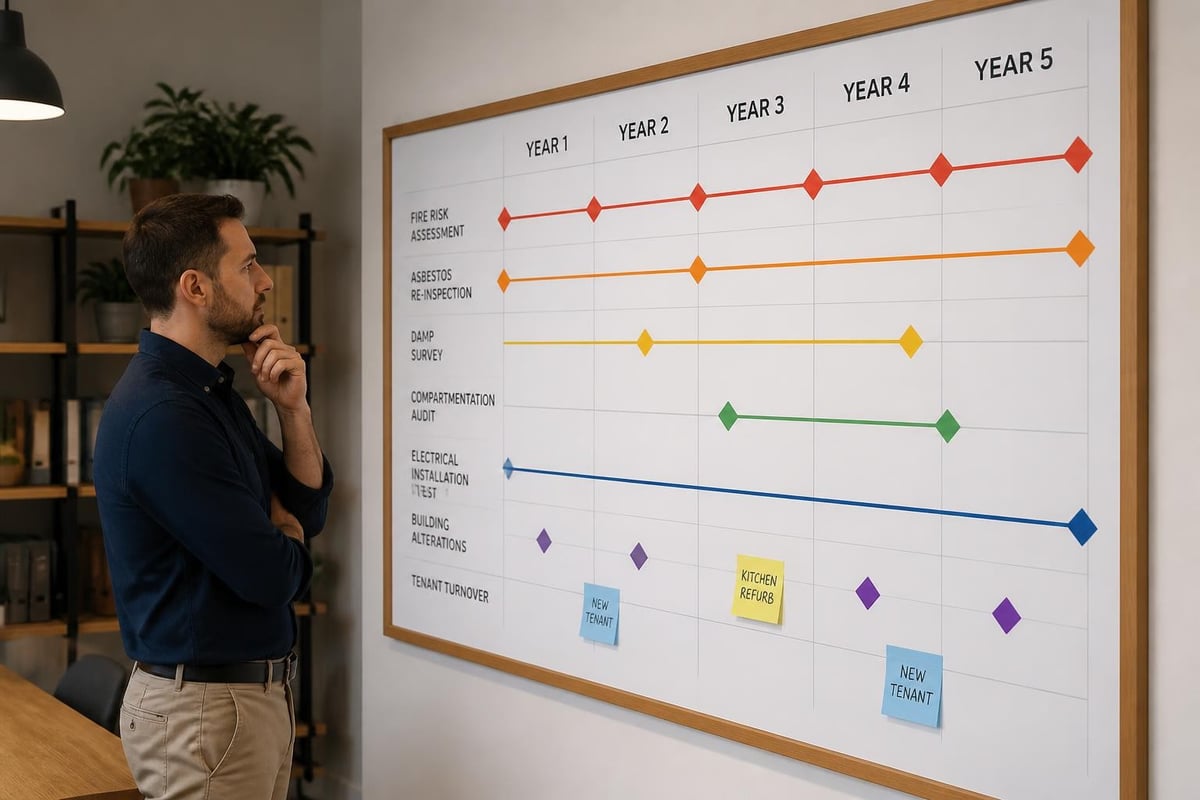
Effective compliance management requires structured scheduling that aligns inspection frequencies with statutory requirements and evidences a systematic approach to hazard control. Landlord compliance services typically establish an annual compliance calendar that sequences assessments to avoid clustering costs whilst maintaining regulatory adherence.
Annual Fixed Inspections
Certain compliance activities recur annually regardless of property condition or prior findings. These form the backbone of any compliance programme:
- Fire risk assessments (annual review minimum, more frequently if high-risk features present)
- Asbestos re-inspections of known ACMs with material score updates
- Legionella risk assessment reviews and temperature regime verification
- Emergency lighting duration tests
- Fire door condition and functionality inspections
- Electrical installation condition reports (five-yearly, but annual PAT testing for portable appliances)
Triggered and Responsive Inspections
Beyond scheduled work, landlord compliance services must respond to change triggers that invalidate previous assessments:
- Building alterations requiring updated fire risk assessments and asbestos refurbishment surveys
- Change of use necessitating revised means of escape calculations
- Tenant reports of damp, mould, or water temperature issues
- Post-incident investigations following fire alarm activations or water quality complaints
- Pre-sale due diligence for portfolio transactions
A competent provider maintains flexibility to deploy surveyors within 48-72 hours for urgent assessments whilst managing the planned inspection programme without disruption. This dual capability distinguishes professional compliance services from single-discipline contractors who lack cross-functional coordination.
Selecting Landlord Compliance Services: Accreditation and Competence
The compliance industry operates without universal licensing, making third-party accreditation the primary competence indicator. Landlords should verify that service providers hold recognised credentials across each discipline they claim to offer.
Essential Accreditations and Memberships
Professional bodies and certification schemes provide quality assurance frameworks that landlords can rely upon when selecting compliance partners:
| Discipline | Key Accreditation | Verifying Body | Why It Matters |
|---|---|---|---|
| Asbestos Surveying | BOHS P402/P403 | British Occupational Hygiene Society | Demonstrates surveyor training in sampling methodology and risk assessment |
| Fire Risk Assessment | CFPA-E / NEBOSH Fire | IFSM / NEBOSH | Evidences competence in fire safety management principles |
| Legionella Assessment | Legionella Control Association membership | LCA | Indicates adherence to industry best practice and CPD requirements |
| Laboratory Analysis | UKAS ISO 17025 | United Kingdom Accreditation Service | Ensures analytical results are legally defensible |
| General Compliance | ISO 9001 Quality Management | UKAS or equivalent | Demonstrates systematic approach to service delivery and record retention |
Landlords managing commercial portfolios should also consider providers with Constructionline Gold or Achilles Building Confidence certification, indicating financial stability and insurance adequacy for larger projects.
The Multi-Discipline Advantage
Engaging separate contractors for each compliance discipline creates coordination burdens, conflicting survey schedules, and fragmented documentation systems. Landlord compliance services that deliver multi-discipline risk management under a single contract offer significant operational advantages:
- Unified reporting platforms consolidating all compliance certificates in one audit-ready portal
- Cross-discipline insights where asbestos surveyors note fire-stopping defects or water hygiene assessors identify electrical risks
- Simplified procurement with single purchase orders and consolidated invoicing
- Accountability clarity eliminating finger-pointing between multiple contractors when issues arise
For landlords with portfolios exceeding 50 units, the administrative efficiency of consolidated compliance services typically delivers cost savings that offset any marginal premium over lowest-price single-discipline contractors.
Documentation Standards and Audit Readiness
Regulators increasingly request compliance documentation during routine inspections or following tenant complaints. The quality of record-keeping often determines whether authorities issue improvement notices or proceed directly to prohibition orders and prosecutions. Professional standards for landlord documentation emphasise completeness, traceability, and accessibility.
What "Audit-Ready" Actually Means
Audit-ready compliance documentation satisfies specific criteria that generic survey reports often miss:
- Unique asset referencing allowing cross-referencing between fire risk assessments, asbestos registers, and water system schematics
- Photographic evidence geo-tagged and dated to prove assessment scope and condition at inspection
- Competent person declarations with surveyor qualifications, insurance details, and accreditation certificates appended
- Action priority matrices with timescales aligned to legal requirements, not contractor convenience
- Revision control showing how assessments update following remedial works or building alterations
- Digital accessibility with secure cloud storage and role-based access for managing agents, contractors, and enforcement officers
Landlord compliance services deliver this rigour through standardised templates, quality assurance reviews, and document management systems purpose-built for regulatory scrutiny. The investment proves its value when handling enforcement actions or defending civil claims where contemporaneous records form the primary evidence.
Remedial Coordination and Project Management
Identifying hazards represents only half the compliance equation; landlords must also demonstrate timely and effective remediation. Professional compliance providers extend beyond survey delivery to coordinate the remedial works needed to close out high-priority findings.
This project management layer ensures:
- Specification accuracy translating survey findings into contractor-ready scope documents
- Competent contractor selection from pre-vetted frameworks holding appropriate licences (e.g., HSE-licensed asbestos removal contractors)
- Progress monitoring verifying that fire-stopping installations or water system modifications meet the recommended standards
- Verification testing confirming that remedial works achieve their intended risk reduction
- Updated documentation revising fire risk assessments and asbestos registers to reflect post-works condition
For landlords without in-house technical teams, this turnkey approach prevents the common failure mode where excellent surveys languish unactioned because property managers lack the expertise to procure specialist remediation contractors.
Cost-Benefit Analysis of Professional Compliance Services
Landlords frequently question whether professional landlord compliance services represent value compared to managing obligations through generalist contractors or in-house staff. A structured comparison reveals the true cost differential.
Direct Cost Comparison
| Approach | Annual Cost (10-unit portfolio) | Hidden Costs | Risk Exposure |
|---|---|---|---|
| Ad-hoc contractors | £3,500-£5,000 | Coordination time, missed inspections, incompatible documentation | High (gaps in coverage) |
| In-house management | £8,000-£12,000 (staff time) | Training, accreditation, insurance, equipment | Medium (competence gaps) |
| Professional compliance service | £6,000-£9,000 | Minimal | Low (contractual accountability) |
The calculation shifts further in favour of professional services when considering the avoided costs of enforcement notices (typical £5,000-£15,000 in emergency works plus legal fees), prohibition orders (lost rental income during closure), and liability claims (averaging £25,000-£150,000 in settled cases involving serious injury or death).
Portfolio Scaling Efficiencies
Landlord compliance services achieve economies of scale that single-property landlords cannot replicate. Providers surveying multiple properties in the same area combine site visits, reducing travel charges and enabling discounted per-unit pricing. For portfolios exceeding 100 units, annual compliance costs frequently drop below £60 per unit whilst maintaining full multi-discipline coverage.
Technology Integration and Compliance Platforms
Modern landlord compliance services increasingly deliver findings through digital platforms that transform static PDF reports into actionable compliance management systems. These cloud-based portals provide:
- Dashboard visualisation showing portfolio-wide compliance status at a glance
- Automated alerts notifying landlords 60 days before inspection due dates
- Contractor portals where remedial works can be commissioned, tracked, and signed off
- Document versioning maintaining full audit trails of assessment updates and remedial action
- Regulatory change notifications alerting landlords to new obligations affecting their property types
Integration with property management software allows compliance data to flow automatically into tenancy files, ensuring that pre-tenancy checks include up-to-date safety certificates and that periodic inspections align with compliance assessment schedules.
For landlords managing diverse property types-HMOs, standard ASTs, commercial units, mixed-use buildings-platform-based compliance services provide the only practical method of maintaining oversight across differing regulatory regimes without dedicated compliance staff. The technology removes the manual administrative burden whilst preserving human expertise where it matters: site assessment and remediation specification.
Regional Variations and Nationwide Service Delivery
Landlord compliance obligations derive primarily from national legislation, but local authority enforcement priorities and licensing schemes create regional variations that complicate multi-area portfolios. Professional compliance providers operating nationwide maintain knowledge of local requirements that single-region contractors may miss.
Key regional considerations include:
- Selective and additional HMO licensing varying by local authority, with different property standards and inspection frequencies
- Article 4 directions removing permitted development rights and triggering planning compliance obligations
- Local air quality management areas potentially affecting heating system specifications
- Conservation area restrictions limiting external alterations needed for fire safety improvements
Landlords with assets across multiple regions benefit from compliance services that deploy locally-based surveyors who understand area-specific requirements whilst maintaining standardised reporting formats and quality assurance processes. This model combines local knowledge with national consistency, particularly valuable for institutional investors and portfolio landlords operating through multiple SPVs.
Effective landlord compliance in 2026 demands specialist knowledge across at least five distinct regulatory regimes, each with its own competence requirements and evidential standards. Rather than attempting to coordinate multiple single-discipline contractors or burden property managers with technical obligations beyond their expertise, forward-thinking landlords are consolidating compliance under professional multi-discipline providers. If you need audit-ready compliance across your residential or commercial portfolio, oxford-ec.co.uk delivers integrated asbestos, fire safety, water hygiene, damp and mould, and building safety services with nationwide coverage and the technical depth to withstand regulatory scrutiny.