

Integrated. Precise. Compliant. Fragmented safety reporting isn't merely an administrative inconvenience, it's a profound systemic risk that leaves duty-holders vulnerable to the severe legal and financial penalties recently exemplified by the £2.2 million fine issued to Huws Gray Limited in 2026 for preventable workplace failures. You're likely exhausted by the logistical friction of coordinating disparate asbestos, fire, and water hygiene contractors whilst attempting to maintain a coherent risk profile across your entire portfolio. This guide explores how multi-disciplinary safety surveys provide a robust methodology for streamlining regulatory compliance and mitigating asset risk through a unified, audit-ready reporting framework.
We understand that the administrative burden of managing separate compliance streams is unsustainable in an era of heightened regulatory scrutiny. By consolidating these critical disciplines into a single point of delivery, you'll secure a more holistic view of property health and significantly reduce the operational costs associated with fragmented logistics. We'll examine the technical advantages of unified data, the impact of the Building Safety Act 2022 on your current processes, and the specific framework needed to ensure your organisation remains a safe pair of hands for every asset under its control.
Key Takeaways
- Understand how multi-disciplinary safety surveys replace siloed inspections with a unified "Golden Thread" of information to ensure total regulatory alignment.
- Identify the core technical pillars required for a rigorous property audit, spanning asbestos management, fire safety, and water hygiene protocols.
- Evaluate the logistical efficiency and data integrity benefits of consolidated site visits compared to managing multiple disparate contractors.
- Access a strategic roadmap for implementing integrated surveys across your national portfolio, prioritising assets based on specific risk profiles.
- Learn how meticulous, audit-ready reporting provides a protective shield against the legal and financial consequences of non-compliance.
Table of Contents
- What are Multi-Disciplinary Safety Surveys in Property Compliance?
- The Core Pillars of a Comprehensive Safety Survey Programme
- Fragmented Surveys vs. Multi-Disciplinary Audits: A Comparison
- Implementing Integrated Surveys Across Your Property Portfolio
- Oxford Environmental Consultants: Your Partner in Property Compliance
What are Multi-Disciplinary Safety Surveys in Property Compliance?
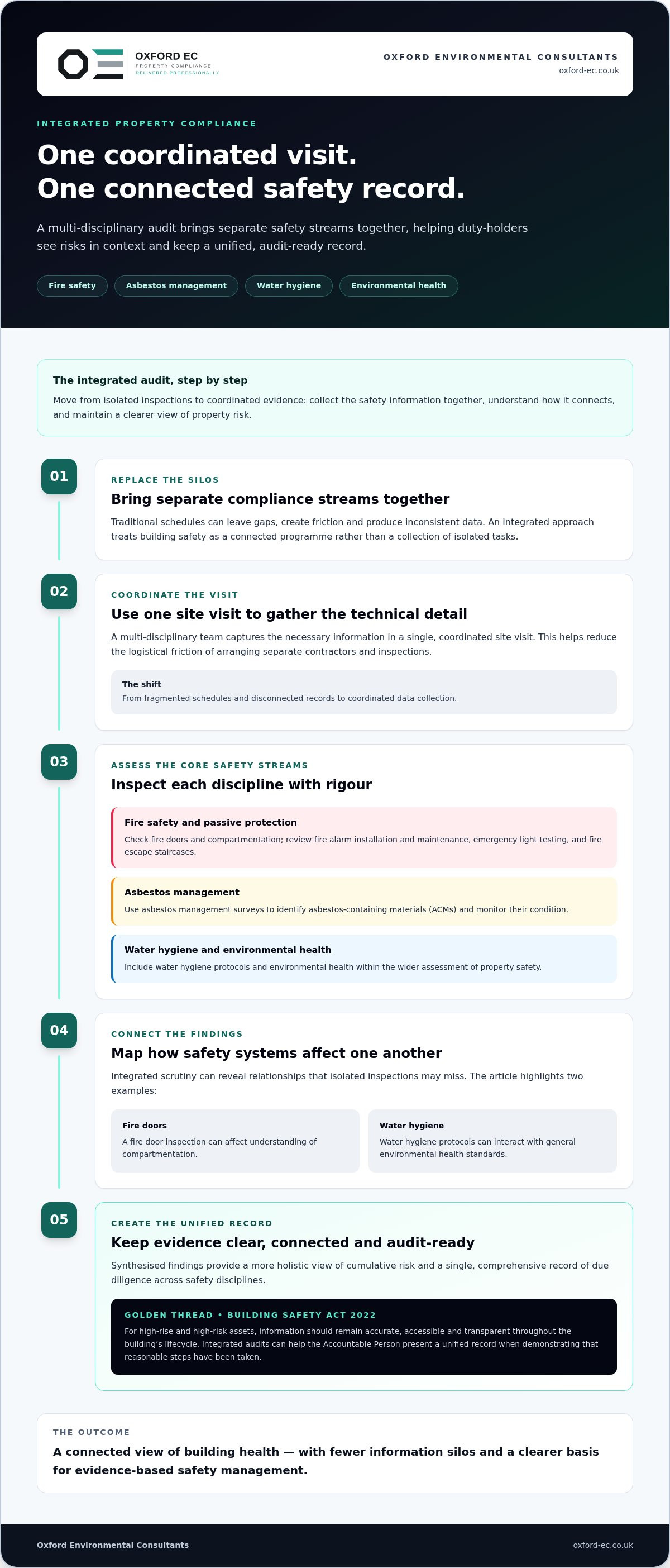
Multi-disciplinary safety surveys represent a paradigm shift in professional property management. They are holistic. They are concurrent. They are rigorous. Unlike traditional methods that treat building safety as a collection of isolated tasks, these surveys provide a unified assessment across multiple critical streams including asbestos, fire safety, water hygiene, and environmental health. This integrated approach aligns directly with the "Golden Thread" requirement established by the Building Safety Act 2022, ensuring that information regarding high-rise and high-risk assets remains accurate, accessible, and transparent throughout the building's lifecycle.
By consolidating disparate inspections into a single, comprehensive audit, duty-holders can eliminate the technical blind spots that often emerge when different contractors work in isolation. A multi-disciplinary safety survey doesn't just identify risks; it maps the interdependencies between different safety systems. For example, understanding how a fire door inspection might impact compartmentation or how water hygiene protocols interact with general environmental health standards is vital for maintaining a truly safe environment. This level of integrated scrutiny is essential for any organisation aiming to achieve absolute precision in their compliance strategy.
The Evolution of the Integrated Compliance Audit
Traditional compliance strategies often rely on fragmented schedules. These siloed inspections create gaps. They cause friction. They lead to inconsistent data that can obscure the true risk profile of a property. Integrated audits solve this by deploying a multi-disciplinary team to capture all necessary technical details in a single, coordinated site visit. This meticulous data collection is essential for modern property management, as it allows duty-holders to move beyond reactive maintenance toward a proactive, evidence-based safety strategy. This transition ensures that every asset is scrutinised with the same high-register technical mastery, regardless of the specific discipline being audited.
The Legal Duty-Holder and Multi-Disciplinary Accountability
The Building Safety Act 2022 introduces the role of the "Accountable Person" for higher-risk buildings. This individual carries significant legal responsibility. They must demonstrate that all reasonable steps have been taken to prevent major incidents. Multi-disciplinary safety surveys simplify this burden by providing a singular, comprehensive record of due diligence across all safety disciplines. Utilising these integrated audits ensures that the Accountable Person can present a unified front during a property compliance audit, proving that their safety management system is both robust and legally defensible. This level of scrutiny isn't just a best practice; it's the standard for professional property management in the UK. It provides the necessary evidence to satisfy regulators, insurers, and stakeholders that the property is being managed by a safe pair of hands.
The Core Pillars of a Comprehensive Safety Survey Programme
Precision. Scrutiny. Accountability. A robust multi-disciplinary safety survey programme is built upon foundational technical pillars that, when executed with rigour, provide an exhaustive 360-degree view of building health. Each discipline within the audit must be treated with absolute precision to ensure that no regulatory gap remains unaddressed. Central to this framework is the execution of professional fire risk assessments, which serve as a primary pillar for life safety and asset protection whilst providing the baseline for all subsequent safety interventions.
The strength of an integrated programme lies in how these pillars interact. When data from fire safety, asbestos management, and water hygiene are synthesised, duty-holders gain a clear understanding of the cumulative risk across their portfolio. This systemic approach eliminates the "information silos" that often lead to non-compliance or hazardous oversights. By treating these streams as a single, interconnected ecosystem, property managers can ensure that their compliance strategy is both comprehensive and audit-ready.
Fire Safety and Passive Protection Systems
This pillar extends beyond basic audits to include detailed fire door inspections and compartmentation surveys designed to verify the integrity of a building's internal fire spread barriers. Inspectors must scrutinise fire alarm installation and maintenance alongside emergency light testing to ensure system reliability during a critical event. Furthermore, fire escape staircase inspections are vital for guaranteeing safe egress, particularly in high-occupancy or high-rise structures where structural fire protection is paramount. These elements collectively form a protective shield, ensuring the building remains resilient against fire-related risks.
Asbestos Management and Hazardous Material Scrutiny
Effective risk mitigation requires the deployment of asbestos management surveys to identify and monitor the condition of any asbestos-containing materials (ACMs) within the premises. It's critical to distinguish these routine audits from more intrusive refurbishment or demolition surveys, which are mandatory before any structural alterations occur. Integrated asbestos consultancy ensures that these findings are woven into the broader safety strategy, preventing accidental exposure during routine maintenance or major capital works. This meticulous approach maintains a safe environment for both occupants and contractors.
Water Hygiene and Environmental Health Standards
Water safety is non-negotiable. Rigorous Legionella risk assessments and regular water sampling form the backbone of this pillar, ensuring compliance with ACOP L8 and technical guidance. In the current regulatory climate, a damp and mould inspection is equally critical, particularly as Awaab’s Law mandates stricter timelines and increased depth for mould surveys in social housing. These environmental health checks protect both the physical asset and the long-term wellbeing of its occupants. Achieving this level of detail requires a partner who understands the complex interplay between different safety streams. If you're looking to consolidate your property data, you can speak with our compliance experts to discuss a tailored survey programme.
Fragmented Surveys vs. Multi-Disciplinary Audits: A Comparison
Efficiency. Precision. Accountability. The transition from fragmented, siloed inspections to multi-disciplinary safety surveys represents more than just a logistical shift; it's a fundamental upgrade in property governance. Traditional compliance models rely on disparate contractors who often work in isolation, leading to conflicting data, duplicated site visits, and administrative exhaustion. Integrating these streams into multi-disciplinary safety surveys allows for a level of technical scrutiny that separate contractors simply cannot match, ensuring every safety stream is aligned with the latest UK legislative requirements whilst providing absolute peace of mind for duty-holders.
Fragmented reporting is a legacy risk. It creates gaps. It invites failure. By contrast, a unified audit provides a singular, authoritative record that simplifies the demonstration of due diligence to insurers, regulators, and stakeholders. This approach replaces the friction of managing multiple points of contact with a streamlined, "one-stop" logical solution that protects both the physical asset and the legal standing of the organisation. Ultimately, the shift toward integrated audits is about moving from a reactive "tick-box" exercise to a proactive, evidence-based safety culture.
Operational Efficiency and Logistical Benefits
Concurrent site visits significantly reduce the administrative burden of coordinating multiple contractors across a national portfolio. By deploying a single team to conduct asbestos, fire, and water hygiene audits simultaneously, duty-holders can minimise disruption to building occupants and day-to-day operations. This integrated delivery model reduces travel-related costs and the overall carbon footprint of the compliance programme whilst ensuring that reporting is delivered with far greater speed. When data is captured in a single site visit, the time from inspection to actionable report is dramatically compressed, allowing for faster remediation and risk mitigation across high-risk assets.
Data Integrity and the Unified Risk Dashboard
A multi-disciplinary approach eliminates the risk of conflicting safety recommendations that often arise when separate contractors work in isolation. For instance, an integrated team understands how the presence of asbestos might complicate the maintenance of fire doors or the installation of passive fire protection systems. This cross-discipline insight ensures that every recommendation is technically sound and aligned with the building's overall safety profile. The resulting compliance report is a singular, audit-ready document that provides insurers and legal authorities with clear evidence of due diligence, establishing a definitive "Golden Thread" of building safety information that fragmented reporting cannot provide.
Implementing Integrated Surveys Across Your Property Portfolio
Strategic. Systematic. Scalable. Transitioning from fragmented inspections to a unified model requires a clear roadmap that prioritises assets based on their inherent risk profiles and operational complexity. Implementing multi-disciplinary safety surveys across a national portfolio isn't merely a logistical exercise; it's an exercise in technical rigour that demands a high degree of foresight. To begin, duty-holders should conduct a thorough commercial building safety inspection to establish a baseline of existing compliance data and identify critical gaps in the current safety management system.
Managing on-site logistics is the next critical phase. Precision is paramount. You must ensure that all relevant areas, from plant rooms to tenanted spaces, are accessible to the survey team during their visit. This level of coordination minimises the risk of "no-access" exclusions, which can compromise the integrity of the final report. By centralising the instruction process, property managers can ensure that the survey scope is consistently applied across every asset, providing a standardised dataset that is essential for accurate portfolio-wide risk analysis.
Portfolio Risk Stratification and Scoping
Effective implementation begins with categorising properties based on age, occupancy type, and known structural hazards. Older assets may require more intensive asbestos scrutiny, whilst high-rise residential buildings demand enhanced fire safety focus under the Building Safety Act 2022. For those managing residential portfolios, incorporating Awaab’s Law damp surveys into the multi-disciplinary framework is essential for meeting the strict timelines for mould identification and remediation. This stratification ensures that resources are deployed where they're most needed, protecting both the duty-holder and the building occupants.
The Survey Lifecycle: From Instruction to Remediation
The lifecycle of an integrated audit begins long before the surveyors arrive on site. Meticulous pre-survey planning involves reviewing historical asbestos registers, previous fire risk assessments, and water hygiene records to provide the survey team with necessary context. Post-survey, the process moves into a technical review phase where data is verified for accuracy and cross-referenced across different disciplines. These multi-disciplinary reports are not static documents; they're active management tools that inform long-term remedial strategies and capital expenditure planning. This structured approach ensures that every safety intervention is evidence-based and aligned with the overarching compliance strategy.
Oxford Environmental Consultants: Your Partner in Property Compliance
Meticulous. Accountable. Disciplined. Founded in 2018, Oxford Environmental Consultants (OEC) has established itself as the premier choice for national multi-disciplinary safety surveys. We operate as a high-level consultancy that thrives on technical order, acting as a "guardian" of your legal obligations in an increasingly complex regulatory environment. By integrating our comprehensive range of compliance services into a singular, logical delivery model, we provide duty-holders with the absolute precision required to navigate the Building Safety Act and other critical UK frameworks. Our national coverage ensures that whether you manage a single high-risk asset or an expansive commercial portfolio, you receive the same level of rigorous, audit-ready scrutiny.
Choosing OEC means partnering with a firm that values transparency and evidence-based results above all else. We don't just act as a service provider; we position ourselves as a protective shield for duty-holders, mitigating risk through technical mastery and regulatory expertise. Our team provides the "safe pair of hands" needed for multi-faceted property requirements, ensuring that every survey is conducted with the gravity and seriousness that safety compliance demands. This uncompromising commitment to standards is what allows our clients to maintain absolute peace of mind regarding their asset management and legal standing.
Technical Expertise Across Every Safety Discipline
OEC’s mastery of asbestos management and consultancy ensures that hazardous materials are identified, monitored, and managed with surgical accuracy across your premises. Our fire safety and risk assessment services go beyond surface-level checks, scrutinising passive protection systems, fire doors, and compartmentation to ensure structural resilience. This technical rigour extends to our water hygiene and Legionella management protocols, where we provide the exhaustive sampling and assessment needed to protect building occupants. By housing these distinct specialisms under one roof, we eliminate the friction of fragmented contracting and ensure a unified approach to building safety.
Meticulous Reporting and Audit-Ready Results
Transparent. Precise. Definitive. Every OEC report is a professional document designed to withstand the highest levels of scrutiny from regulators, insurers, and stakeholders. We support our clients through the entire compliance lifecycle, providing not only the initial multi-disciplinary safety surveys but also the technical oversight required for remedial works to close identified gaps. This end-to-end accountability ensures that your data remains consistent and your assets remain protected. We invite duty-holders to secure their portfolios with a professional audit that delivers a robust framework for long-term compliance and operational efficiency.
Securing the Future of Your Property Portfolio
Protect your assets. Minimise risk. Ensure compliance. The transition to multi-disciplinary safety surveys is no longer a luxury but a fundamental necessity for duty-holders operating under the rigorous demands of the Building Safety Act 2022. By consolidating asbestos management, fire risk assessments, and water hygiene protocols into a singular, unified framework, you eliminate the technical gaps inherent in fragmented reporting and establish a definitive "Golden Thread" of information. This integrated approach provides the absolute precision required to satisfy insurers and regulators whilst significantly reducing the administrative friction of managing disparate contractors across a national portfolio.
Oxford Environmental Consultants provides the meticulous expert oversight and national UK coverage required to manage these complex requirements with total confidence. Our audit-ready reporting serves as a robust protective shield, ensuring your organisation remains a safe pair of hands for every asset under its control. It's time to replace logistical complexity with a streamlined, evidence-based solution that prioritises building safety and long-term asset value.
Take the decisive step toward a more efficient, legally robust property management strategy.
Frequently Asked Questions
What is the primary benefit of a multi-disciplinary safety survey?
The primary benefit is the creation of a unified risk profile that eliminates the information silos common in fragmented reporting. By consolidating asbestos, fire, and water hygiene audits, duty-holders gain a holistic view of building health whilst reducing the administrative friction of coordinating multiple contractors. This integrated approach ensures that safety recommendations across different disciplines are aligned, preventing technical conflicts and providing a more robust framework for long-term property compliance.
How often should multi-disciplinary safety surveys be conducted?
The frequency is determined by the specific risk profile of the asset and its occupancy type. Whilst fire risk assessments are typically reviewed annually, other disciplines like asbestos management surveys or Legionella risk assessments follow their own statutory intervals. Multi-disciplinary safety surveys are often synchronised with these cycles to maximise logistical efficiency. For high-risk assets subject to the Building Safety Act 2022, a more frequent, rigorous audit schedule is essential to maintain data integrity.
Does a multi-disciplinary survey cover all legal requirements for the Building Safety Act?
These surveys provide the foundational data required to satisfy the "Golden Thread" and Safety Case requirements for higher-risk buildings. Whilst they cover the core technical pillars such as fire safety and hazardous materials, the Act also mandates ongoing management systems and occupant engagement strategies. An integrated audit is a critical component of a broader compliance strategy, ensuring that the Accountable Person has the evidence-based reporting needed to demonstrate due diligence to the Building Safety Regulator.
Can multi-disciplinary surveys help reduce insurance premiums for commercial properties?
Professional integrated audits can lead to reduced insurance premiums by demonstrating a proactive and rigorous approach to risk management. Insurers value the transparency and data integrity provided by a unified compliance report, as it reduces the likelihood of unforeseen hazards. Presenting an audit-ready risk profile across multiple disciplines proves that the asset is managed by a safe pair of hands, which often results in more favourable terms and lower liability costs for commercial property owners.
What happens if a multi-disciplinary survey identifies a high-risk safety issue?
Immediate notification and a structured remediation plan are triggered if a high-risk hazard is identified during the audit. The surveyor will provide a detailed technical review of the deficiency, categorising it by severity to allow for urgent prioritisation. This process ensures that critical failures, such as compromised fire compartmentation or significant asbestos disturbance, are addressed with absolute precision. OEC supports clients through this entire lifecycle, from the initial identification to the completion of necessary remedial works.
Is it possible to customise the disciplines included in a multi-disciplinary audit?
Yes, the scope of a multi-disciplinary audit is entirely customisable to meet the specific requirements of a property or portfolio. Duty-holders can select from a range of technical streams including fire door inspections, damp and mould surveys, or emergency lighting testing based on their asset's age and usage. This flexibility allows for a tailored compliance solution that addresses specific regulatory gaps whilst maintaining the logistical and financial benefits of a consolidated, single-visit survey model.
How do multi-disciplinary surveys address the requirements of Awaab’s Law?
Multi-disciplinary safety surveys integrate specialist damp and mould inspections to meet the strict timelines mandated by Awaab’s Law. These assessments identify the root causes of moisture ingress and provide evidence-based remediation strategies to protect occupant health. By including environmental health standards within the broader audit framework, property managers can ensure they're meeting the rigorous new standards for social housing whilst maintaining oversight of other critical safety streams like asbestos and fire protection.
Who is legally responsible for acting on the findings of a safety survey?
The legal responsibility lies with the designated duty-holder or the Accountable Person as defined under UK safety legislation. This individual or entity is tasked with ensuring that all identified risks are managed and remediated in accordance with statutory requirements. Failure to act on the findings of a professional survey can result in significant legal and financial penalties, as seen in recent HSE prosecutions. The survey report serves as the definitive roadmap for these individuals to discharge their legal obligations.