

A broad service list alone is not enough. To decide how to choose a property compliance company, assess whether its services meet your buildings’ needs, whether it understands your property sector and whether it can coordinate work and records across your portfolio. Look for a clear process from assessment through to reporting and follow-up.
A provider should do more than complete individual inspections. Knowing how to choose a property compliance company also means considering how its expertise and working methods fit your buildings, since compliance responsibilities can span different property types and specialist areas.
This article explains how to compare service coverage, sector experience, portfolio management and end-to-end support. You’ll learn what to look for in a provider’s approach and how to identify a practical next step for strengthening property compliance.
Key Takeaways
- Match a provider’s sector experience to your building types, occupancy and specific compliance needs.
- Assess whether its approach can organise records, inspections and follow-up across your property portfolio.
- Look for clearly defined support from assessment and reporting through to practical next steps.
- Understand which legal duties apply to your properties and how they shape the work required.
- Evaluate qualifications and accreditations against the specific services and expertise your buildings need.
Table of Contents
- Assessing a compliance company’s sector experience
- Managing compliance across a property portfolio
- Choosing an end-to-end compliance provider
- What UK laws and regulations must property compliance companies understand?
- How can landlords verify a property compliance company's qualifications and accreditations?
- Oxford Environmental Consultants (OEC): Asbestos Management Surveys
Assessing a compliance company’s sector experience
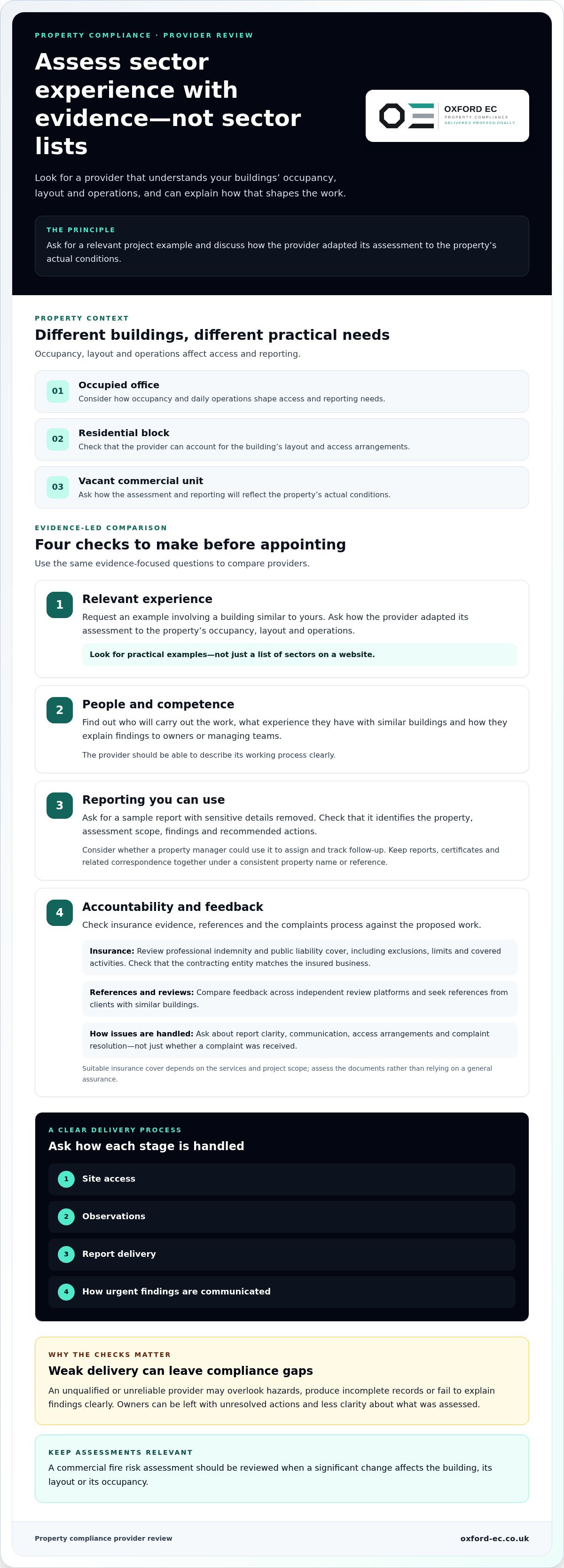
Sector experience means more than recognising a building’s use. A company should understand how occupancy, layout and operations affect the work required. An occupied office, a residential block and a vacant commercial unit, for example, have different access and reporting needs. Ask for a relevant project example and discuss how the provider adapted its assessment to the property’s actual conditions.
Look for evidence of practical experience, not just a list of sectors on a website. Ask who will carry out the work, what experience they have with similar buildings and how they explain findings to owners or managing teams. A provider should describe its process clearly, including site access, observations, report delivery and how urgent findings are communicated.
Compare reports and records by checking whether each document identifies the property, assessment scope, findings and recommended actions. Ask for a sample with sensitive details removed, then consider whether a property manager could use it to assign and track follow-up. Keep reports, certificates and related correspondence together under a consistent property name or reference.
For insurance and liability cover, ask for evidence of professional indemnity and public liability insurance relevant to the work. Review the policy schedule for exclusions, limits and covered activities, and check that the contracting entity matches the insured business. Suitable cover depends on the services and project scope, so assess the documents rather than relying on a general assurance.
To assess reviews, references and complaint history, compare feedback across independent review platforms and request references from clients with similar buildings. Ask about report clarity, communication, access arrangements and how issues were handled. Review any published complaints process and note whether responses explain the resolution, rather than merely confirming that a complaint was received.
An unqualified or unreliable provider may overlook hazards, produce incomplete records or fail to explain findings clearly. This can leave owners with unresolved actions and make it harder to demonstrate what was assessed. For example, a commercial fire risk assessment should be reviewed when a significant change affects the building, its layout or its occupancy.
Use a simple evidence-led comparison before appointing a company:
- Relevant experience: Request a project example for a building similar to yours.
- Personnel: Identify who will complete the work and review their relevant competence.
- Reporting: Examine a sample report for clear findings and usable actions.
- Accountability: Match insurance documents, references and complaint procedures to the proposed work.
These checks help distinguish sector knowledge from broad claims. For an overview of property compliance services, consider how the assessment scope and reporting process fit the buildings and obligations you manage.
Managing compliance across a property portfolio
For a portfolio, consistent records matter as much as individual assessments. Start with a property register that identifies each building, its location, use, occupancy and responsible contact. Add the relevant compliance work for each site, then record completed assessments, findings, actions and review dates. This gives property teams a controlled overview instead of separate files scattered across inboxes.
Property compliance requirements can differ across England, Scotland and Wales. Licensing and planning requirements may also vary by local authority, ward, street or mapped area. Organise the register by jurisdiction and local area, so a requirement attached to one address is not assumed to apply across the portfolio.
Use a shared action log to connect assessment findings with operational decisions. Each entry should identify the property, issue, current status, person responsible and evidence that closes the action. A manager reviewing an inspection report, for example, should be able to distinguish an open remedial task from a completed one without searching through email history.
Agree a consistent information structure with the compliance provider before work begins. A shared template makes reports easier to compare while preserving the site-specific detail each building needs. Include fields for:
- Property identity: address, building name and internal reference.
- Assessment record: scope, inspection date and report location.
- Action tracking: finding, owner, status and supporting evidence.
- Site coordination: access arrangements and the relevant property contact.
- Portfolio review: outstanding tasks grouped by site, type or status.
Tenants and on-site teams affect how work is scheduled and communicated. Record access constraints and the appropriate site contact for each building, then share relevant arrangements before visits. A residential block with managed access, for instance, needs a clear process for arranging entry and communicating the work’s scope.
Review the register when a property changes use, management or occupancy. Record which documents remain relevant, which actions are outstanding and whether the new arrangement affects planned work. Keep a dated change log so future reviewers can trace why a record or responsibility changed.
Schedule regular portfolio reviews around the records themselves, not just a calendar reminder. Compare open actions, missing documents and upcoming reviews by property, then assign follow-up to a named role. This makes gaps visible and helps managers prioritise work according to each building and its obligations.
For a structured overview of property compliance services, consider how a consistent assessment and reporting approach could support your portfolio records.
Choosing an end-to-end compliance provider
An end-to-end provider coordinates the stages from defining a property’s needs to delivering usable findings. This can include agreeing the scope, arranging site access, carrying out the assessment, issuing the report and clarifying follow-up actions. For a mixed-use building, the owner should know which stages the provider handles and which remain with the property team.
Before hiring, ask which tasks are included, who completes and reviews the work, and what the final report will contain. Discuss how urgent findings are communicated, how follow-up questions are handled and what happens if access is unavailable. Clear answers help you map responsibilities before work starts.
A written scope is the foundation. It should identify the building or areas covered, the assessment’s purpose, relevant access arrangements and expected outputs. If a site has separate residential and commercial areas, for example, the scope should specify which spaces are included. This prevents the assumption that one visit covers every part of the property.
Next, examine how the provider manages each handover. A useful process names the point of contact, explains how site information is gathered and states how findings reach the person responsible for acting on them. If a report identifies a concern, the owner should understand what it means and what next step is recommended.
End-to-end support does not remove the owner’s responsibilities. The agreement should distinguish assessment and reporting from decisions, authorisations or remedial work. A provider may document an issue, for instance, while the owner or managing agent arranges the response. Confirming this division in writing helps prevent gaps between assessment and follow-up action.
Use these points to assess whether the proposed service is properly coordinated:
- Scope: Does the proposal identify the buildings, areas and assessment outputs?
- Coordination: Is there a named contact for access, questions and report delivery?
- Findings: Will the report explain issues in language property teams can act on?
- Follow-up: Does the process explain how clarifications and further actions are handled?
- Accountability: Are the provider’s tasks distinct from the owner’s decisions and responsibilities?
Compare proposals using the same building information and requested outcomes. If one covers assessment and reporting while another also describes follow-up support, compare their scopes line by line. A lower headline fee alone does not show whether the work, outputs or responsibilities are equivalent.
To understand how property compliance services can fit into a coordinated process, consider the assessments and reporting your buildings require.
Where work includes energy performance compliance, ask the provider what evidence it will deliver and how it will report any gap. Penalties for failing to provide a valid EPC or letting a commercial property below the legal minimum can be based on the property’s rateable value. This makes the scope and report trail important: check that the service covers the relevant property and clearly records its findings.
Keep compliance support distinct from legal advice about possession. Regaining possession after Section 21 is abolished requires proving statutory grounds under Section 8. Confirm what the provider can document and which decisions or proceedings remain with the owner or its advisers before relying on the service.
What UK laws and regulations must property compliance companies understand?
A competent property compliance provider should understand the rules relevant to each building, its use and the commissioned work. A residential block, commercial premises and house in multiple occupation (HMO) can involve different responsibilities. Ask the provider to identify the legal framework behind its proposed assessment and explain how it affects the scope, findings and recommended actions.
According to the UK legislation register, the Regulatory Reform (Fire Safety) Order 2005 is a fire-safety regulation relevant to UK landlords. The UK legislation register also cites the Fire Safety Act 2021 as a fire-safety regulation relevant to UK landlords. A provider should be able to explain how relevant fire-safety requirements relate to the building being assessed.
Under the Regulatory Reform (Fire Safety) Order 2005, the responsible person for commercial premises is typically the building owner, employer or landlord, depending on who controls the premises. A compliance company can assess and report, but property owners should understand who holds responsibility for decisions and follow-up. Clarify those roles in the work scope and reporting arrangements.
The required approach depends on the premises. A suitable and sufficient fire risk assessment is a legal requirement for commercial premises and should be reviewed regularly. Residential buildings, including HMOs with common parts, must undergo regular fire risk assessments by competent assessors. Ask how the provider accounts for shared areas, occupancy and building layout.
Other requirements may affect a property’s compliance plan. For example, mandatory HMO licensing in England and Wales applies to properties of three or more storeys, rented to five or more people from more than one household who share facilities, with at least one tenant paying rent. Licensing and planning requirements may also vary by local authority, ward, street or mapped area.
Ask how the provider distinguishes national requirements from local rules, and how it records the basis for its conclusions. The Building Safety Act 2022 is relevant to property management compliance for resident management companies and freeholders. A provider should identify whether this framework is relevant to the building and the work under discussion.
Consequences make accurate interpretation important. According to the UK Government, property compliance offences in England and Wales can attract penalties of up to £40,000 per offence. This is not a universal penalty for every compliance issue, so ask the provider to explain which duty applies and who holds it.
- Ask for the applicable framework: Request the legislation or requirement relevant to the proposed assessment.
- Confirm the duty holder: Identify who controls the premises and who must act on findings.
- Account for local variation: Separate national requirements from council licensing or planning rules.
- Review the report: Check that findings, recommendations and relevant responsibilities are clearly distinguished.
How can landlords verify a property compliance company's qualifications and accreditations?
Match each qualification to the proposed work. A company may deliver several types of assessment, but competence in one discipline does not automatically demonstrate competence in another. Ask for the named practitioner’s relevant training, experience and role, then compare these details with the assessment scope and building type.
Check the evidence, not just a logo on a proposal. Request the certificate or membership details, the issuing organisation’s name and the qualification’s scope. If the organisation provides a verification process, use it to confirm that the credential belongs to the named person or business and is current. Record the result with your procurement documents.
Read the wording carefully. A certificate may relate to a training course, individual membership, company registration or specific technical activity. These are different forms of evidence. A course certificate, for example, shows that someone completed that course, but does not by itself demonstrate experience assessing a particular building type.
Use a consistent evidence review for each proposed service:
- Identify the practitioner: Record the person expected to conduct or review the assessment.
- Match the discipline: Check that their documented training relates to the work being commissioned.
- Inspect the certificate: Note the holder, issuer, scope and any validity dates shown.
- Verify the claim: Use the issuing organisation’s own verification route where available.
- Check the business: Ensure the proposal names the contracting entity and clarifies who delivers the work.
Accreditation should be relevant to the service, not treated as a universal quality mark. Ask what the credential covers and how it relates to the proposed assessment. If a company refers to an accreditation, establish whether it applies to the organisation, an individual, a process or a defined technical discipline.
Test the evidence against a practical example. Ask the proposed assessor how they would approach a property with unusual access restrictions, mixed occupancy or incomplete building records. Their response should connect the relevant qualification with a clear method, appropriate limitations and a report suited to the property.
Keep a procurement record containing the proposal, named personnel, qualification evidence and verification notes. If the assigned practitioner changes, compare the replacement’s credentials with the original scope before work proceeds. This creates a traceable basis for appointment and helps property teams understand who performed each assessment.
For a discussion about assessment requirements, contact the Oxford Environmental Consultants (OEC) property compliance team.
When selecting a compliance partner, keep qualification checks separate from other tenancy and property obligations, and record which issue each document addresses. Landlords switching managing agents during an active tenancy typically give between thirty and ninety days’ written notice.
Under the Housing Act 2004, a court in England and Wales can order a landlord to pay a tenant between one and three times the deposit for failures relating to deposit protection or prescribed information. This is separate from whether an assessor holds a relevant credential, so document both checks rather than treating one as evidence of the other.
In England and Wales, landlords generally cannot grant a new lease or continue letting commercial property rated F or G unless a valid exemption is registered. Keep this requirement distinct from the company’s qualifications, and ensure the proposed work addresses the relevant property issue.
Oxford Environmental Consultants (OEC): Asbestos Management Surveys
Oxford Environmental Consultants (OEC) provides Asbestos Management Surveys for building owners who need property-specific information to support their compliance records. Choose this service when you need an assessment focused on the building and findings that can inform ongoing management decisions.
OEC also offers Legionella Risk Assessments, Damp & Mould Surveys and Fire Door Inspections. Each service addresses a distinct property compliance need, so identify the buildings and issues requiring attention before deciding which assessment is relevant. A clear scope helps align the work with your property records and responsibilities.
For building owners assessing asbestos-related requirements, an Asbestos Management Survey is a relevant starting point. Contact Oxford Environmental Consultants (OEC) to discuss your property’s requirements.
Put a clear compliance plan into motion
Turn your assessment into a practical brief before commissioning further work. Identify the property, the issue requiring attention and the outcome you need from the assessment. This gives your chosen provider a defined starting point and helps your team connect the resulting work with its wider property management plans.
Knowing how to choose a property compliance company also means matching the service to the task, rather than treating every requirement as interchangeable. Oxford Environmental Consultants (OEC) offers Asbestos Management Surveys, Fire Risk Assessments and Legionella Risk Assessments. Each addresses a distinct property need, giving building owners a clear way to discuss the relevant assessment.
A considered next step can be straightforward: describe the property and the compliance question you need answered, then discuss the appropriate scope. A clear brief keeps the conversation focused on your building’s needs and the practical outcome you require.
Take the next step with a clear brief, and ground your property compliance decisions in the work required.
Frequently Asked Questions
Why is property compliance difficult to manage across a portfolio?
Choosing can be difficult because buildings have different conditions, operational teams and decision-makers. A site with vacant areas may need different access planning from an occupied building, while contractors may use inconsistent file names or report formats. Those differences complicate comparisons and handovers. Assign responsibility for consistent records and retain a clear version history so staff can distinguish current documents from superseded copies.
What services should a UK property compliance company provide?
A UK property compliance company should provide assessments suited to the buildings and risks it has been appointed to address. Depending on the property, this may include asbestos surveys, fire risk assessments, Legionella risk assessments, damp and mould surveys, fire door inspections or emergency lighting inspections. No single service mix suits every property. Match each assessment to the building’s materials, use, systems and planned work.