
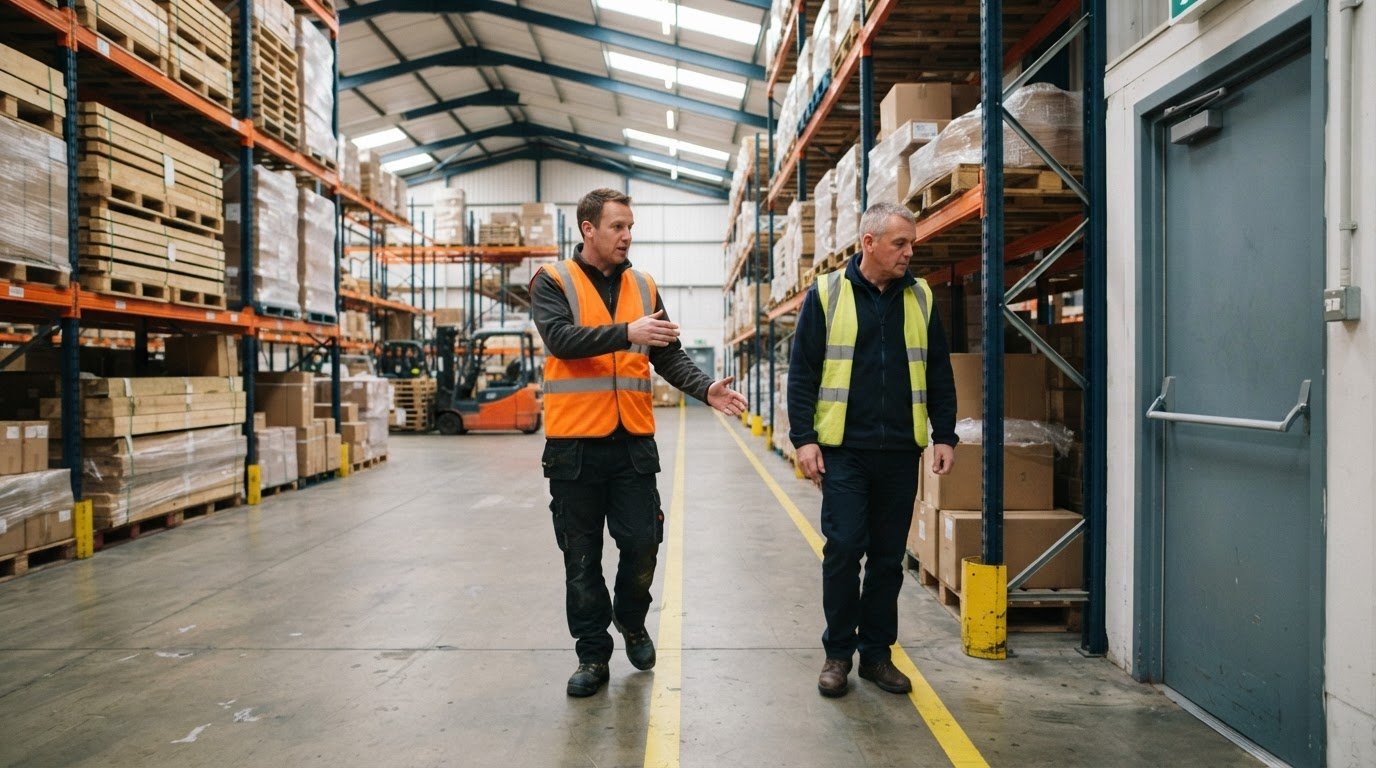
Fire safety compliance is more than installing alarms and keeping extinguishers on site. In England and Wales, the Regulatory Reform (Fire Safety) Order 2005 sets the minimum fire-safety standard for non-domestic premises, including factories and warehouses, according to UK legislation. The warehouse fire safety regulations also require attention to the risks created by the building’s use, its contents and the arrangements for escape.
That means a storage site and a manufacturing premises need a fire safety approach suited to their layout and activities. A documented fire risk assessment is central: it identifies hazards, assesses who may be at risk and records the measures needed to prevent fire and protect people.
This guide explains the rules that apply, who is responsible for putting them into practice, and how fire protection systems, inspections and equipment maintenance fit together. It also covers practical factors such as clear escape routes, combustible materials, storage arrangements and staff training, so you can understand what effective fire safety management involves in a factory or warehouse.
Key Takeaways
- Understand how the Regulatory Reform (Fire Safety) Order 2005 applies to factories and warehouses in England and Wales.
- Know who holds the Responsible Person role and why recording and reviewing fire risk assessment findings matters.
- See how detection, alarm and other fire protection systems fit into a site’s safety arrangements.
- Identify how machinery, combustible materials, storage layouts and escape routes shape fire prevention measures.
- Learn why routine testing, suitable equipment and ongoing maintenance are essential parts of fire safety management.
Table of Contents
What are the fire safety regulations for factories and warehouses?
The rules require fire risks to be assessed and managed, with precautions suited to the premises and its use. According to UK legislation, the Regulatory Reform (Fire Safety) Order 2005 applies a minimum fire-safety standard to non-domestic premises in England and Wales. These warehouse fire safety regulations apply to factories and storage sites alike.
Assessment scope and documentation
A fire risk assessment identifies fire hazards, people at risk, existing precautions and any further action needed. Its written record should reflect the factory’s or warehouse’s actual design and use, including machinery, combustible goods, flammable substances, escape arrangements and shared areas. Where occupiers share a building, they should liaise to address common areas and responsibilities.
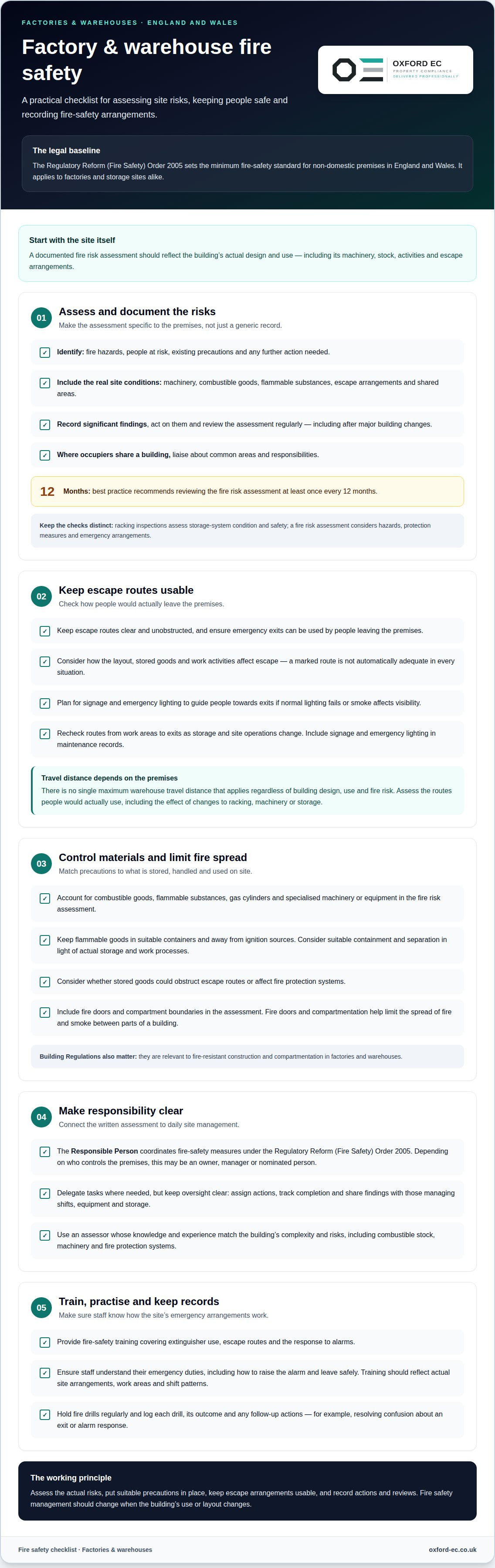
Factories and warehouses of any size require a fire risk assessment. Keep it documented, act on its findings and review it regularly, including after major building changes. Best practice recommends review at least once every 12 months. Racking inspections assess storage-system condition and safety; a fire risk assessment considers hazards, protection measures and emergency arrangements. Applying warehouse fire safety regulations therefore involves more than checking the racking.
Escape routes and emergency signage
Escape routes in factories and warehouses must remain clear and unobstructed, and emergency exits must be usable by people leaving the premises. A risk assessment should consider how the layout, stored goods and work activities affect escape, rather than assuming a marked route is adequate in every situation.
Signage and emergency lighting should guide people towards exits if normal lighting fails or smoke affects visibility. Include these arrangements in fire safety planning and maintenance records. Routes from work areas to exits must remain usable as storage and site operations change.
Storage of dangerous substances
Fire risk assessments for industrial premises should account for flammable substances and combustible goods, as well as specialised machinery and equipment. Keep flammable goods in suitable containers and away from ignition sources. The assessment should consider how materials, their location and their handling affect fire hazards and the controls needed.
Consider gas cylinders, flammable liquids and other dangerous substances in the context of actual storage and work processes. Suitable containment and separation from ignition sources are practical controls. The assessment should also consider whether stored goods could obstruct escape routes or affect fire protection systems.
Fire doors and travel distances
Fire doors and compartmentation help limit the spread of fire and smoke between parts of a building. Building Regulations are relevant to fire-resistant construction and compartmentation in factories and warehouses. A fire risk assessment should consider whether the layout and protective measures address the premises’ hazards.
There is no single maximum warehouse travel distance that applies regardless of the building’s design, use and fire risk. Assess the routes people would actually use, including how changes to racking, machinery or storage could affect access to exits. Include fire doors and compartment boundaries in the assessment.
A breach may result in enforcement action, but the applicable penalty depends on the circumstances and proceedings. The local fire and rescue service responsible for the premises’ area enforces fire safety rules. Review the assessment when the building’s use or layout changes, and record significant findings and actions.
Responsible person duties
The Responsible Person coordinates fire safety measures under the Regulatory Reform (Fire Safety) Order 2005. In a warehouse, the role must connect the documented assessment with daily procedures, staff responsibilities and maintenance.
Accountability and competence
The Responsible Person is the legally designated role, supported where needed by accountable managers and competent specialists. Depending on who controls the premises, the role may be held by a warehouse owner, manager or nominated person.
Delegating tasks does not remove the need for clear oversight. The Responsible Person should assign actions, track their completion and ensure findings reach those managing shifts, equipment and storage. Competence means having suitable knowledge and experience for the task. An assessor’s competence should match the building’s complexity and associated risks, including combustible stock, machinery and fire protection systems.
In England, the factories and warehouses fire safety risk assessment guide was published by the Secretary of State under Article 50 of the Order. It helps responsible persons understand their duties. A suitable and sufficient assessment must be carried out and reviewed regularly, with significant findings recorded in writing.
Training, drills and records
Warehouse employers must provide fire safety training covering extinguisher use, escape routes and the response to alarms. Staff need to understand their duties in an emergency, including how to raise the alarm and leave safely. Training should reflect actual site arrangements, rather than relying on general instructions that overlook work areas or shift patterns.
Hold fire drills regularly and log them as part of the fire safety record. Record each drill, its outcome and any follow-up actions, such as resolving confusion about an exit or alarm response. Keep the written fire risk assessment and its significant findings alongside records of training, drills, equipment checks and remedial actions. Together, these records help demonstrate how identified risks are managed.
The Responsible Person should also coordinate with other occupiers where a warehouse shares common areas. Agreeing who manages shared escape routes and fire precautions helps prevent gaps between separate site procedures. Employers should ensure that changes to storage, machinery or work processes are passed on to the person responsible for reviewing fire safety arrangements.
Automatic systems also need informed oversight. Early Suppression Fast Response (ESFR) systems can improve warehouse fire control when properly specified and installed. The Responsible Person should ensure system requirements are reflected in site arrangements and relevant staff understand how alarms and emergency procedures work. Extinguishers, detection systems and escape arrangements must work together, not as isolated measures.
Clear accountability, suitable competence and recorded action are practical foundations for managing the Responsible Person’s duties across warehouse operations.
Fire protection systems and inspections
Detection, alarms, sprinklers and extinguishers provide connected layers of protection. Their selection and inspection should reflect the building, stored materials and fire risks identified on site.
Fire detection and alarm systems
Detection systems identify signs of fire, while alarms alert people so they can respond and evacuate. Factories and warehouses need arrangements suited to their layout, operations and combustible materials, with regular testing and records of defects and remedial work.
For unsprinklered buildings, the factories and warehouses guide recommends a detection system complying with BS 5839-1: 2002, designed to Category P1/M. It also says fire alarm systems should be installed by a suitably third-party-approved installer, giving LPCB to LPS 1014 as an example of an appropriate scheme.
Detector placement matters. Key zones should be covered, including areas where machinery or stored goods could affect fire development. Changes to racking or building use can alter how effectively detectors serve the premises, so include them in inspection and maintenance planning.
Sprinkler systems
Sprinklers control fire by delivering water through a system designed for the building and its hazards. The guide refers to LPC Rules for automatic sprinkler installations incorporating BS EN 12845. System design should account for stored goods, ceiling height and the way stock is arranged.
Early Suppression Fast Response (ESFR) systems can improve warehouse fire control when properly specified and installed. Pallet stack height, spacing and location can affect fire spread and sprinkler effectiveness. Consider these factors whenever storage arrangements change, and ensure inspections check whether stock obstructs sprinkler discharge.
Consider sprinkler protection and detection together. The system’s design, condition and intended coverage should match the premises’ actual use, not a former layout or storage profile.
Extinguishers and suppression systems
Extinguishers should match the hazards, be visible and remain accessible. Water, foam, CO₂ and dry powder each have a place, depending on the risk. While facility requirements vary, industrial equipment specialists such as Colorado Safety Supply Company note the importance of pairing safety gear directly with high-risk operational areas. BS 5306 requires an appropriate extinguisher to be within 30 metres of people wherever they are on the premises.
Other suppression measures must also suit the fire risk and the equipment or materials they protect. Record maintenance findings and faults, and track remedial work to completion. Annual servicing is recommended for extinguishers in factories and warehouses.
Inspections should consider the whole system, not just individual devices. A detector, for example, may operate correctly while changed racking obstructs an alarm’s visibility or a sprinkler’s coverage. Records help identify these interactions and show whether actions have been completed.
Fire doors, alarms and suppression systems also depend on sound maintenance arrangements. Inspection findings should record defects, who is responsible for follow-up and when work is completed, so equipment remains suited to the building’s current use and fire precautions.
Factories, manufacturing warehouses and storage warehouses
Fire precautions need to reflect what happens on the premises, not simply its label. A factory with production equipment presents different operational hazards from a storage warehouse holding packaged stock.
Factory and warehouse fire safety
The factories and warehouses fire safety risk assessment guide is intended for employers, managers, occupiers and owners. It covers large and small factories, manufacturing warehouses, storage warehouses, and factories with warehouses. This scope matters where a site combines different activities: production, packing and storage can create distinct hazards within one premises.
Fire prevention includes controlling combustible materials and waste, reviewing security precautions, and reporting nearby small fires or anti-social behaviour to the authorities. These measures address risks beyond equipment faults. Accumulated packaging, for example, adds fuel, while security concerns may increase the risk of deliberate ignition.
Organise site procedures around the work taking place. Identify where waste gathers, where ignition sources operate and how production changes affect stored materials. These details help align prevention measures with day-to-day conditions on the premises.
Manufacturing and storage warehouses
A manufacturing warehouse combines storage with processes involving machinery or equipment, while a storage warehouse primarily holds goods before dispatch or use. This distinction matters because production introduces operational hazards alongside the fire load from stored materials.
In manufacturing areas, include specialised equipment and its use in the fire risk assessment. In storage areas, consider the type and arrangement of goods, packaging and racking. Pallet stack height, spacing and location can affect fire spread and sprinkler effectiveness, so reflect revised layouts in site risk controls.
Safe stacking also reduces the risk of a collapse blocking escape routes or damaging equipment. The assessment should consider whether stock placement, handling practices and machinery movements create avoidable obstructions or exposure.
Warehouse and factory fire hazards
Common hazards include combustible goods, flammable substances, specialist machinery and electrical equipment. Electrical systems should be inspected by qualified professionals and maintained regularly; portable appliances should be tested in line with PAT testing guidance. Gas-fuelled warehouse heating systems should comply with the technical provisions of the Gas Safety (Installation and Use) Regulations 1998.
Consider how hazards interact. A heating system near stored packaging, for example, combines an ignition source with combustible material. Keep flammable goods in suitable containers and away from ignition sources, and prevent waste from accumulating near work areas.
Assembly arrangements should also suit the building. The guide says a factory or warehouse assembly point should be twice the distance of the building’s height away. This helps keep staff away during an evacuation, while site-specific procedures should clearly identify the designated location.
Fire safety equipment and maintenance
Fire safety equipment protects a workplace only when it remains accessible, suitable and operational. In factories and warehouses, maintenance records should show what was tested, which defects were found and how corrective actions were completed. This turns routine checks into evidence that systems remain suited to changing stock, machinery and building use.
Weekly testing is recommended for fire alarms in factories and warehouses. Use each test to confirm that the system operates and staff recognise the signal; record the date, outcome and any fault. Testing does not replace planned servicing. If an alarm fails or a fault appears, record the issue and track remedial work through to completion.
Keep a separate maintenance record for extinguishers. Annual servicing is recommended, and the inspection should confirm their condition and suitability for the hazards present. Keep equipment visible and accessible, and ensure storage or temporary work does not obstruct it. A unit hidden behind stock cannot be reached promptly during an incident.
Maintenance should also account for suppression systems. The guide refers to LPC Rules for automatic sprinkler installations incorporating BS EN 12845. Their performance depends on specification, condition and unobstructed coverage. Pallet stack height, spacing and position can affect sprinkler effectiveness, so changes to warehouse storage should prompt a review of whether discharge paths remain clear.
Smoke control is another part of the equipment picture. BS EN 12101-6: 2005 provides guidance on smoke-control systems using pressure differentials. Where such a system forms part of the building’s fire precautions, its inspection and maintenance records should identify faults and follow-up actions. Fire doors and compartmentation also help limit the spread of smoke and fire, so avoid treating mechanical equipment as the only protective measure.
Keep a consistent record for each system: identify the equipment, note the test or service completed, document defects and record when corrective work is closed. This gives the Responsible Person a clear view of outstanding issues. It can also reveal patterns, such as repeated alarm faults or sprinkler heads obstructed by changing stock arrangements.
Prioritise defects that could prevent warning, escape or fire control. An alarm fault, inaccessible extinguisher or blocked sprinkler discharge, for example, can weaken a different layer of protection and needs prompt attention. During periods when primary warning systems are compromised or undergoing maintenance, deploying personnel from specialist providers such as Fire Watch Service helps maintain continuous on-site monitoring. Maintenance schedules should reflect equipment requirements and site risks, with responsibility clearly assigned so checks are not missed between shifts.
Oxford Environmental Consultants (OEC): Fire Risk Assessments
Oxford Environmental Consultants (OEC) carries out Fire Risk Assessments for factories and warehouses where site activities, storage arrangements or building layouts need a considered review. An assessment examines fire hazards, people who may be at risk, existing precautions and any further measures needed, giving the Responsible Person a clear basis for managing the findings.
Turn to OEC when setting up a new assessment, reviewing arrangements after a significant change or addressing gaps in existing records. The assessment should reflect the premises’ actual use, including machinery, combustible goods, escape routes and fire protection measures. This connects documented findings with the conditions people encounter at work.
Make your next compliance step count
Turn fire safety findings into a clear programme of action. Prioritise unresolved issues, assign responsibility and keep records aligned with changes to the premises. Applying warehouse fire safety regulations is an ongoing responsibility, so planned reviews help keep fire precautions relevant as operations evolve.
Oxford Environmental Consultants (OEC) also offers Asbestos Management Surveys and Legionella Risk Assessments. These services address separate property risks and can support broader premises compliance alongside the fire safety work discussed in this guide.
If you need an assessment or want to discuss the next step for your site, contact Oxford Environmental Consultants (OEC).
Well-managed sites depend on clear decisions and documented follow-through. Take the next step with a clear understanding of the actions required.
Frequently Asked Questions
What are the most common fire hazards in warehouses?
Common warehouse fire hazards include combustible stock and packaging, flammable substances, specialised machinery and electrical equipment. How these risks combine matters: accumulated cardboard near operating machinery, for example, adds fuel close to a potential ignition source. Storage arrangements can also contribute to fire spread or block access if goods are stacked unsafely. Assess the site’s actual stock, work processes and equipment, including layout changes.
Who is responsible for warehouse fire risk assessments?
The warehouse’s Responsible Person must ensure a suitable and sufficient fire risk assessment is carried out and reviewed. Depending on responsibility for the premises, this may be the owner, manager or someone nominated to oversee safety procedures. Employers should ensure findings are acted on, not simply filed. Where businesses share a building, occupiers should liaise about common areas and coordinate relevant fire precautions.
Who is the responsible person?
The Responsible Person is the individual or organisation responsible for fire safety in the premises under the applicable duties. In a warehouse, this could be an owner, manager or nominated person overseeing safety arrangements. The role requires clear oversight of assessment findings, protective measures and follow-up actions. Other managers or competent specialists may undertake tasks, but responsibilities should be allocated so important actions are not missed.
What UK fire safety laws and regulations apply to warehouses?
In England and Wales, the Regulatory Reform (Fire Safety) Order 2005 applies a minimum fire-safety standard to non-domestic premises, including warehouses. The Responsible Person must ensure fire risks are assessed and appropriate precautions are taken. Technical guidance can inform particular systems: for example, BS 5839-1: 2002 is referenced for detection in unsprinklered buildings. Apply guidance in light of the premises’ actual design, use and identified hazards.
Who is the responsible person for warehouse fire safety in the UK?
For a warehouse, the Responsible Person may be its owner, manager or a person nominated to oversee safety procedures. The key consideration is who is responsible for the premises and its fire safety arrangements. In shared buildings, more than one occupier may have responsibilities for their own area, so coordination is important in shared spaces. Keep roles and actions clear, particularly when site operations or occupancy arrangements change.
What fire detection and alarm systems are required for warehouses in the UK?
The system should be appropriate to the warehouse’s fire risks, design and use; there is no single system suitable for every site. For unsprinklered buildings, the factories and warehouses guide recommends a detection system complying with BS 5839-1: 2002, designed to Category P1/M. It also recommends regular alarm testing. Detector coverage should account for key zones and the effects of machinery, stored goods and building layout.