Rigour. Precision. Accountability. A tick-box approach to water hygiene is no longer a viable defence against the legal and biological risks facing modern property managers. In an era of heightened scrutiny and evolving standards such as the 2026 monitoring requirements for PFAS and microplastics, commercial water sampling has transitioned from a routine maintenance task into a critical pillar of corporate risk management. You likely recognise that the anxiety surrounding potential Legionella outbreaks is often compounded by the difficulty of interpreting dense laboratory results whilst ensuring absolute alignment with Health and Safety Executive (HSE) expectations.
This comprehensive guide empowers you to master the technical requirements and legal obligations of commercial water sampling to ensure your property remains safe, compliant, and beyond reproach. We'll examine the mandatory testing frequencies for 2026, provide a structured roadmap for ACOP L8 compliance, and transform complex microbiological data into actionable safety protocols that protect your tenants and employees. By the end of this article, you'll have the clarity required to move from reactive anxiety to a state of absolute, audit-ready confidence.
Key Takeaways
- Define your legal duties. Understand the alignment between ACOP L8 guidelines and your obligations as a duty-holder to maintain a safe, compliant water system.
- Prioritise critical contaminants. Learn how to implement a rigorous commercial water sampling programme that targets Legionella pneumophila and Total Viable Counts (TVC).
- Ensure laboratory precision. Discover why UKAS-accredited analysis and a secure chain of custody are essential for producing legally defensible results.
- Recognise mandatory triggers. Identify the specific routine intervals and reactive scenarios that necessitate immediate water testing to ensure continuous compliance in 2026.
- Translate data into strategy. Master the interpretation of complex laboratory reports to transform raw microbiological data into an actionable safety record.
Table of Contents
Understanding Commercial Water Sampling and Legal Obligations
Verification. Validation. Accountability. Commercial water sampling is the systematic process of extracting and analysing water from a property's distribution system to ensure it remains free from harmful pathogens. It isn't a substitute for maintenance, but rather the empirical proof that your hygiene protocols are effective. Whilst visual inspections can identify stagnant pools or corroded pipework, they cannot detect the microscopic presence of Legionella pneumophila or other coliforms. In the context of modern property management, relying solely on a visual check is a significant compliance failure that leaves duty-holders exposed to substantial legal risk.
The Health and Safety Executive (HSE) provides the definitive framework through ACOP L8, which outlines the control of Legionella bacteria in water systems. This Approved Code of Practice carries a unique legal status; failing to follow its guidance is often used as primary evidence of negligence in criminal proceedings. This requirement intersects with broader building safety standards, including fire and asbestos management, creating a multi-disciplinary compliance burden that demands technical precision. Effective commercial water sampling acts as the final line of defence, transforming a theoretical safety plan into a robust, evidence-based reality.
The Legal Framework for UK Duty Holders
The Health and Safety at Work etc. Act 1974 places a clear, non-delegable duty on employers and landlords to protect individuals from risks arising from their activities. This is further refined by the Control of Substances Hazardous to Health (COSHH) Regulations, which categorises biological agents like Legionella as hazardous substances that must be controlled or eliminated. Whilst the Drinking Water Inspectorate oversees public supplies, duty-holders are responsible for the safety of water once it enters their private distribution system, necessitating strict adherence to water quality testing regulations to mitigate biological hazards. Non-compliance isn't just a matter of fines; it can lead to corporate manslaughter charges if a preventable outbreak occurs. Liability remains with the duty-holder, even if they've outsourced the physical testing to a third party.
Water Sampling vs Risk Assessment
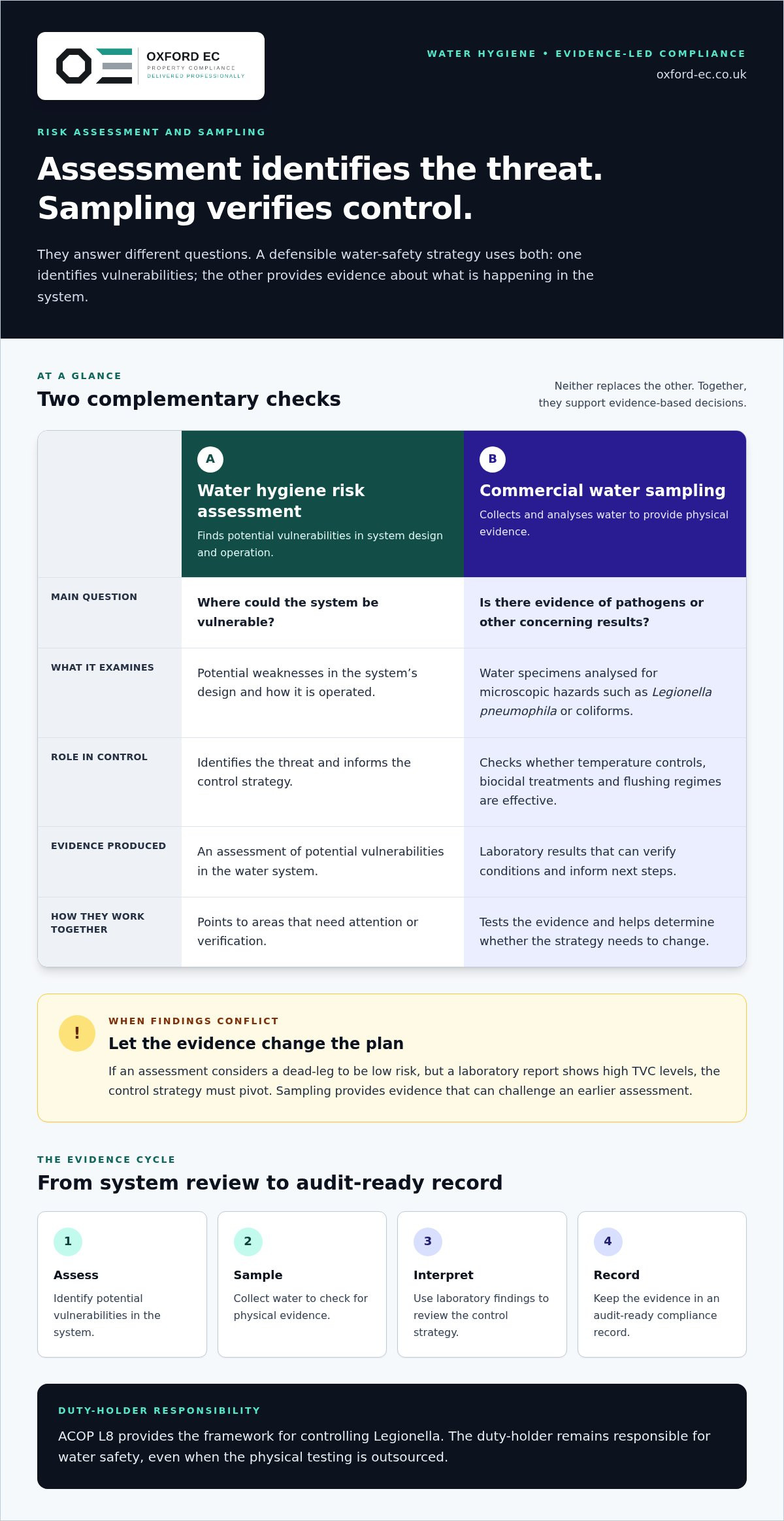
It's vital to distinguish between a survey and a sample. Whilst a water hygiene risk assessment identifies potential vulnerabilities in your system's design and operation, sampling provides the physical evidence that those vulnerabilities aren't being exploited by pathogens. One identifies the threat, whilst the other confirms the presence of the enemy. An evidence-based approach to property management requires both components to function in tandem. Commercial water sampling validates the effectiveness of your temperature controls, biocidal treatments, and flushing regimes. If your risk assessment suggests that a particular dead-leg is a low-risk area, but a laboratory report shows high TVC levels, your strategy must immediately pivot. This cycle of assessment and verification ensures your compliance record is audit-ready and legally defensible.
Critical Contaminants: What Should Businesses Test For?
Identify. Quantify. Mitigate. A robust strategy for commercial water sampling must extend beyond a singular focus on Legionella to encompass a broader spectrum of microbiological and chemical variables. Whilst Legionella pneumophila remains the primary regulatory concern due to its potential for fatal respiratory infection, it's often the presence of other indicators that reveals a system's underlying vulnerability. Total Viable Count (TVC) analysis serves as a fundamental metric for assessing the general "health" of the water system. These tests provide a baseline of microbial activity that can indicate nutrient availability or temperature failures before they escalate into a crisis.
Microbiological Risks in Commercial Systems
Stagnant water in large, complex buildings acts as a primary incubator for bacterial proliferation. In high-occupancy environments, low-use outlets or incorrectly balanced loops create "dead legs" where biofilm can flourish undisturbed. The danger becomes acute during aerosolisation. Showers, taps, and cooling towers can disperse contaminated droplets into the air, where they're easily inhaled by occupants. To ensure accuracy during collection, practitioners must adhere to proper water sampling techniques that prevent cross-contamination and preserve the integrity of the specimen. For duty-holders, these results are essential components of their Legionella risk assessments, providing the empirical data needed to justify control measures. In healthcare settings, testing for Pseudomonas aeruginosa is equally critical, as this opportunistic pathogen poses a severe risk to immunocompromised individuals in augmented care units.
Chemical and Heavy Metal Analysis
Microbes aren't the only threat to building safety. Chemical analysis, including the monitoring of pH, conductivity, and corrosion inhibitor levels, is vital for maintaining the structural integrity of the distribution network. In older properties, testing for lead and copper is necessary to ensure that leaching from legacy pipework doesn't exceed the limits set by the Private Water Supplies Regulations. High acidity or improper mineral balance can accelerate pipework degradation. This leads to leaks that compromise the building's fabric and create environments conducive to damp and mould. If you require a meticulous review of your building's water chemistry, our team can provide expert guidance on your sampling protocols. By monitoring these variables through commercial water sampling, property managers can prevent costly remedial works whilst ensuring that potable water remains safe for human consumption.
The Professional Sampling Protocol: Accuracy and Integrity
Accuracy. Integrity. Defensibility. When executing commercial water sampling, the methodology employed is just as critical as the results themselves. A laboratory report is only as reliable as the collection process that preceded it. For duty-holders, the primary objective is to obtain data that's legally robust and scientifically sound. This necessitates a move away from "DIY" testing kits, which frequently lack the rigour required for regulatory compliance. These consumer-grade solutions often fail to account for variables such as cross-contamination during handling or the degradation of biological markers during transit, rendering the final data inadmissible in a formal audit.
The use of UKAS-accredited laboratories is a non-negotiable requirement for professional property management. Accreditation ensures that the facility operates to the highest international standards, providing a "linguistic handshake" of quality that regulators recognise. Central to this is the chain of custody. Every sample must be tracked from the moment of extraction to the point of analysis, ensuring it remains untainted and temperature-controlled. Professional technicians monitor temperatures throughout the sampling process, utilising insulated transit cases to maintain the specimen between 2°C and 8°C, which prevents the artificial proliferation or die-off of bacteria whilst in transit.
Sterile Collection Techniques
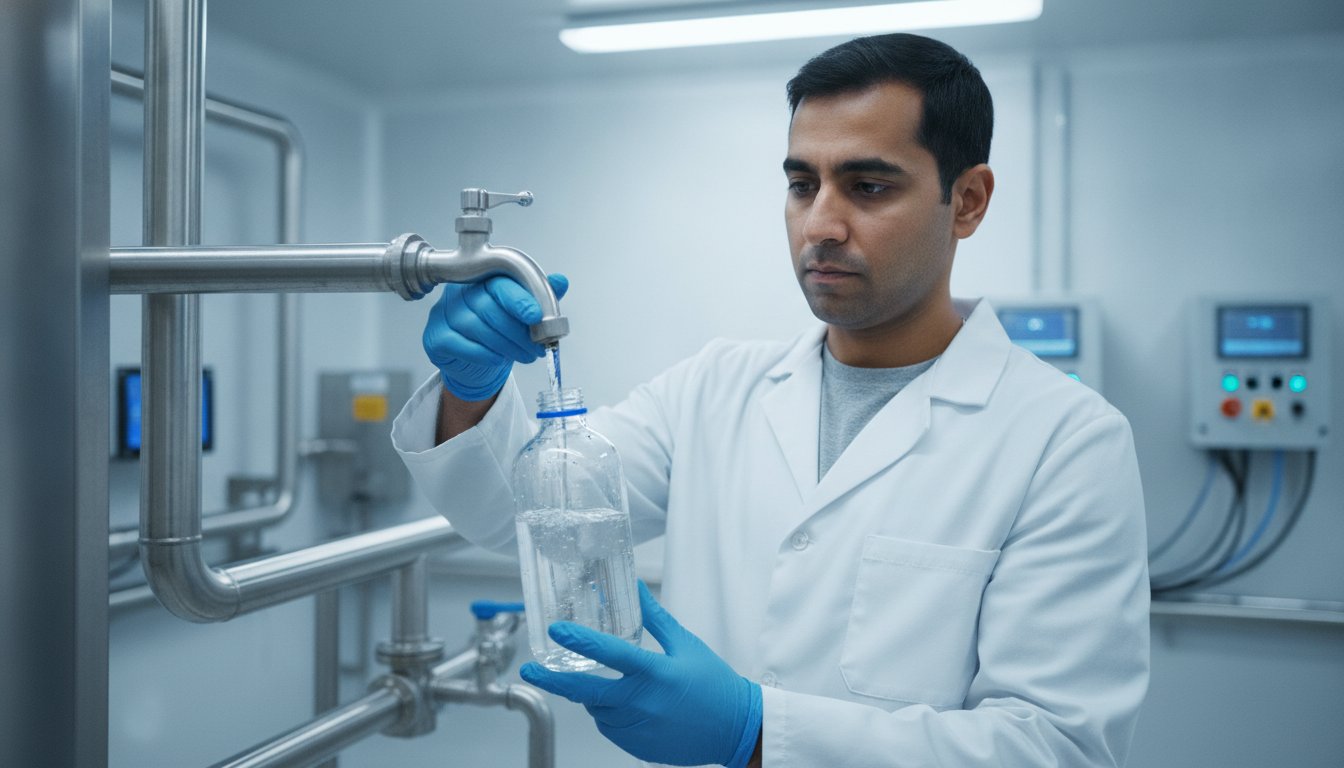
Precision begins at the outlet. Professional protocols often utilise a dual-sampling approach, taking both pre-flush and post-flush samples to pinpoint the exact source of contamination. A pre-flush sample identifies issues within the local fitting, such as a contaminated tap head, whilst a post-flush sample provides data on the condition of the wider distribution system. Technicians use standardised, sterile bottles containing neutralising agents like sodium thiosulphate, which immediately halts the action of any residual chlorine or biocides. This ensures the laboratory measures the true microbial population of the system at the time of sampling. Beyond the physical samples, all on-site testing equipment is subject to professional calibration to ensure that parameters like pH and conductivity are recorded with absolute exactness.
Laboratory Analysis and Reporting
Interpreting a water analysis report requires an understanding of specific metrics, primarily Colony Forming Units (CFU) per litre. Results are typically categorised as "Detected" or "Not Detected", with specific thresholds triggering immediate remedial action under ACOP L8 guidelines. Turnaround times vary depending on the biological culture; for example, a Legionella culture typically requires 10 to 12 days for a definitive result, whilst TVC results are often available within 48 to 72 hours. Oxford Environmental Consultants (OEC) ensures that every report is "audit-ready" by providing clear, structured summaries that translate technical data into a strategic management plan, maintaining your status as a diligent and compliant duty-holder.
Frequency and Triggers: When is Sampling Mandatory?
Schedule. Monitor. Verify. Determining the frequency of commercial water sampling isn't a matter of discretion, but a structured requirement dictated by your property's specific risk profile. Whilst ACOP L8 doesn't mandate sampling for every simple domestic-style system, it does require it for any scenario where control measures aren't consistently achieved. High-risk assets, such as cooling towers or evaporative condensers, demand a more rigorous cadence. For these systems, microbiological analysis for Legionella is typically a quarterly requirement, supplemented by weekly chemical checks to ensure biocide levels remain within effective parameters. In 2026, this landscape has expanded to include a greater focus on emerging contaminants, reflecting a global shift towards more stringent water quality scrutiny.
Routine Monitoring Frameworks
Establishing a baseline is the first step for any new or refurbished building. Before a property is handed over or re-occupied, a comprehensive suite of tests must confirm that the installation process hasn't introduced contaminants. Once operational, monthly temperature monitoring acts as the primary precursor to sampling. If cold water temperatures rise above 20°C or hot water falls below 50°C, the risk of bacterial proliferation increases, necessitating immediate commercial water sampling to validate system safety. You should integrate these tests into a broader property compliance audit to ensure no gaps exist in your safety record. Occupancy levels also play a pivotal role; buildings with low throughput or seasonal usage require more frequent testing to account for increased stagnation risks. Reviewing the Legionella testing requirements UK duty-holders must follow will help you align your schedule with current legislative expectations.
Reactive and Remedial Triggers
Compliance isn't always a scheduled event. Reactive sampling is mandatory following any period where a system has been out of use, such as after a holiday period or a temporary building closure. Stagnation is the primary driver of bacterial growth, and flushing alone may not be sufficient to restore safety. If your monitoring programme identifies a positive Legionella result or if a case of Legionnaires' disease is suspected, immediate reactive sampling is required to identify the extent of the colonisation. Significant plumbing alterations or the completion of remedial works also trigger a requirement for verification. You can't assume that a repair has been successful without the empirical proof provided by a laboratory report.
From Data to Action: Managing Your Compliance Record
Evidence. Strategy. Resolution. Obtaining a laboratory report is merely the midpoint of the compliance journey. The true value of commercial water sampling lies in the subsequent analysis and the precise implementation of corrective actions. Under UK health and safety legislation, duty-holders must maintain a meticulous record of all testing results for a minimum of five years. This historical data provides the longitudinal evidence required to prove that your water hygiene management programme is not just reactive, but consistently effective over time. Without this audit trail, your property remains legally vulnerable regardless of your physical maintenance efforts.
Technical reports often present data in a format that feels inaccessible to non-specialists. Whether it's a Total Viable Count (TVC) indicating general system cleanliness or a specific Legionella count measured in Colony Forming Units (CFU) per litre, the numbers require expert context. Oxford Environmental Consultants (OEC) acts as the "safe pair of hands" by translating these complex microbiological findings into a clear strategic roadmap. We strip away the jargon to provide a transparent overview of your system's status. This ensures you understand exactly where your risks lie and how to mitigate them without getting lost in lab-specific terminology.
Remedial Actions and Risk Mitigation
Identify. Disinfect. Verify. When a sample returns a "Positive" result for Legionella or excessive TVC levels, immediate action is mandatory. This typically involves a targeted thermal disinfection, where water temperatures are raised to 60°C or higher for a sustained period, or a chemical "shock" treatment using high-dose chlorine. Once remediation is complete, re-testing protocols must be strictly followed. You can't assume the system is clear based on the intervention alone. A follow-up round of commercial water sampling is essential to confirm the success of the disinfection before the system is deemed safe for continued use.
The OEC Advantage: Comprehensive Property Compliance
Managing a property requires a holistic view of safety. Niche laboratories often provide data in isolation, leaving the duty-holder to bridge the gap between a test result and a broader compliance strategy. OEC provides a streamlined, one-stop solution by integrating water hygiene data into a multi-disciplinary safety plan. By combining your water requirements with fire safety and asbestos management, you eliminate the fragmentation that often leads to compliance failures. This unified approach ensures that every aspect of your building's safety is managed with the same level of technical rigour and legal accountability.
Contact OEC for a professional water sampling programme
Master Your Property Compliance in 2026
Precision. Protection. Peace of mind. Effective property management in 2026 demands a shift from passive observation to rigorous, evidence-based verification. We've explored how a structured approach to commercial water sampling serves as the vital link between identifying a risk and proving its mitigation. By aligning your protocols with ACOP L8 and COSHH regulations, you transform raw laboratory data into a legally robust safety record that stands up to the highest levels of scrutiny.
Relying on meticulous expert analysis ensures that your building remains a safe environment for every tenant and employee. Oxford Environmental Consultants provides technical mastery and comprehensive property compliance across the UK, acting as your guardian against biological and legal risks. Our multi-disciplinary expertise ensures that your water, fire, and asbestos records are perfectly aligned. You don't have to navigate these complex requirements alone.
Take the decisive step towards absolute compliance today.
Frequently Asked Questions
Is commercial water sampling a legal requirement for all UK businesses?
Yes, duty-holders have a legal obligation to protect occupants under the Health and Safety at Work etc. Act 1974. Whilst ACOP L8 doesn't mandate sampling for every single outlet, it requires it whenever control measures like temperature aren't consistently achieved. It's a critical verification step for proving that your biological risk management strategy is functioning correctly in a professional environment.
How often should a commercial building test for Legionella?
Frequency is determined by your specific risk profile and asset types. Cooling towers and evaporative condensers require quarterly commercial water sampling as a minimum. For standard domestic systems, sampling is often triggered by temperature failures, system stagnation, or as part of a routine annual verification. High-occupancy buildings or healthcare settings may require more frequent microbiological monitoring to protect vulnerable occupants.
What is the difference between a water risk assessment and water sampling?
A risk assessment is a qualitative survey that identifies potential hazards and vulnerabilities within your water distribution network. Sampling is the quantitative verification of those risks through laboratory analysis. You can't rely on an assessment alone to prove a system is safe; sampling provides the empirical data required to validate that your control measures are actually working.
Can I take my own water samples for laboratory analysis?
Whilst you can purchase kits, "DIY" collection lacks the technical rigour required for a legally defensible audit trail. Professional technicians follow sterile protocols, use specific neutralising agents like sodium thiosulphate, and maintain a strict temperature-controlled chain of custody. Samples collected by untrained personnel are frequently contaminated or degraded during transit, rendering the laboratory results inaccurate and inadmissible for compliance purposes.
What happens if Legionella is found in my building’s water supply?
Immediate remedial intervention is required to protect building occupants. You must implement thermal or chemical disinfection and conduct a thorough review of your current control measures to identify the failure point. Following the disinfection, you must perform follow-up commercial water sampling to confirm the pathogen has been eradicated. All actions and re-test results must be documented in your compliance logbook.
How long do I need to keep water sampling records for compliance?
You're legally required to retain all water hygiene records for at least five years. This includes your risk assessments, monitoring data, and laboratory analysis reports. Maintaining this meticulous historical record is vital for demonstrating a continuous commitment to safety. If an incident occurs, these documents serve as your primary evidence that you've fulfilled your legal duties as a responsible duty-holder.
What is a UKAS-accredited laboratory and why does it matter?
A UKAS-accredited laboratory has been independently verified for its technical proficiency and adherence to international quality standards. This accreditation is the "gold standard" for accuracy and reliability in environmental testing. Using an accredited facility ensures that your data is scientifically sound and legally robust. Regulators and health and safety inspectors will typically only accept reports from laboratories that carry this specific mark of quality.
Does a landlord or a tenant have the duty to organise water sampling?
The responsibility typically falls upon the "duty-holder", which is the individual or entity in control of the premises. In a commercial setting, this is often the employer or the building manager. Whilst lease agreements may distribute specific maintenance tasks, the legal accountability for ensuring a safe water supply remains with the party responsible for the health and safety of those on-site.