

Facilities management compliance represents the intersection of statutory duty, operational excellence, and risk mitigation. In 2026, duty holders across commercial and residential portfolios face an increasingly complex web of regulations spanning fire safety, asbestos management, water hygiene, damp and mould control, and structural building safety. The consequences of non-compliance extend far beyond financial penalties, encompassing criminal liability, enforcement notices, insurance invalidation, and reputational damage that can fundamentally threaten business continuity.
The Compliance Landscape in 2026
The regulatory environment governing facilities management compliance has undergone substantial evolution following high-profile incidents and subsequent legislative reform. The Building Safety Act 2022 introduced the concept of Accountable Persons and Principal Accountable Persons, creating personal liability frameworks that extend criminal accountability to named individuals rather than corporate entities alone.
This shift has fundamentally altered how organisations approach compliance. Where previous regimes permitted delegation without consequence, current legislation demands demonstrable competence, documented decision-making, and traceable accountability chains. Duty holders must now evidence not merely that inspections occurred, but that competent persons conducted them, that findings triggered proportionate action, and that risks remain under active management.
Regulatory Touchpoints Across the FM Lifecycle
Facilities management compliance intersects with multiple regulatory frameworks simultaneously:
- Fire Safety: Regulatory Reform (Fire Safety) Order 2005, Fire Safety Act 2021, BS 9997, PAS 79-1/79-2
- Asbestos: Control of Asbestos Regulations 2012, HSG 264
- Water Hygiene: Health and Safety at Work Act 1974, ACoP L8, BS 8580-1
- Building Safety: Building Safety Act 2022, Higher-Risk Building Regulations
- Health and Safety: Workplace (Health, Safety and Welfare) Regulations 1992, Management of Health and Safety at Work Regulations 1999
- Housing Standards: Homes (Fitness for Human Habitation) Act 2018, Social Housing (Regulation) Act 2023
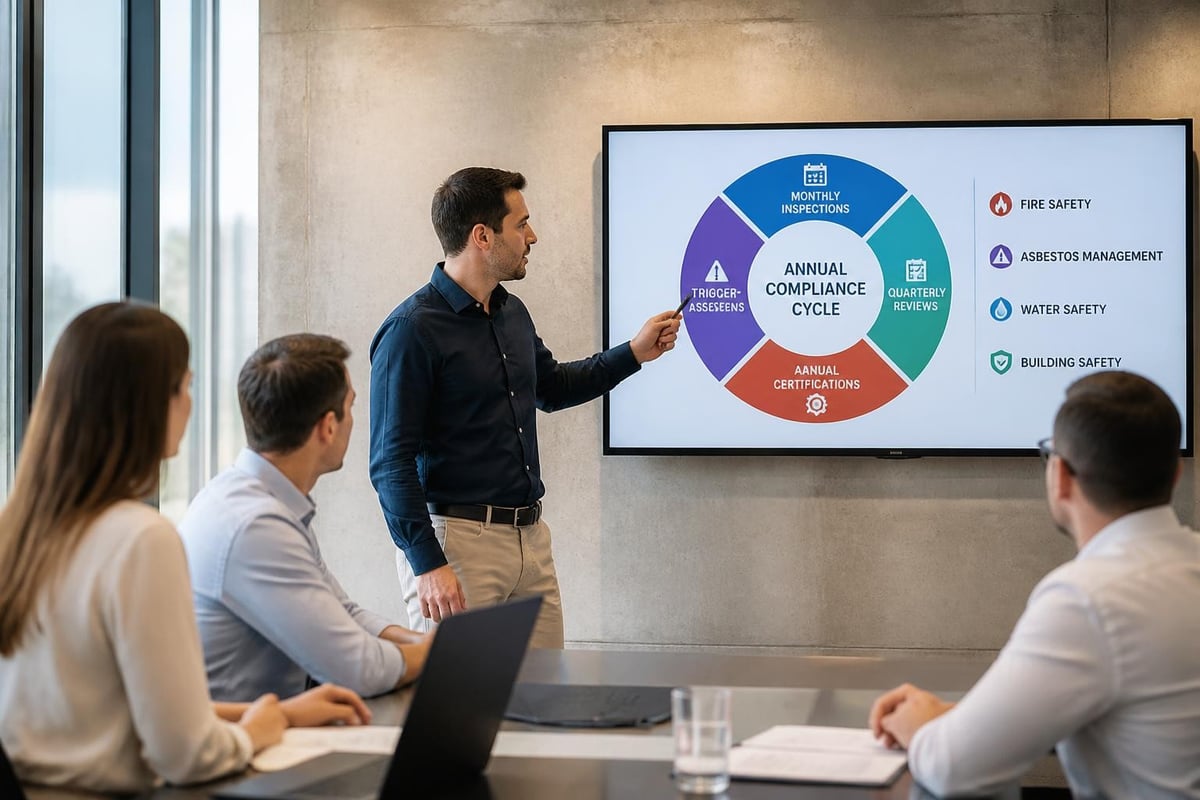
Each framework imposes distinct obligations, reporting requirements, and competence thresholds. The challenge lies not in addressing any single domain, but in orchestrating a unified compliance strategy that satisfies all applicable regimes whilst remaining operationally sustainable and financially viable.
Building a Compliance Framework That Withstands Scrutiny
Effective facilities management compliance rests on documented systems rather than individual expertise. Compliance frameworks in facilities management provide the structural foundation that ensures consistency, traceability, and resilience against staff turnover or organisational change.
A defensible compliance framework comprises five core elements:
- Risk Assessment Foundation: Comprehensive, competent-person assessments across all applicable disciplines
- Priority Action Plans: Costed, time-bound remedial programmes aligned to risk scoring methodologies
- Management Plans: Living documents defining routine inspections, testing regimes, and escalation protocols
- Competence Verification: Documented evidence of surveyor qualifications, accreditations, and insurance
- Audit Trail Architecture: Centralised record-keeping systems linking assessments to actions to completion evidence
Documentation Standards for Audit-Ready Compliance
The ProFM Body of Knowledge emphasises that compliance documentation must satisfy both operational and evidential requirements. Operational documentation guides day-to-day decision-making; evidential documentation demonstrates compliance to regulators, insurers, and legal counsel.
| Document Type | Operational Purpose | Evidential Purpose | Retention Period |
|---|---|---|---|
| Risk Assessments | Identifies hazards and controls | Proves competent assessment | Life of building + 40 years |
| Inspection Records | Tracks asset condition | Demonstrates duty discharge | 6 years minimum |
| Test Certificates | Confirms system function | Validates compliance | Until superseded + 2 years |
| Remedial Logs | Manages corrective actions | Shows timely response | Permanent |
| Training Records | Ensures competence | Verifies qualification | Employment + 6 years |
This dual-purpose approach ensures that compliance systems serve immediate operational needs whilst simultaneously building the defensible evidence base required in enforcement actions or civil proceedings.
Fire Safety Compliance: Beyond Tick-Box Assessment
Fire safety represents the most heavily regulated aspect of facilities management compliance, with overlapping duties under the Regulatory Reform (Fire Safety) Order 2005, the Fire Safety Act 2021, and building-specific regulations for higher-risk residential buildings.
Responsible Persons must appoint competent persons to conduct Fire Risk Assessments aligned to PAS 79-1 for non-residential premises and PAS 79-2 for residential buildings. These assessments extend beyond simple identification of fire hazards to encompass management systems, maintenance regimes, and human behaviour factors.

The Five-Pillar Fire Safety Model
Comprehensive fire safety compliance demands integrated attention across five interconnected domains:
Detection and Warning Systems: Conformance to BS 5839-1 for commercial premises or BS 5839-6 for residential properties, with category appropriate to building risk profile and occupancy characteristics.
Means of Escape: Protected routes, fire doors meeting certification standards, emergency lighting providing minimum illumination levels, and directional signage complying with BS 5499.
Passive Fire Protection: Compartmentation integrity across floors and walls, service penetration fire-stopping, cavity barriers in concealed voids, and external wall construction meeting performance standards.
Active Suppression: Sprinkler systems, dry risers, wet risers, and fire extinguishers positioned according to BS 5306 recommendations.
Management and Maintenance: Testing schedules, staff training, emergency plans, evacuation drills, and contractor permit-to-work systems.
Failure in any single pillar compromises the entire fire strategy. Understanding fire safety compliance requires recognising these interdependencies and managing them as an integrated system rather than isolated components.
Asbestos Management: The Silent Compliance Obligation
The Control of Asbestos Regulations 2012 impose absolute duties on those who manage non-domestic premises to identify asbestos-containing materials (ACMs) and manage the risks they present. Unlike fire safety, where risk assessment triggers action, asbestos compliance begins with a presumption: all buildings constructed or refurbished before 2000 must be presumed to contain asbestos until proven otherwise.
Duty holders must commission management surveys conforming to HSG 264 standards, establish asbestos registers with photographic evidence and material risk scores, and implement management plans defining inspection frequencies, access controls, and emergency procedures.
Asbestos Compliance in Practice
Annual re-inspections of known ACMs assess material condition against deterioration criteria, updating risk scores and triggering encapsulation or removal where condition has degraded. Before any refurbishment or demolition work, duty holders must commission fully intrusive surveys identifying every material containing asbestos, with destructive investigation where necessary.
The multi-discipline approach to asbestos management recognises that asbestos risks intersect with maintenance activities, capital projects, and routine FM operations. Failure to integrate asbestos management into work planning exposes contractors to fibre exposure and duty holders to criminal prosecution.

Water Hygiene and Legionella Control
Legionella bacteria thrive in water systems maintained between 20°C and 45°C, making commercial and residential buildings with hot and cold water services, cooling towers, or evaporative condensers inherently susceptible. The Health and Safety at Work Act 1974 and ACoP L8 impose duties to assess and control legionella risks through systematic management approaches.
Legionella risk assessments aligned to BS 8580-1 identify potential bacterial amplification sites, evaluate exposure routes, and define control measures spanning temperature management, system cleanliness, water treatment, and monitoring regimes. Written schemes of control translate risk assessment findings into actionable procedures that facilities management teams can implement consistently.
Monthly temperature monitoring, quarterly cleaning and disinfection of cold water storage tanks, annual thermostatic mixing valve servicing, and biannual sampling for legionella, pseudomonas, and total viable counts create the evidence trail demonstrating active risk management. UKAS laboratory analysis provides the independent verification that duty holders have discharged their obligations competently.
Damp and Mould: The Emerging Compliance Frontier
The Social Housing (Regulation) Act 2023 and Awaab's Law introduced mandatory timescales for landlords to investigate and remediate damp and mould hazards in residential properties. Following the tragic death of two-year-old Awaab Ishak, these provisions impose strict statutory deadlines: 14 days to investigate reported hazards and further prescribed periods to complete remediation based on hazard severity.
Whilst these requirements initially targeted social housing, the Homes (Fitness for Human Habitation) Act 2018 and the Health and Safety at Work Act 1974 create parallel obligations for private landlords and commercial duty holders. Damp and mould now represent compliance risks of equivalent gravity to asbestos or fire safety.
A Systematic Approach to Damp and Mould Compliance
Effective compliance demands moving beyond reactive repair to systematic identification and root-cause resolution:
- Occupant Reporting Systems: Accessible channels for tenants to report concerns with documented acknowledgement and tracking
- Proactive Surveys: Regular inspections identifying damp and mould before occupant complaints
- Diagnostic Investigation: Moisture mapping, thermal imaging, and ventilation assessment to determine causation
- Remediation with Root-Cause Resolution: Addressing underlying building defects, not merely surface treatment
- Post-Remediation Verification: Independent inspection confirming effective resolution
The comprehensive approach to damp and mould recognises that surface mould represents a symptom of underlying building performance failure. Compliance requires addressing condensation risk, thermal bridging, ventilation inadequacy, water ingress, or rising damp-not simply applying anti-fungal treatments.
Data Protection and Compliance Record Management
Facilities management compliance generates substantial volumes of personal data, from asbestos registers identifying individual offices to fire evacuation plans listing Personal Emergency Evacuation Plans (PEEPs) for disabled occupants. The UK General Data Protection Regulation imposes obligations on data controllers to process this information lawfully, store it securely, and delete it when no longer required.
The tension between data protection requirements and regulatory retention obligations demands careful navigation. Facilities management compliance in the UK must balance the GDPR principle of storage limitation against regulatory requirements to retain asbestos records for the life of the building plus forty years.
Anonymisation, pseudonymisation, and access controls provide mechanisms to satisfy both regimes. Fire evacuation plans can reference role titles rather than names; asbestos registers can identify locations without naming occupants; water temperature logs can record asset identifiers without personal references.
Competence: The Foundation of Defensible Compliance
Regulatory frameworks increasingly emphasise competence as the distinguishing factor between compliance and non-compliance. The Building Safety Act 2022 defines competence across knowledge, skills, experience, and behaviours-rejecting the notion that qualifications alone suffice.
Duty holders must demonstrate that appointed persons possess:
- Technical Knowledge: Understanding of regulatory requirements, industry standards, and best practice guidance
- Practical Skills: Ability to conduct assessments, operate testing equipment, and interpret results
- Relevant Experience: Track record in similar buildings, systems, or risk profiles
- Professional Behaviours: Independence, objectivity, and willingness to challenge inadequate standards
Verifying Competence in Practice
The ASHE Core Competency Framework provides a structured model for evaluating facilities management compliance competence across knowledge domains, skill applications, and performance indicators.
| Competence Domain | Verification Method | Evidence Required |
|---|---|---|
| Qualifications | Certificate review | NEBOSH, RSPH, BOHS, IFE |
| Accreditation | Body membership check | RICS, CIOB, IWFM, CABE |
| Insurance | Policy review | Professional indemnity minimum £5m |
| Experience | Project reference validation | Similar scope, scale, complexity |
| Continuity | Staff retention data | Surveyor assignment consistency |
Organisations consolidating compliance under specialist consultancies gain access to depth and breadth of competence unachievable through generalist FM providers. Multi-discipline practices employ dedicated specialists in each regulatory domain, ensuring assessments reflect current standards and emerging case law.
Federal Facilities and Specialised Compliance Requirements
Whilst this guide focuses on UK regulatory frameworks, facilities managers operating specialised environments face additional compliance obligations. Healthcare facilities must satisfy Care Quality Commission standards; educational institutions answer to Ofsted requirements; government buildings comply with federal facility management benchmarking requirements where applicable.
The principle remains consistent: identify all applicable regulatory frameworks, assess current compliance status, implement remedial programmes addressing gaps, and maintain systems ensuring ongoing conformance. Modern facilities management compliance demands integrated platforms connecting regulatory obligations to operational tasks to completion evidence.
Facilities management compliance integration showing regulatory requirements flowing into risk assessments, generating priority actions, triggering maintenance tasks, creating completion records, and producing audit reports within a unified management system
Technology and Compliance Management Systems
Digital compliance platforms transform facilities management compliance from reactive firefighting to proactive risk management. Cloud-based systems centralise risk assessments, inspection schedules, remedial tracking, and certification management within unified databases accessible to duty holders, facilities teams, and appointed consultancies.
Automated workflows trigger inspection requirements based on regulatory frequencies, asset criticality, and risk scores. Mobile applications enable on-site data capture with photographic evidence, GPS location stamping, and real-time synchronisation to central records. Dashboard analytics provide portfolio-wide visibility of compliance status, highlighting emerging risks before they escalate to enforcement actions.
Integration with building management systems enables automated temperature monitoring for water hygiene compliance, fire alarm fault logging, and emergency lighting duration testing. This convergence of facilities management compliance and building automation reduces manual intervention whilst enhancing evidence quality and audit trail completeness.
The Financial Case for Proactive Compliance
Facilities management compliance represents a cost centre in financial reporting but functions as a risk mitigation investment in operational reality. The direct costs of surveys, testing, and remediation appear in annual budgets; the avoided costs of enforcement notices, civil claims, and insurance premium increases remain invisible until compliance fails.
A comprehensive facility management compliance checklist demonstrates that preventive maintenance and proactive compliance cost substantially less than reactive responses to regulatory enforcement or catastrophic failures.
Return on Investment in Compliance Excellence
- Insurance Premium Reductions: Demonstrable compliance management can reduce premiums by 15-30%
- Enforcement Action Avoidance: A single improvement notice triggers legal fees, consultant appointments, and priority remediation
- Asset Longevity: Systematic maintenance extends building component lifecycles by 20-40%
- Liability Limitation: Documented competent assessment and proportionate action provides civil claim defence
- Operational Continuity: Planned compliance activities avoid service disruption from emergency closures
The strategic value of consolidating compliance extends beyond cost efficiency to encompass risk reduction, evidence quality, and strategic visibility that multi-vendor fragmentation cannot achieve.
Building a Culture of Compliance
Facilities management compliance fails when organisations treat it as a procurement exercise rather than a cultural commitment. Appointing competent consultancies and implementing digital platforms provide necessary foundations, but sustainable compliance demands engagement across organisational hierarchies.
Senior leadership must allocate adequate budgets, accept that compliant buildings cost more to operate than non-compliant ones, and resist pressures to defer necessary remediation. Facilities managers require authority to pause works when asbestos risks emerge, challenge contractors proposing non-compliant methodologies, and escalate unresolved issues without career consequences.
Operational teams need training to recognise compliance triggers: the maintenance task requiring asbestos survey updates, the water system modification demanding legionella risk assessment review, the door replacement requiring fire certification verification. This distributed compliance awareness transforms facilities management from a specialist function to an organisational competence.
Facilities management compliance in 2026 demands integrated thinking, specialist competence, and systematic evidence creation across multiple regulatory domains simultaneously. Duty holders who treat compliance as fragmented procurement exercises expose themselves to gaps that regulatory frameworks specifically target. Oxford Environmental Consultants delivers one-stop, multi-discipline risk management across asbestos, fire safety, water hygiene, damp and mould, and building safety with audit-ready precision, nationwide. Contact us to consolidate your compliance obligations under a single, competent, accountable partner.