

The "Legionella certificate" you are being pressured to provide is a legal fiction. Rigorous compliance. Absolute precision. Statutory protection. Whilst many letting agents insist upon a legionella certificate for landlords, the Health and Safety Executive does not actually recognise or require such a document. You likely feel the weight of this confusion, especially when the threat of a £20,000 fine for non-compliance looms over your property portfolio. It's frustrating to manage conflicting advice while trying to ensure your tenants remain safe from waterborne pathogens.
This guide will dismantle the myths surrounding water hygiene and provide a definitive roadmap for meeting your obligations under the Health and Safety at Work etc. Act 1974. You'll learn exactly how to conduct a valid risk assessment, when to appoint a competent professional, and how to maintain the audit-ready records necessary to shield yourself from legal liability. We'll explore the technical parameters of ACOP L8, the necessity of water sampling in high-risk systems, and the practical steps to keep your cold water below 20°C and your hot water stored safely at 60°C to ensure total regulatory alignment.
Key Takeaways
- Understand why the term legionella certificate for landlords is a misnomer and why the statutory focus remains on a robust, evidence-based risk assessment.
- Navigate the legislative requirements of the Health and Safety at Work etc. Act 1974 and COSHH 2002 to ensure full legal robustness and protection.
- Evaluate the criteria for technical competence to decide whether a professional assessment or a self-managed survey is appropriate for your specific property type.
- Implement a structured hazard identification process that scrutinises both mechanical system integrity and specific tenant vulnerability factors.
- Master the strategic review cycles and triggers that keep your safety documentation accurate, relevant, and fully audit-ready throughout the tenancy.
Table of Contents
- Understanding the Legionella Certificate Myth for Landlords
- The Legal Framework: Statutory Obligations for Residential Landlords
- How to Carry Out a Landlord Legionella Risk Assessment
- Professional vs DIY Assessments: Evaluating Competence and Risk
- Maintaining Compliance: Record Keeping and Review Cycles
Understanding the Legionella Certificate Myth for Landlords
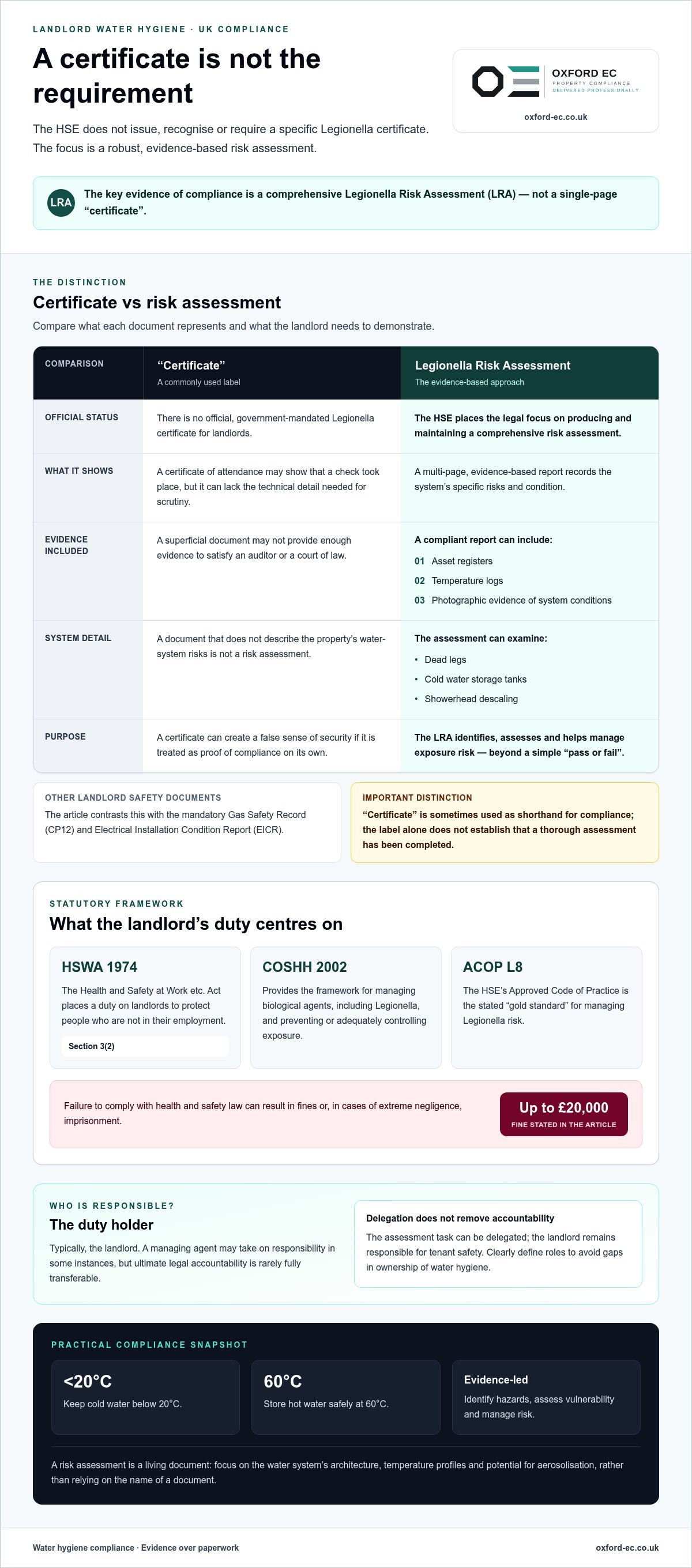
The search for a legionella certificate for landlords often begins with a fundamental misunderstanding of UK safety legislation. Statutory clarity. Technical precision. Legal robustness. Unlike the mandatory Gas Safety Record (CP12) or the Electrical Installation Condition Report (EICR), there is no official, government-mandated "certificate" for water hygiene. The Health and Safety Executive (HSE) does not issue, recognise, or require a specific certificate to prove compliance. Instead, the legal burden rests entirely on the production and maintenance of a comprehensive Legionella Risk Assessment (LRA).
Why Landlords Search for Certificates
Many property owners mistakenly seek a single-page document to mirror their other annual safety checks. This misconception is often reinforced by letting agents or insurance providers who use "certificate" as shorthand for compliance. Whilst searching for a legionella certificate for landlords might seem like the logical path to immunity, a "certificate of attendance" lacks the technical depth required to satisfy an auditor or a court of law. Relying on a superficial document provides no legal protection; it merely creates a false sense of security that evaporates under regulatory scrutiny. Understanding What is Legionella bacteria and how it colonises domestic systems is the first step toward genuine protection.
In the insurance and letting industries, the term "certificate" is often used loosely to describe any document that suggests a check has been performed. This is dangerous. A compliant risk assessment report is a multi-page, evidence-based document that includes asset registers, temperature logs, and photographic evidence of system conditions. If your documentation doesn't detail the specific risks associated with dead legs, cold water storage tanks, or showerhead descaling, it isn't a risk assessment. It's a liability. Professional water hygiene services ensure that your records are audit-ready and legally robust.
The Real Goal: Statutory Compliance
True safety is not a tick-box exercise. It's a proactive management strategy. Identify hazards. Assess vulnerability. Manage risk. Landlords must demonstrate they have taken "reasonably practicable" steps to safeguard tenants, a requirement that goes far beyond simply holding a piece of paper. A professional risk assessment serves as the primary evidence of this duty of care, providing a defensive shield in the event of a health and safety investigation. A Legionella Risk Assessment is a living document that identifies, assesses, and manages the risk of exposure. It moves beyond the binary "pass or fail" of a certificate to provide an exhaustive audit of the water system's architecture, temperature profiles, and potential for aerosolisation. By focusing on the quality of the assessment rather than the name of the document, landlords ensure both tenant safety and their own legal standing.
The Legal Framework: Statutory Obligations for Residential Landlords
Statutory duty. Legal accountability. Regulatory scrutiny. Under the Health and Safety at Work etc. Act 1974 (HSWA), landlords are classified as self-employed business owners with a clear obligation to protect those not in their employment. This duty is specifically articulated in Section 3(2), which mandates that you conduct your undertakings in a manner that does not expose tenants to health risks. Whilst you might be searching for a legionella certificate for landlords, the law actually demands evidence of a rigorous risk management process rather than a standalone piece of paper.
The Control of Substances Hazardous to Health (COSHH) Regulations 2002 provides the framework for managing biological agents, including Legionella. Because Legionella bacteria are classified as a hazardous substance, landlords must prevent or adequately control exposure. The "gold standard" for achieving this is the HSE's Approved Code of Practice L8 (ACOP L8). This document carries special legal status; if you are prosecuted for a breach of health and safety law and it's proved you didn't follow the relevant provisions of the Code, you'll need to demonstrate that you complied with the law in some other way. Detailed HSE guidance on Legionella responsibilities confirms that failure to comply can result in fines of up to £20,000 or even imprisonment in cases of extreme negligence.
Who is the "Duty Holder"?
The "Duty Holder" is typically the landlord. In some instances, this responsibility may fall to a managing agent, but legal accountability is rarely fully transferable. You can delegate the task of assessment, but you cannot delegate the ultimate responsibility for tenant safety. It's essential to define these roles within your management contracts to avoid "compliance gaps" where neither party takes ownership of water hygiene. If you're unsure of your current standing, you should consult a compliance specialist to review your portfolio's safety status and ensure your records are audit-ready.
Specific Legislation for HMOs and Social Housing
Houses in Multiple Occupation (HMOs) and mixed-use properties face heightened scrutiny due to the complexity of their plumbing architectures. The Building Safety Act 2022 has further tightened requirements for high-rise residential buildings, necessitating a more granular approach to risk management. Legionella compliance frequently overlaps with Damp and Mould Inspection requirements; stagnant water and poor ventilation often share the same root causes in poorly maintained properties. Ensuring your professional damp and mould inspection coincides with water safety checks creates a multi-disciplinary shield against property-related litigation and ensures total alignment with current standards.
How to Carry Out a Landlord Legionella Risk Assessment
Systematic scrutiny. Methodical execution. Total compliance. Whilst the industry frequently discusses the legionella certificate for landlords, the statutory reality is a technical evaluation of the water system's architecture and its potential to harbour pathogens. This process must account for the susceptibility of the tenant profile; elderly residents, smokers, or those with compromised respiratory systems are at significantly higher risk of contracting Legionnaires' disease. A professional Legionella risk assessment goes beyond a visual check, providing a forensic analysis of the conditions that allow bacteria to thrive.
Step 1: Identifying the Risk Factors
Inspecting the physical infrastructure is the primary requirement. You must examine cold water storage tanks for signs of corrosion, organic detritus, or sediment, as these materials provide the essential nutrient source for bacterial colonisation. Showerheads and taps require close inspection for limescale and biofilm, which act as protective harbours against thermal and chemical treatments. The water heater, or calorifier, must be scrutinised to ensure it achieves and maintains the necessary thermal threshold to neutralise pathogens before they reach the tenant's outlets.
Step 2: Implementing Control Measures
Mitigation follows identification. A robust flushing programme is essential for vacant properties or infrequently used guest rooms to prevent the stagnation that encourages bacterial growth. The "50/20 rule" remains the cornerstone of thermal control; hot water must reach 50°C at the outlet within one minute of operation, whilst cold water must remain below 20°C to prevent the bacteria from entering its rapid growth phase. Stagnant "dead legs", which are redundant lengths of pipework where water cannot circulate, must be identified and removed. Quarterly descaling and disinfection of showerheads is a non-negotiable maintenance task for any landlord seeking a legionella certificate for landlords that actually holds legal weight.
Step 3: Documenting the Findings
Documentation is the definitive evidence of your diligence. A professional report must contain an asset register, a photographic log of system conditions, and a prioritised list of remedial recommendations. For properties with complex water systems or cooling towers, a "written scheme of control" is mandatory to outline the ongoing management strategy. Documentation must be kept for at least five years to satisfy HSE inspectors. This record-keeping ensures that your safety management is transparent, accountable, and fully aligned with the requirements of ACOP L8.
Professional vs DIY Assessments: Evaluating Competence and Risk
Technical mastery. Regulatory alignment. Absolute accountability. Under the HSE's ACOP L8, the person carrying out a risk assessment must be "competent" to do so. This means they must possess the necessary skills, knowledge, and experience to identify hazards and implement control measures effectively. Whilst many property owners believe they can issue their own legionella certificate for landlords, the HSE's definition of a "competent person" is the true benchmark for compliance. If you lack the technical understanding of water system architecture, your assessment will not withstand legal scrutiny.
A DIY assessment is only appropriate for the simplest of domestic systems. Small flats with direct mains-fed combi-boilers and no cold water storage tanks are generally considered low risk. In these specific cases, a landlord with a basic understanding of water hygiene may be able to conduct the survey. However, the complexity of a property changes the compliance landscape immediately. Relying on a self-issued legionella certificate for landlords for a complex HMO or a property with shared water services is a significant regulatory risk that could lead to prosecution in the event of an outbreak.
Several red flags mandate professional intervention. If your property contains cold water storage tanks, calorifiers, or thermostatic mixing valves (TMVs), the risk profile increases exponentially. These components require specialised knowledge to inspect and maintain. The hidden cost of a DIY error is far higher than the price of a professional survey; an inadequate report can lead to the invalidation of your landlord insurance and leave you personally liable for health and safety breaches.
The Risks of Self-Assessment
Self-assessment often leads to the "blind spot" phenomenon. Landlords frequently overlook technical hazards like thermostatic mixing valves, which can harbour bacteria if not properly maintained, or "dead legs" hidden behind kitchen cabinetry. Inadequate record-keeping is another common failure; a few handwritten notes won't satisfy an HSE inspector. Your documentation must be exhaustive, photographic, and fully audit-ready to provide a robust legal defence. Professional auditors see the risks that property owners simply miss through familiarity or lack of technical training.
The Value of a Professional Water Hygiene Survey
Appointing a professional consultant provides access to high-level technical resources. This includes UKAS-accredited Water Sampling and laboratory analysis, which is essential if a risk assessment identifies a potential contamination issue. You receive expert advice on remedial works, such as the removal of redundant pipework or the re-insulation of tanks, to eliminate risks permanently. Most importantly, a comprehensive Water Hygiene Risk Assessment provides the peace of mind that your tenants are safe and your business is fully protected against litigation.
Maintaining Compliance: Record Keeping and Review Cycles
Systematic vigilance. Continuous monitoring. Absolute transparency. Compliance is not a static state but a perpetual management requirement that demands ongoing scrutiny. Whilst many property owners believe that obtaining a legionella certificate for landlords marks the end of their responsibilities, the statutory framework requires a living record of safety. You must maintain an active log of temperature checks, flushing regimes, and remedial actions to ensure your documentation remains audit-ready and legally resilient. This level of detail is necessary to prove that your duty of care is being exercised on a daily basis, not just on the day of the initial assessment.
Review Triggers and Frequency
A risk assessment is not a "once and for all" document. You must review your assessment whenever there is a significant change to the water system architecture, such as the installation of new storage tanks or the removal of redundant pipework. Changes in tenant vulnerability also necessitate a fresh evaluation; transitioning to elderly occupants or those with respiratory conditions increases the risk profile of the property. New legislative guidance or updates to ACOP L8 also serve as critical triggers for an immediate review of your scheme of control to ensure your management practices remain aligned with the latest health and safety standards.
Successful long-term management depends on clear communication with your occupants. Landlords should provide tenants with specific guidance on water hygiene, including the requirement to descale showerheads every three months and the importance of flushing taps after periods of vacancy or holidays. This transparency creates a documented trail of your diligence as a duty holder. It moves your safety strategy beyond the search for a legionella certificate for landlords toward a culture of genuine risk reduction that protects both your tenants and your legal standing.
The Multi-Disciplinary Advantage
Managing a property portfolio requires balancing multiple technical requirements across diverse locations. Integrating water hygiene into a broader Property Compliance strategy allows for a streamlined, logical solution to risk management. Combining your Legionella checks with Fire Risk Assessments or Asbestos Management Surveys ensures all statutory duties are met through a single, accountable partner. This holistic approach eliminates fragmented reporting and ensures your technical documentation is consistently high-register and legally robust across your entire estate.
Contact Oxford Environmental Consultants (OEC) for a professional assessment
Securing Your Statutory Compliance
Achieving full regulatory alignment requires moving beyond the persistent myth of the legionella certificate for landlords. Statutory protection is anchored in the technical depth of your risk assessment rather than a superficial document. Landlords must prioritise the forensic identification of system hazards and the implementation of a structured written scheme of control to satisfy the HSE's uncompromising standards. This process ensures that every thermal threshold and flushing regime is documented with the precision required for a robust legal defence.
Rigorous oversight. Legal robustness. Total peace of mind. Oxford Environmental Consultants (OEC) acts as your safe pair of hands, providing multi-disciplinary safety expertise that spans the entire United Kingdom. Our meticulous consultants deliver detailed, audit-ready compliance reporting that bridges the gap between fragmented safety checks and absolute regulatory assurance. We provide the technical mastery needed to manage complex water architectures and protect your property portfolio from the severe penalties of non-compliance.
Safeguarding your tenants and your reputation starts with precise, evidence-based water hygiene management. Take the first step toward absolute property safety today.
Frequently Asked Questions
Is a Legionella risk assessment a legal requirement for landlords?
Yes, conducting a risk assessment is a mandatory statutory obligation. Under the Health and Safety at Work etc. Act 1974 and the COSHH Regulations 2002, landlords must identify and assess sources of risk in their water systems. This duty ensures that pathogens are managed effectively to prevent tenant exposure to Legionnaires' disease.
Do I need a Legionella test certificate to rent out my property?
No, there is no official or statutory "test certificate" recognised by the Health and Safety Executive. Whilst you may encounter a legionella certificate for landlords offered by some providers, the actual legal requirement is a detailed risk assessment report. A simple certificate lacks the technical depth needed to provide legal immunity during a regulatory audit.
How often does a landlord Legionella risk assessment need to be done?
There is no fixed period for renewal, but the assessment must be reviewed whenever there is a significant change to the water system or building use. Common triggers include new plumbing installations, changes in the vulnerability of the tenant population, or properties remaining vacant for several weeks. Regular reviews ensure your safety documentation remains accurate and relevant.
Can I carry out a Legionella risk assessment myself as a landlord?
You can perform the assessment if you are "competent" to do so. This means you must possess the technical knowledge to identify hazards like dead legs, stagnation, and incorrect temperature profiles. For anything beyond the simplest mains-fed systems, appointing a professional ensures your records are audit-ready and legally robust.
What happens if a tenant contracts Legionnaires’ disease in my property?
You will face an immediate investigation by the Health and Safety Executive or local authorities. If you cannot produce a valid risk assessment proving you took "reasonably practicable" steps to manage the water system, you could face fines of up to £20,000. Negligence can also lead to criminal prosecution and significant civil compensation claims.
Does a Legionella risk assessment apply to properties with no water tanks?
Yes, all rental properties require an assessment regardless of their plumbing configuration. Properties with combi-boilers and no storage tanks are typically lower risk, but they still contain outlets like showerheads where scale and biofilm can harbour bacteria. The assessment serves as the necessary evidence that you have considered and managed these risks.
How much does a professional Legionella risk assessment cost for a landlord?
Professional fees vary based on the property's size, the number of water outlets, and the complexity of the plumbing architecture. A standard residential flat requires less time to survey than a large House in Multiple Occupation (HMO) with shared facilities and water storage. You should seek a site-specific quote to ensure all technical parameters are covered.
What should be included in a Legionella risk assessment report?
A compliant report must include a full asset register, water temperature logs, and photographic evidence of the system's condition. It should also feature a prioritised list of remedial actions and a written scheme of control for managing ongoing risks. This level of detail is essential for a legionella certificate for landlords to be considered valid during a safety inspection.