

Did you know that 42% of commercial fire safety audits conducted by UK Fire and Rescue Services were deemed unsatisfactory in the most recent reporting period? Precise auditing. Expert delivery. Total accountability. For the modern duty-holder, a professional fire alarm installation is not merely a procurement exercise; it's the technical execution of a broader safety strategy dictated by uncompromising legislative frameworks. We understand that the nuances of BS 5839-1:2017 and the distinction between L1, L2, and P categories can feel overwhelming, especially when the threat of unlimited fines or custodial sentences for non-compliance remains a constant concern.
This guide serves as your definitive roadmap for 2026, ensuring you meet every obligation under the Regulatory Reform (Fire Safety) Order 2005 with absolute confidence. We'll scrutinise the technical requirements of different system categories, explain the role of the Responsible Person, and demonstrate how a unified approach to property compliance provides the ultimate protective shield for your business.
Key Takeaways
- Statutory Compliance. Understand your legal obligations under the Regulatory Reform (Fire Safety) Order 2005 to ensure your premises meets the rigorous standards required of a modern duty-holder.
- Strategic Categorisation. Learn how to align your Fire Risk Assessment with BS 5839 objectives to select the optimal system category for both life safety and property protection.
- Technical Precision. Evaluate the operational differences between addressable and conventional systems to secure a fire alarm installation that provides the exact detection capabilities your building requires.
- Professional Delivery. Navigate the structured installation roadmap from the initial technical survey and design through to final commissioning and the issuance of compliance certification.
- Rigorous Maintenance. Establish a dependable servicing regime that combines mandatory six-monthly professional inspections with weekly testing to ensure continuous system reliability and legal robustness.
Table of Contents
- Understanding Fire Alarm Installation and UK Legislation
- Selecting the Correct Fire Alarm Category for Your Building
- Comparing Fire Alarm System Types: Conventional vs Addressable
- The Professional Installation Process: From Survey to Certification
- Ongoing Compliance: Maintenance and Multi-Disciplinary Safety
Understanding Fire Alarm Installation and UK Legislation
Precise engineering. Legal alignment. Uncompromising safety. A professional fire alarm installation is far more than the mounting of sensors; it's a multi-stage technical workflow encompassing strategic design, precise placement, and rigorous commissioning. A modern fire alarm system provides the primary sensory network for a building, acting as the critical early-warning mechanism that triggers both life safety protocols and property protection measures. For the commercial duty-holder, this process represents the physical manifestation of their statutory obligations, ensuring that every square metre of the premises remains under constant, reliable scrutiny.
Legislation demands precision. Under the Regulatory Reform (Fire Safety) Order 2005, every commercial premises must be equipped with a "suitable" fire detection system, a requirement that is assessed through the lens of specific building risks. This system does not operate in isolation. It must be seamlessly integrated with passive fire protection measures, such as fire doors and compartmentation, to create a unified defensive shield. By aligning every technical specification with the findings of a robust Fire Risk Assessment, duty-holders can ensure that their detection networks operate in total harmony with the physical structure of the building.
The Legal Framework: Regulatory Reform Order 2005
Accountability. Scrutiny. Protection. The 2005 Order fundamentally shifted the UK’s fire safety landscape by abolishing fire certificates and placing the burden of compliance directly on the "Responsible Person." In a commercial setting, this is typically the employer, building owner, or facilities manager who exercises control over the premises. Failure to deliver a compliant fire alarm installation carries severe legal weight. Inadequate detection is viewed as a significant breach of duty, potentially resulting in unlimited fines or custodial sentences of up to two years, particularly where negligence leads to avoidable risk.
British Standard BS 5839: The Gold Standard for Installation
Technical mastery requires adherence to defined pillars of excellence. BS 5839-1 serves as the primary code of practice for fire detection and fire alarm systems in UK non-domestic premises. This standard is distinct from BS 5839-6, which governs domestic requirements, and provides the granular detail needed for "audit-ready" compliance. Adhering to these standards is the only way to demonstrate that a system has been designed, installed, and commissioned with the necessary level of professional scrutiny. BS 5839-1:2017 is the definitive British Standard providing recommendations for the planning, design, installation, commissioning, and maintenance of fire detection systems in non-domestic buildings.
Selecting the Correct Fire Alarm Category for Your Building
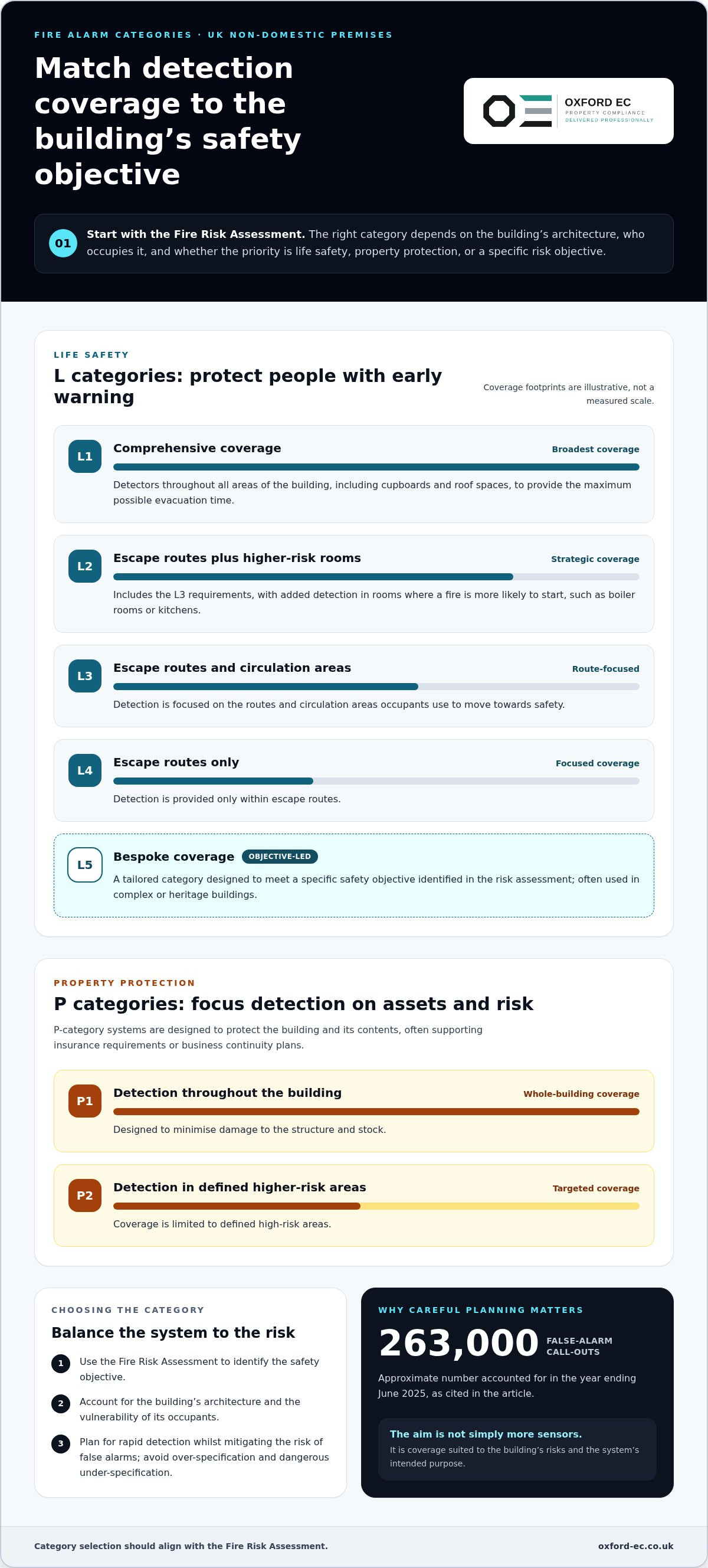
Objective-driven. Risk-based. Legally aligned. The specification of a fire alarm installation is dictated by the specific safety objectives identified within your Fire Risk Assessment. It is a common misconception that more sensors equate to better safety; in reality, the system must be calibrated to the unique architecture and occupancy of the building. The Fire Industry Association emphasises that correct categorisation ensures a balance between rapid detection and the mitigation of false alarms, which accounted for approximately 263,000 call-outs in the year ending June 2025. Meticulous planning before a single cable is laid prevents the twin risks of over-specification and dangerous under-specification.
Life Safety Categories (L1 to L5)
L-category systems are designed with the primary purpose of protecting human life by providing early warning to occupants. The level of coverage required depends on the complexity of the building and the vulnerability of its inhabitants.
- L1: Comprehensive Coverage. This represents the highest level of protection, with detectors installed throughout all areas of the building, including cupboards and roof spaces, to provide the maximum possible evacuation time.
- L2 and L3: Strategic Detection. L3 systems focus on escape routes and circulation areas to ensure safe passage. L2 systems include these L3 requirements but add detection in high-risk rooms, such as boiler rooms or kitchens, where a fire is more likely to start.
- L4 and L5: Minimalist and Bespoke. L4 systems provide detection only within escape routes. L5 is a tailored category designed to satisfy a specific safety objective identified in the risk assessment, often used in complex or heritage buildings.
Property Protection and Manual Systems (P and M)
Asset preservation. Rapid response. Human intervention. Whilst L-categories focus on people, P-category systems are engineered to protect the building and its contents, often to satisfy insurance requirements or business continuity plans.
- P1 and P2: Asset Guards. P1 systems provide detection throughout the entire building to minimise damage to the structure and stock. P2 systems limit detection to defined high-risk areas where the threat to the asset is greatest.
- Category M: Manual Systems. These systems do not feature automatic detection; they rely entirely on human activation via manual call points (break-glass units).
In complex multi-use developments, it is common for these categories to be combined to create a tiered safety ecosystem. Accurate planning is the only way to avoid "alarm fatigue" amongst staff, which occurs when frequent false alarms lead to a complacent response. If you require clarity on which category aligns with your current risk profile, you can request a professional compliance review to ensure your system design is both robust and efficient.
Comparing Fire Alarm System Types: Conventional vs Addressable
Hardware selection. Technical alignment. Strategic integration. Choosing the correct system architecture is a critical phase of any professional fire alarm installation. The decision rests on building scale, occupancy type, and the complexity of your wider property compliance requirements. Whilst some environments demand the simplicity of zone-based detection, others require the granular precision of addressable loops to manage high-risk infrastructure effectively. Integrating these systems with emergency lighting and other safety assets ensures a unified response during a critical event.
Conventional Fire Alarms: Simplicity and Value
Conventional systems remain a robust, cost-effective solution for smaller, single-storey retail units or simple office layouts. These systems operate on a zone-based methodology; when a detector is triggered, the control panel identifies the broad area of the incident rather than the specific device. This simplicity is its strength in small footprints, yet it presents significant limitations regarding "search distance" in larger buildings. Fire and Rescue services must be able to locate the source of ignition rapidly. If a building is too large or complex, the time lost searching a broad zone can be catastrophic. Maintenance for older conventional hardware also requires a meticulous approach to ensure legacy components remain "audit-ready" and reliable.
Addressable Fire Alarms: Precision and Scalability
Addressable systems are the industry standard for larger complexes and high-rise structures. Every detector, call point, and sounder is assigned a unique identity on a continuous data loop, allowing the control panel to pinpoint the exact location of an activation. This level of precision is essential for buildings with complex compartmentation strategies, where the fire alarm must trigger specific automated responses, such as closing fire doors or isolating ventilation. These systems utilise sophisticated sensor data analysis to distinguish between genuine combustion and environmental interference, which is a vital factor in reducing the incidence of costly false alarms across expansive sites.
Wireless Systems: Modern Solutions for Heritage Assets
Wireless (radio) systems offer a sophisticated alternative for heritage assets or occupied commercial spaces where intrusive cabling is prohibited. These networks eliminate the need for extensive trunking, preserving the aesthetic integrity of sensitive environments whilst significantly reducing installation downtime. Modern wireless technology ensures signal integrity through dual-frequency hopping; however, it requires a disciplined approach to battery management and signal strength auditing. A professional fire alarm installation using wireless components allows for rapid deployment without compromising the rigorous standards of BS 5839, providing a flexible solution for active business environments.
The Professional Installation Process: From Survey to Certification
Methodical execution. Technical scrutiny. Absolute transparency. A professional fire alarm installation follows a structured, multi-stage roadmap designed to eliminate error and ensure regulatory alignment. This process begins with a comprehensive site survey to evaluate the physical environment and existing infrastructure, followed by a meticulous design phase. Once the technical blueprint is finalised, the installation is executed with precision, followed by rigorous commissioning. The final handover provides the duty-holder with the essential certification required to prove compliance during a fire safety audit.
Why the Design Phase is Non-Negotiable
Precision in design prevents failure in crisis. The design phase is the critical period where blind spots are identified and eliminated, ensuring that no corner of the building remains unmonitored. This stage also verifies that audibility levels meet the mandatory decibel requirements for all occupants, including those in high-noise environments or remote areas. Additionally, the design must be coordinated with emergency lighting testing schedules to ensure that detection and illumination work in tandem to facilitate safe egress. A flawed design renders even the most expensive hardware ineffective.
Commissioning and Handover Documentation
Verification. Validation. Accountability. Commissioning is the process of testing every individual component of the fire alarm installation before the system is officially brought into service. This phase ensures that the control panel, detectors, and sounders all interact exactly as the design intended. It involves scrutinising battery backup capacities, signal strengths for wireless components, and the functionality of any ancillary links to fire doors or plant shutdowns. Upon successful completion, the duty-holder is issued a Certificate of Commissioning, which serves as the primary evidence of legal compliance for insurers and Fire and Rescue Authorities.
The handover process is not complete without the provision of a comprehensive Log Book. This document must include the following pillars of evidence:
- As-installed drawings showing detector locations and cable routes.
- Design, installation, and commissioning certificates.
- A structured testing and maintenance schedule.
- Operating instructions for the Responsible Person and their staff.
Ensuring the designated Responsible Person is fully trained to operate the panel and interpret signals is a legal necessity, not a courtesy. This ensures that in the event of an activation, the response is controlled, informed, and rapid. A disciplined handover marks the transition from a technical project to an active safety management programme.
Ongoing Compliance: Maintenance and Multi-Disciplinary Safety
Statutory Duty. Constant Vigilance. Operational Integrity. A successful fire alarm installation represents the baseline of a building's safety lifecycle; however, the preservation of that system's technical integrity requires a disciplined, ongoing maintenance regime. Under BS 5839-1, the duty-holder is legally mandated to ensure the detection network remains functional through a combination of weekly user tests and periodic professional inspections. Neglecting these requirements invalidates your compliance certification and places the organisation at significant legal risk during a post-incident investigation or a Fire and Rescue Service audit.
Weekly testing remains the responsibility of the designated Responsible Person. This involves activating a different manual call point each week to verify that the control panel receives the signal and successfully triggers the alarm sounders. This process must be meticulously recorded in the system logbook, creating a transparent audit trail of system verification. Without this evidence, a duty-holder cannot demonstrate that they have taken reasonable steps to manage fire risk, regardless of the sophistication of the initial hardware.
Servicing and Maintenance Schedules
Precise Auditing. Rigorous Cleaning. Functional Verification. Professional six-monthly servicing involves a comprehensive examination of the entire network, from the central control panel to individual field devices. Technicians perform battery load tests to ensure power continuity during mains failure whilst conducting smoke and heat sensor calibrations to maintain sensitivity and prevent the accumulation of dust. This proactive approach is a core pillar of commercial fire safety testing, reducing the likelihood of system faults and ensuring the installation remains "audit-ready" for regulatory scrutiny at all times.
The Benefit of Holistic Property Compliance
Integrated Risk Management. Streamlined Delivery. Total Accountability. Compliance is rarely a standalone discipline. When performing remedial works or system upgrades, duty-holders must navigate the intersection of multiple hazards, such as the potential disturbance of hazardous materials identified in asbestos management surveys. Oxford Environmental Consultants (OEC) provides a "safe pair of hands" by managing fire safety, water hygiene, and asbestos consultancy through a single, authoritative point of contact. This multi-disciplinary approach eliminates the administrative burden of coordinating fragmented contractors and ensures that no safety gaps emerge between disparate compliance pillars.
By utilising a single compliance partner, business owners benefit from a unified reporting structure where every technical intervention is cross-referenced against the building's total risk profile. This prevents situations where a fire alarm installation might inadvertently compromise compartmentation or where asbestos is disturbed during cable routing. A single compliance partner ensures that technical specifications and legislative requirements are harmonised across every safety discipline to provide a robust protective shield for complex property requirements.
Securing Your Statutory Compliance for 2026
Technical precision. Legal robustness. Absolute peace of mind. A professional fire alarm installation is the technical execution of a rigorous risk-based strategy, requiring total alignment with BS 5839 standards and the Regulatory Reform (Fire Safety) Order 2005. We've established that the transition from a technical project to a sustained safety programme relies on correct categorisation, disciplined commissioning, and a multi-disciplinary approach to property compliance.
Oxford Environmental Consultants (OEC) acts as your safe pair of hands, providing authoritative guidance that bridges the gaps between disparate safety disciplines. Our expertise across fire safety, asbestos management, and water hygiene ensures that your detection network is installed without compromising other vital compliance pillars. We provide rigorous, audit-ready certification with every project, ensuring you possess the definitive evidence needed to satisfy both insurers and regulatory inspectors.
Adopting a structured and meticulously mapped out safety strategy today provides the ultimate protective shield for your assets and occupants in the years to come.
Frequently Asked Questions
What are the legal requirements for fire alarm installation in UK commercial buildings?
The primary legal framework is the Regulatory Reform (Fire Safety) Order 2005, which mandates that every commercial premises must have a "suitable" fire detection system based on a risk assessment. Adherence to BS 5839-1:2017 is the recognised method for demonstrating compliance. Precise engineering. Legal alignment. Total protection. Failure to meet these standards can lead to unlimited fines or imprisonment, particularly if the installation is deemed inadequate for the specific building risks.
How often should a commercial fire alarm system be professionally serviced?
Professional servicing must occur at least every six months to remain compliant with BS 5839-1 recommendations. These inspections involve a deep-level audit of the control panel, battery backup capacities, and individual sensor sensitivities. Rigorous testing. Expert delivery. Peace of mind. Whilst weekly user tests are necessary for basic verification, these bi-annual professional visits are the only way to ensure the long-term technical integrity and legal robustness of your safety infrastructure.
What is the difference between a Grade A and Grade D fire alarm system?
Grade A systems incorporate a central control panel, separate sounders, and a dedicated power supply, typically required for complex commercial environments. In contrast, Grade D systems consist of one or more mains-powered smoke alarms with an internal battery backup, often utilised in smaller residential properties or certain HMOs. Precise categorisation. Technical distinction. Risk alignment. Selecting the incorrect grade can leave a duty-holder exposed to significant legal and insurance liabilities during a safety audit.
Does my small office legally require an addressable fire alarm system?
Not strictly; a conventional system is often sufficient for small, single-storey offices with simple layouts and short search distances. However, if your office is part of a larger complex or features intricate compartmentation, an addressable system may be recommended to provide precise location data to emergency services. Strategic design. Technical suitability. Cost efficiency. The final decision should always be dictated by the specific findings and objectives of your Fire Risk Assessment.
Can I install a wireless fire alarm system in a listed building?
Yes, wireless systems are the preferred solution for listed buildings where intrusive cabling and trunking are restricted by heritage protections. These systems utilise dual-frequency radio technology to ensure signal integrity whilst maintaining the aesthetic and structural integrity of the asset. Rapid deployment. Minimal disruption. Total compliance. A professional wireless fire alarm installation provides a sophisticated, non-destructive method for achieving BS 5839 alignment without compromising the historical value of the property.
What documentation must I receive after a new fire alarm installation?
You must receive a suite of "audit-ready" documentation, including Design, Installation, and Commissioning Certificates as per BS 5839-1 requirements. Additionally, you should be provided with as-installed drawings, a comprehensive system logbook, and manufacturer operating instructions. Absolute transparency. Legal evidence. Technical accountability. These documents serve as your primary proof of compliance for Fire and Rescue Authorities and are essential for maintaining a clear, evidence-based safety trail for your premises.
Who is responsible for the weekly testing of a fire alarm system?
The designated "Responsible Person" or duty-holder is legally accountable for ensuring weekly functional tests are conducted and recorded. This process involves activating a manual call point to verify that the system triggers correctly and that all sounders are audible. Disciplined routine. Operational verification. Statutory duty. Whilst the testing can be delegated to a competent staff member, the ultimate legal responsibility for maintaining the system logbook remains with the primary duty-holder.
What happens if my building fails a fire risk assessment due to the alarm system?
If an assessment identifies an inadequate alarm system, the Responsible Person must implement immediate remedial actions to mitigate the risk. Fire and Rescue Authorities may issue an enforcement notice, legally compelling you to upgrade the system within a specified timeframe. Precise rectification. Managed risk. Statutory alignment. Failure to address these deficiencies can lead to prohibition notices, which effectively close the building until a compliant fire alarm installation is commissioned.