
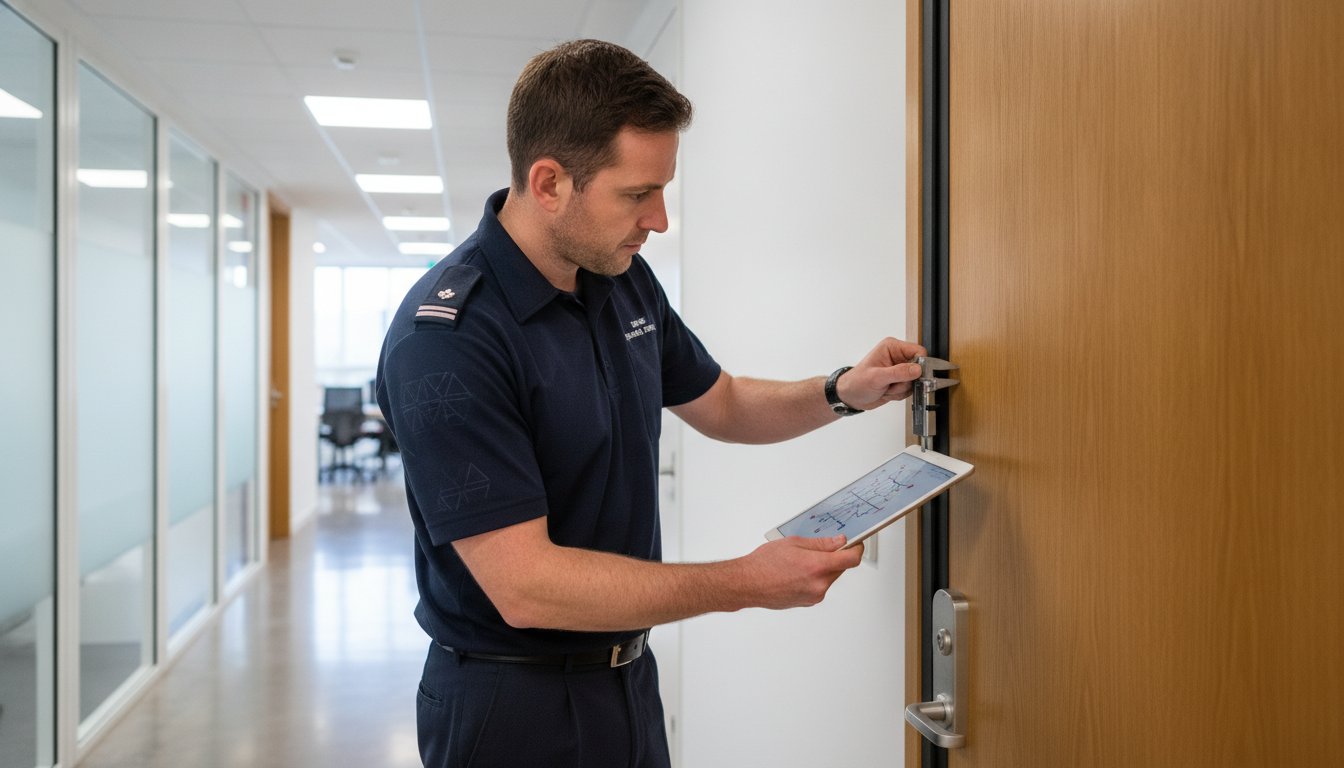
Approximately 75% of fire doors inspected in the UK fail to meet required safety standards. Technical precision. Legal robustness. Occupant safety. This alarming statistic represents a critical vulnerability in your building’s life-safety ecosystem, particularly as regulatory scrutiny intensifies under the Fire Safety (England) Regulations 2022. Conducting a professional fire door inspection is no longer a simple tick-box exercise; it's a rigorous, evidence-based necessity that ensures every component, from intumescent seals to hardware compatibility, functions as a unified, life-saving system.
You likely find the management of fragmented safety data across multiple properties a significant source of professional anxiety. It's a valid concern, especially whilst the "golden thread" of information becomes the mandatory standard for higher-risk residential buildings. This guide promises to clarify your statutory duties as a Responsible Person, providing the technical mastery required to withstand legal challenge. We will preview the implications of the BS 8214:2026 standards, the importance of UKAS-accredited competence, and the methodology for creating an audit-ready compliance trail that offers absolute peace of mind. Precision. Accountability. Protection.
Key Takeaways
- Master the statutory obligations under the Fire Safety (England) Regulations 2022 to protect your organisation from legal liability and ensure occupant safety.
- Learn to identify the critical structural and hardware failures during a professional fire door inspection that compromise the integrity of FD30 and FD60 rated systems.
- Define the precise standard of a "competent person" to ensure your technical assessments withstand the rigorous scrutiny of fire authorities and insurers.
- Establish a digital "Golden Thread" of information to maintain a transparent, verifiable compliance record from initial installation through to decommissioning.
- Integrate your passive fire protection measures with active systems to create a unified, multi-disciplinary safety strategy for complex property portfolios.
Table of Contents
- What is a Fire Door Inspection and Why is it Legally Mandatory?
- The Anatomy of Compliance: Key Components of a Fire Door Inspection
- Professional vs. Routine Checks: Defining Competence in 2026
- Inspection Frequency and the "Golden Thread" of Documentation
- Integrating Fire Door Safety into Your Multi-Disciplinary Strategy
What is a Fire Door Inspection and Why is it Legally Mandatory?
Passive fire protection. Technical scrutiny. Statutory obligation. A formal fire door inspection is a rigorous, evidence-based assessment designed to verify that every component of a door set, including the leaf, frame, intumescent seals, and self-closing devices, remains capable of resisting the passage of fire and smoke for a specified duration, such as FD30 or FD60. These systems serve as the primary defence within a building's passive fire protection strategy, effectively containing a fire at its source and preserving the integrity of protected escape routes for occupants and emergency services alike.
The legal framework governing these requirements is primarily the Regulatory Reform (Fire Safety) Order 2005. Failure to maintain compliant door sets carries severe repercussions, including the potential for unlimited fines, custodial sentences for negligence, and the immediate invalidation of building insurance. A fire door that fails to perform during an incident is not merely a technical breach; it's a fundamental failure of life-safety management that places the entire organisation at risk.
The Legal Duty-Holder: Who is the Responsible Person?
Accountability. Precision. Liability. The "Responsible Person" (RP) is the individual or entity tasked with maintaining the safety of a premises, ranging from business owners and employers to managing agents and multi-academy trust directors. Under current UK legislation, the RP holds a non-delegable duty to ensure all fire safety equipment is maintained in an efficient state, in efficient working order, and in good repair. The Building Safety Act 2022 has further sharpened this focus, demanding a higher standard of transparency and competence in how safety data is recorded and managed. You can't outsource the liability; you can only outsource the technical execution to a "safe pair of hands" capable of delivering audit-ready results.
Fire Safety Regulations 2022: Key Updates for 2026
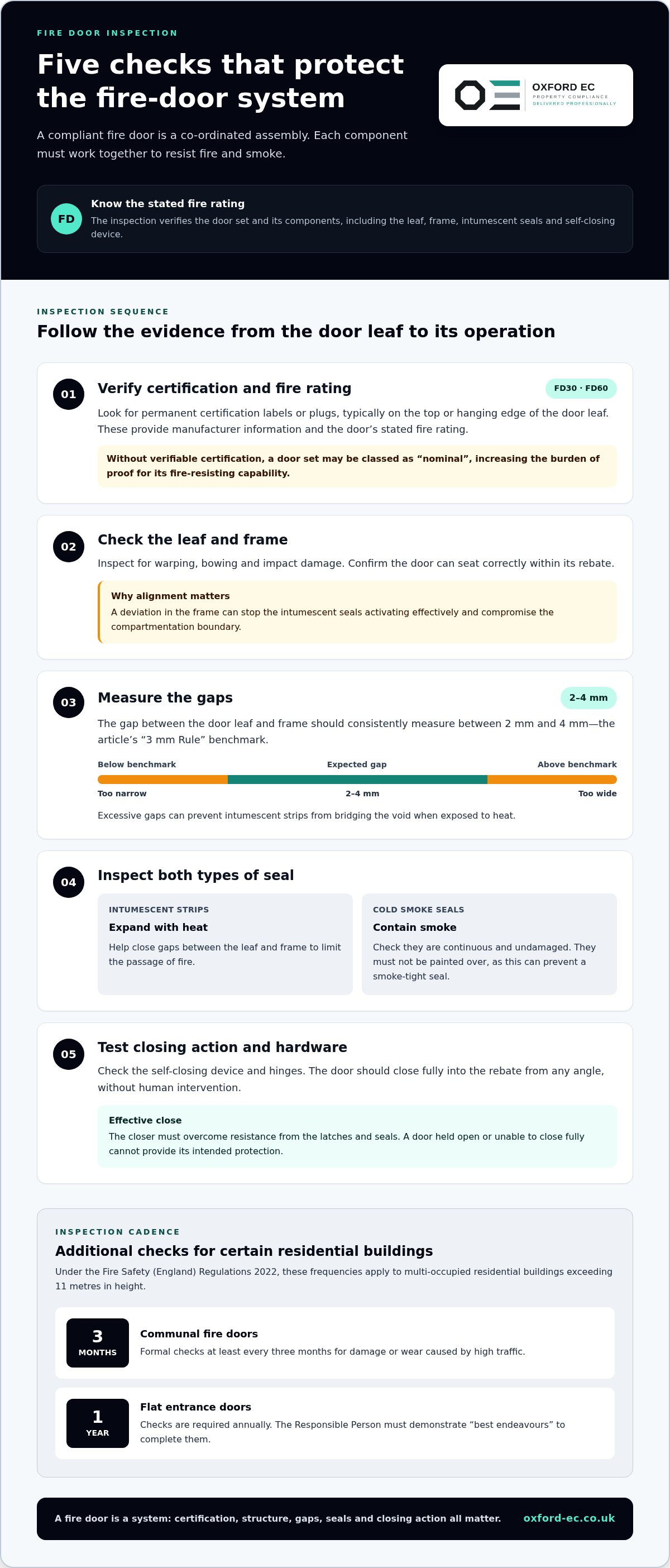
Prescriptive standards. Rigorous frequency. Enhanced transparency. Since the commencement of the Fire Safety (England) Regulations 2022, the requirements for multi-occupied residential buildings exceeding 11 metres in height have become significantly more stringent. RPs must now ensure that communal fire doors undergo a formal fire door inspection at least every three months to identify damage or wear caused by high traffic. Additionally, flat entrance doors must be checked on an annual basis. This requirement presents a unique operational challenge regarding resident access, yet the law remains uncompromising: the RP must demonstrate "best endeavours" to complete these checks, ensuring that the fire-stopping integrity of the entire building remains uncompromised by individual door failures.
The Anatomy of Compliance: Key Components of a Fire Door Inspection
Technical precision. Systemic integrity. Absolute scrutiny. A compliant fire door is not merely a single product but a co-ordinated assembly of components that must function in perfect unison to preserve life. During a professional fire door inspection, the first point of verification is the presence of permanent certification labels or plugs, typically found on the top or hanging edge of the door leaf. These identifiers provide the essential manufacturer data and fire rating (FD30 or FD60) required to prove the system's provenance. Without verifiable certification, a door set is often classified as "nominal," which significantly increases the burden of proof regarding its fire-resisting capabilities.
Structural stability is equally paramount. Inspectors must examine the leaf and frame for any signs of warping, bowing, or impact damage that could compromise the door's ability to seat correctly within its rebate. Even a minor deviation in the frame's alignment can prevent the intumescent seals from activating effectively during a fire, leading to a premature failure of the compartmentation boundary.
Gaps and Seals: The Difference Between Safety and Failure
Precise tolerances. Thermal activation. Smoke containment. The "3mm Rule" is a fundamental benchmark in fire safety; gaps between the door leaf and the frame should consistently measure between 2mm and 4mm. If these gaps are excessive, the intumescent strips, which expand when exposed to heat, may fail to bridge the void, allowing flames to breach the compartment. Whilst intumescent strips protect against heat, cold smoke seals are designed to stop the primary cause of fire fatalities: smoke inhalation. According to the Official UK Government Fire Door Guidance, these seals must be continuous, free from damage, and never painted over, as paint can brittle the material and prevent it from forming a smoke-tight seal. If you have concerns about the integrity of your seals across a large estate, you can speak with our technical team for a detailed site assessment.
Self-Closing Devices and Hinges: Ensuring Automatic Protection
Mechanical reliability. Unobstructed operation. Automatic closure. A fire door is entirely ineffective if it's held open or fails to close fully into the rebate from any angle. The "effective close" test ensures the self-closing device overcomes the resistance of latches and seals without human intervention. Ironmongery must be CE or UKCA marked, specifically requiring Grade 13 hinges to support the substantial weight of fire-rated leaves. Common failures often involve the use of non-fire-rated hinges or the dangerous practice of wedging doors open, both of which constitute a major non-compliance that would be flagged immediately during a professional fire door inspection.
Professional vs. Routine Checks: Defining Competence in 2026
Technical mastery. Legal defensibility. Verifiable competence. Under the Regulatory Reform (Fire Safety) Order 2005, a "competent person" is defined as someone possessing sufficient training, experience, and knowledge to implement fire safety measures effectively. However, the regulatory environment in 2026 has transitioned toward a more formalised framework. With the implementation of PAS 8673, the expectations for those managing fire safety in high-rise and complex buildings have reached a new peak of technical rigour. You can no longer rely on anecdotal experience; you must demonstrate a level of scrutiny that aligns with the latest UKAS-accredited standards.
Routine checks, typically conducted monthly by the Responsible Person or an on-site facilities team, are designed to identify obvious operational failures such as wedged doors, missing self-closers, or visible damage to intumescent seals. Whilst these checks are a vital component of your property compliance regime, they do not constitute a full fire door inspection. A professional survey involves a forensic, component-by-component analysis of the door set's ability to withstand a fire, providing the robust data required to maintain a safe and audit-ready estate.
When is a Professional Inspection Required?
Specific operational triggers demand expert intervention. An initial, baseline fire door inspection is essential for all new developments or following major refurbishments to ensure the "as-built" installation meets the design specification. Specialist surveys are also mandatory when a Fire Risk Assessment identifies significant compartmentation risks or systemic door failures. For high-risk environments, such as hospitals or care homes, the complexity of the life-safety strategy requires the "safe pair of hands" that only a specialist consultancy can provide.
The Risks of DIY Inspections for High-Risk Assets
Hidden vulnerabilities. Latent defects. Liability exposure. Relying on an internal, non-specialist checklist often creates a dangerous illusion of security. DIY checks frequently overlook critical internal defects, such as non-compliant glazing beads, incorrect hinge fixings, or compromised door cores that are invisible to the untrained eye. Beyond the physical safety risk, an internal log may fail to withstand a court of enquiry or a post-incident audit. Third-party verification provides an independent, evidence-based record that proves you have discharged your legal duties with absolute precision. This professional scrutiny acts as a protective shield, ensuring that your safety records are not only accurate but legally irreproachable.
Inspection Frequency and the "Golden Thread" of Documentation
Digital continuity. Risk-based scheduling. Legislative alignment. Determining the frequency of a fire door inspection requires a nuanced understanding of building usage, occupant vulnerability, and the physical demands placed upon each door set. Whilst the Fire Safety (England) Regulations 2022 provide a mandatory baseline for specific residential structures, a robust safety strategy often necessitates more frequent scrutiny for high-traffic assets. You must move beyond the minimum requirements to ensure your estate remains consistently compliant and safe.
Recommended Inspection Frequencies
The regulatory tiering is clear. For residential buildings over 11 metres in height, the law mandates quarterly checks on communal doors and annual assessments of flat entrance doors. However, in high-traffic commercial environments, such as schools or retail centres, the rate of wear often demands monthly professional scrutiny to identify faults before they escalate into systemic failures. Integrating these checks into your wider fire safety services schedule ensures that passive protection remains as dynamic as the active systems protecting your property.
Building an Audit-Ready Compliance Trail
The "Golden Thread" of information is a fundamental requirement of the Building Safety Act 2022. It represents a living, digital record of a building’s safety components from design through to demolition. An audit-ready report must go beyond a simple pass/fail status; it requires high-resolution photographic evidence, precise timestamping, and detailed technical justifications for every finding. Many modern estates now utilise asset tagging technology to track the specific maintenance history of individual door sets, ensuring that the Responsible Person can provide residents and regulators with transparent, verifiable safety data at a moment's notice.
Managing the output of a survey is just as critical as the inspection itself. Repairs must be prioritised using a risk-based categorisation system, where faults affecting the door's ability to close or seal are addressed with immediate urgency. This structured approach transforms a fragmented list of defects into a clear, manageable roadmap for remediation, shielding your organisation from the risks of non-compliance and ensuring that your passive fire protection remains uncompromised whilst providing a defensible record for insurers and regulatory bodies alike.
Integrating Fire Door Safety into Your Multi-Disciplinary Strategy
Systemic resilience. Strategic alignment. Holistic protection. Fire safety is never a collection of isolated tasks but a unified life-safety ecosystem where each component must support the next. A professional fire door inspection serves as a critical diagnostic tool within this framework, yet its true value is only realised when integrated into a broader multi-disciplinary strategy. You shouldn't manage fire doors in a vacuum whilst ignoring the integrity of the walls they are set into or the active systems designed to detect the very threats those doors are built to contain.
Linking the health of your door sets to your wider fire alarm installation and maintenance programme ensures a seamless transition from detection to containment. Whilst an alarm provides the necessary warning for evacuation, it's the fire door that provides the vital time required for that evacuation to be successful. Once an inspection identifies a deficiency, the logical next step is a swift transition to remedial action to close the loop on your compliance obligations and restore the building's protective envelope.
Compartmentation and Passive Fire Protection
Structural integrity. Fire-stopping. Compartmentation. A fire door is effectively the only "movable" part of a building's compartmentation; it's the first line of defence in any compartmentation survey. If a door set fails to seal correctly, the fire-resisting performance of the surrounding walls and floors becomes irrelevant as smoke and flames find the path of least resistance. Comprehensive passive fire protection surveys allow property managers to understand this relationship in detail, ensuring that every penetration, joint, and doorway within a fire compartment meets the same rigorous standard of resistance. A failed door doesn't just represent a single defect; it's a breach in the entire life-safety strategy that can lead to rapid fire spread and catastrophic loss.
Streamlining Compliance with Oxford Environmental Consultants
Technical mastery. Administrative efficiency. Peace of mind. Managing multiple safety streams—from asbestos and water hygiene to fire safety—often results in fragmented data and inconsistent standards. Oxford Environmental Consultants provides a streamlined, one-stop solution that reduces the administrative burden on Responsible Persons by consolidating these complex requirements under a single, expert partner. Our approach is fundamentally professional, rigorous, and dependable, positioning us as the "safe pair of hands" for national property portfolios. We don't just identify risks; we provide the evidence-based roadmap required to manage them with absolute precision. Secure your building with a professional fire door inspection from OEC today.
Securing Your Compliance Legacy for 2026 and Beyond
Technical precision. Legal robustness. Occupant safety. The transition toward the rigorous standards of BS 8214:2026 and the "Golden Thread" demands a level of scrutiny that transcends basic visual checks. A professional fire door inspection is the fundamental cornerstone of a defensible life-safety strategy, ensuring that every FD30 and FD60 assembly functions as a co-ordinated barrier against the passage of smoke and flame. By establishing a digital, evidence-based record of compliance, you don't just satisfy regulatory bodies; you build a transparent legacy of accountability that protects both your occupants and your organisation from the severe consequences of non-compliance.
Oxford Environmental Consultants offers the national coverage and multi-disciplinary expertise required to manage these complex property requirements with absolute precision. We act as your safe pair of hands, delivering comprehensive, audit-ready reporting that integrates fire safety with asbestos and water hygiene management for total property resilience. Our meticulous approach ensures that your estate remains safe, compliant, and legally irreproachable.
Secure your estate with the technical mastery your building deserves.
Frequently Asked Questions
How often should fire doors be inspected in the UK?
Frequency is dictated by building height and usage. For residential buildings exceeding 11 metres, the Fire Safety (England) Regulations 2022 mandate communal checks every three months and flat entrance door checks annually. Commercial properties generally require six-monthly professional assessments. High-traffic environments, such as schools or healthcare facilities, often necessitate monthly scrutiny to address accelerated wear. A risk-based approach ensures your fire door inspection schedule remains proportionate to the building's specific safety requirements.
Is it a legal requirement to have a fire door inspection?
Yes, maintenance is a statutory obligation under the Regulatory Reform (Fire Safety) Order 2005. The legislation requires the Responsible Person to keep all fire safety equipment in an efficient state and in good repair. Neglecting to conduct a regular fire door inspection constitutes a breach of fire safety law. This can result in unlimited fines, custodial sentences for negligence, and the immediate invalidation of your property insurance.
What is the difference between a fire door check and a fire door inspection?
A fire door check is a frequent visual assessment, usually conducted monthly by on-site staff to spot obvious damage or obstructions. It's a technical, forensic audit performed by an expert when you move to a full inspection. This involves measuring precise tolerances against the 3mm standard, checking the compatibility of all ironmongery, and verifying the manufacturer’s certification. This deeper level of scrutiny is required to confirm the door's actual fire-resisting performance.
Who can carry out a fire door inspection?
Legislation mandates that a "competent person" performs these assessments. This individual must have sufficient training, experience, and knowledge to identify complex technical defects. Whilst basic visual checks can be managed by on-site staff, a formal survey should be conducted by a multi-disciplinary consultancy. This ensures the output is a professional, evidence-based report that provides the legal robustness required to satisfy the Building Safety Regulator and fire authorities.
What are the most common reasons for fire door failure?
Technical failures are frequently identified during professional surveys. Common reasons for non-compliance include:
- Gaps between the door and frame exceeding the 4mm tolerance.
- Damaged, missing, or painted-over intumescent and smoke seals.
- Self-closing devices that fail to close the leaf fully into the rebate.
- Non-fire-rated ironmongery, such as domestic hinges or latches.
These issues prevent the door from containing fire at its source.
Do I need to inspect fire doors in a block of flats?
Yes, specific legal duties apply to multi-occupied residential buildings. For blocks over 11 metres, the law requires quarterly checks of communal doors and annual checks of all flat entrance doors. In buildings under 11 metres, the Responsible Person still holds a general duty to ensure fire doors are fit for purpose. These checks are vital for protecting the primary escape routes for all residents whilst ensuring the building's compartmentation remains intact.
What documentation do I need to keep for fire door compliance?
You must maintain a digital "Golden Thread" of safety information. This file should contain original manufacturer certification, installation data, and a detailed log of all maintenance activities. A robust compliance trail requires timestamped inspection reports and photographic evidence of each door set's condition. This documentation is essential for proving to insurers and the fire service that you have managed your life-safety obligations with the necessary level of rigour.
Can I paint over fire door seals during maintenance?
You must never paint over intumescent or smoke seals during maintenance. Paint can harden the seals, preventing them from expanding under heat or forming a smoke-tight barrier. If seals are compromised by paint, they are non-compliant and require immediate replacement to restore the door's integrity. When redecorating, always use masking tape to protect the seals or remove them temporarily if they are the push-fit variety to ensure the system remains functional.