

In the year ending March 2026, fire services in England attended 170,597 fires, marking a sharp 19% increase from the previous year. Legal liability. Professional scrutiny. Absolute accountability. You understand that managing a multi-occupied property carries a unique set of risks that single-family dwellings simply do not share. The fear of prosecution under the Regulatory Reform (Fire Safety) Order 2005 is a legitimate concern for any serious landlord, especially when the definition of a "suitable and sufficient" hmo fire risk assessment remains a point of significant confusion amongst property owners.
This guide provides the technical clarity you need to ensure your property portfolio remains rigorously compliant and legally robust against the scrutiny of local authorities. We'll examine the technicalities of the Fire Safety Act 2021, the April 2026 mandates for Personal Emergency Evacuation Plans, and the meticulous management of assets like FD30 fire doors and integrated alarms to guarantee audit-ready documentation and the total protection of life. By the end of this article, you'll possess a comprehensive roadmap for navigating complex fire safety legislation with precision and confidence.
Key Takeaways
- Understand the non-negotiable legal requirements under the Regulatory Reform (Fire Safety) Order 2005 to ensure your hmo fire risk assessment meets the rigorous standards demanded by local authorities.
- Identify the critical technical pillars of a professional assessment, from mapping ignition sources and fuel loads to safeguarding vulnerable occupants through precise evacuation planning.
- Evaluate the structural integrity of your property by prioritising fire door inspections and compartmentation surveys to prevent the rapid spread of smoke and flame throughout shared spaces.
- Recognise the legal and safety pitfalls of self-certification and learn why appointing a "competent person" is essential for managing complex or high-risk multi-occupied buildings.
- Discover how to consolidate your property compliance through a multi-disciplinary approach that secures your assets against fire, asbestos, and water hygiene risks simultaneously.
Table of Contents
- What is an HMO Fire Risk Assessment and Why is it Mandatory?
- The Anatomy of a Rigorous HMO Fire Risk Assessment
- Professional Assessment vs. Self-Certification: Managing the Risk
- Structural Integrity: Compartmentation and Fire Escape Safety
- Oxford Environmental Consultants: Rigorous HMO Compliance Solutions
What is an HMO Fire Risk Assessment and Why is it Mandatory?
An hmo fire risk assessment is a rigorous, technical evaluation of a property’s potential fire hazards and the safety of its occupants. It functions as a formal audit of structural integrity, management behaviour, and emergency preparedness. This is not a superficial exercise. It's a legal safeguard. It's a life-saving necessity. Under current UK legislation, every House in Multiple Occupation must have a written assessment that identifies how to minimise fire risks and ensure safe evacuation.
The primary legislative driver for these requirements is the Regulatory Reform (Fire Safety) Order 2005, which places the legal burden of safety on the "Responsible Person." In 2026, the compliance landscape has become increasingly complex. The Building Safety Act 2022 and the intersection of Awaab’s Law mean that landlords must now consider how environmental factors like damp and mould might compromise fire safety systems or structural compartmentation. Neglecting these multi-disciplinary connections can lead to catastrophic legal and physical failures.
The Legal Framework: Fire Safety Order 2005
Statutory law requires every assessment to be "suitable and sufficient," a standard that has evolved significantly in recent years. In 2026, a basic checklist is no longer legally defensible against professional scrutiny. Enforcement authorities now demand evidence of high-level competency and a deep technical understanding of the building’s fire-stopping capabilities. The consequences of non-compliance are severe and unyielding:
- Unlimited financial penalties issued by the courts.
- Custodial sentences of up to two years for serious breaches.
- Immediate prohibition notices that prevent the property from being occupied.
Defining the HMO: When Does the Duty Apply?
The duty to conduct a professional hmo fire risk assessment applies whenever a property is occupied by at least three tenants forming more than one household with shared facilities. While mandatory licensing typically targets properties with five or more occupants, the fire safety obligations remain absolute for smaller multi-let properties. Purpose-built blocks of flats and converted Victorian houses present different structural challenges, but the standard of protection must be uniform. Under the 2005 Order, the Responsible Person is defined as the individual or entity with control over the premises who carries the ultimate legal accountability for the safety of every person on-site.
The Anatomy of a Rigorous HMO Fire Risk Assessment
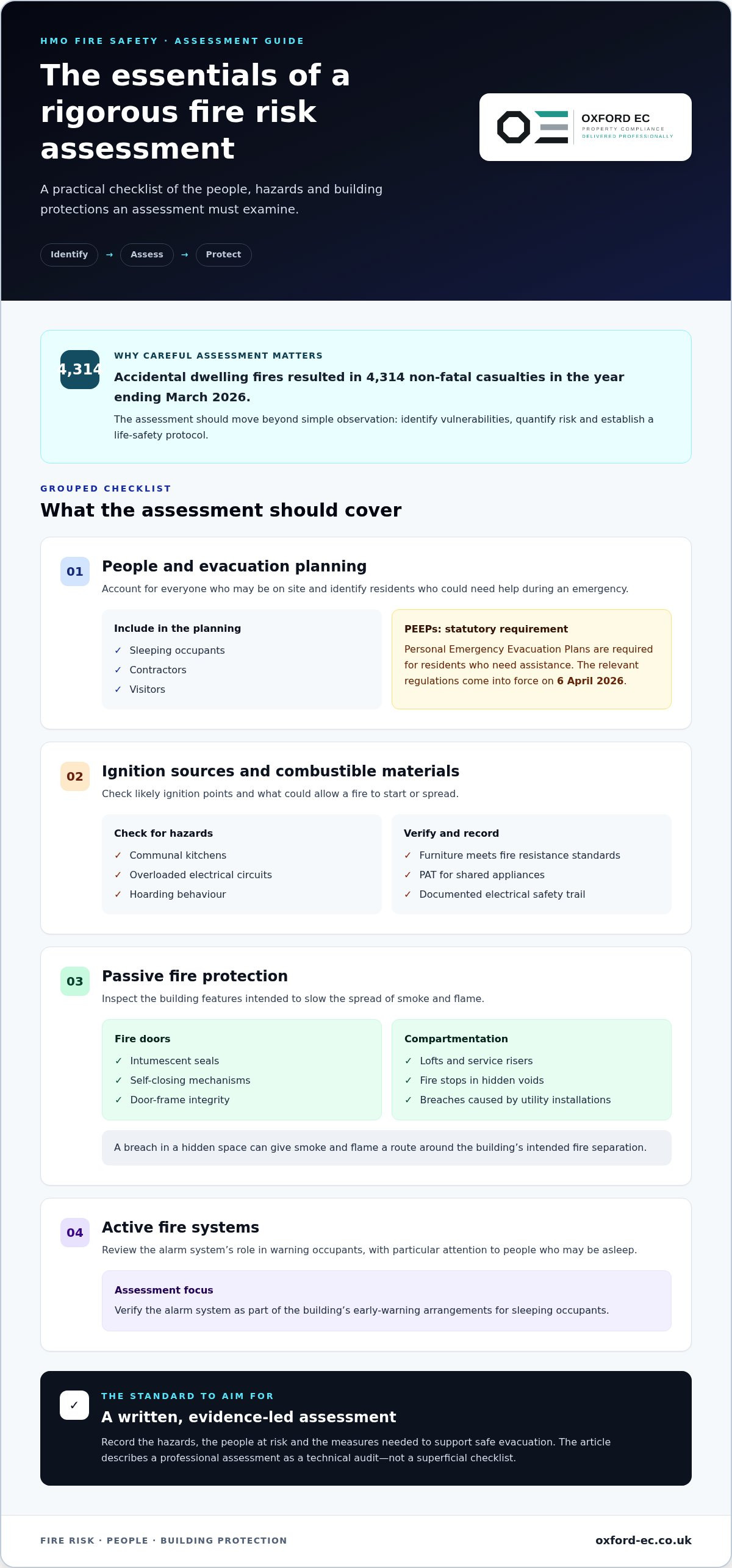
A professional hmo fire risk assessment is a five-step technical audit. It identifies vulnerabilities. It quantifies risk. It establishes a protocol for life safety. This process moves beyond simple observation to scrutinise the building's structural and operational safety, ensuring that every ignition source and fuel load is accounted for whilst maintaining a clear focus on the protection of residents.
Identifying people at risk is a core component of this scrutiny. With the Fire Safety (Residential Evacuation Plans) (England) Regulations 2025 coming into force on April 6, 2026, duty holders must now identify residents who require assistance during an emergency. Creating Personal Emergency Evacuation Plans (PEEPs) is no longer an optional gesture; it's a statutory requirement for ensuring that vulnerable tenants, who are disproportionately affected by dwelling fires, have a viable path to safety. You must account for sleeping occupants, contractors, and visitors within your emergency planning to achieve total legal robustness and protect your assets from the consequences of a failed audit.
Step 1: Identifying Hazards and Combustible Materials
Communal kitchens and overloaded electrical circuits remain the primary ignition points in multi-occupied properties. Given that accidental dwelling fires resulted in 4,314 non-fatal casualties in the year ending March 2026, rigorous scrutiny of these areas is non-negotiable. We assess the impact of hoarding behaviour and verify that all furniture meets strict fire resistance standards. Portable Appliance Testing (PAT) serves as a critical pillar in this process, providing a documented trail of electrical safety for shared appliances and reducing the likelihood of electrical fires originating in communal spaces.
Step 2: Evaluating Passive Fire Protection
Passive protection is your building’s silent guardian. We examine the condition of fire doors, checking intumescent seals, self-closing mechanisms, and overall frame integrity. It's essential to align with the latest fire door inspection regulations uk to avoid enforcement action. Beyond doors, we investigate compartmentation within lofts and service risers. These hidden voids often harbour breached fire stops due to modern utility installations, creating a bypass for smoke and flame that can undermine the entire safety strategy of the building.
Step 3: Reviewing Active Fire Systems
Active systems provide the necessary early warning for sleeping occupants. We verify that the alarm system meets the required grade and category, typically Grade A LD1 for higher-risk HMOs, ensuring comprehensive detection in all high-risk rooms and escape routes. Emergency lighting must provide sufficient illumination during a total power failure to guide residents safely. Our fire safety services include a thorough review of testing logs to confirm that monthly and annual discharge tests are being recorded correctly. If you're concerned about the technical sufficiency of your current documentation, you can request a professional compliance audit to secure your portfolio.
Professional Assessment vs. Self-Certification: Managing the Risk
While some local authorities accept signed self-certification forms for licensing purposes, this practice creates a dangerous illusion of safety. It's a gamble. It's a liability. It's a potential legal catastrophe. A self-conducted hmo fire risk assessment often lacks the technical depth required to withstand a formal audit from the Fire and Rescue Authority. When an enforcement officer arrives, they don't merely scrutinise the signature; they scrutinise the evidence of structural integrity and the robustness of your management behaviour.
Generic templates and checklists are fundamentally insufficient for complex or high-rise buildings. These one-size-fits-all documents fail to account for the unique hydraulic demands of integrated alarm systems or the specific compartmentation failures common in older converted properties. Relying on a superficial document during a local authority audit leaves you exposed. Professional scrutiny provides the only definitive defence against the severe penalties mandated by the 2005 Order, ensuring your property is not just "compliant on paper" but safe in practice.
The "Competent Person" Standard Explained
The law requires that the individual carrying out the assessment is a "competent person" possessing a blend of formal training, practical experience, and technical knowledge. Competence is not a self-declared status. It's a measurable standard of expertise. For properties with complex layouts or suspected structural defects, we often recommend a type 4 fire risk assessment, which involves destructive sampling to inspect hidden voids and service risers. Professional consultants provide the rigorous oversight necessary to identify these high-stakes vulnerabilities that a landlord's visual inspection would inevitably miss.
Insurance and Liability Implications
A professional assessment serves as your primary protective shield against claims of "gross negligence." In the event of a fire, insurers will meticulously review the "suitability and sufficiency" of your documentation to determine if you met your statutory duties. If your assessment is deemed insufficient, insurers frequently void policies, leaving you personally liable for property damage and life-safety failures. By partnering with a consultancy that carries professional indemnity insurance, you secure a "safe pair of hands" that guarantees accountability and provides total peace of mind for your property portfolio. The cost of a professional audit is negligible when compared to the risk of unlimited fines or the total loss of your property assets.
Structural Integrity: Compartmentation and Fire Escape Safety
Compartmentation is the structural backbone of building safety. Contain the fire. Protect the occupants. Secure the asset. It works on an uncompromising principle: containing the fire at its source. By creating fire-resistant cells within the property, typically rated for 30 to 60 minutes, you provide residents with the vital time required for a safe evacuation. In a high-density environment, the failure of a single fire-stop can lead to rapid, uncontrollable spread. A rigorous hmo fire risk assessment must therefore go beyond visual checks to evaluate the technical adequacy of these internal barriers.
Modern utility installations frequently compromise this integrity. High-speed fibre cables. New plumbing runs. Electrical retrofits. These additions often pierce firewalls and ceilings without the subsequent installation of approved fire-stopping materials. These breached compartments act as chimneys for smoke and heat, bypassing fire doors and rendering active systems less effective. We scrutinise service risers and voids to ensure that passive fire protection remains intact, protecting both the residents' lives and the property's physical assets from avoidable destruction.
Fire Escape Staircase Inspections
External fire escape staircases are often the most neglected assets in a property portfolio. Whether constructed from metal or timber, these structures are subject to constant environmental degradation. Rust. Rot. Structural fatigue. A collapse during an emergency evacuation is a catastrophic failure that carries severe legal liability for the Responsible Person. We conduct detailed fire escape staircase inspection protocols to verify structural safety and ensure that communal exits remain unobstructed and fit for purpose under the highest physical stress.
Passive Fire Protection and Damp Surveys
The intersection of Awaab’s Law and fire safety is a critical compliance frontier in 2026. Persistent damp and mould growth don't just affect respiratory health; they actively degrade the structural integrity of fire-stopping materials. Damp-saturated plasterboard loses its fire-resistance rating, whilst moisture can cause intumescent seals on fire doors to fail prematurely. Integrating a professional damp and mould inspection into your broader hmo fire risk assessment strategy ensures that your passive protection remains robust. This multi-disciplinary approach provides a comprehensive shield against fragmented risks.
Oxford Environmental Consultants: Rigorous HMO Compliance Solutions
Oxford Environmental Consultants (OEC) provides a streamlined, logical solution to the fragmented problems of property management. Technical mastery. Regulatory precision. Absolute accountability. We operate as a "safe pair of hands" for landlords managing complex HMO portfolios across the United Kingdom. Our national coverage ensures that whether you hold a single high-risk asset or a diverse national portfolio, your documentation remains rigorously compliant and ready for local authority inspection. This disciplined approach eliminates the uncertainty often associated with multi-occupied property management, positioning OEC as a guardian of your legal and physical assets.
The "Audit-Ready" reporting style we employ is designed specifically to meet the high-level scrutiny of Fire and Rescue Authorities. We don't just provide a document; we provide a technical shield. By addressing the requirements of the Building Safety Act 2022 alongside fire safety mandates, we ensure that your property management strategy is holistic rather than reactive. This proactive alignment with statutory standards protects your life-safety assets and your legal standing against the increasing pressure of regulatory enforcement.
Our Multi-Disciplinary Compliance Approach
Fragmented compliance leads to missed risks and unnecessary administrative friction. We solve this by integrating our professional hmo fire risk assessment with other essential disciplines, such as asbestos management surveys and water hygiene sampling. This single-provider model ensures that your compliance profile is cohesive. By addressing the intersection of Awaab’s Law and structural fire safety, OEC ensures that environmental factors like damp and mould are not allowed to compromise your fire-stopping integrity. Our focus remains fixed on precision, delivery, and regulatory alignment, providing you with a clear, evidence-based overview of your entire building safety profile.
Securing Your Property Portfolio
Securing your assets begins with a comprehensive technical audit. When you book a professional hmo fire risk assessment with OEC, you gain access to a disciplined team of experts who understand the nuances of structural compartmentation and passive fire protection. Our support does not end with the delivery of a technical report. We provide end-to-end management, including post-assessment remedial actions, fire alarm maintenance, and emergency light testing. It's a comprehensive service loop that ensures your property remains legally robust throughout the year. We pride ourselves on transparency and evidence-based results, ensuring you are always audit-ready. If you are ready to consolidate your risk management under a meticulous expert partner, you should contact our compliance team to discuss your specific requirements.
Securing Your HMO Portfolio Against Regulatory Scrutiny
Maintaining a compliant property portfolio in 2026 requires more than a superficial understanding of safety standards. It demands a rigorous commitment to structural integrity, professional competence, and meticulous documentation. We've explored the critical role of compartmentation, the legal necessity of identifying vulnerable residents through PEEPs, and the severe liability risks associated with self-certification. A professional hmo fire risk assessment serves as your primary protective shield, ensuring that every ignition source is managed and every escape route is structurally sound.
Oxford Environmental Consultants brings meticulous technical expertise and national UK compliance coverage to every project. Our comprehensive multi-disciplinary property surveys provide a streamlined solution to fragmented risks, consolidating fire, asbestos, and water hygiene requirements into a single, audit-ready framework. You can protect your assets and your tenants by choosing an accountable partner dedicated to technical excellence.
Achieving total legal robustness is a manageable process when supported by experts who prioritise precision. You can move forward with confidence, knowing your property meets the highest standards of safety and regulatory alignment.
Frequently Asked Questions
How often should an HMO fire risk assessment be reviewed?
A professional review must be conducted annually as a minimum standard or immediately following any significant physical or operational change to the property. It functions as a formal audit. It quantifies risk. It establishes accountability. High-risk environments, such as those with vulnerable occupants, often require reviews every six months. Regular reviews are essential for protecting life-safety assets and maintaining a robust legal defence whilst ensuring protocols reflect current conditions.
Can I carry out my own fire risk assessment for a licensed HMO?
You can legally conduct your own assessment, provided you meet the statutory definition of a "competent person" with sufficient training, experience, and technical knowledge. It's a gamble. It's a liability. It's a potential legal failure. The complexity of licensed properties often makes self-certification a significant liability. Appointing a professional ensures the document is "suitable and sufficient" and capable of withstanding local authority scrutiny. Don't risk your portfolio on a checklist.
What is the difference between a Type 1 and a Type 4 fire risk assessment?
A Type 1 assessment is a non-destructive survey limited to communal areas and a sample of flat entrance doors, whereas a Type 4 assessment involves destructive sampling of the building's fabric. Type 4 surveys are necessary when structural defects are suspected or when utility installations have potentially breached fire-stopping barriers. Technical depth. Destructive sampling. Structural certainty. This technical depth is required to confirm the integrity of lofts and service risers.
Is a fire alarm system mandatory in all HMO properties?
Interlinked detection. Mains power. Battery backup. A fire alarm system is mandatory in all HMO properties to provide early warning to sleeping occupants who may be unfamiliar with the building layout. These systems must be interlinked and mains-powered with a battery backup to ensure functionality during a power failure. The specific grade, often Grade A LD1, is determined by occupancy density. Weekly testing is statutory.
What are the specific fire door requirements for an HMO?
FD30 integrity. Intumescent seals. Certified closers. HMO properties require FD30-rated fire doors on all bedrooms and kitchens to contain fire for at least thirty minutes. These doors must be fitted with certified self-closing mechanisms and seals that expand under heat to prevent smoke bypass. Regular inspections every six months are necessary to verify that frames remain square and closers operate effectively. Correct installation is a fundamental pillar of structural compartmentation.
What happens if a local authority finds my fire risk assessment is insufficient?
If a local authority deems your hmo fire risk assessment insufficient, they may issue an enforcement notice or a prohibition notice that prevents the property from being occupied. Unlimited fines. Prohibition notices. Potential imprisonment. Serious breaches can lead to financial penalties or custodial sentences of up to two years. Failure to comply also voids insurance policies, leaving you personally liable for damages. Professional audits are the only way to avoid these severe consequences.
Do I need a separate assessment for communal areas and individual rooms?
No, a single hmo fire risk assessment should cover the entire property, including communal escape routes, plant rooms, and individual tenant rooms. The Fire Safety Act 2021 clarified that the 2005 Order applies to the structure, external walls, and flat entrance doors. Your documentation must reflect a holistic evaluation. This ensures that hazards within individual dwellings don't compromise the safety of common areas. Total compliance. Rigorous protection. Audit-ready evidence.
How does the Building Safety Act 2022 affect HMO landlords in 2026?
The Building Safety Act 2022 places a greater emphasis on the competency of those conducting assessments and the accountability of the designated "Responsible Person." Technical evidence. Absolute transparency. Continuous accountability. In 2026, landlords must maintain a "golden thread" of safety information that documents the structural integrity and fire-stopping capabilities of the building. This legislation demands higher standards of evidence. It ensures that safety management is a continuous, documented process rather than a one-off exercise.